5 Essential Clauses South African Employers Must Include in a Mutual Separation Agreement

Managing an employee exit is one of the most sensitive operational tasks a business owner faces. When an employment relationship reaches a natural end or irreconcilable misalignment occurs, negotiating a mutual separation agreement provides a legally secure, dignified route for both employer and employee to part ways without protracted conflict.
In South Africa, standard dismissal procedures under the Labour Relations Act (LRA) demand rigorous substantive and procedural fairness. However, South African labour legislation is completely silent on mutual separation agreements, meaning there is no statutory code of good practice outlining their exact terms. Instead, their validity rests on general principles of contract law and proven mutual consent.
Without meticulous drafting, an employer risks costly disputes at the Commission for Conciliation, Mediation and Arbitration (CCMA) or Labour Court. By structuring your agreement with the right protective clauses, you ensure finality, safeguard intellectual property, and minimize commercial disruption.
Table of Contents
- Understanding Mutual Separation in South African Labour Law
- Key Differences: Mutual Separation vs Dismissal vs Resignation
- 5 Essential Clauses to Include in Your Agreement
- Common Pitfalls That Risk CCMA Challenges
- Step-by-Step Implementation Process for Small Businesses
- Protect Your Business with Professional Exit Agreements
- Frequently Asked Questions
- Recommended
Quick Summary
| Takeaway | Explanation |
|---|---|
| Contractual Basis | Mutual separations are governed by common law contracts rather than explicit statutory LRA mechanisms. |
| Absolute Voluntariness | The employee must sign willingly without duress or misrepresentation to prevent subsequent unfair dismissal claims. |
| Full & Final Settlement | A comprehensive waiver bars future claims at the CCMA, Labour Court, or civil courts regarding the employment. |
| Statutory Entitlements | The settlement must satisfy baseline earnings under the Basic Conditions of Employment Act (BCEA). |
| Intellectual Property & Restraints | Existing restraints, non-competes, and IP protections must be explicitly preserved upon exit. |
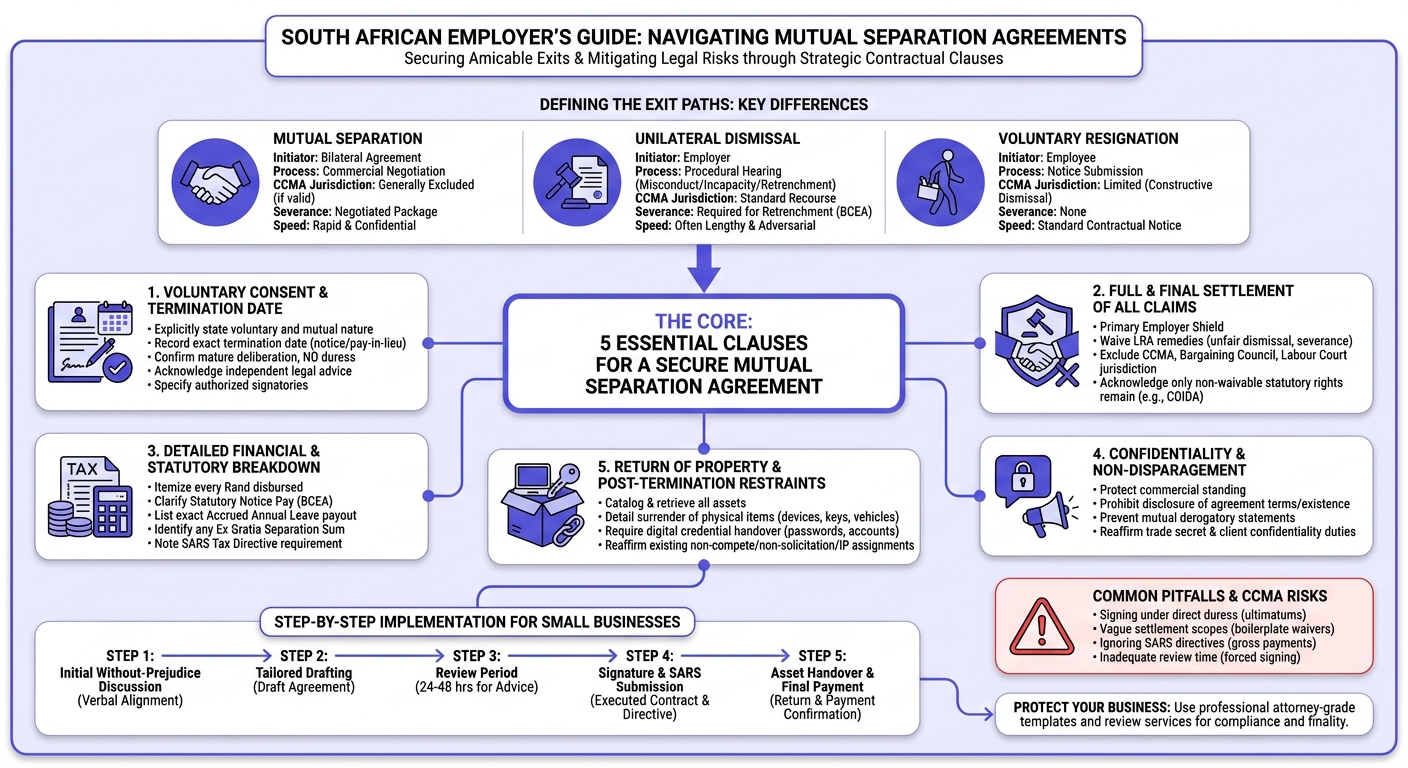
Understanding Mutual Separation in South African Labour Law
A mutual separation agreement (often called a mutual termination agreement or settlement agreement) is a binding contract in which an employer and an employee agree to terminate an employment relationship on negotiated terms.
Because the exit is consensual, it does not constitute a unilateral dismissal by the employer. The South African Labour Appeal Court has repeatedly confirmed that a valid mutual separation agreement deprives the CCMA of jurisdiction to hear an unfair dismissal dispute. When an employee signs a valid settlement, the employment contract terminates by mutual consensus, leaving no "dismissal" to challenge.
However, the legal protection of this document depends entirely on the genuine consent of both parties. If an employee can prove they signed under duress, coercion, or substantial misrepresentation, the CCMA may set the agreement aside and proceed with an unfair dismissal hearing.
Key Differences: Mutual Separation vs Dismissal vs Resignation
Understanding where mutual separation sits within South African labour mechanics prevents procedural missteps.
| Feature | Mutual Separation | Unilateral Dismissal | Voluntary Resignation |
|---|---|---|---|
| Initiator | Bilateral agreement | Employer | Employee |
| Process Required | Commercial negotiation | Procedural hearing (misconduct/incapacity/retrenchment) | Notice submission |
| CCMA Jurisdiction | Generally excluded if valid | Standard recourse for disputes | Limited to constructive dismissal |
| Statutory Severance | Negotiated package | Required for retrenchment (1 week per completed year) | None |
| Speed & Discretion | Rapid and confidential | Often lengthy and adversarial | Follows standard contractual notice |
5 Essential Clauses to Include in Your Agreement
To insulate your business against downstream litigation, every exit contract must incorporate five core provisions.

1. Voluntary Consent and Confirmation of Termination Date
The agreement must explicitly state that the termination is voluntary and mutual. It must establish that neither party coerced the other and that both entered into the arrangement after mature deliberation.
- Record the exact date: State the specific effective date of termination clearly, indicating whether the employee will work out their notice or be paid in lieu of notice.
- Independent legal advice: Include a clause stating the employee was given sufficient time to review the document and obtain independent legal advice prior to signing.
- Signatory authority: Specify the designated director or manager executing the document on behalf of the company.
2. Full and Final Settlement of All Claims
The full and final settlement clause is the primary shield for an employer. It formalizes that the financial and non-financial terms resolve all past, present, and future claims arising from the employment contract.
- Waiver of LRA remedies: Expressly waive claims relating to unfair dismissal, unfair labour practices, and statutory severance.
- Jurisdictional exclusion: Affirm that the agreement settles all disputes that could otherwise fall under the jurisdiction of the CCMA, Bargaining Councils, or Labour Court.
- Statutory exclusions: Acknowledge that non-waivable statutory rights (such as occupational injuries or statutory compensation under COIDA) remain unaffected by law.
3. Detailed Financial Severance and Statutory Pay Breakdown
Ambiguity in payment figures often causes post-signature disputes. The agreement must itemize every single Rand being disbursed to the departing employee.
- Statutory notice pay: Clarify whether notice pay is provided in accordance with the Basic Conditions of Employment Act.
- Accrued annual leave: Itemize exact accrued, untaken leave days to be paid out on the final payroll run.
- Ex gratia separation sum: Clearly identify any additional discretionary separation amount offered above statutory requirements.
- Tax treatment: Note that all severance payments are subject to standard South African Revenue Service (SARS) tax directives, which the employer must apply for before disbursing funds.
4. Confidentiality and Non-Disparagement
Small businesses and tech startups often separate on sensitive terms. Protecting your commercial standing and internal affairs is vital.
- Terms of separation: Prohibit both parties from disclosing the existence, financial contents, and negotiations of the agreement to third parties.
- Mutual non-disparagement: Prevent the employee and the employer's management from making derogatory or harmful statements on social media, public channels, or to industry peers.
- Customer and operational secrecy: Reaffirm existing confidentiality duties protecting trade secrets, client lists, pricing structures, and intellectual property.
5. Return of Property and Post-Termination Restraints
Ensure company assets are cataloged and retrieved before finalizing the separation payout.
- Physical assets: Detail the surrender of laptops, keys, access cards, mobile phones, and vehicles.
- Digital credentials: Require immediate handover of passwords, cloud accounts, administrative rights, and repositories.
- Restraint of trade reaffirmation: Explicitly reaffirm that pre-existing non-solicitation, non-competition, or intellectual property assignment terms remain binding post-termination.
Common Pitfalls That Risk CCMA Challenges
Even when both sides appear satisfied during negotiations, drafting errors can leave an employer vulnerable.
- Signing under direct duress: Presenting an ultimatum like "sign this separation agreement today or be summarily dismissed tomorrow without a hearing" can be construed as duress or constructive dismissal.
- Vague settlement scopes: Using generic boilerplate clauses that fail to specifically cite labour dispute waivers.
- Ignoring SARS directives: Paying out gross lump sums without securing a prior tax directive from SARS, which exposes the company to statutory penalties.
- Inadequate review time: Forcing an employee to sign on the spot without allowing 24 to 48 hours to consider the terms.
Step-by-Step Implementation Process for Small Businesses
Executing a seamless mutual separation requires a disciplined operational timeline.
| Step | Action Item | Key Deliverable |
|---|---|---|
| Step 1: Initial Without-Prejudice Discussion | Open an exploratory conversation on a "without prejudice" basis to gauge exit interest. | Verbal alignment |
| Step 2: Tailored Drafting | Draft the comprehensive agreement covering payments, tax directives, and IP waivers. | Draft agreement |
| Step 3: Review Period | Provide the employee with at least 24 to 48 hours to review the document and take advice. | Review record |
| Step 4: Signature & SARS Submission | Both parties execute the contract; submit the tax directive application to SARS. | Signed agreement & SARS directive |
| Step 5: Asset Handover & Final Payment | Collect all company property and process the final, taxed payout via payroll. | Return certificate & payment confirmation |
When managing routine workforce adjustments, relying on a formal Template Employment Agreement from the start establishes clear notice and operational expectations that make eventual separations simpler.
Protect Your Business with Professional Exit Agreements
Handling employee departures smoothly protects your team culture, brand reputation, and balance sheet. With our transparent fixed-fee approach, you get attorney-grade protection without unexpected legal costs or protracted timelines.
Secure your company today with a professionally drafted Template Mutual Termination of Employment Agreement. If you are navigating an exit with complex severance negotiations, order a comprehensive Contract / Legal Document Review or book an Online Consultation with an Attorney to ensure your business remains fully compliant and dispute-free.
Frequently Asked Questions
What is a mutual separation agreement in South Africa?
A mutual separation agreement is a legally binding contract where an employer and an employee agree to end their employment relationship by mutual consent on negotiated financial and non-financial terms.
What clauses should an employer include to make the agreement clear and enforceable?
Essential clauses include an acknowledgment of voluntary consent, confirmation of the final termination date, a comprehensive full and final settlement waiver, an itemized financial breakdown, confidentiality provisions, and terms governing the return of company property.
Can an employee still challenge a mutual separation agreement later?
An employee can only challenge a valid mutual separation agreement if they prove it was signed under duress, undue influence, fraud, or material misrepresentation. If the agreement was entered into freely, the CCMA lacks jurisdiction to adjudicate an unfair dismissal claim.
How does a mutual separation agreement differ from a dismissal or resignation?
A dismissal is a unilateral termination by the employer, requiring strict procedural and substantive fairness under the LRA. A resignation is a unilateral decision by the employee. A mutual separation is a bilateral contractual consensus between both parties.
Does an employer have to pay statutory severance in a mutual separation?
Statutory severance pay (one week per completed year of service) is strictly mandatory only in retrenchments under section 41 of the BCEA. In a mutual separation, financial payments are entirely subject to commercial negotiation, though employers often provide an ex gratia payment to secure agreement.
Recommended
Need Legal Assistance?
Our expert legal team is ready to help you navigate complex legal matters with confidence.