Free Trademark Search Database South Africa: The Founder's Clearance Guide

Launching a brand in South Africa without verifying its availability is one of the most expensive mistakes an entrepreneur can make. Using a free trademark search database south africa offers allows you to identify identical or confusingly similar registered marks before spending capital on marketing, signage, domain purchases, or official filing fees.
In 2024/25, 42,218 trade mark applications were filed with the Companies and Intellectual Property Commission (CIPC), underscoring how rapidly brand names and proprietary assets are claimed across local commercial sectors.
While preliminary search portals provide immediate visibility into active registrations, understanding how to navigate databases, classify goods, and spot legal conflicts is essential for securing long-term brand ownership.
Table of Contents
- Why Brand Clearance Matters Before Launching
- How the CIPC Free Trademark Search Database Operates
- Step-by-Step Guide to Conducting a Preliminary Search
- How to Interpret Red Flags and Search Results
- Free Search vs. Formal Clearance: When to Upgrade
- Common Pitfalls When Using Free Trademark Databases
- Protect Your Brand with Professional Guidance
- Frequently Asked Questions
- Recommended
| Takeaway | Explanation |
|---|---|
| Primary Tool | The CIPC provides a public, no-fee search tool via its IP Online portal for preliminary availability checks. |
| Core Purpose | Identifies direct name collisions and active pending or registered marks within specific commercial classes. |
| Scope Limit | Basic searches do not evaluate common-law rights, subtle phonetic conflicts, or cross-class brand dilution. |
| Key Benefit | Saves upfront filing fees and prevents costly forced rebranding after launching your product or service. |
| Next Step | Follow a structured preliminary search with legal verification before filing a formal application. |
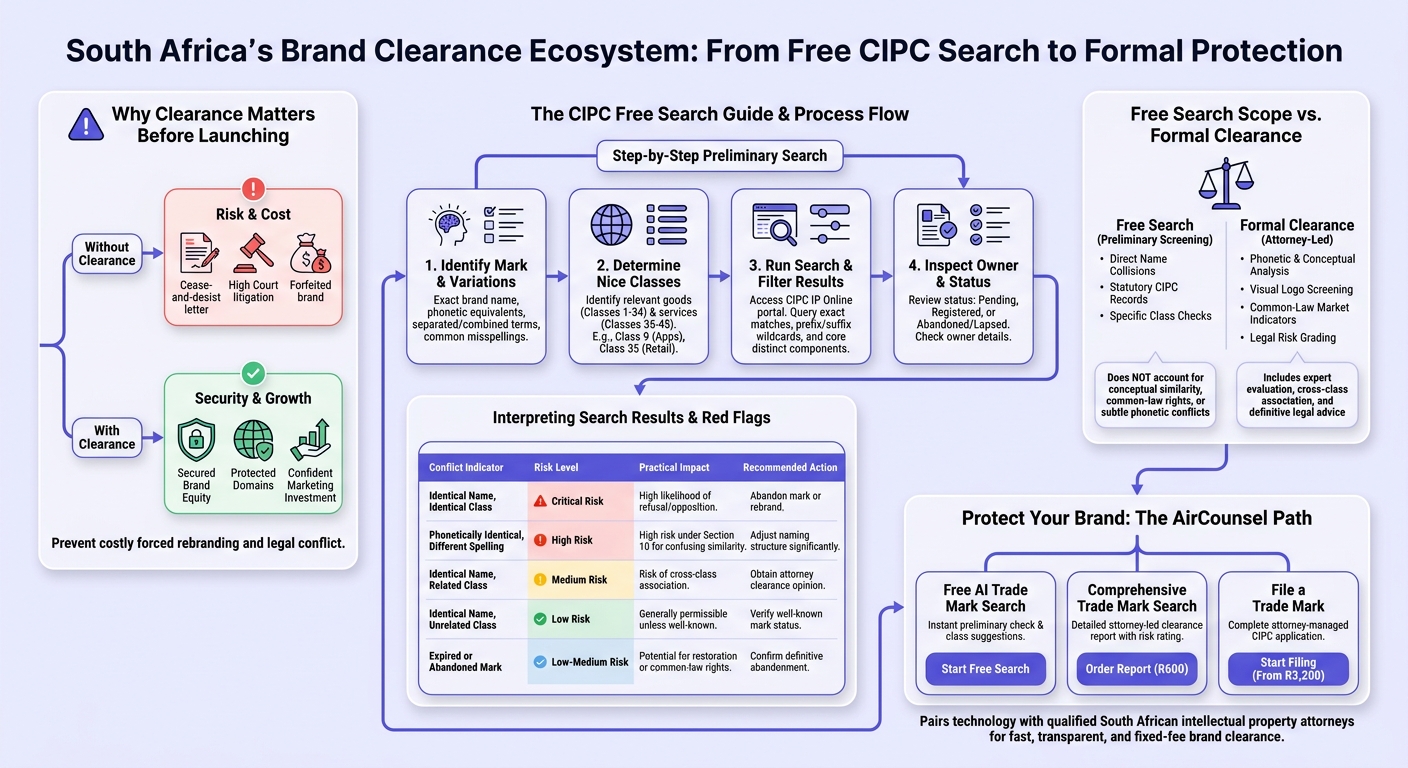
Why Brand Clearance Matters Before Launching
Registering a company name with the CIPC does not grant exclusive proprietary rights to that name. A registered company name merely satisfies corporate registration requirements under the Companies Act, whereas trademark protection under the Trade Marks Act 194 of 1993 grants the exclusive right to prevent competitors from using identical or confusingly similar marks.
Conducting preliminary clearance protects your business from receiving cease-and-desist notices or facing High Court trademark infringement litigation. If an existing entity holds prior rights to an identical or similar mark in related goods or services, your registration can be blocked or expunged, forcing you to forfeit your brand equity, domains, packaging, and advertising spend.
How the CIPC Free Trademark Search Database Operates
In South Africa, the CIPC administers the official Register of Trade Marks, maintaining records of applications and registrations dating back to 1916 according to official government records. To facilitate public access, the CIPC hosts a basic electronic search portal on its IP Online Platform.
The free e-search allows founders to query the database by trade mark name, application number, or proprietor name without paying access fees or creating an account. It provides a baseline view of existing filings, display statuses, class numbers, and journal publication details. However, this tool acts as a cursory check rather than a comprehensive legal clearance opinion.

Step-by-Step Guide to Conducting a Preliminary Search
To extract actionable insights from a free database search, founders should follow a structured four-step methodology.
Step 1: Identify Your Proposed Mark and Phonetic Variations
Start by listing your exact brand name alongside all plausible variations. Trademarks are evaluated for visual, phonetic, and conceptual similarity. If your brand is "KlipTech," you must also search:
- Phonetic equivalents (e.g., "ClipTech", "KlipTek", "ClypTech")
- Separated or combined terms (e.g., "Klip Tech", "Clip-Tech")
- Plural forms and common misspellings
Step 2: Determine Your Relevant Nice Classification Classes
Trademarks are categorized across 45 international classes under the Nice Classification system (Classes 1–34 for physical goods, Classes 35–45 for services). A conflict exists when an identical or similar mark operates in an overlapping or related class. For example:
- Class 9: Mobile applications, software, consumer electronics
- Class 35: Advertising, business management, retail and wholesale services
- Class 42: Software-as-a-Service (SaaS), IT consulting, technology development
Step 3: Run the Free Search and Filter Results
Navigate to the public search interface, enter your target terms, and filter by your identified classes. Run separate queries for:
- Exact word matches
- Prefix and suffix wildcards
- Core distinctive components (e.g., searching "Klip" without the suffix "Tech")
To accelerate this phase, founders can also utilize AirCounsel's Free AI Trade Mark Search to scan both statutory CIPC records and common-law market indicators simultaneously.
Step 4: Inspect Owner Details and Application Status
For every matching result, review the status entry on the record:
- Pending / Application in Progress: The mark is under examination and holds priority over newer applications.
- Registered: The mark is active and enforceable throughout South Africa.
- Abandoned / Lapsed / Expired: The mark may no longer be active, though grace periods and restoration applications must be checked.
How to Interpret Red Flags and Search Results
Identifying an identical match in the same class is an immediate red flag that requires selecting a new name or securing formal legal advice. However, many conflicts are subtler.
| Conflict Indicator | Risk Level | Practical Impact | Recommended Action |
|---|---|---|---|
| Identical Name in Identical Class | Critical | High likelihood of refusal by CIPC and opposition from the owner. | Abandon the mark or completely rebrand. |
| Phonetically Identical, Different Spelling | High | High risk under Section 10 of the Trade Marks Act for confusing similarity. | Adjust the naming structure significantly. |
| Identical Name in Related Class | Medium | Risk of cross-class association (e.g., Class 9 software vs. Class 42 SaaS). | Obtain an attorney clearance opinion. |
| Identical Name in Unrelated Class | Low | Generally permissible unless the prior mark is a well-known household brand. | Verify well-known mark status before filing. |
| Expired or Abandoned Mark | Low to Medium | Prior registrant may attempt restoration or maintain common-law passing-off rights. | Confirm definitive abandonment on the CIPC register. |
For founders balancing naming validation with overall corporate structure, you can review our guide on how to register a trademark with the CIPC to protect your digital brand in South Africa.
Free Search vs. Formal Clearance: When to Upgrade
A free database search is a preliminary screening tool. It answers whether an identical name is visibly registered in a specific class, but it does not account for complex trademark law principles such as conceptual similarity, foreign well-known mark protections, or unregistered common-law rights established through trading history.
If you are committing significant capital to brand development, launching a national product line, or seeking institutional investment, upgrading from a cursory search is critical. A Comprehensive Trade Mark Search includes attorney-guided evaluations of the CIPC register, phonetic indexing, visual image screening for logos, and conflict risk grading.
Common Pitfalls When Using Free Trademark Databases
- Searching Only Exact Matches: Assuming a brand name is available because "SwiftPay" returned zero results, while missing registered marks like "SwyftPay" or "Swift-Payment".
- Ignoring Services Classes: A software creator searching only Class 9 (goods) while missing competitors registered under Class 42 (software services).
- Overlooking Unregistered Rights: South African law recognizes common-law rights under the delict of passing off. A business trading without a CIPC registration can still stop you if they hold prior established goodwill.
- Relying on CIPC Company Name Approval: Assuming that securing a name reservation for a
(Pty) Ltdgives trademark exclusivity.
Protect Your Brand with Professional Guidance
Clear your brand name with certainty before committing resources to an unprotectable identity. AirCounsel pairs technology with qualified South African intellectual property attorneys to deliver fast, transparent, and fixed-fee brand clearance.
Whether you need an automated check, a detailed attorney clearance report, or complete filing representation, we protect your intellectual property quickly and without surprise costs.
Start by checking your brand using our Free AI Trade Mark Search, order an in-depth Comprehensive Trade Mark Search for R600, or let our attorneys File a Trade Mark in South Africa starting from R3,200.
Frequently Asked Questions
How do I use South Africa's free trade mark search to check a brand name?
You can access the CIPC IP Online portal, select the basic trade mark search option, and enter your target brand name without logging in. Filter your search by relevant Nice Classification classes and run queries for exact names as well as phonetic variations to evaluate baseline availability.
What does a free search show, and what does it not show?
A free search displays registered and pending trademarks, application numbers, filing dates, owner names, and Nice classes listed in the statutory CIPC database. It does not display unregistered common-law trademarks, international marks that may claim convention priority within 6 months, or legal assessments of confusing similarity.
Can I rely on a free search alone before filing a trade mark in South Africa?
A free search is suitable for eliminating obvious name collisions early in your ideation process. However, relying solely on it before filing carries risk because it does not evaluate subtle phonetic conflicts, cross-class association, or passing-off vulnerabilities.
What is the difference between a free search and a more detailed CIPC search?
A basic free search checks text strings directly typed into the portal. A detailed clearance search involves comprehensive phonetic indexing, device/logo image comparisons, and an assessment by a licensed attorney who evaluates statutory registrability under the Trade Marks Act.
Recommended
- Free AI Trade Mark Search - Instant preliminary trademark conflict check and class suggestions for South African businesses.
- Comprehensive Trade Mark Search - Detailed attorney-led trademark clearance report covering CIPC records, phonetic similarities, and risk ratings for R600.
- File a Trade Mark in South Africa - Complete attorney-managed CIPC trademark application service with fixed, transparent pricing.
Need Legal Assistance?
Our expert legal team is ready to help you navigate complex legal matters with confidence.