How to Register a Trademark in South Africa: A Practical Startup Guide

Building a recognizable brand takes relentless work, but failing to secure your brand assets leaves your company vulnerable to imitators, domain squatters, and expensive rebranding disputes. When you register a trademark in South Africa, you secure exclusive commercial rights to your company name, logo, or product identifiers across the nation.
In South Africa, trademark registration is administered under the Trade Marks Act 194 of 1993 by the Companies and Intellectual Property Commission (CIPC). According to official intellectual property filing records, over 35,000 trademark applications are submitted annually in South Africa by local and international businesses looking to protect their enterprise value.
This step-by-step checklist breaks down the legal process of registering a trademark in South Africa, from preliminary clearance searches to final certificate issuance.
Table of Contents
- What a South African Trademark Protects
- Why Early Registration Matters for Startups
- Step 1: Conduct a Trademark Clearance Search
- Step 2: Choose the Correct Nice Classes
- Step 3: Prepare and Submit Your CIPC Application
- Step 4: Examination, Publication, and Opposition
- Trademark Registration Costs and Timelines
- Common Trademark Registration Mistakes to Avoid
- Secure Your Brand with Expert Support
- Frequently Asked Questions
- Recommended
Quick Summary
| Takeaway | Explanation |
|---|---|
| Governing Authority | Trademarks are processed and granted through the CIPC IPOnline Portal under the Trade Marks Act. |
| Territorial Limitation | South African registration covers South Africa only; foreign protection requires separate territorial filings. |
| Classification System | Goods and services are filed across 45 international Nice classes based on your exact offerings. |
| Duration and Renewal | A registered trademark is valid for 10 years from filing and can be renewed indefinitely every 10 years. |
| Estimated Timeline | Expect between 12 and 24 months from the initial filing date to the issuance of the registration certificate. |
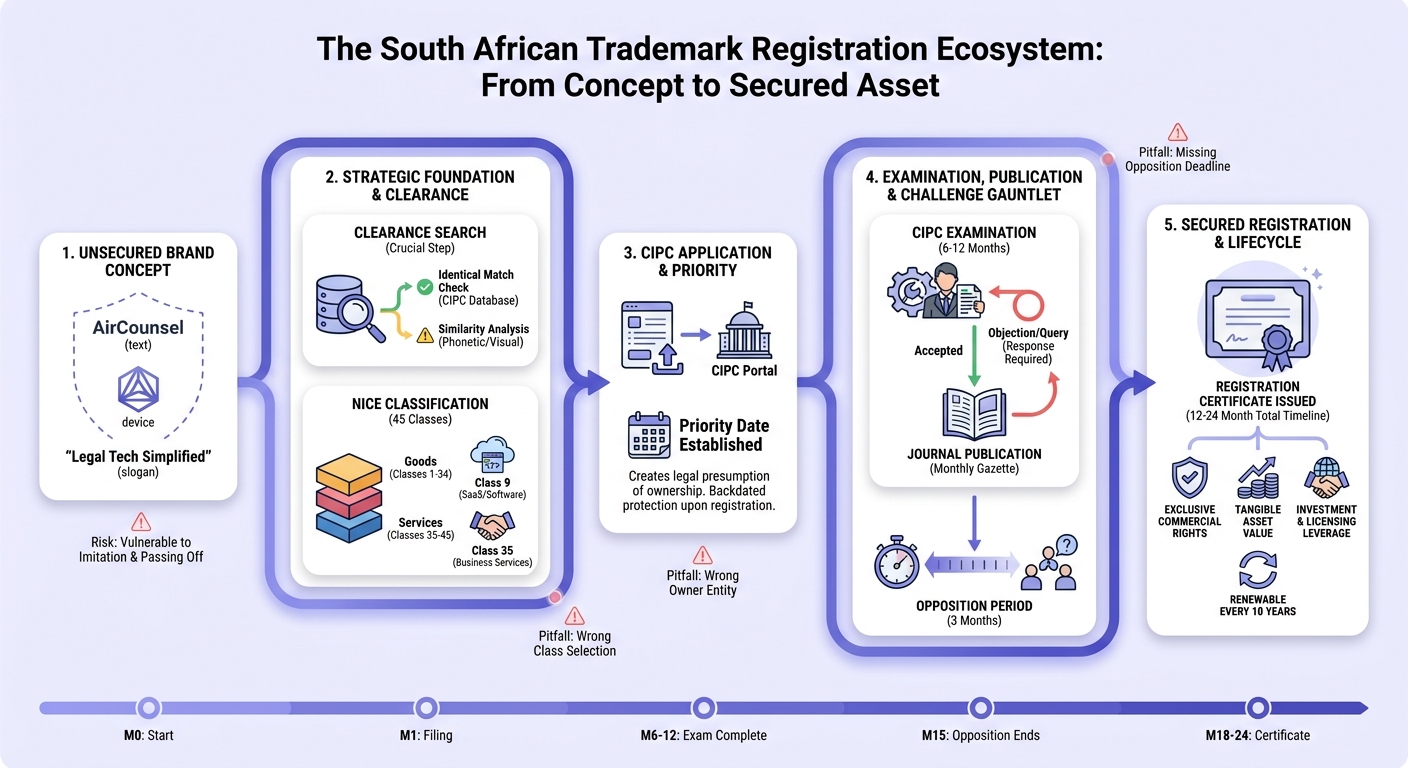
What a South African Trademark Protects
A trademark serves as a badge of origin. It distinguishes your goods or services from those of your competitors in the marketplace. Under South African law, you can protect several types of identifiers:
- Word Marks: Brand names, company names, product lines, and invented words.
- Device Marks: Logos, symbols, stylized lettering, and graphic emblems.
- Slogans and Taglines: Distinctive marketing phrases and brand promises.
- Shapes and Colors: Distinctive packaging, 3D product configurations, or specific color combinations that have acquired distinctiveness.
Registering a trademark gives you the statutory right to prevent third parties from using identical or confusingly similar marks for related goods or services in South Africa.
Why Early Registration Matters for Startups
Many founders assume that registering a company name with CIPC or purchasing a .co.za domain secures their brand rights. In reality, company registration only reserves your corporate entity name on the commercial register; it provides no statutory trademark protection.
South Africa operates primarily on a system where registered rights take precedence over unregistered common law rights. Enforcing an unregistered mark requires proving common law "passing off," which demands substantial evidence of market reputation and is notoriously expensive to litigate.
By contrast, registering your trademark creates an immediate, public legal presumption of ownership. It also strengthens your position when raising venture capital, licensing your technology, or preventing counterfeiters from infringing on your products.
Step 1: Conduct a Trademark Clearance Search
Before submitting an application, you must verify that your proposed mark is available for use and registration. Filing without searching risks rejection by CIPC examiners or legal opposition from existing brand owners.
Clearance involves two main layers of investigation:
- Identical Searches: Checking the CIPC trademark database for exact matches in your target commercial classes.
- Confusing Similarity Searches: Analyzing phonetically similar names, translations, visual matches, and overlapping service descriptions.
Startups can quickly check potential conflicts with a Free AI Trade Mark Search or commission a formal Comprehensive Trade Mark Search reviewed by an intellectual property attorney before committing capital.
Step 2: Choose the Correct Nice Classes
South Africa follows the international Nice Classification system, which divides all commercial activities into 45 distinct classes: Classes 1 through 34 cover tangible goods, while Classes 35 through 45 cover services.

When filing, you must select the classes that reflect your current offerings and near-term expansion plans:
- Software & SaaS: Typically filed in Class 9 (downloadable software and apps) and Class 42 (cloud software, hosting, and technology services).
- Retail & eCommerce: Typically filed in Class 35 (online retail, business administration, and advertising).
- Consulting & Financial Services: Commonly filed in Class 35 (business management) or Class 36 (financial and insurance services).
Your trademark rights only extend to the specific classes and specifications listed in your application. Selecting too few classes leaves blind spots, while selecting irrelevant classes increases filing costs and exposes your mark to cancellation for non-use.
Step 3: Prepare and Submit Your CIPC Application
Once you have completed your clearance search and finalized your classes, you are ready to file through the official South African Government Intellectual Property Portal.
Your application package must contain:
- Applicant Details: The full legal name, registered address, and company registration number of the owner.
- Mark Representation: A clean high-resolution digital copy of your logo or the exact text of your word mark.
- Class Specifications: A clear, standardized description of the goods or services covered.
- Power of Attorney: An authorization form if a registered legal practitioner is filing on your behalf.
Your official filing date establishes your priority date in South Africa, protecting your place in line against subsequent filers.
Step 4: Examination, Publication, and Opposition
After filing, your application moves through several procedural stages:
- Formal and Substantive Examination: A CIPC examiner reviews the mark for distinctiveness and checks for conflicts with previously registered marks. This stage typically takes 6 to 12 months.
- Official Acceptance: If the examiner raises no objections (or if responses to official queries are accepted), CIPC issues a formal Notice of Acceptance.
- Journal Publication: The accepted application is advertised in the monthly Patent and Trade Marks Journal.
- Opposition Window: Third parties have a 3-month window from the publication date to oppose the registration if they believe the mark infringes on their existing rights.
- Registration Certificate: If no opposition is filed, CIPC issues the final certificate of registration.
Trademark Registration Costs and Timelines
Trademark registration is a long-term commercial investment. Below is an overview of the key milestones, administrative stages, and statutory fees.
| Stage | Estimated Timeline | Focus / Deliverable |
|---|---|---|
| Clearance & Search | 1 to 3 business days | Conflict assessment across CIPC registers and common law records |
| CIPC Filing | 1 to 2 business days | Formal lodgment and priority date receipt |
| CIPC Examination | 6 to 12 months | Examiner review for distinctiveness and conflicting prior marks |
| Journal Advertisement | 1 to 2 months post-acceptance | Publication in the Patent and Trade Marks Journal |
| Opposition Period | 3 months | Statutory window for third-party objections |
| Certificate Issuance | 2 to 4 months post-opposition | Final electronic registration certificate delivered |
Common Trademark Registration Mistakes to Avoid
Small mistakes during the initial application can cause years of delay or result in an unenforceable registration. Avoid these common pitfalls:
- Selecting Purely Descriptive Names: Names that merely describe the function, quality, or geographic origin of your goods (e.g., "Cape Town Web Design") are generally refused for lack of distinctiveness.
- Failing to Secure Designer Copyright: If an external contractor or agency designed your brand logo, ensure you execute a Template Copyright Assignment Agreement to transfer IP ownership to your company before filing.
- Filing in the Wrong Owner's Name: Registering a mark under an individual founder's name rather than the operating company entity can complicate fundraising, equity distribution, and corporate licensing.
- Missing Opposition Deadlines: Failing to monitor the trademark journal leaves you unaware of competitors filing confusingly similar marks in your sector.
Secure Your Brand with Expert Support
Protecting your brand should not be slowed down by complex administrative workflows or hidden legal fees. Ensuring that your classification, distinctiveness review, and CIPC documentation are handled correctly from day one avoids costly re-filings and unnecessary legal disputes.
If you are ready to protect your business identity with clear, transparent fixed pricing, you can directly File a Trade Mark in South Africa with our experienced intellectual property team.
Frequently Asked Questions
How long does it take to register a trademark in South Africa?
The full registration process generally takes between 12 and 24 months from the initial filing date to the issuance of the certificate. However, your legal protection is backdated to your original filing date once registered.
What does a trademark registration protect in South Africa?
A South African trademark registration gives you the exclusive legal right to use your brand name, logo, or slogan for the specific goods and services registered within South Africa, enabling you to block competitors from using confusingly similar marks.
Do I need to register my trademark in more than one class?
You only need to register in multiple classes if your business provides goods or services that span different categories. For example, a tech company selling both downloadable hardware devices and cloud subscription services typically registers in both Class 9 and Class 42.
Can I file a trademark myself with CIPC or should I use an attorney?
While individuals can file directly on the CIPC online portal, using an intellectual property attorney ensures your clearance search is accurate, your class specifications are legally robust, and official examiner queries are handled correctly.
Does a South African trademark give me global protection?
No. Trademark protection is territorial. A registration granted by CIPC protects your brand exclusively within the borders of South Africa. To protect your brand abroad, you must file separate national applications or use international filing systems.
Recommended
Need Legal Assistance?
Our expert legal team is ready to help you navigate complex legal matters with confidence.