9 Mandatory Clauses for South Africa Service Agreements in the Gig Economy

As South Africa's gig economy continues to scale rapidly, more startups, founders, and small-business operators are outsourcing core tasks to freelancers. However, hiring external talent carries significant structural risks. Executing a legally robust, compliant independent contractor agreement in South Africa is the single most effective way to protect your business assets, ensure operational continuity, and secure critical intellectual property.
Failing to properly define the status of your external workforce exposes you to intense legal and regulatory scrutiny. Under amended labor laws, workers earning below the statutory earnings threshold of R254,371.67 per annum are legally presumed to be employees if just one factor of employment is present. If the Commission for Conciliation, Mediation and Arbitration (CCMA) rules that a contractor is actually an employee, your business faces retroactively paying employee benefits, back-taxes, and penalties.
To mitigate this risk, you must look beyond the title of your contract. Courts evaluate the operational reality of the relationship using the "dominant impression test." Below, we break down the 9 mandatory legal clauses you need in your contracts to safely leverage independent contractors.
Table of Contents
- Understanding the Misclassification Risk in South Africa
- The 9 Mandatory Clauses for Your Service Agreement
- Explicit Independent Contractor Status
- Result-Oriented Scope of Work
- Commercial Autonomy and Non-Exclusivity
- Milestone-Based Payment Terms
- Independent Tax Responsibility
- Clear Intellectual Property Assignment
- Confidentiality and POPIA Compliance
- Alternative Dispute Resolution
- Distinct Termination Procedures
- Practical Tips to Stay Compliant
- Timeline and Costs for Implementing Compliant Contracts
- Secure Your Workforce Contracts Today
- Frequently Asked Questions
- Recommended
Quick Summary
| Takeaway | Explanation |
|---|---|
| Dominant Impression Test | The legal framework South African authorities use to determine the true nature of a worker relationship (substance over form). |
| SARS Compliance | Contractors are solely responsible for their own tax obligations; employers do not withhold PAYE tax. |
| IP Ownership | Independent contractors own their work by default under South African law unless a contract explicitly assigns ownership to the client. |
| POPIA Requirements | Outsources must implement strict data-handling policies compliant with the Protection of Personal Information Act. |
| Deliverables Focus | Contracts must measure output rather than working hours to remain distinct from formal employment relationships. |
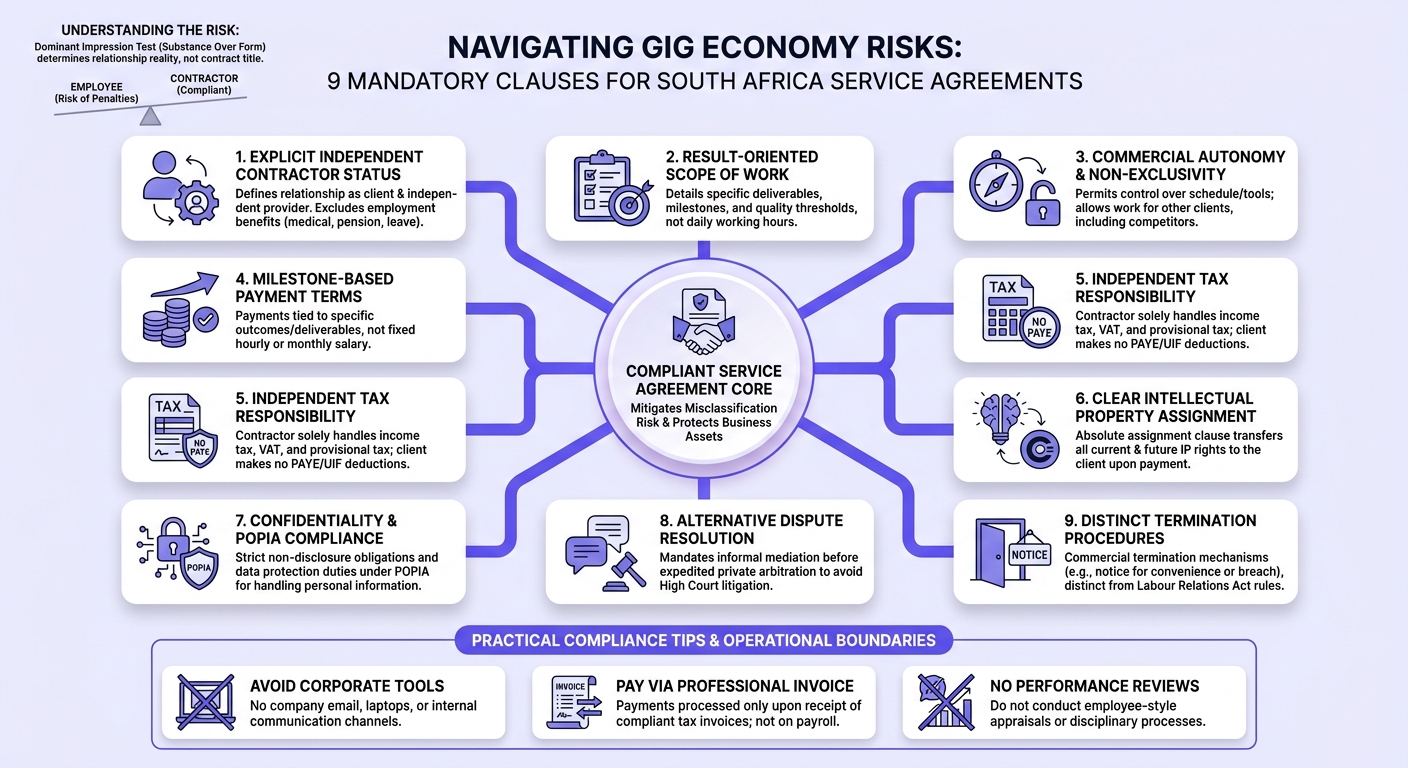
Understanding the Misclassification Risk in South Africa
The distinction between an employee and a contractor is not based on what you call the contract. Instead, the CCMA and South African courts look closely at how the relationship functions day-to-day. If your contractor is subject to employee-like supervision, uses your office equipment exclusively, or works fixed hours every week, they may be classified as an employee under the Basic Conditions of Employment Act (BCEA).
Misclassification can severely damage a growing business. A ruling against you means your business could be forced to pay up to 12 months' salary as compensation for unfair dismissal, payout accumulated annual leave, and face severe fines from the South African Revenue Service (SARS).
If you are actually looking to hire a full-time team member, you should instead use an attorney-vetted Template Employment Agreement to ensure complete alignment with South African labor regulations.
The 9 Mandatory Clauses for Your Service Agreement
Every service contract must outline key areas clearly so that there is no room for legal misinterpretations.
Explicit Independent Contractor Status
This clause explicitly states that the relation is that of a client and an independent service provider. It must clarify that no employment relationship, agency, or partnership is created. The clause must clearly exclude the contractor from company benefits such as medical aid, pension schemes, paid annual leave, and sick leave.
Result-Oriented Scope of Work
Unlike employment contracts that detail general day-to-day duties, a contractor agreement must detail specific, result-oriented deliverables. Avoid specifying "daily hours of work." Instead, define clearly defined milestones, technical specifications, and expected quality thresholds.
Commercial Autonomy and Non-Exclusivity
To pass the dominant impression test, the contractor must retain control over how they complete their tasks. Include a clause that explicitly permits them to set their own schedules, use their own tools or machinery, and hire subcontractors to complete the work. It should also state that the contractor is free to provide services to other third-party clients, including competitors, during the duration of the agreement.
Milestone-Based Payment Terms
Ensure payments are tied to the completion of specific milestones or delivery of specific outcomes, rather than a fixed hourly rate or monthly recurring salary. The contract should outline an invoicing process where payments are only authorized once defined deliverables are approved.
Independent Tax Responsibility
To maintain compliance, the contract must state that the contractor is entirely responsible for administering their own provisional taxes, income tax, and Value Added Tax (VAT) obligations. Declare that the hiring business will not make any deductions for Pay-As-You-Earn (PAYE) or Unemployment Insurance Fund (UIF) contributions.
Clear Intellectual Property Assignment
Under South African copyright law, an independent contractor owns any intellectual property (IP) they create in the course of providing services, unlike a traditional employee. To prevent disputes, your contract must contain an absolute IP assignments clause that transfers all existing and future IP rights to your company immediately upon payment.
For general consulting arrangements, utilizing a robust Template Consulting Agreement will protect your primary company assets.
Confidentiality and POPIA Compliance
Your agreements must secure your proprietary data. Ensure the contractor is legally bound to strict non-disclosure obligations. Additionally, because contractors often process data on behalf of your customers, you must include a sub-clause outlining clear data protection duties under the Protection of Personal Information Act (POPIA).
For deeper protection, execute a comprehensive Template Data Protection Policy or a specialized Template Non-Disclosure Agreement.
Alternative Dispute Resolution
To avoid expensive, slow-moving High Court litigation, draft a clause requiring both parties to resolve disagreements through alternative channels. Specify that any conflict must first undergo informal mediation before proceeding to expedited private arbitration (such as through the Arbitration Foundation of Southern Africa, or AFSA).
Distinct Termination Procedures
Traditional employment terminate rules are strictly guarded by the Labour Relations Act. To remain distinct, your contractor contract must highlight a commercial termination mechanism. Enable either party to terminate the contract "for convenience" with a simple written notice (e.g., 14 days), or immediately if there is a material breach of the defined deliverables.
Practical Tips to Stay Compliant

To keep your contractor relations safe from legal reclassification, always maintain a clean operational boundary:
- Avoid Corporate Tools: Do not issue company laptops, email addresses hosted on your primary domain, or corporate communication channels unless strictly segmented.
- Pay via Invoice: Never include contractors on your monthly payroll runs. They must submit professional tax invoices before receiving standard electronic bank transfers (EFTs).
- Reject Performance Reviews: Do not conduct employee-style annual performance evaluations or administer company disciplinary processes on contractors.
If you are currently managing a blend of local and international service providers, using a specialized Template Independent Contractor Agreement can save you hours of administrative drafting while protecting your startup's core valuation.
Timeline and Costs for Implementing Compliant Contracts
Securing safe, legally compliant contract frameworks does not have to be slow or incredibly expensive. Below is an overview of how your startup can access attorney-drafted documentation:
| Service Option | Best For | Turnaround | Price (ZAR) |
|---|---|---|---|
| Independent Contractor Template | Quick onboarding for standard freelancers and gig workers. | Instant download | ZAR 950.00 |
| Custom Contractor SLA | Complex development, creative work, or high-value partnerships. | 3 Business Days | ZAR 8,000.00 |
| Contract Review Service | Checking existing agreements for hidden risks and compliance traps. | 2 Business Days | ZAR 1,500.00 |
Secure Your Workforce Contracts Today
Protecting your startup begins with solid contract structures. Do not wait for a CCMA audit or an IP dispute to discover your agreements are legally unenforceable or incorrectly formatted. We specialize in providing transparent, fixed-price legal resources to safeguard your commercial interests.
Get immediate protection for your business operations today. Download our quick-start Template Independent Contractor Agreement or schedule a comprehensive, tailored development package with a Custom Independent Contractor / Consulting Agreement drafted directly by licensed South African attorneys.
This article provides general information and is not legal advice.
Frequently Asked Questions
What is the dominant impression test in South Africa for classifying independent contractors?
The dominant impression test is a qualitative assessment used by South African courts and the CCMA. It evaluates several factors of a relationship to determine if a worker is a contractor or a de factor employee. Key indicators include the level of control over work hours, whether the worker uses their own tools, if they are economically dependent on one client, and if they are integrated into the client's everyday business operations.
How can I prove an employee is actually an independent contractor in a South Africa contract?
You can support a contractor classification by structuring the agreement around defined deliverables, milestones, and output, rather than hours worked. You must also ensure the contractor issues professional invoices, works with their own tools, maintains independent business insurance, and retains the right to work for other clients.
What are the tax obligations for independent contractors in South Africa?
Independent contractors are categorized as provisional taxpayers in South Africa. They must register as such with SARS and are responsible for paying their own income tax, provisional taxes, and registering for VAT if their annual turnover exceeds R1 million. They are not subjected to monthly PAYE or UIF payroll deductions by the client.
Can an independent contractor in South Africa claim unfair dismissal if misclassified?
Yes. If an independent contractor believes they have been misclassified, they can refer an unfair dismissal dispute to the CCMA. If the CCMA determines that the relationship was essentially an employment relationship under the dominant impression test, the worker can claim reinstatement, backdated employee benefits, or up to 12 months' compensation for unfair dismissal.
Recommended
- Template Independent Contractor Agreement – Grab a compliant, attorney-drafted template for rapid onboarding.
- Custom Independent Contractor / Consulting Agreement – Partner with specialized lawyers to build a tailored contract framework.
- Contract / Legal Document Review – Secure your existing service agreements against regulatory and tax risks.
Need Legal Assistance?
Our expert legal team is ready to help you navigate complex legal matters with confidence.