Why Technology Companies Must Align with the Information Regulator South Africa

For technology startups and expanding small businesses in South Africa, regulatory compliance often takes a back seat to shipping features and acquiring users. However, under the mandate of the information regulator south africa, private bodies face strict obligations under both the Promotion of Access to Information Act (PAIA) and the Protection of Personal Information Act (POPIA).
Historically, many small private entities operated under temporary exemptions regarding PAIA manual submissions. Today, 100% of private companies in South Africa, regardless of headcount or annual turnover, are required to compile, maintain, and publish an up-to-date PAIA manual that reflects their data processing activities.
Failing to maintain a compliant manual creates immediate operational friction, exposure to enforcement notices, and credibility issues during fundraising or enterprise procurement. Ensuring your documentation reflects the supervisory role of the Information Regulator is a straightforward process when managed proactively.
Table of Contents
- Understanding the Role of the Information Regulator South Africa
- Why Private Technology Companies Must Comply with PAIA
- Mandatory Contents of a Private Body PAIA Manual
- Step-by-Step Guide to Updating Your PAIA Manual
- Publication and Accessibility Requirements
- Key Risks of Using an Outdated PAIA Manual
- Streamline Your PAIA and POPIA Compliance
- Frequently Asked Questions
- Recommended
Quick Summary
| Takeaway | Explanation |
|---|---|
| Mandatory Applicability | Every private company in South Africa must maintain a valid PAIA manual; exemptions for small businesses have expired. |
| Dual Regulatory Scope | The Information Regulator oversees both access to information (PAIA) and data privacy protection (POPIA). |
| Core Documentation | Your manual must document company records, Information Officer details, request procedures, and POPIA data categories. |
| Public Availability | Manuals must be published on the company website and held physically at the principal place of business. |
| Enforcement Exposure | Non-compliance exposes leadership to administrative fines, compliance notices, and reputational risk. |
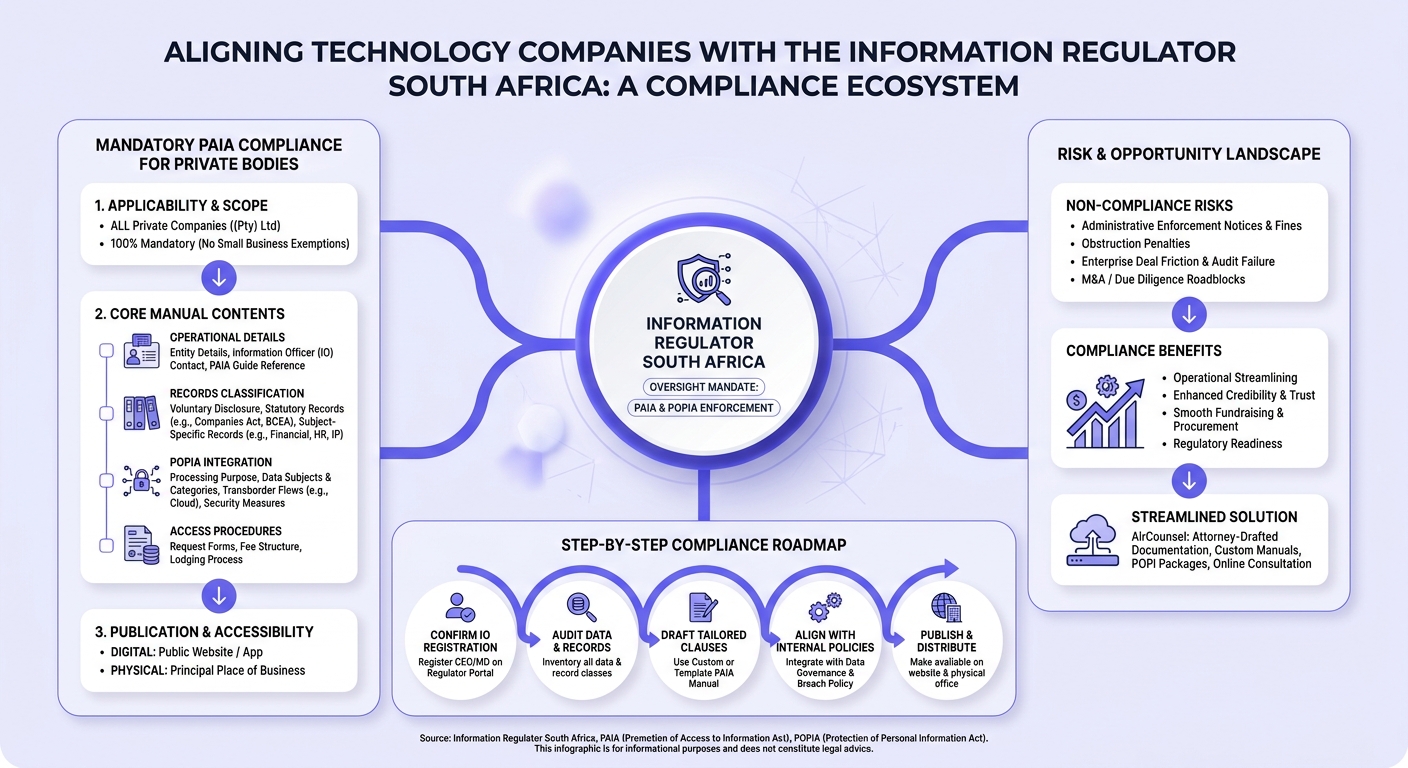
Understanding the Role of the Information Regulator South Africa
The Information Regulator is an independent statutory body established in terms of Section 39 of POPIA. It monitors and enforces compliance with both POPIA and PAIA across public and private bodies in South Africa.
Before the Information Regulator assumed its full enforcement mandate, PAIA oversight fell under the South African Human Rights Commission (SAHRC). Today, the regulator has extensive monitoring, investigatory, and enforcement powers. The official Information Regulator South Africa portal provides the statutory forms, compliance assessment notices, and guidance notes that dictate how businesses must handle information access requests.
For founders, this consolidated oversight means that access requests, data subject inquiries, and security compromise notifications all fall under one authority. Your internal records and external policies must align seamlessly to avoid regulatory scrutiny.
Why Private Technology Companies Must Comply with PAIA
A common misconception among software developers, digital agencies, and platform founders is that PAIA applies solely to state institutions and public entities. Under South African law, a "private body" includes any natural person who carries on a trade or profession, a partnership, or any juristic person, including a private company ((Pty) Ltd).
Technology companies handle significant volumes of sensitive records, including:
- User account details, telemetry logs, and transactional databases.
- Proprietary source code, software architecture designs, and API documentation.
- Employment contracts, contractor agreements, and human resources records.
- Third-party vendor arrangements, cloud hosting agreements, and software licenses.
Under Section 50 of PAIA, a requester must be given access to any record of a private body if that record is required for the exercise or protection of any rights. Your PAIA manual functions as the official roadmap that informs external parties what records you hold and how they can formally request them.
Mandatory Contents of a Private Body PAIA Manual
The Information Regulator requires every private body to draft a structured manual outlining its operational and information landscape. A generic, copy-pasted template from an overseas jurisdiction will not meet statutory standards under South African law.

Core Operational Details
Your manual must open with practical operational facts regarding your entity:
- Entity Details: Full registered name, company registration number, and physical and postal addresses.
- Information Officer Contact: The full name, email address, and direct telephone number of your registered Information Officer (and any formally delegated Deputy Information Officers).
- Guide Description: A reference to the official guide published by the Information Regulator on how to use PAIA.
Records Classification and Access Categories
Your manual must explicitly categorize the records your business maintains and how they may be accessed:
- Voluntary Disclosure: Records automatically available without submitting a formal request (e.g., public website content, marketing brochures, published terms).
- Statutory Records: Records held in compliance with other legislation, such as the Companies Act, Basic Conditions of Employment Act (BCEA), Value-Added Tax Act, and Labour Relations Act.
- Subject-Specific Records: Detailed lists of operational records, such as financial statements, customer lists, intellectual property files, and internal policies.
POPIA Integration Section
Because the Information Regulator harmonized PAIA and POPIA, private body manuals must outline data protection practices:
- The purpose of processing personal information within your platform or systems.
- Categories of data subjects and the personal information processed for each.
- Planned transborder flows of personal information (e.g., using overseas cloud infrastructure like AWS or Google Cloud).
- A general description of technical and organizational security measures implemented to protect data integrity.
| Component | PAIA Requirement | Practical Tech Application |
|---|---|---|
| Information Officer Details | Mandatory contact details for access requests | Designate the CEO or registered director via the Registration of Information Officer process |
| Records Schedule | Exhaustive list of record categories held by the entity | Inventory source code repos, user database schemas, and financial ledgers |
| POPIA Disclosures | Description of data subjects, purposes, and recipients | Match internal processing mapped in your Custom Privacy Policy |
| Fee Structure | Reference to statutory request and access fees | Publish current regulated prescribed fee tables directly in the manual |
Step-by-Step Guide to Updating Your PAIA Manual
If your startup has changed business models, updated its technical infrastructure, appointed new directors, or never drafted a compliant manual, follow these steps to achieve alignment with regulator standards:
- Confirm Information Officer Registration: Ensure your CEO or managing director is formally registered on the Information Regulator's e-Services portal.
- Audit Data and Records: Conduct an internal inventory across your engineering, marketing, HR, and accounting tools to document all active record classes.
- Draft Tailored Clauses: Prepare your manual using an attorney-reviewed structure such as a Custom PAIA Manual or a verified Template PAIA Manual.
- Align with Internal Policies: Ensure your access manual aligns with your internal data governance, including your Custom Data Breach Policy and workplace rules.
- Publish and Distribute: Place the final version on your public-facing application or website and store a printed or readily accessible copy at your principal place of business.
Publication and Accessibility Requirements
Under Section 51 of PAIA, private bodies must make their manuals easily discoverable. Meeting regulatory expectations requires fulfilling two core distribution rules:
- Digital Publication: If your business maintains a public website or mobile application, you must post the manual in an easily accessible location, typically alongside your terms of service and website privacy policy.
- Physical Availability: A copy of the manual must be available for inspection at your company's registered physical office during normal business hours.
Unlike older procedures where copies were mailed directly to the SAHRC, private bodies are not required to submit annual copies to the Information Regulator unless explicitly requested during a compliance audit or formal investigation.
Key Risks of Using an Outdated PAIA Manual
Operating with an obsolete PAIA manual exposes a business to operational and regulatory risks:
- Administrative Enforcement: The Information Regulator can issue compliance notices with strict deadlines to remediate documentation defects.
- Obstruction Penalties: Failing to respond appropriately to access requests or obscuring statutory procedures can lead to legal penalties.
- Enterprise Deal Friction: Mid-market and enterprise enterprise clients running vendor risk assessments routinely audit PAIA and POPIA documentation before closing software contracts.
- M&A and Due Diligence Roadblocks: Investors and acquirers evaluate data compliance readiness as part of standard corporate governance audits.
Implementing a structured compliance baseline with an Intermediate POPI Compliance Package ensures your governance infrastructure supports company growth without legal friction.
Streamline Your PAIA and POPIA Compliance
Navigating information regulations should not pull your leadership team away from scaling your business. AirCounsel offers attorney-drafted, transparently priced documentation to help your technology startup align with Information Regulator standards quickly and affordably.
Get your compliance fully up to date with a Custom PAIA Manual, secure comprehensive protection through our Basic Package: Full POPI Compliance Template Package, or schedule an Online Consultation with an Attorney to review your regulatory posture.
Frequently Asked Questions
Does a private technology company in South Africa need a PAIA manual?
Yes. All private companies registered in South Africa, including technology startups, SaaS providers, and consultancies, are legally required under Section 51 of PAIA to compile and maintain a PAIA manual. Previous exemptions for small businesses have expired.
How often should a PAIA manual be updated in South Africa?
A private body should update its PAIA manual whenever material changes occur within the business. This includes changes to registered directors, contact information for the Information Officer, categories of records held, primary office addresses, or data processing activities. Regular annual reviews are recommended.
What must be included in a private body PAIA manual?
A private body PAIA manual must contain company contact details, Information Officer information, descriptions of records available voluntarily or via formal requests, statutory records held under South African acts, POPIA data processing details (categories of subjects and data), transborder flow notifications, security measure summaries, and prescribed access request procedures.
Where should a PAIA manual be made available to the public?
The manual must be published on the company's official website if one is operated. Additionally, a copy must be kept available for inspection at the principal place of business during normal business hours.
Recommended
Need Legal Assistance?
Our expert legal team is ready to help you navigate complex legal matters with confidence.