How to Structure an Intellectual Property Assignment Agreement for a South African Tech Startup

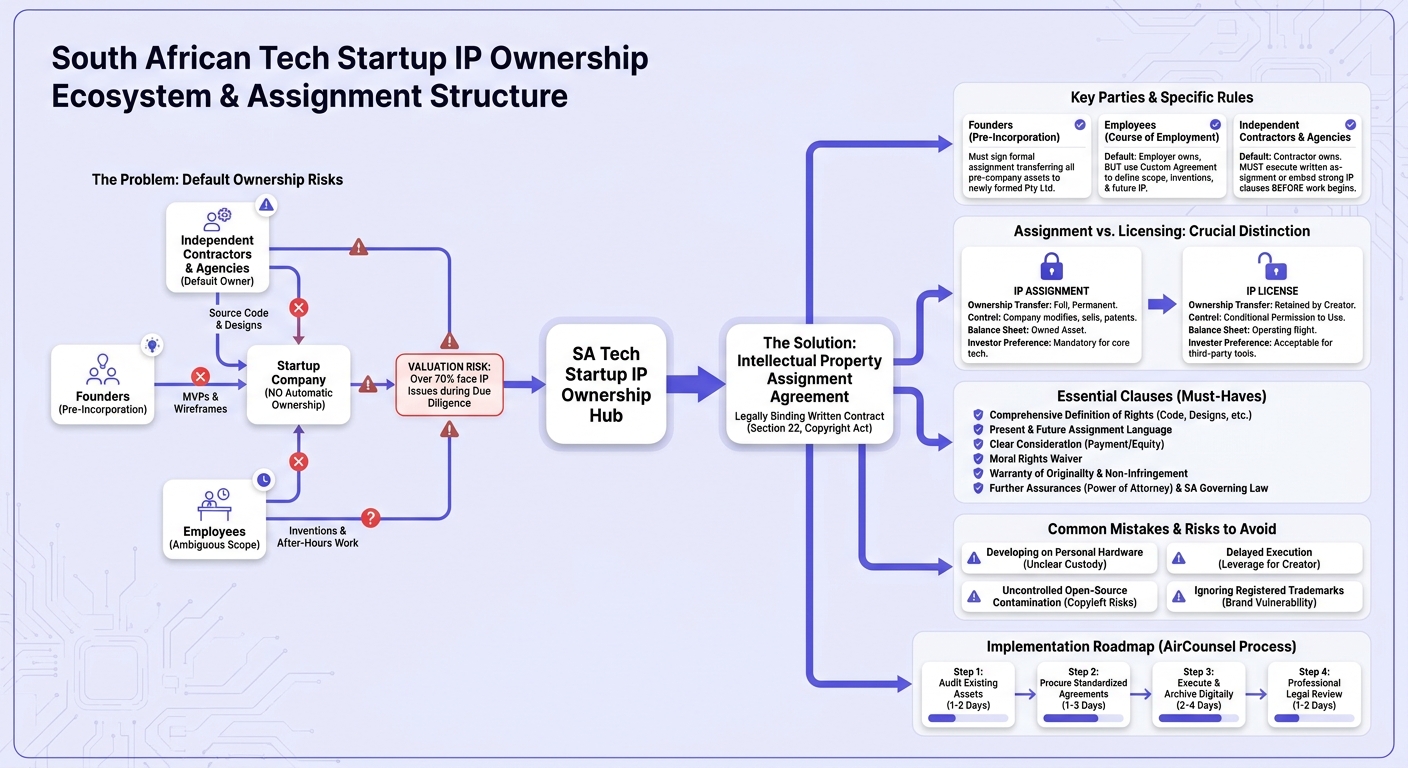
In South Africa's growing tech ecosystem, a startup's valuation relies heavily on its proprietary assets—including software code, user interface designs, algorithms, and brand collateral. According to venture capital audit insights, over 70% of early-stage tech startups face intellectual property ownership complications during due diligence due to informal creation arrangements and missing documentation.
Many founders assume that because their company paid for development work or because a co-founder built the initial product, the company automatically owns the rights. Under South African law, this assumption is incorrect. Without a written agreement, intellectual property (IP) created by contractors, agencies, and even pre-incorporation founders remains the personal property of the individual creator.
Executing a comprehensive intellectual property assignment agreement ensures that all proprietary rights are permanently transferred to your registered private company (Pty) Ltd. This guide explains how South African tech startups can structure these agreements to protect company value, satisfy future investors, and secure complete ownership of their digital assets.
Table of Contents
- Quick Summary
- What Is an Intellectual Property Assignment Agreement?
- South African Legal Formalities: Why Written Assignment Is Non-Negotiable
- IP Assignment vs. IP Licensing: Understanding the Difference
- Key Parties: Founders, Employees, and Contractors
- Essential Clauses in a South African IP Assignment Agreement
- Common Startup IP Mistakes and How to Avoid Them
- Costs, Timelines, and Implementation Process
- Secure Your Startup Assets with AirCounsel
- Frequently Asked Questions
- Recommended
Quick Summary
| Takeaway | Explanation |
|---|---|
| Statutory Written Requirement | Under Section 22 of the South African Copyright Act, a copyright assignment has no legal effect unless it is in writing and signed by the assignor. |
| Contractor Ownership Default | Paying an invoice does not transfer copyright; independent contractors own what they build unless an explicit written assignment agreement is executed. |
| Pre-Incorporation Assets | Code and designs created by founders prior to formal company registration remain individual property until formally assigned to the registered company. |
| Complete Transfer vs. Permitted Use | An assignment permanently transfers all title and ownership, whereas a license merely grants conditional permission to use the IP. |
| Investor Due Diligence | Venture capital funds require an unbroken chain of title covering all core code, trademarks, and design assets before closing funding rounds. |
What Is an Intellectual Property Assignment Agreement?
An intellectual property assignment agreement is a legally binding contract that permanently transfers ownership of intellectual property rights from the creator (the assignor) to a business entity (the assignee).
When applied to a tech startup, the agreement transfers all claims, title, and interest in digital and physical creations. This includes:
- Proprietary Source Code: Backend algorithms, frontend code, database schemas, and APIs.
- Brand Assets: Trademarks, business names, logos, domains, and marketing materials.
- Product Designs: User interfaces (UI), user experience flows (UX), wireframes, and design systems.
- Trade Secrets & Know-How: Internal processes, technical documentation, testing scripts, and customer lists.
By consolidating these rights within the startup entity, the business builds an unencumbered balance sheet of proprietary technology.

South African Legal Formalities: Why Written Assignment Is Non-Negotiable
South African intellectual property law is governed by statutes administered through the Companies and Intellectual Property Commission (CIPC) and established legislation, including the Copyright Act No. 98 of 1978 and the Trade Marks Act No. 194 of 1993.
Under South African copyright law, copyright arises automatically upon creation of an original work in material form; no registration is required for software or literary works, as outlined by South African Government IP Services. However, transferring ownership requires strict adherence to statutory formalities.
Under Section 22(1) of the Copyright Act:
- An assignment of copyright is of no force or effect unless it is in writing and signed by or on behalf of the assignor.
- Oral agreements, email promises, or implied understandings fail the statutory threshold.
- Invoices stating "all rights reserved" or payment proofs do not qualify as a valid statutory assignment.
If a contractor builds a core feature for your application and signs no agreement, they retain legal ownership of the copyright, even if your business paid the invoices in full.
IP Assignment vs. IP Licensing: Understanding the Difference
Tech founders often confuse assigning intellectual property with licensing it. Both mechanisms regulate IP use, but they provide fundamentally different rights and valuation outcomes:
| Feature | IP Assignment | IP License |
|---|---|---|
| Ownership Transfer | Full, permanent transfer of legal title to the company. | Retained by the creator; company receives permission to use. |
| Control | Company can modify, sell, relicense, or patent the IP without consent. | Company is subject to license conditions, restrictions, and expiry terms. |
| Balance Sheet Impact | Asset is owned outright by the company, boosting balance sheet value. | Intangible asset remains off the balance sheet; treated as an operating right. |
| Investor Preference | Mandatory for core technology, source code, and key trademarks. | Acceptable only for standard third-party tools, SaaS, or open-source libraries. |
| Revocability | Irrevocable once executed and consideration is satisfied. | Can be revoked or terminated if contractual terms or payment obligations breach. |
Startups must always secure an assignment rather than a license for core products, custom code, UI/UX designs, and primary brand assets.
Key Parties: Founders, Employees, and Contractors
IP ownership rules in South Africa vary significantly depending on the relationship between the startup and the individual creating the asset.
Founders and Pre-Incorporation Work
Founders typically develop wireframes, business models, and minimum viable products (MVPs) before formally registering a private company with CIPC. Because the legal entity did not exist at the time of creation, the company cannot automatically own those assets.
Each founder must sign a formal assignment agreement transferring all pre-incorporation IP to the newly formed company. Failing to do this can lead to serious complications if a founder departs later with the initial source code.
Employees and the Scope of Employment
Under Section 21 of the South African Copyright Act, when an employee creates a work in the course and scope of their employment contract, the employer generally owns the copyright by default.
However, relying on statutory default rules is risky for two reasons:
- Ambiguity of "Course of Employment": If a developer writes code after hours on a personal laptop, disputes can arise regarding whether the work fell within their standard employment scope.
- Inventions and Patents: Default rules for patentable inventions and non-copyrightable trade secrets differ from copyright.
To eliminate ambiguity, use a Custom Employment Agreement that explicitly assigns all present and future IP, inventions, and moral rights waivers to the company.
Independent Contractors and External Agencies
Unlike full-time employees, independent contractors, freelancers, and software agencies own the intellectual property they create by default.
Even if your startup supplies detailed specifications and pays a project fee, ownership remains with the contractor under South African law. Startups must execute a dedicated Template Copyright Assignment Agreement or embed strong IP assignment provisions directly inside a Custom Independent Contractor / Consulting Agreement before work begins.
Essential Clauses in a South African IP Assignment Agreement
A well-drafted intellectual property assignment agreement must contain clear, protective clauses tailored to the South African regulatory environment:
- Comprehensive Definition of Assigned Rights: Specify all deliverables, including code repositories, documentation, designs, graphics, databases, and associated trademarks.
- Present and Future Assignment: Use language assigning existing works alongside an immediate transfer of all rights in works created during the engagement ("hereby assigns all present and future copyright").
- Consideration: Explicitly state the legal consideration exchanged (e.g., cash remuneration, shares, or founder equity) to ensure contract validity.
- Moral Rights Waiver: Include a waiver of moral rights to allow the startup to modify, update, or reformat the work without requiring author attribution or consent.
- Warranty of Originality: Require the assignor to warrant that the work is original, does not infringe on third-party rights, and contains no unauthorized open-source dependencies.
- Further Assurances (Power of Attorney): Obligate the assignor to execute any subsequent documents required to register trademarks or defend patents, with an express power of attorney allowing the company to sign on their behalf if they become unreachable.
- Governing Law and Jurisdiction: Specify that the agreement is governed by the laws of the Republic of South Africa, subject to local court jurisdiction.
Common Startup IP Mistakes and How to Avoid Them
When scaling rapidly, early-stage startups often overlook basic IP governance. Avoid these common pitfalls:
- Developing on Personal Hardware: When developers use personal GitHub accounts or laptops without company tracking, clear documentation becomes critical to prove the chain of custody.
- Uncontrolled Open-Source Contamination: Incorporating copyleft open-source libraries (like GNU GPL) can legally require the release of proprietary source code. Ensure contracts include warranties against unauthorized open-source usage.
- Delayed Execution: Attempting to get a contractor or ex-founder to sign an assignment agreement years later—especially when an acquisition or funding round is imminent—gives them immense leverage to demand additional payout.
- Ignoring Registered Trademarks: Relying solely on copyright leaves brand names vulnerable. File your brand assets directly via File a Trade Mark in South Africa to secure statutory brand protection across relevant NICE classes.
Costs, Timelines, and Implementation Process
Securing intellectual property should be implemented systematically as part of your company setup:
- Step 1: Audit Existing Assets (1–2 Days): Identify all founders, contractors, and agencies who contributed to your product, code, or branding prior to or during company operations.
- Step 2: Procure Standardized Agreements (1–3 Days): Implement tailored contractor and employee assignment templates for your team. You can establish your core compliance through the Bronze Startup Legal Package.
- Step 3: Execute and Archive (2–4 Days): Ensure all parties execute written agreements with digital or physical signatures. Store executed copies in a secure, centralized data room.
- Step 4: Professional Legal Review (1–2 Days): If you have existing legacy agreements or complex developer arrangements, use a Contract / Legal Document Review to identify and correct any gaps in your chain of title.
Secure Your Startup Assets with AirCounsel
Unclear IP ownership introduces risk that can derail fundraising, company sales, or key commercial partnerships. AirCounsel provides fixed-fee, attorney-drafted legal solutions designed specifically for South African entrepreneurs and growing tech startups.
Whether you need to assign historic founder code, secure third-party contractor deliverables, or conduct a full audit before an investment round, our licensed South African commercial attorneys deliver practical, risk-aware contracts within 3 business days.
Get started by selecting an attorney-drafted Template Copyright Assignment Agreement for immediate use, or choose a Custom Independent Contractor / Consulting Agreement tailored to your product and team structure.
This article provides general information and is not legal advice.
Frequently Asked Questions
What intellectual property should be assigned to the startup in South Africa?
Startups should assign all custom source code, wireframes, UI/UX designs, algorithms, database architectures, domain names, logos, branding assets, technical documentation, and business workflows created by founders, employees, and third-party contractors.
Does a copyright assignment in South Africa have to be in writing and signed?
Yes. Under Section 22(1) of the South African Copyright Act No. 98 of 1978, an assignment of copyright has no legal force or effect unless it is in writing and signed by or on behalf of the assignor. Oral agreements and payment confirmations are insufficient.
What is the difference between an IP assignment and an IP licence?
An IP assignment is a full, permanent transfer of legal ownership, placing the asset entirely under the company's control. A license merely grants permission to use the IP under specified conditions while legal title remains with the creator.
Should founders, contractors, and employees use the same IP assignment terms?
No. Founders require broad assignments covering all pre-incorporation development; employees require provisions aligned with employment law and the scope of work; and contractors require strict, deliverable-specific assignment terms with warranties on originality and open-source compliance.
What happens if a contractor refuses to sign an IP assignment agreement after being paid?
If a contractor has not signed a written assignment, they remain the legal owner of the copyright under South African law. Resolving this after payment often requires negotiating a formal assignment fee or litigating implied contract terms, which is costly and time-consuming.
Recommended
Need Legal Assistance?
Our expert legal team is ready to help you navigate complex legal matters with confidence.