4 POPIA Compliance Failures That Could Result in Enforcement Committee Fines in 2026

The regulatory landscape in South Africa has shifted permanently from soft education to hard enforcement. As the Information Regulator intensifies its monitoring exercises, founders, small business owners, and corporate executives are finding out that ticking a few compliance boxes on a website is no longer enough to protect them from severe administrative penalties.
By 2026, data protection specialists confirm that most data protection failures originate with third-party operators, exposing businesses to massive legal liabilities before they even realize a breach has occurred. Under the Protection of Personal Information Act (popia), a single overlooked operational loop can trigger an investigation, leading to public reputational damage, multi-million Rand fines, or even personal criminal liability for directors.
To protect your business from the Information Regulator’s Enforcement Committee, you must recognize where the real regulatory traps lie. Below is the blueprint of the 4 critical operational failures currently landing South African businesses in legal trouble, and how you can resolve them before an audit.
Table of Contents
- Quick Summary
- Failure 1: Production Data in Non-Production Environments
- Failure 2: Unmanaged Retention and Data Graveyards
- Failure 3: The Cloud Shared Responsibility Trap
- Failure 4: Inconsistent Masking Strategies
- The Operational Cost of Non-Compliance
- Real-World Enforcement Case Studies
- Action Plan: How to Secure Your Business Today
- Protect Your Business Against POPIA Liabilities
- Frequently Asked Questions
- Recommended
Quick Summary
| Takeaway | Explanation |
|---|---|
| Section 19 Violations | Using live customer or employee data in development, testing, or sandbox environments violates POPIA security safeguards. |
| Section 14 Violations | Keeping personal information longer than necessary creates "data graveyards," which are highly vulnerable to breaches. |
| Shared Responsibility Fallacy | Assuming your cloud, ERP, or SaaS provider handles all your data privacy compliance is a major security and legal risk. |
| Inconsistent Masking | Concealing personal details on the user interface while leaving backend databases unmasked fails regulatory standards. |
| Real Enforcement Fines | The Information Regulator is actively issuing heavy fines and administrative compliance orders to small and large entities alike. |
Failure 1: Production Data in Non-Production Environments
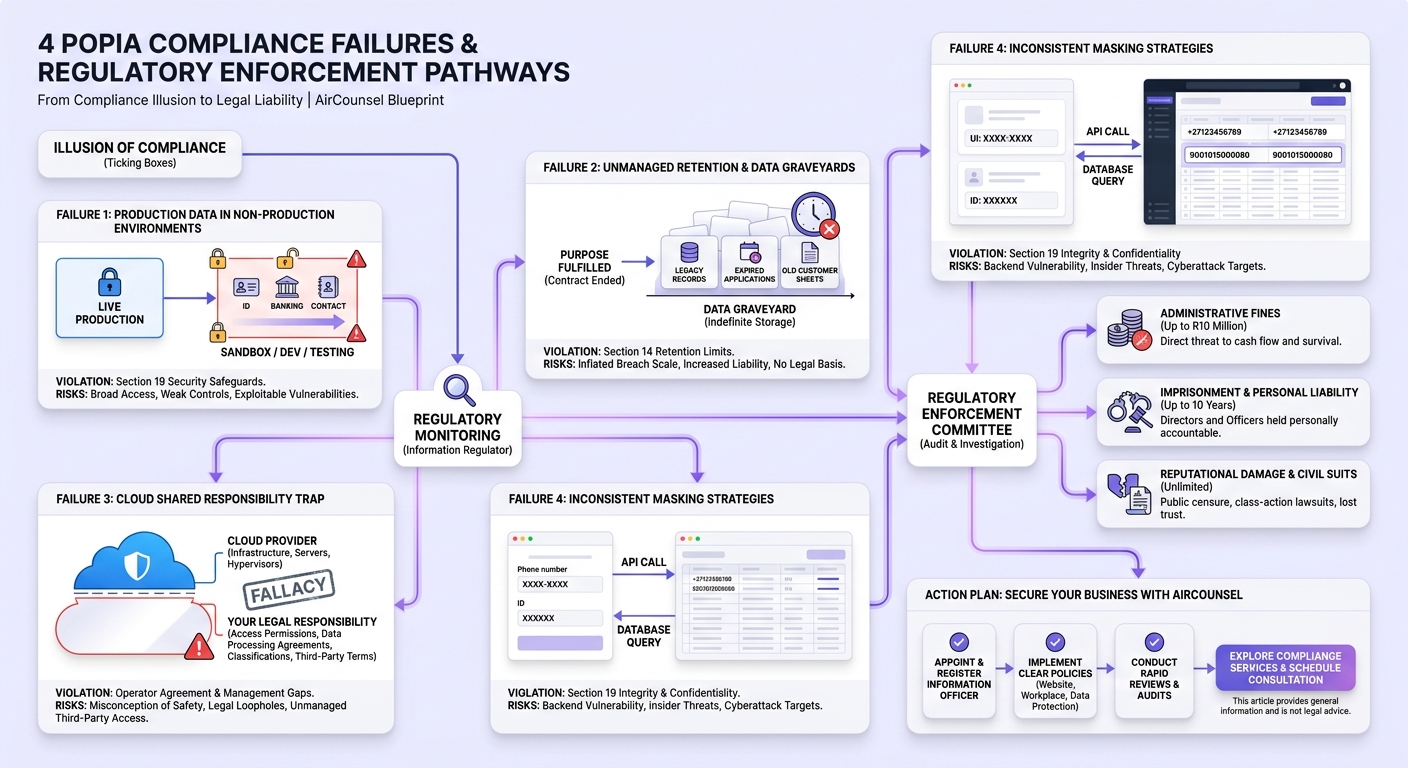
Many businesses copy live databases into sandbox, testing, or development environments so their developers can work with realistic data. However, exposing real personal information—such as ID numbers, banking details, or contact info—in these less secure non-production environments directly violates Section 19 of POPIA.
Section 19 requires responsible parties to secure the integrity and confidentiality of personal information by taking appropriate technical and organizational measures. Non-production systems typically lack the strict access controls, activity logging, and firewalls of live production systems. If developers, external contractors, or third-party testers have broad access rights to these sandboxes, you have an active security vulnerability waiting to be exploited.
Failure 2: Unmanaged Retention and Data Graveyards
Holding onto historical data indefinitely is one of the most common organizational habits in South Africa. Under Section 14 of POPIA, personal information must not be retained any longer than is necessary for achieving the purpose for which the information was originally collected or processed.

Leaving legacy records, expired job applications, and old customer sheets on local servers or cloud drives creates "data graveyards." If a breach occurs, this surplus data inflates the scale of the notification process and increases your liability. Once the legal, operational, or contractual justification for keeping data expires, you must destroy, delete, or de-identify that data completely.
Failure 3: The Cloud Shared Responsibility Trap
A major misconception among modern business owners is that hosting their applications with global software giants like Microsoft, Amazon Web Services, or RISE with SAP automatically makes them fully compliant.
This is a legal fallacy. Cloud providers operate under a "shared responsibility model." While they secure the physical infrastructure, servers, and hypervisors, you remain the "responsible party" under South African law. This means you are legally responsible for:
- Managing who has access permissions.
- Ensuring your data processing agreements are legally sound.
- Implementing clear data classifications and retention periods.
- Signing comprehensive legal terms with third-party operators.
To ensure your third-party processing meets these high standards without legal loopholes, you must put a structured Template Data Processing / Operator Agreement in place with every external service provider.
Failure 4: Inconsistent Masking Strategies
Some companies believe they are safe because they use front-end user interface (UI) masking. For example, a customer service dashboard might show call center agents a masked mobile number or obscured ID number.
However, if the underlying database backend, API call, or export spreadsheet remains unmasked and unencrypted, your compliance framework is incomplete. During post-breach investigations, the Information Regulator reviews whether security measures were applied consistently. If an analyst or IT admin can read plain-text personal data directly from database queries, your business is highly vulnerable to inside threats and targeted cyberattacks.
The Operational Cost of Non-Compliance
Managing compliance is not just about avoiding bad press; it is about protecting your company's balance sheet from direct loss. The POPIA penalty structure is designed to enforce compliance through severe financial and operational pressure.
| Enforcement Tool | Maximum Legal Exposure | General Impact on SMBs |
|---|---|---|
| Administrative Fines | Up to R10 million | Direct threat to business cash flow and operational survival. |
| Imprisonment | Up to 10 years for severe offenses | Personal criminal liability for directors and key officers. |
| Civil Damages | Unlimited class-action lawsuits | Affected data subjects can sue you directly for damages. |
| Enforcement Notices | Mandatory stop-processing orders | Can completely shut down your digital channels and sales. |
Real-World Enforcement Case Studies
The Information Regulator has moved beyond issuing warnings. Recent enforcement actions highlight the personal and financial risks of neglecting POPIA.
- The Lancet Laboratories Case: Lancet Laboratories was issued an enforcement directive and faced a R100,000 fine for failing to establish sufficient organizational controls to secure patient data, exposing how severely private health and personal details can compromise a consumer brand.
- The Blowback Municipality Case: A government entity received a direct R500,000 administrative fine following systemic failures to secure personal databases and ignore previous official warnings.
- The Department of Justice and Constitutional Development: Hit with a massive R5 million administrative fine after failing to renew their antivirus and security software licenses, highlighting that basic IT maintenance is a statutory requirement under Section 19.
These cases prove that neither public departments nor private enterprises are exempt. If you ignore official notices or fail to demonstrate proactive compliance, the Enforcement Committee will issue severe fines.
Action Plan: How to Secure Your Business Today
To protect your business from POPIA audits, administrative fines, and security breaches, follow these operational steps:
- Appoint and Register Your Information Officer: It is legally mandatory to formally register your representative with the Information Regulator. Use our quick Registration of Information Officer service to handle this filing.
- Implement Clear External Policies: Your website, mobile applications, and software must clearly describe how you collect and process user data. Implement a robust, localized Template Website Privacy Policy immediately.
- Govern Your Workplace: Your employees are your first line of defense. Bind your staff to strict data handling, device protection, and reporting protocols through a customized Custom POPI Act Workplace Policy.
- Secure Your Vendor Relationships: Every third party acting as an operator for your business must be contractually bound to the same security standards. Use a tailored Template Data Protection Policy to govern external operations.
Protect Your Business Against POPIA Liabilities
Building a compliant business does not have to be slow, confusing, or incredibly expensive. At AirCounsel, we help South African founders and small businesses secure their entities with transparent, fixed-price legal solutions.
Whether you need a quick audit, custom-drafted policies, or a rapid review of your third-party vendor agreements, our licensed South African attorneys are ready to help. Protect your brand, safeguard your customer relationships, and secure your company's compliance before the Information Regulator knocks on your door.
Explore our POPIA Compliance Services today or schedule an Online Consultation with an Attorney to identify and close your legal exposure gaps in minutes.
This article provides general information and is not legal advice.
Frequently Asked Questions
What are the top 4 reasons South African companies fail a POPIA audit in 2026?
The key failures are placing live production data in uncompromised non-production sandboxes, storing obsolete user data indefinitely (data graveyards), assuming cloud providers handle all security, and failing to mask sensitive personal information at the database backend.
How much is the maximum fine for failing to comply with a POPIA enforcement notice?
Under the Protection of Personal Information Act, businesses that obstruct the regulator or fail to comply with an official enforcement notice can face administrative fines of up to R10 million or imprisonment for up to 10 years.
Does using production data in non-production SAP environments violate POPIA?
Yes. Copying real, unmasked customer or employee data into development or sandbox systems violates the Section 19 Security Safeguards mandate, as these environments rarely feature the same level of access monitoring and protection as live systems.
What happens if a company does not notify the Information Regulator about a data breach?
Setting up a data breach cover-up is a serious offense. Under POPIA, you must notify both the Information Regulator and the affected data subjects as soon as reasonably possible after discovering a compromise. Failing to do so can result in immediate investigation, public censure, and maximum statutory fines.
Recommended
Need Legal Assistance?
Our expert legal team is ready to help you navigate complex legal matters with confidence.