The South Africa Tech Founder's Essential Checklist for Assigning IP from Independent Contractors

When building a startup, founders often rely on external developers, designers, and consultants to get their product to market quickly. However, many business owners mistakenly assume that because they paid for the work, they automatically own the underlying intellectual property (IP). Under South African law, this assumption is a dangerous legal trap.
In South Africa, the default legal position is that an independent contractor retains ownership of any copyright and IP they create, unless a written contract explicitly transfers those rights to the hiring business. In fact, research indicates that 85% of small businesses in South Africa fail to include explicit IP assignment clauses in contractor contracts, leaving them highly vulnerable to devastating ownership disputes down the road.
To secure your company's proprietary assets and protect your valuation, you must use a robust, written independent contractor agreement south africa that explicitly handles IP assignment and prevents employment misclassification.
Table of Contents
- Why Paying a Contractor Does Not Mean You Own the IP
- Employees vs. Contractors: How IP Vesting Differs
- Essential Clauses for Securing Contractor IP
- Navigating the Risk of Employment Misclassification
- Compliance, Payment, and POPIA Obligations
- Protecting Your Startup with Clean Contracts
- Frequently Asked Questions
- Recommended
Quick Summary
| Takeaway | Explanation |
|---|---|
| No Automatic IP Transfer | Paying an invoice does not transfer copyright; IP must be assigned in writing. |
| Written Assignment Required | Your independent contractor agreement must feature explicit future IP assignment. |
| Moral Rights Waiver | Contractors must waive their moral rights to prevent them from blocking modifications to the code or design. |
| Misclassification Risk | Avoid treating contractors like employees to prevent South African labor law penalties. |
| POPIA Compliance | Contracts must govern how external operators handle customer personal data. |
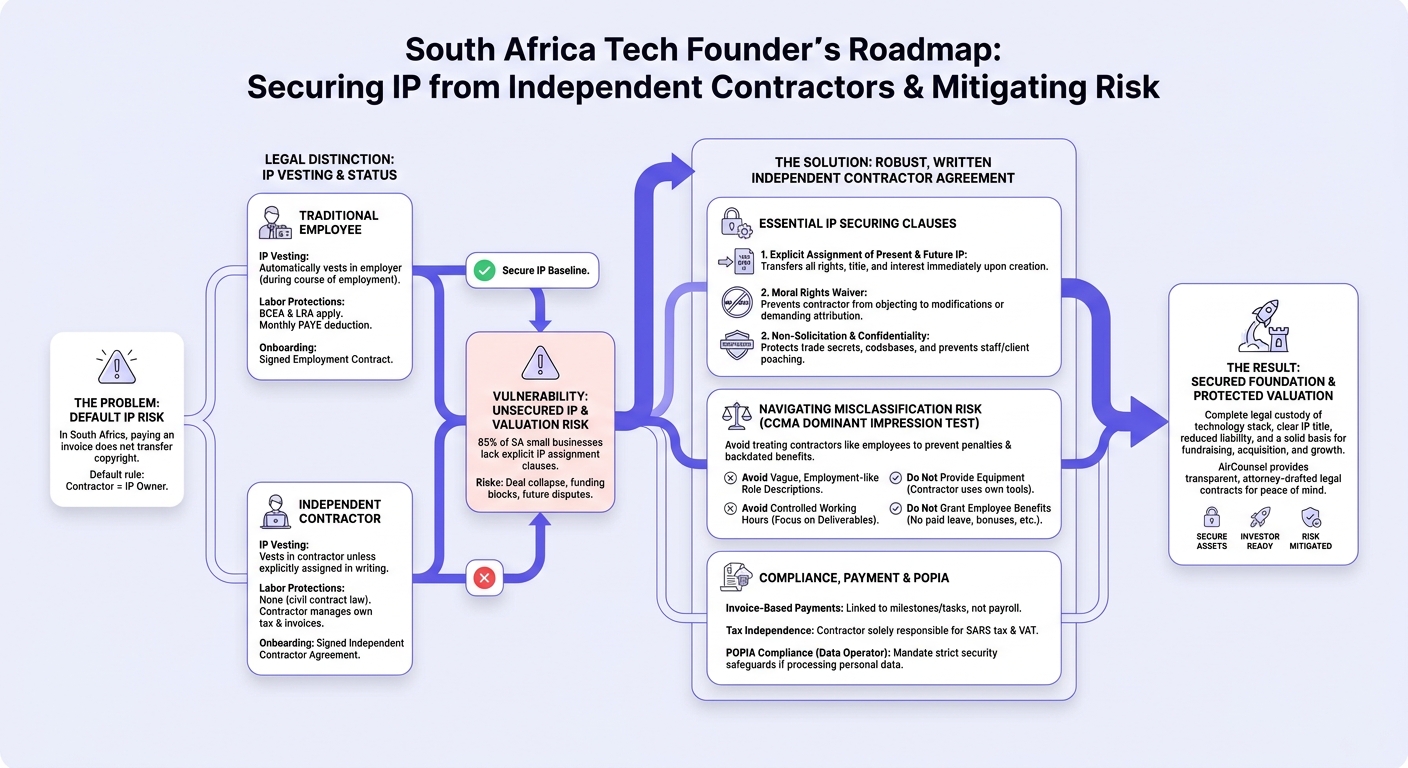
Why Paying a Contractor Does Not Mean You Own the IP
In South African copyright law, the general rule is that the "author" of a work is its first owner. While there are narrow statutory exceptions for certain types of commissioned works (such as taking a photograph, painting a portrait, or creating a gravestone), software code, system architecture, and brand design do not automatically transfer to the payer.
According to authoritative legal analysis in De Rebus, automatic IP vesting applies strictly to traditional employer-employee relationships. If an external developer designs your platform or writes your proprietary code without a written IP transfer on paper, they remain the legal owner of that IP.
If you try to sell your startup, raise venture capital, or secure institutional funding later on, sophisticated investors will conduct legal due diligence. Discovering that key parts of your technology stack are legally owned by a third-party contractor is one of the most common reasons startup deals fall apart in South Africa.
Employees vs. Contractors: How IP Vesting Differs
Under South African law, the legal distinction between an employee and an independent contractor determines not only your tax and labor obligations but also how ownership of intellectual property behaves from the moment of creation.
| IP and Labor Dynamic | Traditional Employee | Independent Contractor |
|---|---|---|
| Default IP Ownership | Automatically vests in the employer if created in the course and scope of employment. | Vests in the contractor unless assigned in writing. |
| Labor Law Protections | Protected by the Basic Conditions of Employment Act and the Labour Relations Act. | Governed purely by civil contract law; no statutory labor protections. |
| Tax Treatment | Employer must deduct Pay-As-You-Earn (PAYE) from salary monthly. | Contractor submits tax invoices and manages their own income tax. |
| Onboarding Method | Signed employment contract. | Signed independent contractor agreement. |
If you need a highly compliant baseline document for permanent hires, you can review our Template Employment Agreement. However, for external freelancers, developers, or agencies, a customized contractor contract is non-negotiable.
Essential Clauses for Securing Contractor IP
To ensure your startup retains complete custody of its proprietary technology, a standard handshake or a simple scope-of-work document is not enough. Your contract must feature several highly specific clauses.
1. Explicit Assignment of Present and Future Intellectual Property
The agreement must state that the contractor assigns and transfers all rights, title, and interest in and to all intellectual property created during the engagement to your company. This assignment must cover both existing work-in-progress and any future IP from the second it is generated.
2. Moral Rights Waiver
Under South African copyright law, creators hold "moral rights," which include the right to be identified as the author and the right to object to any modifications that might harm their reputation. Even if they transfer the copyright, they could theoretically block you from modifying their code or graphics. Your agreement must contain an explicit, written waiver of these moral rights.
3. Non-Solicitation and Confidentiality
Your agreement must legally prevent the contractor from sharing your trade secrets, codebases, or customer databases with competitors. It must also restrict them from poaching your internal staff or other contractors for a set period.

Navigating the Risk of Employment Misclassification
While securing IP is critical, builders must also ensure their agreement does not inadvertently create an employment relationship. South African courts and the Commission for Conciliation, Mediation and Arbitration (CCMA) use the "dominant impression test" to evaluate relationships. They look past the title on your contract to see how the work actually functions in practice.
If the CCMA finds that you have misclassified an employee as a contractor, your business faces harsh financial penalties, backdated employee benefits, and strict labor dispute liabilities.
To keep a clear, legal distinction, ensure your contractor relationship avoids these common pitfalls:
- Avoid Vague Job Descriptions: Do not describe the contractor's role in terms of general company "employment" or integrate them into daily internal hierarchies.
- Avoid Controlled Working Hours: Let the contractor choose when and where they work, focusing entirely on milestones and deliverables rather than desk time.
- Do Not Provide Equipment: Contractors should use their own laptops, software licenses, and workspaces.
- Do Not Grant Employee Benefits: Never provide paid sick leave, annual leave, or performance bonuses structured like company salary packages.
To protect your business from both IP loss and labor disputes, you can secure our attorney-drafted Template Independent Contractor Agreement to establish clear legal boundaries.
Compliance, Payment, and POPIA Obligations
A robust contract must also align with local financial framework requirements and data privacy legislation.
- Invoice-Based Payments: Payment structures should always be linked to specific project milestones, hourly tasks, or retainer intervals. The contractor must submit a valid tax invoice. Your business should never run their payments through a standard employee payroll run.
- Tax Independence: The contract must explicitly state that the contractor is solely responsible for registering and paying their own income tax and Value-Added Tax (VAT), if applicable, to the South African Revenue Service (SARS).
- Protection of Personal Information Act (POPIA) Aligned: If your contractor processes any personal information of your customers, employees, or partners, they qualify as an "operator" under POPIA. You must include data processing clauses that legally bind them to strict security safeguards. You can evaluate our tailored Template Data Processing / Operator Agreement to manage these specific requirements.
Protecting Your Startup with Clean Contracts
Vague agreements and downloaded templates place your startup's most valuable assets at risk. Ensuring your IP is legally locked down and your contractor relationships are structurally sound from day one protects your valuation and provides absolute peace of mind.
At AirCounsel, we help entrepreneurs secure their businesses with transparent, fixed-price legal contracts drafted by qualified South African attorneys. Whether you want to quickly build a legal foundation or need tailored advice for a complex team setup, our transparent services make professional legal support accessible and efficient.
To get started, you can explore our Custom Independent Contractor / Consulting Agreement for a fully bespoke contract, or book an Online Consultation with an Attorney to address your specific questions.
This article provides general information and is not legal advice.
Frequently Asked Questions
Does a tech founder automatically own IP created by an independent contractor in South Africa?
No. In South Africa, the default legal rule is that copyright and intellectual property remain with the creator (the contractor) unless there is a written agreement that explicitly assigns those rights to the hiring business.
What clauses must be included in an independent contractor agreement south africa to ensure IP assignment?
The agreement must include an explicit clause assigning all present and future intellectual property rights, a robust confidentiality clause, a waiver of moral rights, and provisions for non-solicitation of your team and clients.
How can I distinguish between an employee and an independent contractor under South African law?
South African legal bodies look at the actual working relationship using the dominant impression test. Contractors typically use their own equipment, control their own hours, issue invoices for payment, work for multiple clients, and are not integrated into your daily company command structure.
Can a contractor waive moral rights in their IP assignment to a business in South Africa?
Yes. Although moral rights are distinct from copyright, a contractor can legally agree to wave their moral rights in writing within the contract, which prevents them from objecting to future modifications of their work.
Recommended
- Bronze Startup Legal Package — An essential suite of compliant documents drafted by licensed SA attorneys to launch your new venture.
- Template Consulting Agreement — A robust, cost-effective consulting template tailored for South African business engagements.
- Template Non-Disclosure Agreement — Protect your conversations and proprietary concepts before sharing sensitive data with developers.
Need Legal Assistance?
Our expert legal team is ready to help you navigate complex legal matters with confidence.