The South Africa Founder's Legal Checklist for Raising Venture Capital in 2026

Raising capital is a pivotal milestone for any growing startup, but navigating the regulatory landscape in South Africa requires careful legal preparation. In recent years, local funding structures have evolved rapidly to balance local economic incentives with international investor demands. Securing institutional backing requires founders to align their corporate structuring, exchange control compliance, and tax positioning long before the formal term sheet arrives.
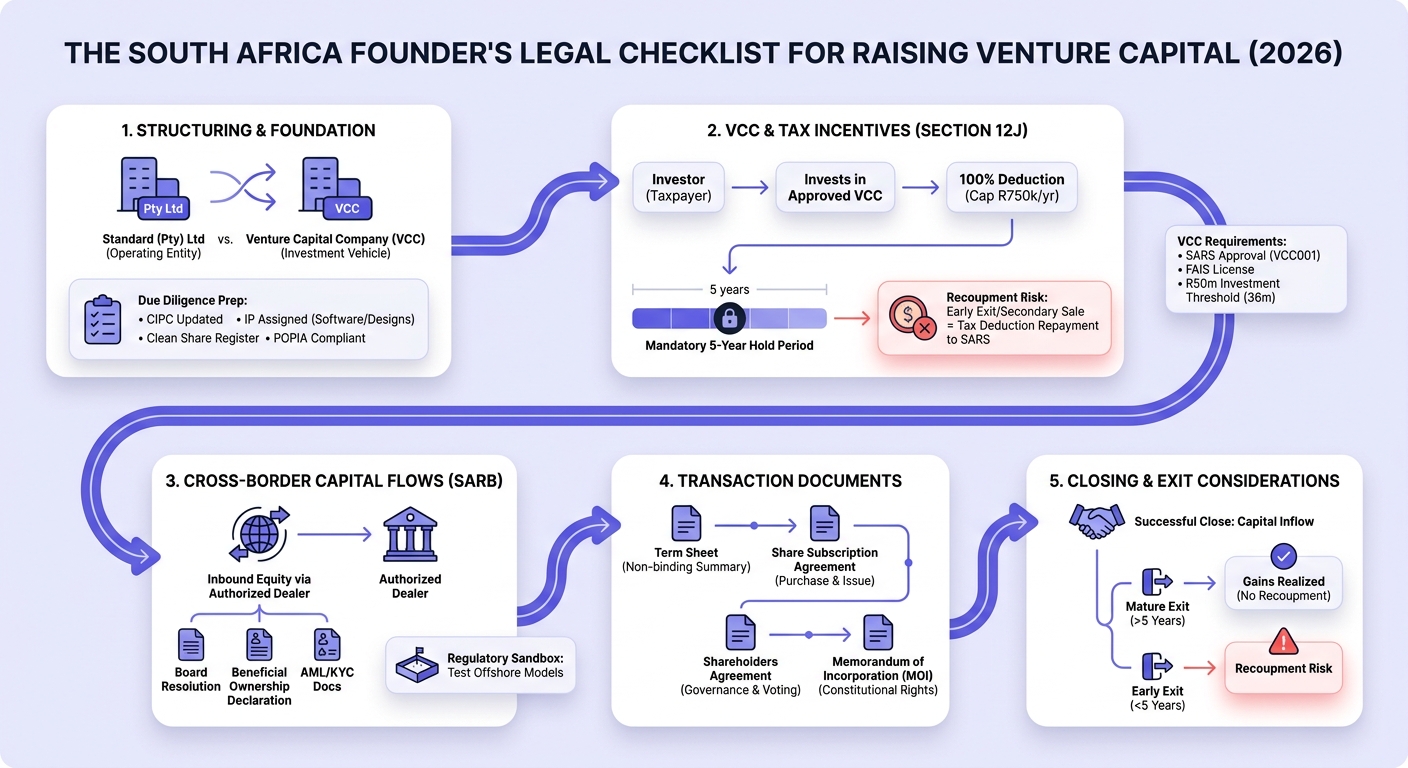
According to data on South African investment structures, investors in approved VCCs can deduct 100% of their investment amount, capped at R750,000 per year of assessment, making tax-incentivized structures highly attractive to local angel networks and early-stage funds. To successfully raise venture capital south africa founders must master these tax mechanisms, maintain compliance with exchange control regulations, and present a legally spotless corporate structure during due diligence.
This comprehensive guide outlines the essential legal steps, regulatory hurdles, and compliance frameworks required to successfully close a venture capital round in South Africa.
Table of Contents
- 1. Structuring the Entity: Pty Ltd vs. VCC
- 2. Preparing for Investor Due Diligence
- 3. Navigating SARS VCC Status and Tax Incentives
- 4. Cross-Border Capital Flows and SARB Regulations
- 5. Key Venture Capital Transaction Documents
- 6. Exit Risks: Recoupment and the Secondary Market
- How AirCounsel Helps Founders Raise Capital
- Frequently Asked Questions
- Recommended Links
Quick Summary
| Key Legal Takeaway | Practical Explanation |
|---|---|
| Pty Ltd is Standard | Most startups operate as a standard Private Company (Pty) Ltd; the VCC is a specialized fund entity. |
| SARS VCC Deductions | Approved Venture Capital Companies allow investors to deduct up to R750,000 annually. |
| SARB Approval | Moving intellectual property or shares offshore requires South African Reserve Bank approval. |
| IP Protection | All software and proprietary intellectual property must be formally assigned to your company. |
| Secondary Market Risk | Selling shares prior to the statutory holding period triggers a recoupment of tax deductions. |
1. Structuring the Entity: Pty Ltd vs. VCC
For most founders, the operating business will be registered as a standard Private Company, designated as a "(Pty) Ltd" in South Africa. This structure offers limited liability protection and accommodates various equity classes.
       [ Venture Capital Fund / VCC ]
                    │
            Invests Capital (Equity)
                    ▼
       [ Standard South African (Pty) Ltd ] (Operating Startup)
However, to attract specific local investors, you may encounter the Venture Capital Company (VCC) regime. Under Section 12J of the Income Tax Act (which remains highly relevant for legacy structures and specific active fund pools), the VCC acts as a marketing and investment vehicle rather than the operating company itself.
- Pty Ltd: The operating company where your team, intellectual property, and customer contracts reside.
- VCC: An investment holding company approved by the South African Revenue Service (SARS) that pools investor funds to seed qualifying operating companies.
Establishing a compliant Pty Ltd requires registration with the Companies and Intellectual Property Commission (CIPC). When preparing to raise venture capital, ensuring your constitutional documents, such as your Memorandum of Incorporation (MOI), facilitate investment is primary. Standard, default CIPC MOIs rarely suffice for institutional VC investments because they lack specialized provisions for drag-along rights, tag-along rights, and structured board representation.
2. Preparing for Investor Due Diligence
Before institutional investors write a check, they will initiate an in-depth legal due diligence process. Any administrative gaps can delay or jeopardize your investment round. Use this checklist to ensure your business is transaction-ready:
- CIPC Registration: Your corporate profile must be entirely up to date, reflecting current active directors. For updates, you can process a formal Company Director Appointment and/or Removal to ensure accurate public records.
- Intellectual Property (IP) Assignment: Investors want absolute certainty that the company owns all proprietary software, designs, and trademarks. Anyone who has written code or designed assets for your business must sign a written agreement assigning those rights to the company.
- Share Certificates and Register: You must maintain a clean, legally binding share register. Ensuring every shareholder has physical or digital Share Certificates and Share Register documentation is a fundamental prerequisite for institutional close.
- POPIA Compliance: Startups handling personal customer data must satisfy the Protection of Personal Information Act (POPIA). Presenting a robust Custom POPI Policy demonstrates to institutional legal teams that your data processing risks are mitigated.
3. Navigating SARS VCC Status and Tax Incentives
If you are setting up or pitching to a registered Venture Capital Company to secure tax-incentivized capital under the legislative framework, strict operational rules apply according to the SARS official guidelines.

To register and maintain an approved VCC status, the fund manager must apply to SARS using the VCC001 application form. Requirements to maintain this status include:
- Licensing: The entity must be licensed as a Financial Services Provider (FSP) under the Financial Advisory and Intermediary Services (FAIS) Act.
- Investment Thresholds: Within 36 months of incorporation, the VCC must have invested at least R50 million in qualifying operating companies (or R250 million if investing in junior mining enterprises).
- Sole Object: The sole object of the VCC must be managing investments in qualifying companies.
For the operating startup receiving the cash, you must remain a "qualifying company". This means you cannot heavily engage in disqualified trades such as commercial banking, financial services, real estate, or operating hotels.
4. Cross-Border Capital Flows and SARB Regulations
For many technology startups, scaling beyond the continent means attracting foreign venture capital. Under South Africa's historical and evolving capital flow regulations, receiving offshore equity investments requires careful compliance with the South African Reserve Bank (SARB).
When inbound equity transactions occur, the funds must enter through an authorized dealer (typically a commercial bank). The transaction package submitted to financial regulators must include:
- A formal directors' board resolution approving the share issue.
- A current beneficial ownership declaration.
- Correctly completed anti-money laundering (AML) and Know Your Customer (KYC) documentation.
- Standard CIPC registration certificates confirming corporate status.
The Regulatory Sandbox Opportunity
To keep South African startups globally competitive, the National Treasury and SARB established a regulatory sandbox. This framework allows participating tech startups and financial innovators to test cross-border models—such as raising foreign equity directly into offshore holding structures—while maintaining operational assets and intellectual property in South Africa under relaxed exchange control rules.
5. Key Venture Capital Transaction Documents
Once you agree on valuation and basic terms, the transaction moves into the contracting phase. These documents govern the relationship between your existing team and the new investors:
| Agreement Type | Primary Legal Purpose | Key Focus Areas |
|---|---|---|
| Term Sheet | Non-binding summary of deal parameters | Valuation, investment amount, board seats |
| Share Subscription Agreement | Regulates the purchase and issue of new shares | Purchase price, representation & warranties, conditions precedent |
| Shareholders Agreement | Dictates governance and voting rights | Board composition, reserved matters, pre-emptive rights |
| Memorandum of Incorporation (MOI) | The public constitutional document filed at CIPC | Class rights, transfer restrictions, capital structure |
When executing the transaction, protect your startup's core rights by using a tailored Custom Share Subscription Agreement. Additionally, you should replace any generic founder agreements with a legally robust Custom Shareholders Agreement to manage rights like board appointments, dividends, and dispute resolutions effectively.
6. Exit Risks: Recoupment and the Secondary Market
A primary risk associated with tax-incentivized venture investment models in South Africa is the strict operational duration rules. For VCC structures, investors receive their upfront 100% tax deduction on the condition that they hold those shares for a minimum statutory period—typically 5 years.
Recoupment of Deductions
If an investor disposes of their VCC shares in a secondary market transaction or through an early corporate exit before the 5-year threshold, the entire previously claimed tax deduction is recoupable. This means the investor must pay back the tax relief to SARS, significantly destroying investment yields.
When structuring exit clauses, buy-back agreements, or founder secondary sales within a deal sheet, your legal team must carefully factor in these timing rules to prevent triggering accidental and costly tax penalties for your early-stage capital partners.
How AirCounsel Helps Founders Raise Capital
Raising venture capital requires swift execution, absolute transparency, and ironclad legal protection. At AirCounsel, we replace slow, high-cost traditional law firms with fast, transparent, fixed-price legal services tailored for South African entrepreneurs.
We can help you prepare your company for due diligence, register trademarks, draft custom agreements, and structure your corporate governance packages. Whether you're starting from scratch or negotiating a term sheet, our experienced legal team ensures your transaction progresses smoothly.
Explore our tailored startup solutions to secure your corporate structure:
- Scale securely with our comprehensive Bronze Startup Legal Package to establish investor-ready foundations.
- Upgrade to the Gold Startup Legal Package for robust, bespoke transactional protection.
- Directly resolve specific questions through an Online Consultation with an Attorney.
Frequently Asked Questions
This article provides general information and is not legal advice.
What is the tax benefit for investors in a SARS-approved Venture Capital Company in South Africa?
Under tax incentives like Section 12J, investors are entitled to a 100% tax deduction on their investment amount, capped at R750,000 per tax year. This deduction directly lowers the investor's taxable income, mitigating some of the risk of early-stage venture investing.
Can a foreign investor raise venture capital for a South African startup without moving the company offshore?
Yes. Foreign venture capital can be directly invested into a standard South African Pty Ltd. However, inbound equity flows must be registered with an authorized dealer (bank) under SARB capital flow regulations, and any outbound IP transfers or royalty schemes require strict regulatory approval.
What documents do I need to apply for SARS VCC approval as a founder?
To register a new VCC fund entity, you must submit a completed VCC001 application form to SARS. This must be accompanied by your CIPC registration certificate, a valid SARS tax compliance status PIN, your company’s custom Memorandum of Incorporation (MOI), and evidence of FAIS FSP licensing.
What happens to my investor's tax deduction if they sell their shares in the secondary market?
If an investor sells their tax-incentivized venture capital shares in a secondary market trade within 5 years of the initial investment, a tax recoupment is triggered. This forces the investor to pay back the full deduction to SARS.
Recommended
Need Legal Assistance?
Our expert legal team is ready to help you navigate complex legal matters with confidence.