SaaS Compliance & Data Protection in South Africa: Why Your Online Terms Need a Health Check

For SaaS founders, solo entrepreneurs, and growing small businesses, digital compliance is no longer just a technical issue. It has evolved into a vital legal shield that dictates how easily you can scale, sign enterprise clients, and secure funding. In a digital landscape governed by the Information Regulator, establishing a robust framework is the difference between seamless operations and catastrophic operational pauses.
Understanding the direct requirements of data protection south africa is essential if your website collects emails, processes payments, or hosts client databases on cloud servers. The financial stakes of operating without compliant terms are substantial: under the South African regulatory framework, administrative fines can reach up to ZAR 10 million for certain non-compliance events, alongside potential criminal liability.
To safeguard your venture, your website terms, privacy policies, and service agreements must act as an aligned, bulletproof legal framework. Copying generic overseas templates or ignoring regional rules opens your business up to hidden operational risks.
Table of Contents
- Understanding POPIA and Data Protection South Africa
- Aligning Privacy Policies, SaaS Terms, and Agreements
- High-Risk Clauses That Create Hidden Legal Liability
- Operational Gaps Founders Often Overlook
- A Practical POPIA Compliance Audit Checklist
- Template Customization vs. Bespoke Legal Redrafts
- Protect Your SaaS Platform with AirCounsel
- Frequently Asked Questions
- Recommended
Quick Summary
| Takeaway | Explanation |
|---|---|
| Statutory Fines | Non-compliance can lead to administrative fines under the Protection of Personal Information Act (POPIA) of up to ZAR 10 million. |
| Role Distinction | SaaS entities must explicitly define if they act as a "Responsible Party" or an "Operator" under South African law. |
| Contract Alignment | Privacy policies, TOS, and service agreements must match to avoid conflicting liability. |
| Cross-Border Transfers | Using foreign hosting requires clear justification, security checks, and specific user notices. |
| Operational Readiness | Appointing an Information Officer and drafting a POPIA workplace policy are mandatory steps. |
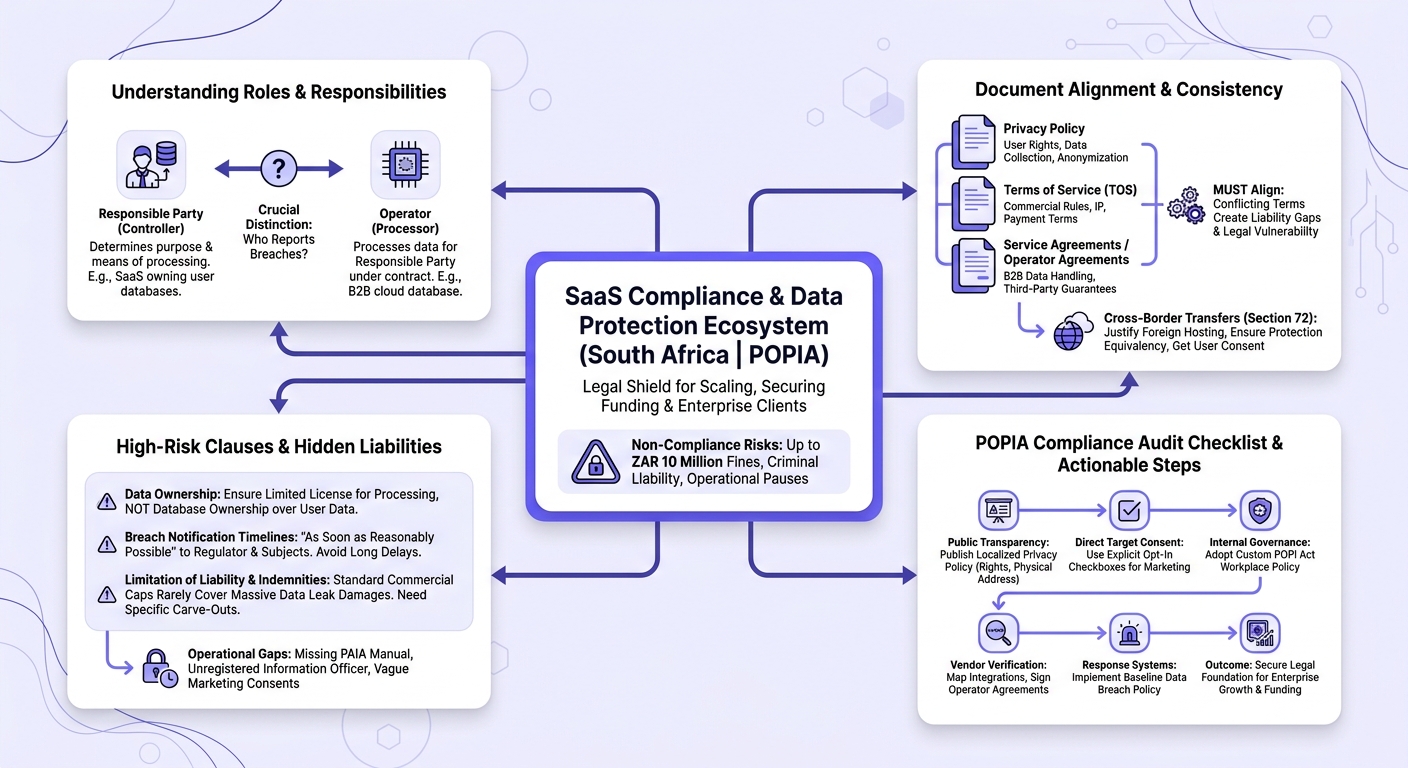
Understanding POPIA and Data Protection South Africa
The primary data privacy law in the country is the Protection of Personal Information Act 4 of 2013 (referred to as POPIA). POPIA governs how any individual or company collects, uses, stores, shares, and deletes personal information. If you run a SaaS platform or an e-commerce website that interacts with South African residents, this framework governs your operations.
The Roles: Responsible Party vs. Operator
Understanding your role is the baseline of modern data protection:
- Responsible Party: This is the entity that determines the purpose of and means for processing personal information (equivalent to a "Data Controller" under European GDPR). For example, your SaaS company is the Responsible Party for its own marketing databases and user accounts.
- Operator: This is an entity that processes personal information for a Responsible Party in terms of a contract or mandate, without coming under the direct authority of that party (equivalent to a "Data Processor" under GDPR). If your business operates a B2B cloud database tracking your clients' customers, you are acting as an Operator.
Failing to clearly distinguish these roles in your digital agreements can cause massive confusion surrounding who actually carries the burden of reporting data breaches to the Information Regulator of South Africa.
Aligning Privacy Policies, SaaS Terms, and Agreements
A common pitfall for founders is having mismatched documents. You might buy a template Terms of Service (TOS) from one site and a cookie privacy policy from another. When these documents conflict, it creates significant legal vulnerability.
Your consumer-facing website documents and your internal operations should tell the exact same story. If your privacy policy states that user metadata is fully anonymized and deleted after 30 days, but your commercial SaaS terms allow you to leverage user aggregates for AI training models indefinitely, you have created an immediate compliance and liability gap.
Furthermore, any B2B transactions require explicit alignment regarding how third-party data is guarded. This is why having a clear Custom Data Processing / Operator Agreement is critical when you rely on third-party cloud tools to support your core products.
High-Risk Clauses That Create Hidden Legal Liability
When drafting software agreements, standard commercial terms often overlook the strict realities of data privacy requirements. Below are the specific clauses most likely to trigger legal battles:

- Data Ownership: While intellectual property rights belong to your software company, the actual personal data remains owned by the user (data subject). Ensure your terms grant you a limited, legal license to process the data for functional software delivery, rather than claiming database ownership.
- Breach Notification Timelines: South African law demands notifying the Regulator and affected data subjects "as soon as reasonably possible" after discovering a compromise. Ensure your terms with vendors do not trap you in long notification delays.
- Limitation of Liability & Indemnity: Standard commercial caps might protect your software from server downtime issues, but they rarely protect you from massive data leak class-action damage. Ensure your liability clauses contain specific carve-outs for direct data security failures.
Cross-Border Hosting and Infrastructure Obligations
Under Section 72 of POPIA, transfers of personal information to foreign recipients are strictly restricted. You cannot transfer personal information outside of South Africa unless the foreign recipient is subject to a law or binding agreement that provides a level of protection substantially similar to POPIA, or the user actively consents to the transfer.
If your SaaS infrastructure relies on overseas public cloud environments (such as AWS in Ireland, Google Cloud in Europe, or Azure in the US), your terms of service must explicitly state where your data resides. Standardizing these declarations stops users from raising non-compliance disputes regarding where their sensitive commercial metrics are stored and backed up.
Operational Gaps Founders Often Overlook
Meeting the baseline rules of data privacy is not just a copy-paste drafting task; it has a significant operational footprint. The top oversights among scaling South African software operations include:
- Missing PAIA Manual: Every company in South Africa must maintain a Promotion of Access to Information Act (PAIA) manual detailing how members of the public can request access to corporate data. Check out a Custom PAIA Manual to quickly resolve this requirement.
- No Registered Information Officer: Your startup's director is automatically considered the default Information Officer under POPIA, but they must be registered with the Information Regulator before taking on active responsibilities.
- Vague Direct Marketing Consents: Buying cold-email databases or automatically opt-in mailing lists violates marketing laws. South Africa requires the use of clean opt-ins for digital communication channels. Relying on a Template Direct Marketing Consent Form helps align campaigns with these rules.
A Practical POPIA Compliance Audit Checklist
Use this swift self-audit guide to verify your platform's operational preparedness.
| Area of Audit | Checklist Action Items | Risk Mitigation Priority |
|---|---|---|
| Public Transparency | Publish a visible, localized privacy policy that explicitly covers user rights, categories of data collected, and physical address details. | High Priority |
| Direct Target Consent | Ensure user registration fields use explicit opt-in checkboxes for processing marketing information. | Medium Priority |
| Internal Governance | Deploy an internal code of conduct regarding client data security by adopting a Custom POPI Act Workplace Policy. | High Priority |
| Vendor Verification | Map out all third-party software integrations and sign specific Operator Agreements with each platform handling South African client data. | High Priority |
| Response Systems | Set up a baseline process for identifying, containing, and reporting active security threats using a Template Data Breach Policy. | Medium Priority |
Template Customization vs. Bespoke Legal Redrafts
While using starter documents can help bootstrap a pre-revenue concept, highly interactive SaaS platforms quickly outgrow standard compliance templates. General templates cannot capture complex operational realities like multi-tenant server set-ups, user metadata usage for machine learning, or integrated payment processors.
If your platform manages customer health records, payment details, employee payroll data, or corporate asset records, using generic forms exposes your brand to significant liability. Relying on specialized attorneys protects your operational assets, minimizes risk, and ensures compliance with South African laws.
Investing in structured compliance reviews secures your legal foundation, enabling you to attract larger enterprise customers and pitch confidently to major venture capital firms.
Protect Your SaaS Platform with AirCounsel
Navigating local privacy laws does not have to be slow, confusing, or prohibitively expensive. At AirCounsel, we offer rapid, professional, and completely transparent fixed-price legal solutions. Our experienced team draft highly customized documents that address your specific risks under South African law, keeping your scaling business legally secure.
Whether you need a full legal sweep of your SaaS platform or simply need to update your online policies, we deliver clean, ready-for-use legal drafts within 3 business days.
Ready to protect your company from hidden data risks? Get started today by booking a flat-rate Online Consultation with an Attorney or explore our complete Intermediate POPI Compliance Package to establish your company's long-term legal safety.
This article provides general information and is not legal advice.
Frequently Asked Questions
Does POPIA apply to my SaaS website if I only collect customer contact details?
Yes, absolutely. Under South African law, "personal information" includes any identifiable data, such as email addresses, telephone numbers, full names, and tracking IP addresses. If your software stores or handles these details for South African users, you must fully comply with POPIA's core processing terms.
Do I need both a privacy policy and updated website terms for South Africa?
Yes. While a general website Terms of Service functions as a binding commercial contract covering usage rules, platform intellectual property, payment terms, and limitations of liability, the Privacy Policy specifically details how personal information is handled. Together, these documents establish a secure legal foundation for your platform.
What clauses should I check first in a SaaS agreement to reduce data protection risk?
You should start by reviewing the clauses that cover data ownership, intellectual property rights, security standards, breach notification procedures, cross-border transfers, and limitations of liability. Ensure your agreements limit your brand's financial liability for non-willful security incidents and outline clear, practical steps for returning or deleting data when service relationships end.
Can I use overseas hosting or cloud tools if my customers are in South Africa?
Yes, but you must ensure compliance with Section 72 of POPIA. This means your customer-facing Privacy Policy must clearly declare that user data is transferred and stored offshore. Additionally, you must confirm that your foreign hosting providers (such as AWS, Azure, or Google Cloud) offer data protection levels comparable to POPIA, or secure explicit consent from your users.
Recommended
- Custom Privacy Policy (For websites, software or applications) - Protect your growing online channels and platforms.
- Registration of Information Officer - Quickly finalize your essential regulatory registrations.
- POPI Act Impact Assessment Report - Clear your compliance doubts and identify infrastructure risks before scaling.
Need Legal Assistance?
Our expert legal team is ready to help you navigate complex legal matters with confidence.