6 Equipment Lease Clauses Small Business Lawyers Recommend for Asset Protection

Acquiring heavy machinery, IT infrastructure, or specialized tools through commercial leasing allows growing enterprises to scale operations without depleting working capital. However, standard lessor agreements are often heavily weighted against the lessee, leaving business owners vulnerable to uncapped liabilities, automatic roll-over terms, and expensive repair obligations.
Working with experienced small business lawyers helps founders identify hidden financial traps before signing a binding contract. According to official government data from GOV.UK, small businesses accounted for 99.18% of the total UK private sector business population at the start of 2025, yet many operate without dedicated legal teams to scrutinize complex supplier terms.
Reviewing your contracts early prevents unexpected downtime, operational disputes, and severe financial losses. Below is an actionable breakdown of the key lease clauses UK entrepreneurs must negotiate to protect their company assets.
Table of Contents
- Quick Summary
- Why Equipment Leasing Poses Hidden Risks for UK Small Businesses
- 6 Essential Asset Protection Clauses in Commercial Equipment Leases
- Commercial Lease Risk Allocation Matrix
- UK Commercial Contract Rules Small Businesses Must Navigate
- Common Pitfalls to Avoid Before Signing an Equipment Lease
- Protect Your Business Assets With Legal Review
- Frequently Asked Questions
- Recommended
Quick Summary
| Takeaway | Explanation |
|---|---|
| Risk Shifts to Lessee | Lessors routinely pass all operational risks, maintenance costs, and loss liabilities directly to the customer. |
| B2B Contracts Lack Statutory Shields | Commercial leases do not enjoy the consumer-level statutory protections found in consumer legislation. |
| Indemnities Require Caps | Broad indemnity clauses can expose your business to unlimited liability unless strictly capped. |
| Return Terms Create Surprise Costs | Strict equipment return and restoration conditions can trigger steep penalties at lease expiration. |
| Pre-Signing Review is Critical | Having a solicitor review clauses upfront ensures balanced obligations and clear exit terms. |
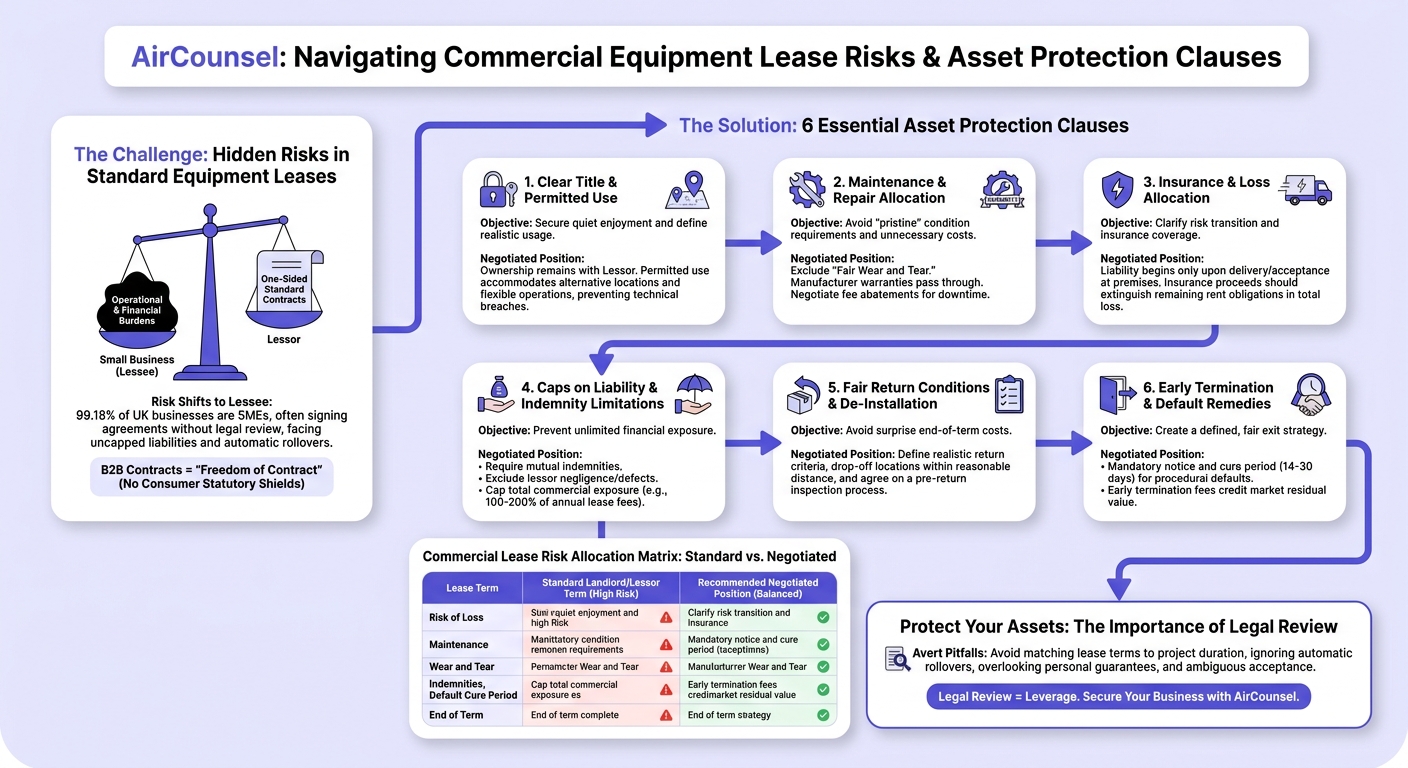
Why Equipment Leasing Poses Hidden Risks for UK Small Businesses
When leasing mission-critical machinery, office tech, or vehicles, small business owners often treat the transaction as a routine monthly utility expense. In reality, an equipment lease is a high-stakes financing and risk-transfer mechanism. Lessors draft standard contracts that protect their capital investment while shifting almost every operational burden onto your company.
Unlike consumer agreements, commercial contracts operate under the principle of freedom of contract. Courts presume both parties are sophisticated commercial entities capable of negotiating their own terms. If you sign an agreement containing onerous indemnities or one-sided repair terms, getting out of it is extraordinarily difficult.
Founders must establish internal contractual hygiene across all their legal structures. Just as founders learn to formalize governance early—as outlined when you read our guide on why UK startups need a shareholder agreement—safeguarding physical operational assets requires proactive contractual risk management.
6 Essential Asset Protection Clauses in Commercial Equipment Leases
To maintain cash flow and prevent operational disruption, negotiate these six core clauses prior to executing any equipment lease agreement.
1. Clear Title and Permitted Use Provisions
The agreement must explicitly state that ownership (title) remains with the lessor while granting your business quiet enjoyment and uninterrupted possession as long as you meet your rent commitments.
Ensure the "permitted use" definition accommodates your realistic business operations. If the clause defines usage too narrowly (such as restricting operation to a single site or standard operating hours), using the equipment in alternative client locations or over peak shifts could trigger a technical breach of contract.
2. Maintenance and Repair Allocation
Standard equipment leases often require the lessee to maintain the equipment in "pristine condition" or mandate expensive maintenance contracts with the lessor’s exclusive vendors.
- Fair Wear and Tear: Ensure normal degradation through standard commercial use is excluded from your repair obligations.
- Warranties and Manufacturer Support: Ensure manufacturer warranties pass through to your company so that you are not paying repair costs for inherent mechanical defects.
- Downtime Credits: If the lessor is responsible for servicing the machinery, negotiate fee abatements if equipment failure halts your production.
3. Insurance Obligations and Loss Allocation
Lessors will require comprehensive insurance covering loss, theft, and damage. However, you must clarify risk transition points.
Ensure your liability for risk of loss begins only upon delivery and acceptance at your premises—not when the equipment leaves the lessor’s warehouse. Furthermore, verify whether insurance proceeds from a total loss extinguish your ongoing rent obligations or if the lessor expects continued rental payments alongside the payout.
4. Caps on Liability and Indemnity Limitations
Indemnity clauses are among the most dangerous sections in commercial agreements. A standard lessor draft often asks you to indemnify them against "any and all losses, claims, and expenses" arising from the equipment’s use.
- Require mutual indemnities rather than unilateral lessee obligations.
- Exclude claims arising from the lessor’s negligence, willful default, or equipment design flaws.
- Tie your total commercial exposure to a reasonable aggregate liability cap, such as 100% to 200% of the total annual lease fees paid.
5. Fair Return Conditions and De-Installation Terms
When the lease term ends, how the equipment must be returned can become an unexpected financial sinkhole. Vague requirements like "returned in original crating at lessee’s sole expense" can cost thousands in specialized transport fees.
Define specific return criteria, including realistic drop-off locations within reasonable transit distances, clear packaging parameters, and an agreed pre-return inspection process to resolve condition disputes before final surrender.
6. Early Termination and Default Remedies
Business needs change rapidly. If you outgrow the machinery or pivot your business model, you need a defined early exit strategy.
Ensure the contract does not accelerate all remaining rental payments immediately upon an innocent procedural default without a mandatory notice and cure period (typically 14 to 30 business days). Negotiate a fair early termination fee calculation that credits the market residual value of the returned equipment against outstanding balances.
Commercial Lease Risk Allocation Matrix
The table below highlights typical standard terms versus the solicitor-approved positions you should seek during contract negotiation:
| Lease Term | Standard Landlord/Lessor Term | Recommended Negotiated Position |
|---|---|---|
| Risk of Loss | Passes upon dispatch from factory | Passes upon signed delivery and testing at premises |
| Maintenance | Lessee pays all repairs, including manufacturing defects | Lessor/Manufacturer covers defect warranties; lessee covers routine care |
| Wear and Tear | Lessee restores equipment to new condition | Exceptions included for ordinary wear and tear |
| Indemnities | Uncapped indemnity covering all third-party claims | Indemnity capped, excluding lessor negligence and defects |
| Default Cure Period | Immediate acceleration of entire lease balance | Minimum 14-day written notice and right to remedy breach |
| End of Term | Automatic 12-month renewal without opt-out notice | Lease transitions to month-to-month or ends automatically |

UK Commercial Contract Rules Small Businesses Must Navigate
In England and Wales, commercial leasing disputes are governed by standard contract principles and statutory frameworks such as the Supply of Goods and Services Act 1982 and the Unfair Contract Terms Act 1977 (UCTA).
Under UCTA, clauses attempting to restrict or exclude liability for business negligence must satisfy the statutory "requirement of reasonableness." However, UK courts are historically reluctant to overturn agreed clauses between commercial enterprises, reasoning that business owners should conduct their own due diligence prior to signing.
Relying on statutory fairness arguments after a dispute arises is costly and risky. Having your draft lease reviewed by a qualified solicitor ensures unreasonable terms, hidden charges, and unbalanced risks are removed before your signature creates binding legal commitments.
Common Pitfalls to Avoid Before Signing an Equipment Lease
Small business operators frequently fall into several predictable traps when acquiring commercial assets:
- Failing to Match Lease Terms With Project Duration: Entering a 36-month lease for machinery tied to an 18-month client contract leaves you paying for idle hardware.
- Ignoring Automatic Evergreen Rollovers: Many leases require written cancellation notices 90 to 120 days prior to expiry, otherwise renewing automatically for another full year.
- Overlooking Personal Guarantees: Financing companies often slip personal director guarantees into the fine print, exposing your personal personal savings and home to business debt.
- Accepting Ambiguous Acceptance Testing: Agreeing that delivery constitutes immediate acceptance without a reasonable inspection window prevents you from rejecting malfunctioning hardware.
Protect Your Business Assets With Legal Review
Signing an unbalanced commercial lease puts your company's operating capital, equipment uptime, and long-term solvency at risk. Getting clear, fixed-price legal advice gives you the leverage to eliminate one-sided terms and safeguard your enterprise.
Ensure your contracts protect your bottom line. Work with qualified solicitors to draft a robust Custom Equipment / Movables Lease Agreement, secure a fast fixed-fee Review of a Contract or Legal Document, or book an Online Consultation with a Solicitor to address your specific commercial risks today.
Frequently Asked Questions
What asset protection clauses should be in a UK commercial equipment lease?
A protective equipment lease must include clear title and quiet possession terms, explicit definitions for ordinary wear and tear, manufacturer warranty pass-throughs, capped indemnity provisions, balanced return conditions, and reasonable default cure periods.
Who is responsible for damage, loss, theft, and maintenance under a UK equipment lease?
In standard commercial leases, lessors typically draft terms that place full responsibility for damage, loss, theft, and ongoing maintenance on the lessee. Businesses should negotiate terms so risk only begins upon delivery and manufacturer defects remain covered under warranty.
Can a small business negotiate liability caps, insurance, and indemnity clauses in an equipment lease?
Yes. Commercial lease terms are negotiable. Lessors frequently accept reasonable modifications such as mutual indemnities, exclusion of lessor negligence, and total liability caps tied to aggregate annual lease values.
What should I check before signing a commercial equipment lease in the UK?
Review the duration, early termination fees, automatic rollover notice windows, repair obligations, delivery acceptance procedures, and whether the document contains any hidden personal guarantees that expose personal assets.
Recommended
Need Legal Assistance?
Our expert legal team is ready to help you navigate complex legal matters with confidence.