How to Structure an Asset Purchase in the UK: Guidance from Small Business Lawyers

Acquiring or selling commercial assets is one of the most effective ways for UK enterprises to scale or exit without inheriting legacy corporate baggage. Working alongside experienced small business lawyers allows buyers and sellers to cherry-pick profitable operations, ring-fence historical risks, and establish clean ownership from day one.
Structuring an asset purchase requires careful legal documentation, asset scheduling, and precise tax planning. According to official UK statutory guidance on Business Asset Disposal Relief, qualifying business asset disposals are taxed at a reduced Capital Gains Tax rate of 10% through 5 April 2025, rising to 14% for disposals between 6 April 2025 and 5 April 2026, and 18% thereafter.
Whether you are acquiring a customer list, transferring intellectual property, or purchasing plant and equipment, understanding how to draft enforceability into your agreements ensures smooth closing and protects your investment.
Table of Contents
- Quick Summary
- Asset Purchase vs Share Purchase
- Identifying and Scheduling Key Assets
- Carving Out Liabilities and Managing Risk
- Tax and VAT Considerations (TOGC and Reliefs)
- TUPE and Employment Transfer Obligations
- Step-by-Step Asset Purchase Workflow
- Why Work With Small Business Lawyers
- Protect Your Asset Transaction Today
- Frequently Asked Questions
- Recommended
Quick Summary
| Takeaway | Explanation |
|---|---|
| Asset vs Share Deal | Buyers acquire specific business assets and leave historical corporate liabilities with the seller. |
| Liability Protection | Debts, historic tax liabilities, and pre-closing disputes stay with the selling legal entity by default. |
| VAT Treatment (TOGC) | Transactions qualifying as a Transfer of a Going Concern are treated as outside the scope of VAT. |
| Employment Law (TUPE) | Employees dedicated to the transferring business unit transfer automatically with their existing terms. |
| Core Contract | A formal agreement defines tangible property, intellectual property, contracts, goodwill, and warranties. |
Asset Purchase vs Share Purchase
In UK commercial transactions, buyers and sellers generally choose between a share purchase and an asset purchase. A share purchase transfers ownership of the entire company, including all historical liabilities, hidden debts, and ongoing obligations.
An asset purchase allows the buyer to acquire specific components of a business while leaving behind unwanted liabilities. Small businesses frequently favor asset purchases because they significantly reduce exposure to undisclosed past liabilities, pending litigation, and historical accounting errors.
For sellers, an asset purchase allows the disposition of non-core divisions or individual revenue streams while retaining control of the underlying limited company.
Identifying and Scheduling Key Assets
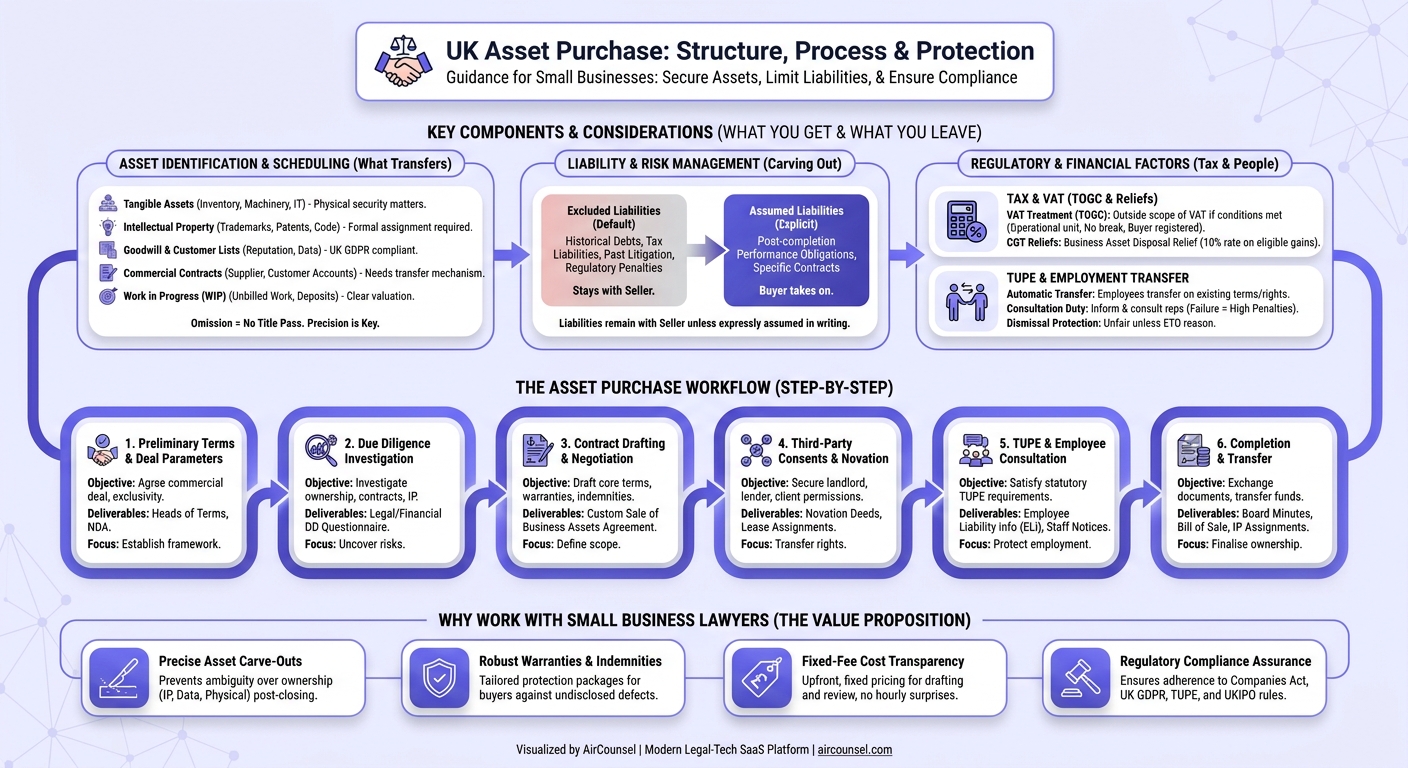
An asset purchase agreement must itemize every single asset transferring to the buyer. If an asset is omitted from the contract schedules, title does not pass at completion.
- Tangible Assets: Physical inventory, machinery, tools, office fittings, and IT hardware. To ensure physical machinery remains properly secured during ownership transitions, read our guide on 6 equipment lease clauses small business lawyers recommend for asset protection.
- Intellectual Property (IP): Registered trademarks, patents, proprietary code, brand names, domain names, and design rights. Registered rights must be assigned via formal assignment forms with the UK Intellectual Property Office.
- Goodwill and Customer Lists: The trading reputation, brand recognition, domain authority, and existing customer databases compliant with UK GDPR.
- Commercial Contracts: Supplier agreements, customer accounts, software subscriptions, and commercial leases that require legal transfer.
- Work in Progress (WIP): Unbilled work, deposits paid to suppliers, and active client orders requiring completion post-sale.
Carving Out Liabilities and Managing Risk
The primary legal benefit of an asset transaction is that liabilities remain with the seller unless expressly assumed in writing by the buyer.
- Excluded Liabilities: Historical tax debts, unpaid supplier invoices, past regulatory penalties, and pre-completion litigation claims stay with the selling company.
- Assumed Liabilities: Post-completion performance obligations under transferred customer or supplier contracts.
- Third-Party Consent and Novation: Commercial contracts cannot be transferred unilaterally. While rights under a contract can often be assigned, obligations require a formal novation agreement signed by the buyer, seller, and counterparty.
- Apportionments: Utility bills, commercial rent, software licenses, and rates must be calculated and divided accurately as of the completion date.
Tax and VAT Considerations (TOGC and Reliefs)
Tax planning directly impacts the net proceeds for sellers and the cash flow requirements for buyers.
VAT and Transfer of a Going Concern (TOGC)
Normally, the sale of commercial assets is subject to standard-rate VAT (20%). However, under official GOV.UK VAT Notice 700/9, the transaction is treated as neither a supply of goods nor a supply of services if it meets Transfer of a Going Concern (TOGC) conditions.
To qualify for TOGC treatment:
- The assets must be used by the buyer in carrying on the same kind of business without a significant break.
- The seller must transfer an identifiable, operational business unit, not merely isolated physical items.
- The buyer must be VAT-registered at completion or become registered immediately as a result of the transfer.
Capital Gains and Corporation Tax Reliefs
When individual business owners or sole traders dispose of business assets, they may qualify for Business Asset Disposal Relief, reducing their tax rate on eligible lifetime gains. If a limited company sells assets, the company pays UK Corporation Tax on chargeable gains, and profits must be extracted through dividends, share buybacks, or liquidation.
TUPE and Employment Transfer Obligations
Under the Transfer of Undertakings (Protection of Employment) Regulations 2006 (TUPE), employees assigned to an organized grouping of resources that changes hands transfer automatically to the buyer.
- Automatic Transfer: Employees transfer on their existing terms and conditions, retaining their continuous service length and accrued rights.
- Information and Consultation: Both buyer and seller must inform and consult with affected employee representatives prior to the transfer. Failure to comply can result in employment tribunal awards of up to 13 weeks of gross pay per affected employee.
- Dismissal Protection: Dismissals connected to the transfer are automatically unfair unless justified by economic, technical, or organizational (ETO) reasons entailing changes in the workforce.
Step-by-Step Asset Purchase Workflow
Executing an asset purchase requires structured negotiation, thorough verification, and tailored drafting.
| Phase | Core Objective | Key Deliverables |
|---|---|---|
| Step 1: Preliminary Terms | Agree commercial deal parameters and exclusivity | Heads of Terms, Non-Disclosure Agreement |
| Step 2: Due Diligence | Investigate asset ownership, contracts, and IP rights | Legal and financial due diligence questionnaire |
| Step 3: Contract Drafting | Draft core terms, warranties, and indemnities | Custom Sale of Business Assets Agreement |
| Step 4: Third-Party Consents | Secure permissions from landlords, lenders, and key clients | Novation deeds, lease assignments, bank waivers |
| Step 5: Employee Consultation | Satisfy statutory TUPE consultation requirements | Employee liability information (ELI), staff notices |
| Step 6: Completion | Exchange executed documents and transfer funds | Board minutes, bill of sale, IP assignments, payment |
Why Work With Small Business Lawyers
Instructing specialized small business lawyers ensures that transaction risks are managed efficiently without unnecessary delays or disproportionate legal costs.
- Precise Asset Carve-Outs: Clear drafting prevents ambiguity over who owns physical equipment, domain names, customer data, and brand collateral after closing.
- Robust Warranties and Indemnities: Tailored warranty packages protect buyers against undisclosed defects, while seller limitations cap total financial exposure.
- Fixed-Fee Cost Transparency: Modern legal platforms provide upfront, fixed pricing for drafting and document reviews rather than unpredictable hourly billing.
- Regulatory Compliance: Legal counsel ensures adherence to Companies Act requirements, UK GDPR data transfer rules, and UKIPO trademark transfer procedures.
Protect Your Asset Transaction Today

Structuring an asset purchase requires balanced contracts that protect your capital, secure proprietary assets, and prevent unassumed liabilities from transferring to your business. AirCounsel connects you directly with experienced, SRA-regulated UK solicitors delivering transparent, fixed-price legal services with rapid turnaround times.
Whether you need a custom Custom Sale of Business Assets Agreement, an independent Review of a Contract or Legal Document, or formal brand protection via UK Trade Mark Filing, our solicitors ensure your transaction closes safely and compliantly.
Frequently Asked Questions
What is included in an asset purchase in the UK?
An asset purchase can include tangible property such as machinery, stock, and IT equipment, as well as intangible assets like registered trademarks, customer lists, websites, software code, supplier agreements, and commercial goodwill.
Do liabilities stay with the seller in an asset purchase?
Yes. Historical liabilities, outstanding debts, and pending legal claims remain with the seller by default. The buyer only assumes obligations that are expressly agreed upon and identified in the written purchase contract.
When does VAT apply to an asset purchase or going concern sale?
Asset sales are subject to standard VAT unless the transaction meets the Transfer of a Going Concern (TOGC) criteria under UK law. To qualify, the assets must form an operational business unit that the buyer continues operating, and the buyer must be VAT-registered at completion.
What tax reliefs may apply when selling business assets in the UK?
Eligible individual sellers may qualify for Business Asset Disposal Relief, which reduces Capital Gains Tax on qualifying business disposals. Companies disposing of assets may utilize rollover relief if proceeds are reinvested into qualifying replacement trading assets.
Recommended
Need Legal Assistance?
Our expert legal team is ready to help you navigate complex legal matters with confidence.