6 Critical Clauses Settlement Agreement Solicitors Review in UK Redundancy Deals

Navigating workforce changes or redundancy is one of the most sensitive transitions an employer or employee can face in the UK. When a business restructures, settling employment terms through a formal legal contract provides certainty, closure, and financial security for both parties.
Official labour market data from the Office for National Statistics shows that the UK redundancy rate stood at 3.9 per 1,000 employees, highlighting how frequent organisational restructuring remains across commercial sectors. Because signing an exit contract permanently waives an employee's statutory rights, engaging dedicated settlement agreement solicitors is both a practical necessity and a strict legal requirement under UK law.
Whether you are an employer drafting a clean exit package or an employee reviewing an offer, understanding the key clauses within a redundancy contract ensures fair compensation and prevents costly post-employment disputes.
Table of Contents
- Quick Summary
- What Is a Redundancy Settlement Agreement?
- 6 Critical Clauses Settlement Agreement Solicitors Examine
- Redundancy Compliance and Practical Negotiation Risks
- Settlement Agreement Costs and Timelines
- Finalise Your Redundancy Settlement with Confidence
- Frequently Asked Questions
- Recommended
Quick Summary
| Takeaway | Explanation |
|---|---|
| Mandatory Legal Advice | Under Section 203 of the Employment Rights Act 1996, an employee must receive independent legal advice from a qualified solicitor or certified adviser for a waiver of claims to be enforceable. |
| Six Essential Clauses | Legal reviews focus on the waiver scope, redundancy pay calculation, tax indemnity structures, non-disclosure terms, agreed references, and legal cost coverage. |
| £30,000 Tax Exemption | Genuine redundancy severance pay up to £30,000 can often be paid free of UK income tax and National Insurance, whereas contractual notice pay (PILON) is fully taxable. |
| Mutual Protection | The document protects employers against tribunal disputes while granting employees enhanced severance, clear departure terms, and an agreed professional reference. |
| Standard Costs Covered | Employers customarily provide a fixed legal fee contribution (typically between £350 and £500 + VAT) so the departing worker incurs no out-of-pocket legal expense for standard reviews. |
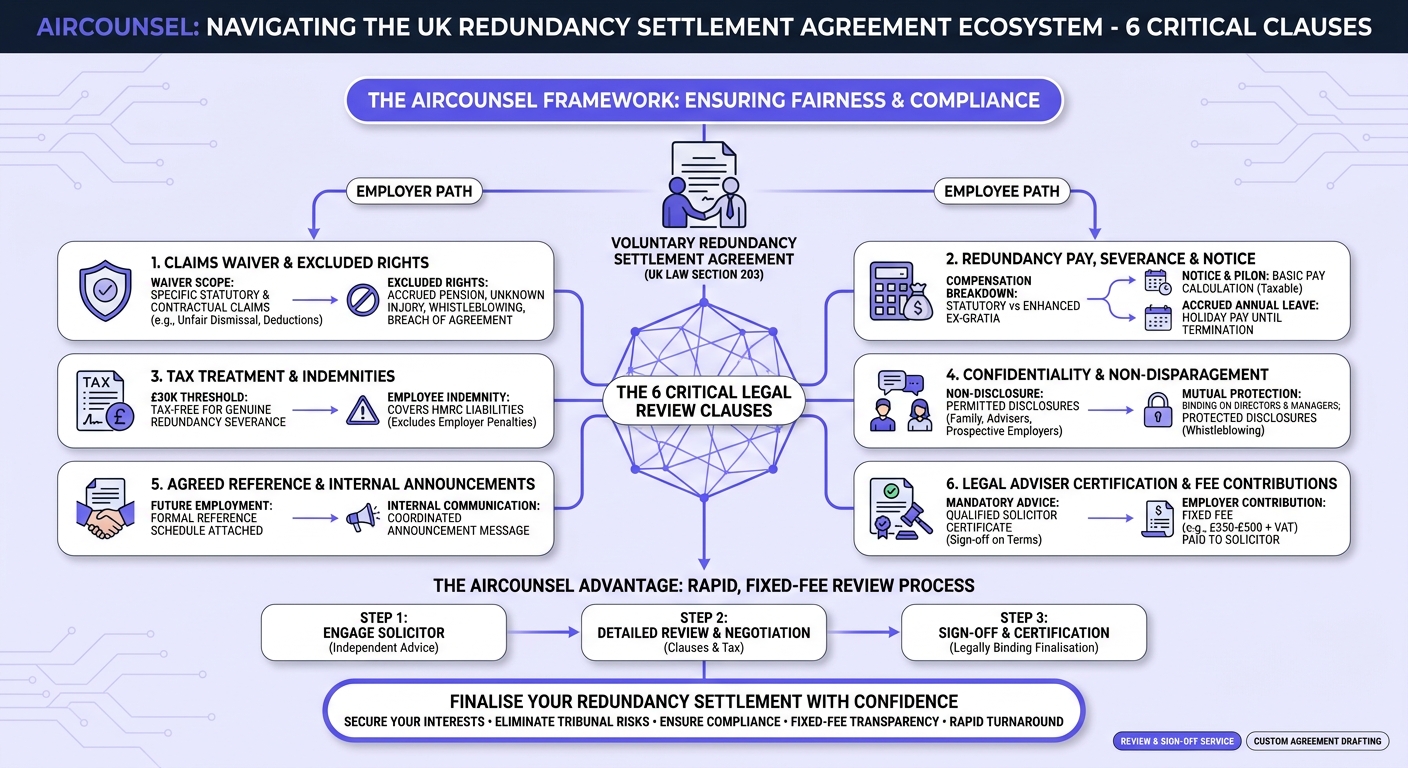
What Is a Redundancy Settlement Agreement?
A settlement agreement (formerly known as a compromise agreement) is a legally binding contract between an employer and an employee. In a redundancy scenario, it sets out the full terms of departure, the financial severance package, and an agreement from the employee not to pursue claims against the employer in an employment tribunal or civil court.
As outlined in formal guidance from ACAS, entering into a settlement agreement is entirely voluntary. Employers frequently offer settlement agreements alongside enhanced redundancy pay to avoid prolonged dispute procedures and ensure an amicable, orderly exit.
To learn more about how legal representation safeguards your interests during an exit negotiation, read our guide on how settlement agreement solicitors help UK employees.

6 Critical Clauses Settlement Agreement Solicitors Examine
When reviewing redundancy paperwork, legal advisers look beyond the headline severance figure to ensure each clause is compliant, balanced, and free from hidden liabilities.
1. Claims Waiver Scope and Excluded Rights
The primary objective for an employer is securing a full waiver of statutory and contractual claims. However, standard drafting must balance legal certainty with employee protection:
- Specific statutory claims: The agreement must list specific claims being settled (such as unfair dismissal, redundancy pay, or unlawful deduction from wages) rather than relying on generic blanket waivers.
- Excluded claims: An enforceable agreement must expressly exclude claims for accrued pension rights, unknown personal injuries, and any dispute arising from the breach of the settlement agreement itself.
- Future unknown claims: UK courts restrict waivers covering claims that the parties could not reasonably have contemplated at the time of signing.
2. Redundancy Pay, Severance, and Notice Terms
The compensation section defines the exact breakdown of the financial package:
- Statutory vs ex-gratia redundancy: The contract must distinguish between mandatory statutory redundancy pay and any enhanced ex-gratia compensation.
- Notice period and PILON: If the employee is not working their contractual notice, the payment in lieu of notice (PILON) must be calculated accurately based on basic pay.
- Accrued annual leave: All untaken statutory and contractual holiday pay owed up to the termination date must be itemised and paid subject to standard deductions.
3. Tax Treatment and Employer Tax Indemnities
Taxation errors can result in unexpected liabilities from HM Revenue & Customs (HMRC):
- The £30,000 threshold: Genuine ex-gratia severance and redundancy payments up to £30,000 can usually be paid free of income tax and employee National Insurance contributions.
- Tax indemnity obligations: Settlement agreements almost always include an indemnity clause requiring the employee to reimburse the employer if HMRC determines tax is due on the severance payment. Solicitors check that this indemnity excludes employer penalties or interest caused by payroll delays.
4. Confidentiality and Non-Disparagement Rules
Non-disclosure and reputation management terms must comply with UK legal standards:
- Whistleblowing protections: Confidentiality clauses cannot prevent an individual from making a protected disclosure under the Public Interest Disclosure Act 1998 or reporting matters to regulators and police.
- Mutual non-disparagement: Solicitors ensure that non-disparagement obligations are mutual, binding company directors and managers from making derogatory remarks about the departing worker.
- Permitted disclosures: The employee must remain free to disclose the terms to their immediate family, professional advisers, and prospective employers (to confirm departure details).
5. Agreed Reference and Internal Announcements
Securing future employment is a priority for redundant staff, making reference wording essential:
- Standard reference schedule: A formal reference letter should be attached as an appendix to the agreement, binding the employer to provide only that agreed text when contacted by future employers.
- Internal communication wording: Agreeing on a coordinated internal announcement ensures that colleagues and clients receive a consistent message regarding the redundancy.
6. Legal Adviser Certification and Fee Contributions
For the contract to be legally valid under UK statute:
- Adviser's certificate: An independent qualified solicitor or certified trade union adviser must sign an attached adviser certificate confirming advice was given on the terms and their effect on the worker's ability to pursue tribunal claims.
- Employer legal contribution: The agreement must specify the employer's contribution toward the employee's legal fees, the payment deadline, and invoicing details.
Redundancy Compliance and Practical Negotiation Risks
Entering into a settlement agreement shifts the legal risk profile for both business owners and employees. Reviewing terms prevents standard operational misunderstandings:
| Feature | Standard Statutory Redundancy | Redundancy via Settlement Agreement |
|---|---|---|
| Legal Claims Waiver | No (Tribunal claims remain open) | Yes (Claims fully settled and waived) |
| Independent Advice | Optional | Mandatory under UK law |
| Compensation Level | Statutory redundancy formula | Enhanced / negotiated severance |
| Reference Protection | No statutory requirement | Legally binding agreed reference |
| Non-Disclosure Terms | Limited to existing contract | Comprehensive mutual confidentiality |
Settlement Agreement Costs and Timelines
Settlement agreements follow a predictable and fast turnaround when handled by experienced legal professionals:
- Turnaround timeline: Standard reviews and sign-offs typically take 2 to 3 business days, with same-day express turnarounds available when restructuring deadlines are tight.
- Legal fee coverage: In the vast majority of UK redundancy exits, the employer pays a fixed contribution ranging between £350 and £500 + VAT directly to the employee's solicitor.
- Fixed-fee transparency: Modern digital legal services operate on fixed pricing, ensuring no unexpected hourly fees for either party.
Finalise Your Redundancy Settlement with Confidence
Whether you are an employee looking for an independent solicitor sign-off or an employer drafting compliant exit documentation, speed and precision are critical. Securing expert legal oversight protects your financial interests, eliminates tribunal risks, and ensures total compliance with UK employment legislation.
AirCounsel provides rapid, fixed-fee employment contract and settlement reviews delivered by qualified UK solicitors. Explore our Review and Solicitor Sign-Off of Employee Settlement Agreement service to complete your legal adviser sign-off smoothly, or commission a Custom Employee Settlement Agreement tailored to your company's operational needs.
Frequently Asked Questions
What should a settlement agreement include in a redundancy package in the UK?
A comprehensive redundancy settlement agreement should clearly outline the termination date, itemised statutory and enhanced redundancy payments, notice pay arrangements, accrued holiday entitlements, tax indemnity provisions, mutual confidentiality terms, an agreed reference schedule, and the employer's contribution toward legal advice fees.
Do I have to sign a settlement agreement if I am being made redundant?
No, signing a settlement agreement is voluntary. If you reject the agreement, your employer may proceed with standard statutory redundancy procedures. However, declining a settlement agreement means you forfeit any enhanced severance pay, agreed references, or custom benefits offered exclusively under the contract.
Why must a settlement agreement solicitor review the agreement before signing?
Under Section 203 of the Employment Rights Act 1996, a settlement agreement is not legally binding unless the employee has received independent legal advice from a qualified adviser, such as a solicitor. The solicitor explains the practical effect of waiving employment claims and signs the mandatory adviser's certificate.
Can a redundancy settlement agreement affect my right to bring an employment claim later?
Yes, the core purpose of a settlement agreement is waiving your right to bring employment tribunal or court claims against your employer regarding your employment and its termination. However, statutory exclusions apply: you cannot waive future personal injury claims you are unaware of, accrued pension rights, or statutory whistleblowing disclosures.
Who pays the legal fees for a settlement agreement review?
In the UK, it is standard commercial practice for the employer to pay a contribution toward the employee's legal fees, typically between £350 and £500 + VAT. This contribution usually covers the full cost of independent legal advice on the terms and effect of the agreement.
Recommended
Need Legal Assistance?
Our expert legal team is ready to help you navigate complex legal matters with confidence.