5 Reasons Settlement Agreement Solicitors Mandate Specific Tax Indemnity Wording in UK Severance Packages

When negotiating an employee exit in the UK, drafting a clean separation requires more than agreeing on a lump-sum figure. Qualified settlement agreement solicitors consistently insist on inserting precise tax indemnity wording into the final agreement. Without these clauses, an employer faces severe financial exposure if HM Revenue and Customs (HMRC) later challenges the tax treatment of the severance package.
Under UK employment tax rules, the first £30,000 of qualifying termination compensation can be paid free of income tax and National Insurance contributions, but miscategorizing contractual earnings as tax-free compensation invites immediate regulatory scrutiny according to Acas guidance on settlement agreements.
For founders, startup operators, and small-business owners with lean administrative teams, a surprise HMRC tax bill after an employee departure can wipe out operating margins. Understanding why legal advisers insist on strict indemnity language ensures your business secures genuine finality, avoids retroactive payroll audits, and completes staff departures smoothly.
Table of Contents
- Understanding Tax Indemnity Clauses in UK Severance
- The £30,000 Exemption vs Taxable Termination Payments
- Why Solicitors Require Specific Tax Indemnity Wording
- Common Negotiation Points in Tax Indemnity Drafting
- Cost and Compliance Checklist for UK Settlement Agreements
- Finalize Your UK Settlement Agreement with AirCounsel
- Frequently Asked Questions
- Recommended
| Takeaway | Explanation |
|---|---|
| Primary Purpose | Shifts potential tax and National Insurance shortfalls back to the departing employee if HMRC disputes the tax-free status. |
| £30,000 Threshold | Applies exclusively to genuine ex-gratia compensation and statutory redundancy, not earned income or contractual notice. |
| Mandatory Itemization | Settlement agreements must separate wages, PILON, holiday pay, and ex-gratia sums into distinct contractual lines. |
| Employer Protection | Shields the business from having to fund an ex-employee's unpaid income tax liabilities out of company reserves. |
| Negotiation Balance | Employees often negotiate reasonable notice periods before indemnities trigger, preventing arbitrary payroll clawbacks. |
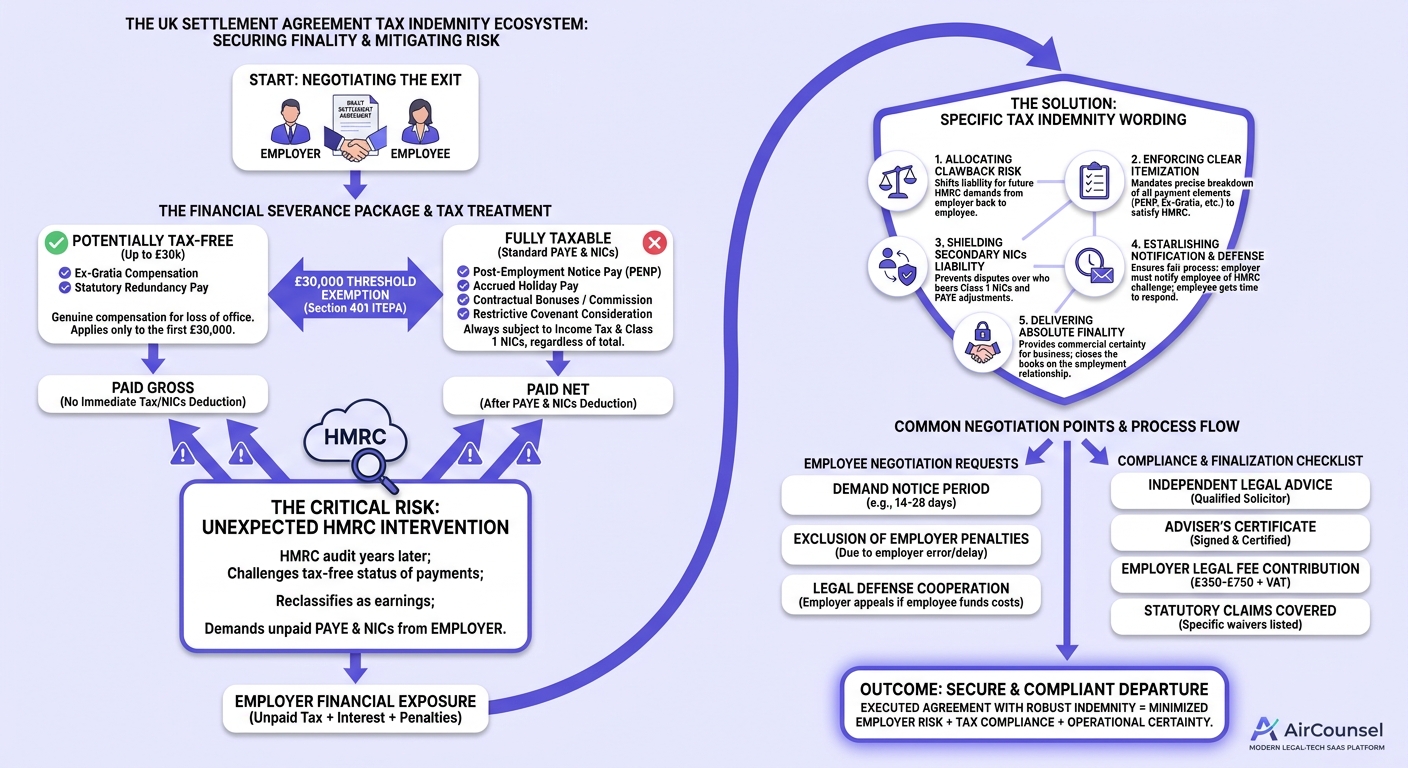
Understanding Tax Indemnity Clauses in UK Severance
A tax indemnity is a binding contractual clause in an employment settlement agreement where the departing employee agrees to reimburse the employer if HMRC later determines that tax or employee National Insurance Contributions (NICs) should have been deducted from payments made under the agreement.
In standard UK employment law, the employer operates Pay As You Earn (PAYE) and carries primary administrative responsibility for deducting income tax and NICs at source. If an employer pays a severance sum gross under the belief that it falls within statutory exemptions, HMRC can audit the transaction years later. If HMRC finds that the payment was taxable, the tax authority assesses the unpaid tax, penalties, and interest directly against the employer.
The tax indemnity creates an enforceable right of recovery, ensuring that the business is not left holding the bill for taxes that were ultimately the individual's legal responsibility.
The £30,000 Exemption vs Taxable Termination Payments
A common misconception among founders and departing workers is that any payment wrapped inside a settlement agreement is automatically tax-free up to £30,000. In reality, HMRC's Employment Income Manual outlines strict rules regarding which components qualify for exemption under Section 401 of the Income Tax (Earnings and Pensions) Act 2003 (ITEPA).
To avoid disputes, employment solicitors categorize each payment item carefully before signing.
| Payment Component | Standard Tax & NIC Treatment | Subject to £30,000 Exemption? |
|---|---|---|
| Ex-Gratia Compensation | Free of Income Tax and NICs up to £30,000 | Yes |
| Statutory Redundancy Pay | Free of Income Tax and NICs up to £30,000 | Yes |
| Post-Employment Notice Pay (PENP) | Fully subject to PAYE Income Tax and Class 1 NICs | No |
| Accrued Holiday Pay | Fully subject to PAYE Income Tax and Class 1 NICs | No |
| Contractual Bonuses / Commission | Fully subject to PAYE Income Tax and Class 1 NICs | No |
| Restrictive Covenant Consideration | Fully taxable as general earnings | No |
Payments for notice pay—calculated using statutory Post-Employment Notice Pay (PENP) formulas—must always be subjected to tax and NIC deductions, regardless of whether the employee works their notice or receives Payment in Lieu of Notice (PILON).

Why Solicitors Require Specific Tax Indemnity Wording
Experienced legal practitioners recognize that generic or poorly drafted tax clauses create substantial operational risks. When drafting or reviewing severance terms, solicitors ensure five key risk factors are addressed.
1. Allocating Unexpected HMRC Clawback Risk
HMRC has statutory authority to review termination payments up to several years after employment ends. If the tax authority decides that a payment labeled as "compensation for loss of office" was actually a veiled retention bonus or contractual entitlement, it will issue a formal demand for unpaid tax.
A robust tax indemnity ensures that the financial burden of such a demand rests with the individual who received the gross funds, rather than the business that distributed them in good faith. You can read our guide on how settlement agreement solicitors help UK employees secure a fair exit while ensuring both parties agree to realistic indemnity terms.
2. Enforcing Clear Itemization of Payment Elements
HMRC routinely penalizes agreements that provide a single, unallocated lump sum to an employee. Solicitors mandate wording that explicitly breaks down:
- Outstanding salary and contractual benefits up to the termination date
- Payment in lieu of accrued but untaken statutory and contractual holiday
- Post-Employment Notice Pay (calculated under standard statutory formulas)
- Ex-gratia termination payment or compensatory sum (eligible for the £30,000 threshold)
By stating the exact statutory basis for each figure, the agreement minimizes the chance of an HMRC audit in the first place.
3. Shielding Businesses from Secondary National Insurance Liability
Since April 2020, termination payments exceeding the £30,000 exemption threshold are subject to Class 1A employer National Insurance contributions (payable at the standard employer rate of 13.8% or prevailing rate).
While an employer cannot legally indemnify itself against employer NICs using an employee deduction unless specific statutory arrangements apply, a carefully tailored tax indemnity prevents disputes over who bears the burden of employee Class 1 NICs and PAYE income tax adjustments.
4. Establishing Fair Notification and Defense Timelines
From an employee perspective, an unchecked tax indemnity is dangerous because an employer could theoretically settle an HMRC claim without mounting a defense and demand immediate reimbursement.
Solicitors representing both founders and employees draft balanced clauses that require the employer to give prompt written notice of any HMRC inquiry, allow the employee reasonable time to review the correspondence, and provide an opportunity to challenge the assessment before funds are paid over.
5. Delivering Absolute Finality for Founders and Small Businesses
Small businesses and early-stage companies rarely have dedicated in-house tax counsel. A post-termination tax audit can create months of administrative distraction and expensive accounting fees.
A clean, solicitor-approved indemnity clause provides commercial certainty. Once the agreement is executed and payments are delivered through payroll, the business can close its accounting books on that employment relationship without unquantified contingent liabilities.
Common Negotiation Points in Tax Indemnity Drafting
When settlement terms are negotiated between legal representatives, the tax indemnity clause frequently undergoes refinement. Key areas of focus include:
- Demand Notice Period: Standard drafting typically allows the employee 14 to 28 days to pay any certified tax demand after receiving written proof from the employer.
- Exclusion of Employer Penalties: Employees routinely request that the indemnity exclude any HMRC fines, interest, or penalties that arose solely from the employer's unreasonable administrative delay or payroll error.
- Third-Party Certification: The clause often requires the employer to provide a formal demand notice or written calculation from HMRC before the indemnity is enforceable.
- Legal Defense Cooperation: High-earning executives may request wording obligating the employer to appeal an incorrect HMRC determination if the employee agrees to cover the reasonable legal costs of the appeal.
Cost and Compliance Checklist for UK Settlement Agreements
For a settlement agreement to be legally binding under Section 203 of the Employment Rights Act 1996, the employee must receive independent legal advice from a qualified adviser, such as a practicing solicitor.
- Employer Contribution to Legal Fees: Employers typically contribute between £350 and £750 plus VAT toward the departing employee's independent legal fees.
- Adviser's Certificate: The employee's solicitor must sign a formal adviser's certificate confirming they have advised on the terms, effect, and tax implications of the document.
- Turnaround Timelines: Standard reviews and revisions generally take 2 to 4 business days when using streamlined, fixed-fee legal platforms.
- Statutory Claims Covered: Ensure the waiver specifically lists applicable employment claims (such as unfair dismissal, redundancy, and discrimination) rather than using unenforceable blanket disclaimers.
Finalize Your UK Settlement Agreement with AirCounsel
Managing employee exits demands complete legal clarity, robust documentation, and rapid turnaround. AirCounsel provides fixed-fee, solicitor-drafted agreements designed to protect your balance sheet, ensure full HMRC tax compliance, and eliminate post-completion disputes.
Whether you need a bespoke document drafted from scratch or require rapid independent legal sign-off, our SRA-regulated solicitors deliver transparent, comprehensive support without unpredictable hourly billing:
- Protect your company with a tailored, legally compliant Custom Employee Settlement Agreement drafted directly by experienced UK solicitors.
- Ensure statutory compliance and secure independent adviser certification with our fixed-fee Review and Solicitor Sign-Off of Employee Settlement Agreement.
Frequently Asked Questions
What is a tax indemnity clause in a UK settlement agreement?
A tax indemnity clause is a contractual term where the departing employee agrees to reimburse the employer if HMRC later assesses that income tax or employee National Insurance Contributions should have been deducted from payments made under the agreement.
Why do solicitors include tax indemnity wording in severance packages?
Solicitors include this wording to allocate the risk of future HMRC tax challenges. Under UK law, employers are initially liable for under-deducted PAYE tax. The indemnity allows the business to recover those unpaid taxes directly from the employee who received the gross sum.
Is the first £30,000 of a settlement always tax-free in the UK?
No. The £30,000 tax exemption applies only to genuine compensatory payments for loss of office or statutory redundancy. Contractual earnings, accrued holiday pay, bonuses, and Post-Employment Notice Pay (PENP) are always subject to standard PAYE income tax and National Insurance deductions.
Who usually pays if HMRC later says tax or NICs were due?
If HMRC determines that additional tax is owed, it will demand payment from the employer first. If the settlement agreement contains a valid tax indemnity clause, the employer can enforce that clause to recover the assessed income tax and employee NICs from the departed employee.
Can an employee negotiate the terms of a tax indemnity?
Yes. Employees frequently negotiate clauses to ensure they receive prompt written notice of HMRC inquiries, are given a reasonable timeframe (such as 14 to 28 days) to respond, and are not held liable for penalties caused by employer payroll delays.
Recommended
Need Legal Assistance?
Our expert legal team is ready to help you navigate complex legal matters with confidence.