4 Website Compliance Traps Small Business Lawyers Find on UK SME Cookie Banners in 2026

Running a modern commercial website in the United Kingdom requires strict adherence to digital privacy standards. When auditing digital assets for emerging enterprises, small business lawyers frequently discover that off-the-shelf cookie popups fail to meet the legal thresholds established under the Privacy and Electronic Communications Regulations (PECR) and UK General Data Protection Regulation (UK GDPR).
Many founders assume that simply installing a generic WordPress plugin or website banner delivers total protection. However, regulatory scrutiny is accelerating. The Information Commissioner's Office (ICO) reviewed cookie compliance across the top 1,000 most visited UK websites, issuing formal warning letters and establishing clear enforcement precedents that now directly impact small and medium enterprises (SMEs).
Operating with non-compliant tracking scripts leaves your business vulnerable to enforcement notices, reputational damage, and commercial disputes. Understanding how cookie consent operates under UK law ensures you collect valuable user data lawfully while shielding your company from avoidable regulatory exposure.
Table of Contents
- Quick Summary
- Understanding UK Cookie Laws: PECR and GDPR Basics
- 4 Critical Cookie Banner Compliance Traps for UK SMEs
- Step-by-Step Audit: How to Bring Your Website into Full Compliance
- Cookie Compliance Checklist and Penalty Overview
- Protect Your Digital Assets with Expert Legal Guidance
- Frequently Asked Questions
- Recommended
Quick Summary
| Takeaway | Explanation |
|---|---|
| Prior Consent Requirement | Non-essential cookies (analytics, ads, tracking) cannot execute until the user gives affirmative consent. |
| Reject-All Parity | Rejecting non-essential cookies must be as easy and prominent as accepting them on the first layer of the banner. |
| No Implied Consent | Continuing to browse or scroll through a page does not constitute valid legal consent under UK PECR. |
| Third-Party Accountability | Website operators are directly liable for non-compliant third-party tracking tags placed on their digital platforms. |
| Documented Policies | A clear, standalone cookie policy must outline specific cookie names, lifespans, purposes, and vendor details. |
Understanding UK Cookie Laws: PECR and GDPR Basics
Website tracking in the UK is governed by Regulation 6 of PECR, read alongside the consent standards of the UK GDPR. Under the Information Commissioner's Office (ICO) Guidance on Cookies, storing information or gaining access to information stored on a user's terminal device is unlawful unless you provide clear, comprehensive information and obtain affirmative user consent.
Consent under UK GDPR must be freely given, specific, informed, and unambiguous. This standard applies not just to traditional browser cookies, but to all similar storage and access technologies, including local storage, tracking pixels, server-side tracking, and browser fingerprinting scripts.
Strictly Necessary vs Non-Essential Cookies
The only statutory exemption to the consent rule is for cookies that are "strictly necessary" to deliver an online service explicitly requested by the user. Distinguishing between necessary and non-essential technologies is where most small business compliance gaps originate:
- Strictly Necessary (Exempt): Session identifiers for user authentication, shopping basket preservation, load balancing, and basic security protections.
- Analytics and Measurement (Non-Exempt): Google Analytics 4, Hotjar heatmaps, and performance tracking scripts.
- Marketing and Social Media (Non-Exempt): Meta Pixel, LinkedIn Insight Tags, Google Ads conversion tracking, and embedded video cookies (e.g., YouTube or Vimeo).
- Functional Customization (Non-Exempt): Language preference selectors or live chat widgets that track users across multiple browsing sessions.

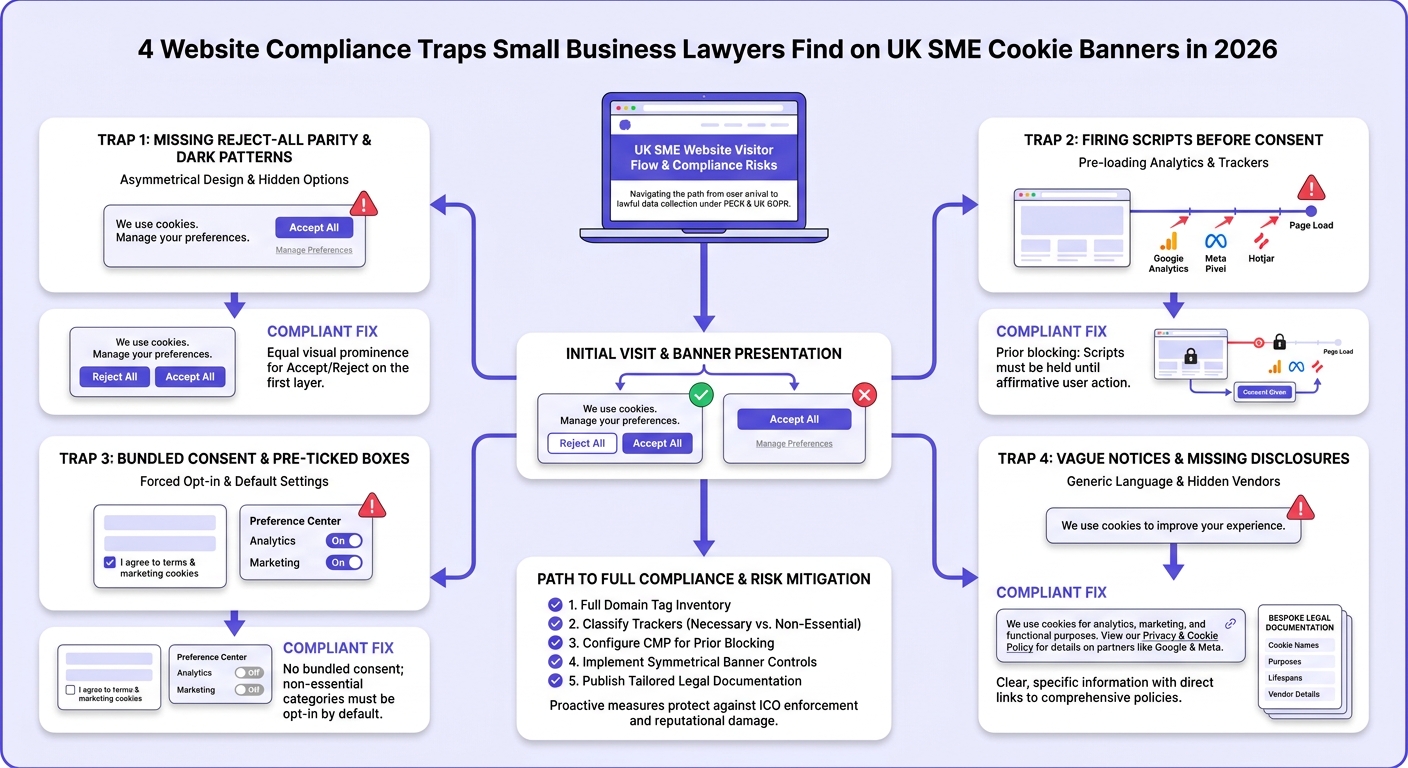
4 Critical Cookie Banner Compliance Traps for UK SMEs
When auditing commercial platforms, experienced corporate solicitors consistently see founders falling into specific structural traps. Eliminating these four flaws resolves over 90% of regulatory risk.
Trap 1: Missing Reject-All Parity and Dark Patterns
The most common failure identified on UK business websites is the absence of an explicit "Reject All" button alongside the "Accept All" button. Many banners present an "Accept All" button next to a secondary "Manage Preferences" link, forcing users to click through multiple screens to opt out.
Under current ICO Online Tracking Enforcement Strategy guidelines, this asymmetrical design constitutes a deceptive design pattern (or "dark pattern"). If accepting non-essential cookies takes 1 click, rejecting them must also take 1 click on the initial banner layer, utilizing equal visual prominence, font sizing, and button styling.
Trap 2: Firing Scripts Before User Consent Is Captured
Many SME websites use Consent Management Platforms (CMPs) that are improperly integrated with their tag management tools (such as Google Tag Manager). While the banner displays correctly, analytics scripts and advertising pixels fire in the background the moment the homepage loads.
Legally, this constitutes an active breach before the visitor even interacts with the banner. All tracking scripts must be held in a blocked state until an affirmative opt-in event is dispatched by the user.
Trap 3: Bundled Consent and Pre-Ticked Preference Boxes
Forcing users to accept tracking cookies as a mandatory condition for downloading a whitepaper, accessing an article, or submitting an inquiry form is invalid. Consent cannot be bundled into general website terms or privacy notices.
Furthermore, when users navigate into granular preference centers, non-essential categories (like analytics and marketing) must be toggled off by default. Pre-ticked boxes or opt-out configurations violate UK GDPR consent thresholds.
Trap 4: Vague Notices and Missing Third-Party Vendor Disclosures
A banner that merely states "We use cookies to improve your experience" fails the legal transparency requirement. The banner must provide immediate clarity on what technologies are utilized and link directly to a comprehensive Custom Privacy & Cookies Policy.
Your policy must disclose the identity of third-party vendors accessing data, the specific purpose of each script, and how long tracking files persist on the user's hardware. If your company shares data across external software tools, you should also ensure commercial suppliers have executed appropriate processing terms; you can read our guide on Why Small Business Lawyers Warn UK SMEs About Missing Data Processing Agreements for more background on vendor management.
Step-by-Step Audit: How to Bring Your Website into Full Compliance
Remediating cookie risks does not require rebuilding your website from scratch. Follow this 5-step process to align your digital operations with UK standards:
- Perform a Full Domain Tag Inventory: Inspect your site in an incognito browser window using developer tools (Application > Cookies) to identify every script set on initial page load.
- Classify All Discovered Trackers: Categorize every cookie into Strictly Necessary, Analytics, Functional, or Advertising classifications.
- Configure Your CMP for Prior Blocking: Ensure your tag container blocks non-essential tags from executing until consent triggers are confirmed.
- Implement Symmetrical Banner Controls: Update your user interface so that "Accept All" and "Reject All" buttons share equal visual weighting on the first banner layer.
- Publish Tailored Legal Documentation: Update your public legal notices to ensure your cookie table lists current trackers, lifespans, and opt-out mechanisms.
Cookie Compliance Checklist and Penalty Overview
Failing to maintain compliant website controls introduces tangible commercial and regulatory liabilities for UK business owners.
| Area of Assessment | Common Defect | Regulatory Risk Level | Required Fix |
|---|---|---|---|
| Initial Layer UI | "Accept" button only; "Reject" buried in sub-menu | High | Add equal-weight "Reject All" button |
| Script Execution | Google Analytics fires before banner choice | High | Implement strict prior blocking triggers |
| Granular Controls | Pre-ticked analytics or ad toggles in settings | Medium | Ensure default state is strictly opt-in |
| Consent Records | No time-stamped proof of user consent choices | Medium | Activate CMP consent logging feature |
| Legal Documentation | Generic cookie text copied from another website | Low to Medium | Draft bespoke, vendor-specific cookie notice |
Protect Your Digital Assets with Expert Legal Guidance
Navigating UK privacy laws should not stall your commercial growth. AirCounsel connects founders, online operators, and growing companies with qualified UK solicitors to secure online platforms through transparent, fixed-fee legal solutions.
Whether you require a Custom Privacy & Cookies Policy tailored to your operational data flows, robust Application, Software or Website Terms of Service, or need to Ask a UK Solicitor a Question regarding specific tracking risks, our experienced team provides actionable clarity within days.
Frequently Asked Questions
Do UK SMEs need consent before setting non-essential cookies?
Yes. Under Regulation 6 of PECR, all non-essential storage and access technologies—including web analytics, marketing pixels, and personalization scripts—require clear information and prior, affirmative consent from the website visitor before they can be set.
What information must a cookie banner give visitors under UK PECR guidance?
A compliant cookie banner must clearly state why cookies are used, identify what categories of data are collected, explain if third parties are involved, and provide an easily accessible link to a detailed, comprehensive cookie policy.
Is a visible reject-all option required on UK cookie banners?
Yes. The ICO requires equal prominence for accepting and rejecting non-essential cookies. If a user can accept all cookies with 1 click on the initial banner, they must also be able to reject all non-essential cookies with 1 click using an equally visible button.
Do cookie banners need to cover third-party trackers and analytics tools?
Yes. Popular third-party tools such as Google Analytics, Meta Pixel, Hotjar, and LinkedIn Insight Tags are legally classified as non-essential technologies. Your cookie management setup must block these scripts until the user explicitly opts in.
Recommended
Need Legal Assistance?
Our expert legal team is ready to help you navigate complex legal matters with confidence.