UK Employment Rights Bill: 5 Mandatory Changes Every Business Must Prepare For

The UK employment landscape is undergoing its most comprehensive structural overhaul in decades. According to data from the Office for National Statistics, UK business births increased to 317,000, representing an 11.1% business birth rate, showing that hundreds of thousands of new and growing ventures are actively hiring and scaling across Britain. As these businesses expand, navigating regulatory changes is essential to avoid operational disruption.
The landmark employment rights bill has transitioned from parliamentary debate into enacted reform, establishing new baseline protections for workers nationwide. For founders, small-business owners, and growing employers, these statutory updates fundamentally alter how you hire, manage, schedule, and dismiss personnel.
Operating under outdated employment contracts or informal HR workflows now carries significant legal and financial exposure. Understanding your statutory obligations allows you to safeguard your balance sheet, retain top talent, and build a compliant, resilient organization.
Table of Contents
- What the Employment Rights Bill Means for Small UK Employers
- 5 Business-Critical Reforms You Need to Know
- Implementation Timelines and Phased Rollout
- Step-by-Step 30-90 Day Compliance Roadmap
- Common Employer Mistakes to Avoid
- Protect Your Business with Fixed-Fee Employment Legal Support
- Frequently Asked Questions
- Recommended
Quick Summary
| Takeaway | Explanation |
|---|---|
| Day-One Dismissal Rights | Removes the previous 2-year qualifying period, introducing unfair dismissal protections from day 1 alongside formal statutory probation rules. |
| Zero-Hours Overhaul | Employers must offer guaranteed hours reflecting actual work patterns over a reference period, plus compensation for short-notice shift cancellations. |
| Statutory Sick Pay (SSP) | Eliminates the 3-day waiting period and lower earnings limit, making SSP payable from the first day of sickness absence. |
| Flexible Working Default | Refusing flexible working requests requires satisfying strict statutory grounds and demonstrating that the refusal is reasonable. |
| Fire-and-Rehire Bans | Dismissing staff to enforce contract variations is heavily restricted and treated as automatic unfair dismissal in standard commercial disputes. |
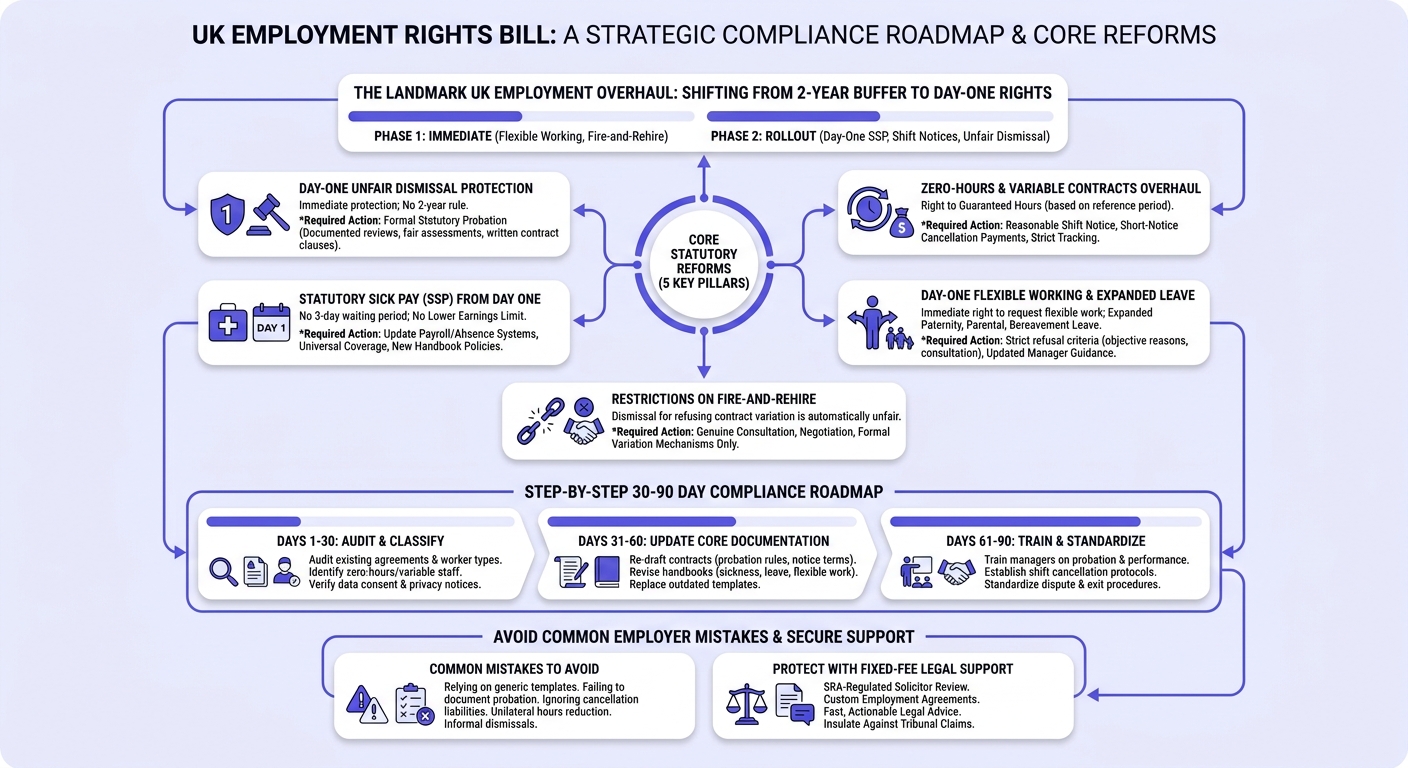
What the Employment Rights Bill Means for Small UK Employers
The statutory changes introduced by the government reshape standard hiring practices. Previously, small employers benefited from a 2-year buffer before employees could claim ordinary unfair dismissal. That qualifying period has been eliminated, making robust onboarding, fair performance management, and clearly drafted agreements mandatory from day one.
These reforms apply across the board. Whether you operate a five-person tech startup, a multi-site retail business, or a boutique consultancy, there is no blanket small-business exemption. If you engage workers, variable-shift staff, or salaried employees, your operational policies must align with the updated framework published in the GOV.UK Employment Rights Act factsheets.
To maintain legal certainty, businesses must treat employment compliance as an active risk-management priority rather than an administrative afterthought.
5 Business-Critical Reforms You Need to Know
                    CORE STATUTORY REFORMS
┌─────────────────────────────────────────────────────────────┐
│ 1. Day-One Unfair Dismissal & Statutory Probation Rules     │
│ 2. Guaranteed-Hours Offers for Variable & Zero-Hours Staff  │
│ 3. Day-One Statutory Sick Pay (No Lower Earnings Limit)     │
│ 4. Strengthened Flexible Working & Family Leave Entitlements│
│ 5. Prohibitions on Fire-and-Rehire Contract Changes         │
└─────────────────────────────────────────────────────────────┘
1. Day-One Protection Against Unfair Dismissal
The removal of the 2-year qualifying period for unfair dismissal is the single largest shift for employers. Employees now hold the right not to be unfairly dismissed from their very first day on the job.
To balance this protection, the law accommodates a statutory probationary period. During this statutory probation, employers can operate a lighter-touch dismissal process for capability or conduct, provided:
- The probation period is formally documented in the written contract of employment.
- The employer conducts structured reviews, documented warnings, and fair assessments.
- The dismissal does not breach discrimination laws, whistleblowing protections, or statutory fair procedure standards.
Relying on informal "bad fit" dismissals without documented performance evidence will expose businesses to immediate employment tribunal claims.
2. Overhaul of Zero-Hours and Variable Contracts
Zero-hours and low-hours contracts have faced extensive revision. Under the new statutory mandate, employers must offer regularized, guaranteed hours to qualifying workers who consistently work regular patterns over a defined reference period (typically 12 weeks).
Key operational requirements include:
- Right to Guaranteed Hours: Workers on casual or zero-hours contracts can demand a contract reflecting their regular hours.
- Reasonable Notice of Shifts: Employers must give adequate advance notice of shift schedules.
- Cancellation Payments: If an employer cancels, curtails, or changes a shift at short notice, they must pay financial compensation to the affected worker.
For shift-based sectors such as hospitality, leisure, healthcare, and logistics, these scheduling changes require strict operational tracking and workforce planning. You can explore how emerging workplace rules impact innovative sectors in our guide on 3 employment law changes in the UK employment rights bill every tech founder must know.
3. Statutory Sick Pay from Day One
Under the previous statutory framework, Statutory Sick Pay (SSP) involved a 3-day waiting period and required workers to earn above the Lower Earnings Limit (LEL).
The new rules remove both hurdles:
- No Waiting Days: Eligible staff receive SSP from the first qualifying day of illness.
- Universal Coverage: The Lower Earnings Limit is abolished, entitling low-wage and part-time workers to statutory sick pay support.
Small businesses must update their payroll software, sickness absence reporting systems, and internal absence management handbooks immediately to account for higher SSP utilization.
4. Day-One Flexible Working and Expanded Leave
Flexible working requests are now an immediate right from day one of employment. While employers can still refuse a request based on statutory business reasons (such as extra costs or inability to reorganize work), they must:
- Formally consult with the employee before rejecting an application.
- State clear, factually verifiable business grounds.
- Demonstrate that their refusal is objectively reasonable.
Additionally, paternity leave, parental leave, and bereavement leave protections have been expanded into immediate day-one entitlements, requiring updated handbook provisions and manager guidance. For broader market context on these statutory rights, read our breakdown of 7 employment law changes UK small business lawyers are tracking this year.
5. Restrictions on Fire-and-Rehire Practices
The controversial practice of dismissing employees and immediately rehiring them on less favorable terms—known as "fire and rehire" or "fire and replace"—is now strictly curtailed.
Under the updated provisions:
- Dismissals made because an employee refused to agree to a contract variation are treated as automatically unfair in standard commercial situations.
- An employer can only defend such dismissals in extreme situations where they can prove severe financial distress threatening the continuous viability of the business.
- Employers seeking contract adjustments must use genuine consultation, negotiation, and formal variation mechanisms rather than termination threats.
Implementation Timelines and Phased Rollout
The provisions of the reform package follow a structured commencement schedule established under secondary legislation and commencement orders such as The Employment Rights Act 2025 Regulations.
| Reform Measure | Status / Phase | Primary Action Required |
|---|---|---|
| Flexible Working Consultations | In Force | Update internal request policies and management decision forms. |
| Day-One Statutory Sick Pay | Phase 1 Rollout | Adjust payroll systems and absence notification triggers. |
| Day-One Unfair Dismissal | Phase 2 Rollout | Implement formal probation clauses and review milestones in all contracts. |
| Zero-Hours Shift Notices & Offers | Phase 2 Rollout | Audit shift-scheduling software and create guaranteed-hour calculation workflows. |
| Fire-and-Rehire Restrictions | Fully Enacted | Cease unilateral contract change threats; adopt legal variation procedures. |
Step-by-Step 30-90 Day Compliance Roadmap

Navigating these regulatory shifts requires a structured compliance plan. Use this 3-step action roadmap to update your business over the next quarter.
Days 1–30: Audit Existing Documentation and Staff Classifications
- Step 1: Conduct an audit of all active employment agreements, worker arrangements, and contractor documentation.
- Step 2: Identify every team member on zero-hours, irregular shift, or variable-rate contracts.
- Step 3: Verify employee privacy notices and data consent protocols using a Custom GDPR Employment Agreement Addendum.
Days 31–60: Update Core Contracts and Employee Handbooks
- Step 1: Re-draft standard offer letters and employment contracts to include enforceable probation rules, structured performance review milestones, and clear notice terms.
- Step 2: Replace non-compliant templates with a solicitor-drafted Custom Employment Agreement tailored to UK statutory law.
- Step 3: Revise company policies on sickness absence, parental leave, bereavement leave, and flexible working requests.
Days 61–90: Train Managers and Standardize Dispute Protocols
- Step 1: Train frontline managers and team leads on documenting performance concerns during probation periods.
- Step 2: Establish formal protocols for handling short-notice shift cancellations and calculating guaranteed-hour offers.
- Step 3: For exiting personnel or negotiated terminations, ensure risk-free departures by issuing a compliant Custom Employee Settlement Agreement.
Common Employer Mistakes to Avoid
- Relying on Generic, Outdated Templates: Free online templates rarely contain compliant statutory probation mechanics or updated day-one leave provisions.
- Failing to Document Probation Milestones: If an employer fails to carry out scheduled probation reviews, terminating an employee becomes vulnerable to an unfair dismissal claim.
- Ignoring Shift Cancellation Liabilities: Canceling shift work without paying statutory cancellation compensation creates immediate wage-deduction claims.
- Unilaterally Slashing Working Hours: Reducing hours for long-standing casual staff to bypass guaranteed-hours thresholds risks severe tribunal penalties.
- Dismissing Staff Informally: The era of informal "it’s not working out" dismissals without documented capability procedures has ended.
Protect Your Business with Fixed-Fee Employment Legal Support
Updating your employment contracts and workplace handbooks is the most cost-effective way to insulate your company against costly employment tribunal claims and regulatory fines. AirCounsel connects founders and small-business owners directly with experienced, SRA-regulated UK solicitors who draft compliant, commercially practical legal documents at transparent, fixed prices.
Whether you need to review your current agreements or roll out updated contracts across your entire team, our legal specialists deliver bespoke documents within 3 business days.
- Ensure your hiring agreements comply with the latest statutory changes by ordering an expert Review of your Employment Contract / Contractor Agreement.
- Implement robust, compliant hiring terms with a solicitor-drafted Custom Employment Agreement.
- Have a pressing compliance question? Submit your query to Ask a UK Solicitor a Question for clear, actionable advice within 2 business hours.
Frequently Asked Questions
What are the biggest changes in the Employment Rights Bill for small UK employers?
The most impactful changes include removing the 2-year qualifying period for unfair dismissal claims, introducing day-one Statutory Sick Pay, mandating guaranteed-hours offers for zero-hours workers, strengthening day-one flexible working rights, and placing severe restrictions on fire-and-rehire tactics.
When do the new UK employment rights changes take effect?
The reforms follow a phased rollout schedule. While provisions regarding flexible working and restrictions on fire-and-rehire practices are active, complex reforms—such as day-one unfair dismissal and zero-hours shift compensation—are being implemented through targeted commencement regulations. Employers must begin updating policies immediately.
Do the new rules apply to employers with just a few staff or only larger businesses?
The statutory changes apply to all UK employers regardless of headcount. There is no exemption for small businesses, early-stage startups, or sole-director companies. Every business employing staff or engaging qualifying workers must comply.
What policies and contracts should businesses update first?
Employers should prioritize their standard employment contracts, adding compliant statutory probation clauses. Following that, businesses must update staff handbooks regarding sickness absence (SSP rules), flexible working application processes, and shift-scheduling practices for variable-hours workers.
Can employers still use probationary periods under the new rules?
Yes. Employers can utilize statutory probationary periods to evaluate performance and suitability. However, the probation terms must be formally stated in writing, and dismissals during probation must follow fair, documented procedures.
Recommended
- Review of your Employment Contract / Contractor Agreement — Have an SRA-regulated solicitor review your employment agreements for statutory compliance and risk reduction.
- Custom Employment Agreement — Get a bespoke, UK law-compliant employment contract drafted within 3 business days.
- Ask a UK Solicitor a Question — Receive fast, actionable employment legal guidance from qualified UK solicitors for a flat fee.
Need Legal Assistance?
Our expert legal team is ready to help you navigate complex legal matters with confidence.