Why Small Business Lawyers Urge UK Startups to Register Trade Marks Before Launch

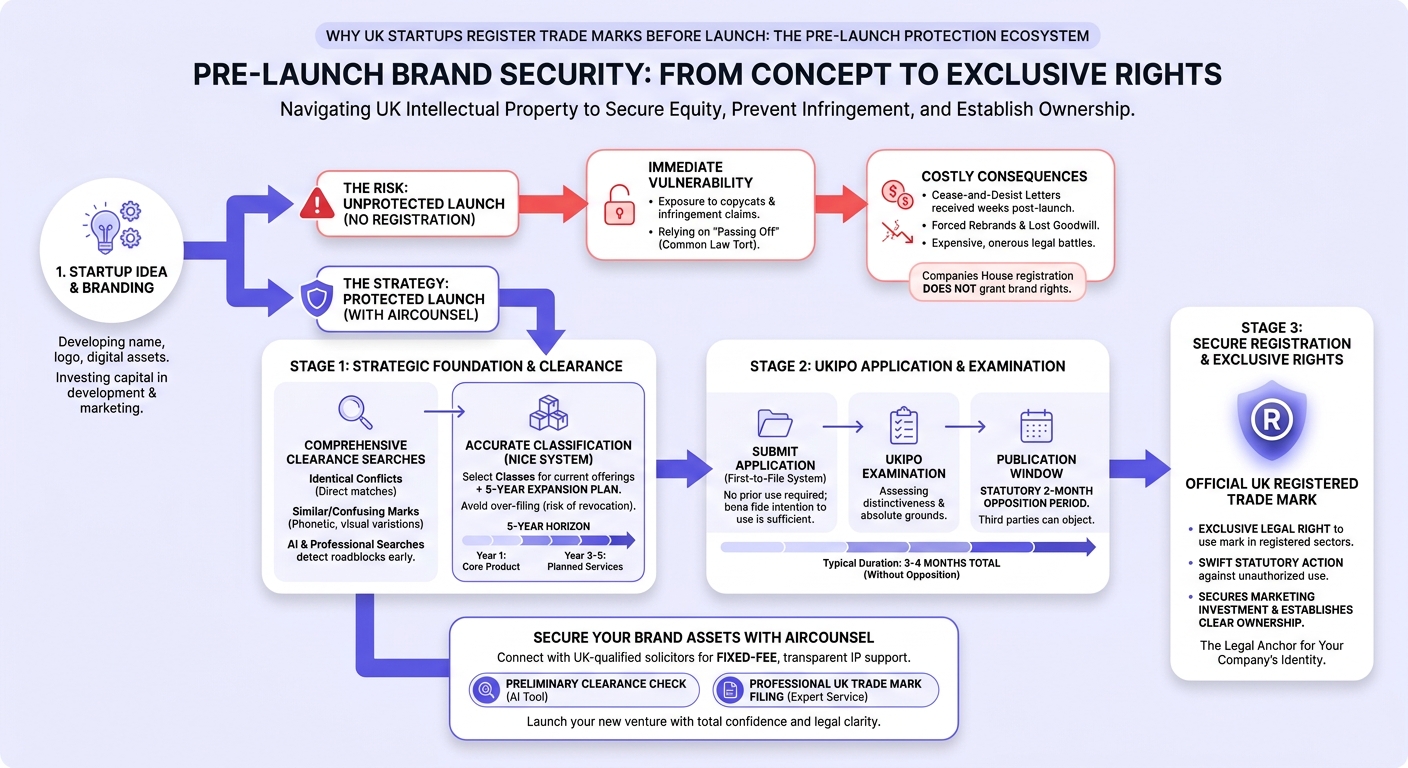
Launching a new startup online is an exhilarating milestone, but going live without securing your intellectual property creates immediate legal vulnerability. Many entrepreneurs invest thousands of pounds into web development, domain acquisition, and marketing collateral, only to receive a cease-and-desist letter within weeks of opening their virtual doors. Experienced small business lawyers consistently advise securing brand assets early to prevent costly rebrands, trademark disputes, and lost customer goodwill.
In the UK, trade mark rights operate primarily on a registration framework rather than automatic creation through mere trading activity. According to official GOV.UK guidance on trade mark applications, businesses should only select trade mark classes relevant to their commercial plans for the next 5 years, making early strategic planning essential for early-stage companies.
Failing to register your brand identity before launching exposes your venture to copycats and infringement claims from established competitors. Securing formal rights from day one protects your equity, secures your marketing investments, and establishes clear brand ownership under UK law.
Table of Contents
- Why Pre-Launch Trade Mark Protection Matters
- How UK Trade Mark Clearance Searches Work
- Step-by-Step Guide to UK Trade Mark Registration
- Common Pre-Launch Brand Protection Mistakes
- Costs, Timelines, and Legal Risk Management
- Secure Your Brand Assets with AirCounsel
- Frequently Asked Questions
- Recommended
Quick Summary
| Takeaway | Explanation |
|---|---|
| First-to-File Priority | The UK operates on a first-to-file basis; prior usage is not required to submit an application. |
| Companies House Distinction | Registering a limited company name does not grant proprietary brand ownership or trade mark rights. |
| 5-Year Specification Window | Class selections must reflect actual commercial offerings and realistic expansion plans over a 5-year horizon. |
| Clearance Prevents Infringement | Pre-filing searches identify confusingly similar marks before substantial capital is committed to marketing. |
| Fixed-Fee Efficiency | Working with small business lawyers on a fixed-fee model provides transparent protection without runaway hourly costs. |
Why Pre-Launch Trade Mark Protection Matters
A trade mark serves as the legal anchor for your company's identity, distinguishing your goods and services from those of competitors. When you register a trade mark with the Intellectual Property Office (UKIPO), you obtain the exclusive legal right to use that mark across the UK within your registered sectors.
Under the Trade Marks Act 1994, registered owners can take swift statutory action against unauthorized third parties using identical or confusingly similar branding. Without a registered mark, founders must rely on the common-law tort of "passing off," which requires onerous, expensive proof of established goodwill, active misrepresentation, and demonstrable commercial damage.
Establishing early legal clarity is just as vital for internal stability as it is for external brand security; for example, founders can read our guide on why UK startups need a shareholder agreement to ensure co-founder governance matches their external intellectual property strategy.
How UK Trade Mark Clearance Searches Work
A common trap for new founders is assuming that an available web domain or social handle indicates legal clearance. Trademark infringement occurs when a new name creates a likelihood of consumer confusion with an existing registered mark across identical or related business categories.
Comprehensive clearance searches evaluate two primary risk profiles:
- Identical Conflicts: Direct matches in spelling, phonetics, or visual styling within identical classes of goods or services.
- Similar or Confusing Marks: Variations in prefix, suffix, pronunciation, or visual presentation that could lead an ordinary consumer to believe the businesses are commercially linked.
Founders can begin with a preliminary check using a Free AI UK & EU Trade Mark Search to spot immediate roadblocks. For definitive clearance before public launch, engaging professional solicitors for a formal UK Trade Mark Search ensures common-law uses, phonetic matches, and UKIPO registry cross-references are thoroughly evaluated.
Step-by-Step Guide to UK Trade Mark Registration
Registering a trade mark requires careful preparation to avoid UKIPO objections or third-party oppositions.
[Clearance Search] -> [Select Nice Classes] -> [UKIPO Submission] -> [Examination] -> [2-Month Publication] -> [Registration]
Step 1: Conduct Comprehensive Clearance Searches
Before drafting your application, verify that your proposed mark is legally available. Searches should cover registered word marks, logos, stylised typography, and existing unregistered market participants.
Step 2: Classify Goods and Services Accurately
The UKIPO relies on the international Nice Classification system, which divides goods and services into 45 distinct classes (Classes 1–34 for physical goods, Classes 35–45 for services).
- Current Offerings: Cover your primary revenue drivers immediately upon launch.
- Planned Expansions: Include product lines or digital services scheduled for rollout within 3 to 5 years.
- Avoid Over-Filing: Filing in classes without a genuine intention to trade leaves your mark vulnerable to partial revocation after 5 years.
Step 3: Submit Your Application to the UKIPO
Submit the formal application detailing applicant entity information, mark representation, and class specifications. In the UK, you do not need to show proof of active use before filing, provided you hold a bona fide intention to use the mark in commerce.
Step 4: Navigate Examination and the Publication Window
Once submitted, the UKIPO examines the mark for absolute grounds of refusal (such as being purely descriptive or devoid of distinctive character). If approved, the mark is published in the Trade Marks Journal for a statutory 2-month opposition period, allowing third parties to raise objections. If no oppositions succeed, the UKIPO issues your registration certificate.
| Filing Stage | Primary Focus | Typical Duration |
|---|---|---|
| Pre-Filing Search | Cross-checking UKIPO and EUIPO databases for identical/similar marks | 1–3 business days |
| UKIPO Examination | Assessing distinctiveness and registrability under UK law | 1–2 months |
| Public Opposition Period | Statutory window for existing brand owners to lodge objections | 2 months |
| Final Registration | Issuance of formal trade mark certificate and entry into register | 3–4 months total |
Common Pre-Launch Brand Protection Mistakes
Navigating intellectual property without legal oversight often leads to preventable setbacks. Small business lawyers frequently see early-stage ventures stumble over these specific issues:
- Relying Exclusively on Companies House: Registering a company name at Companies House only reserves the corporate entity name. It provides zero legal protection against trade mark infringement and does not grant exclusive trading rights.
- Choosing Descriptive or Generic Names: Marks that merely describe the characteristics, quality, or intended purpose of goods (such as "Fast Delivery UK" for logistics) will be rejected by the UKIPO for lack of distinctive character.
- Waiting Until After Launch: Delaying your filing gives competitors or bad-faith actors the opportunity to file ahead of you, creating costly disputes.
- Selecting Inaccurate Class Terms: Utilizing vague, overbroad, or non-standard class descriptions can lead to UKIPO examination reports, delays, and unexpected re-filing fees.
Costs, Timelines, and Legal Risk Management
Managing your legal budget is crucial during pre-launch. Official UKIPO filing fees begin at £170 for an online application covering a single class, with an additional £50 for each extra class.
Working with qualified small business lawyers on a fixed-fee basis eliminates the uncertainty of hourly billing while ensuring your class specifications are legally robust. Partnering with a dedicated legal team through UK Trade Mark Filing allows you to secure comprehensive protection, address examiner queries efficiently, and safeguard your brand before spending capital on public marketing campaigns.
Secure Your Brand Assets with AirCounsel

Protecting your startup from day one shouldn't involve unpredictable legal fees or complex procedural hurdles. AirCounsel connects entrepreneurs directly with UK-qualified solicitors who deliver clear, actionable intellectual property support on transparent, fixed-price terms.
Ensure your brand identity is secure before your launch date. Secure your business name with our expert UK Trade Mark Filing service, or perform a preliminary clearance check using our UK Trade Mark Search to launch your new venture with total confidence.
Frequently Asked Questions
Do I need to use the trade mark before I apply in the UK?
No. Unlike some jurisdictions such as the United States, the UK operates on a first-to-file system where prior commercial use is not required before registration. However, you must have a genuine, bona fide intention to use the mark for the goods and services listed in your application.
How do I check whether my startup name is already taken?
You can search the official UKIPO trade mark register online to identify direct matches. However, because infringement also applies to confusingly similar or phonetically matching marks, conducting a comprehensive search with legal guidance helps identify potential opposition risks before filing.
What classes should a startup choose when registering a trade mark?
Startups should select the specific Nice classes that encompass their current core offerings, alongside categories planned for rollout within the next 3 to 5 years. Choosing accurate sub-terms within those classes is vital to ensure enforceable coverage without over-filing.
How long does UK trade mark registration usually take?
If an application faces no examiner objections and no third-party oppositions during the 2-month publication window, the entire UKIPO registration process typically concludes within 3 to 4 months from the initial submission date.
Recommended
- UK Trade Mark Filing – Complete UKIPO application drafting and submission handled by UK solicitors.
- UK Trade Mark Search – Comprehensive clearance reports to identify legal conflicts before launch.
- Free AI UK & EU Trade Mark Search – Fast automated preliminary search tool for early-stage startup names.
Need Legal Assistance?
Our expert legal team is ready to help you navigate complex legal matters with confidence.