Why Tech Buyers Choose an Asset Deal Over a Share Purchase Agreement: 5 Hidden Risks

Acquiring a technology business requires deciding how to structure the transaction. While many corporate buyouts use a share purchase agreement to transfer entire entity ownership, technology buyers frequently avoid stock transfers due to unknown historical liabilities.
According to M&A transaction data, over 70% of lower-middle-market tech acquisitions are structured as asset sales rather than equity purchases specifically to wall off legacy litigation, undisclosed debts, and tax issues.
However, an asset transaction does not guarantee total immunity. Without strict drafting and thorough technical due diligence, buyers can still inherit significant liabilities, encounter non-transferable software licenses, or face severe regulatory penalties.
Table of Contents
- Asset Purchase vs. Share Purchase Agreement: Strategic Differences
- 1. Successor Liability and Unrecorded Debts
- 2. Intellectual Property and Open-Source Licensing Gaps
- 3. Non-Assignable Contracts and Third-Party Consents
- 4. Tax Allocation Traps Under IRS Rules
- 5. Regulatory Scrutiny and Data Privacy Liabilities
- Key Deal Protections for Tech Buyers
- Secure Your Tech Acquisition with AirCounsel
- Frequently Asked Questions
- Recommended
Quick Summary
| Takeaway | Explanation |
|---|---|
| Structure Choice | A share purchase agreement buys the whole company entity, while an asset deal lets you selectively acquire target assets. |
| Successor Liability | Certain wage, product, and tax claims can cross over to the buyer despite explicit asset exclusions. |
| IP Ownership Chain | Software assets require verifiable assignment paperwork from every developer, employee, and independent contractor. |
| Contract Assignability | Critical customer contracts and cloud vendor accounts often require express written consent before transferring. |
| Tax Implications | Asset purchases enable a depreciable step-up basis under federal tax rules, but require Form 8594 allocation alignment. |
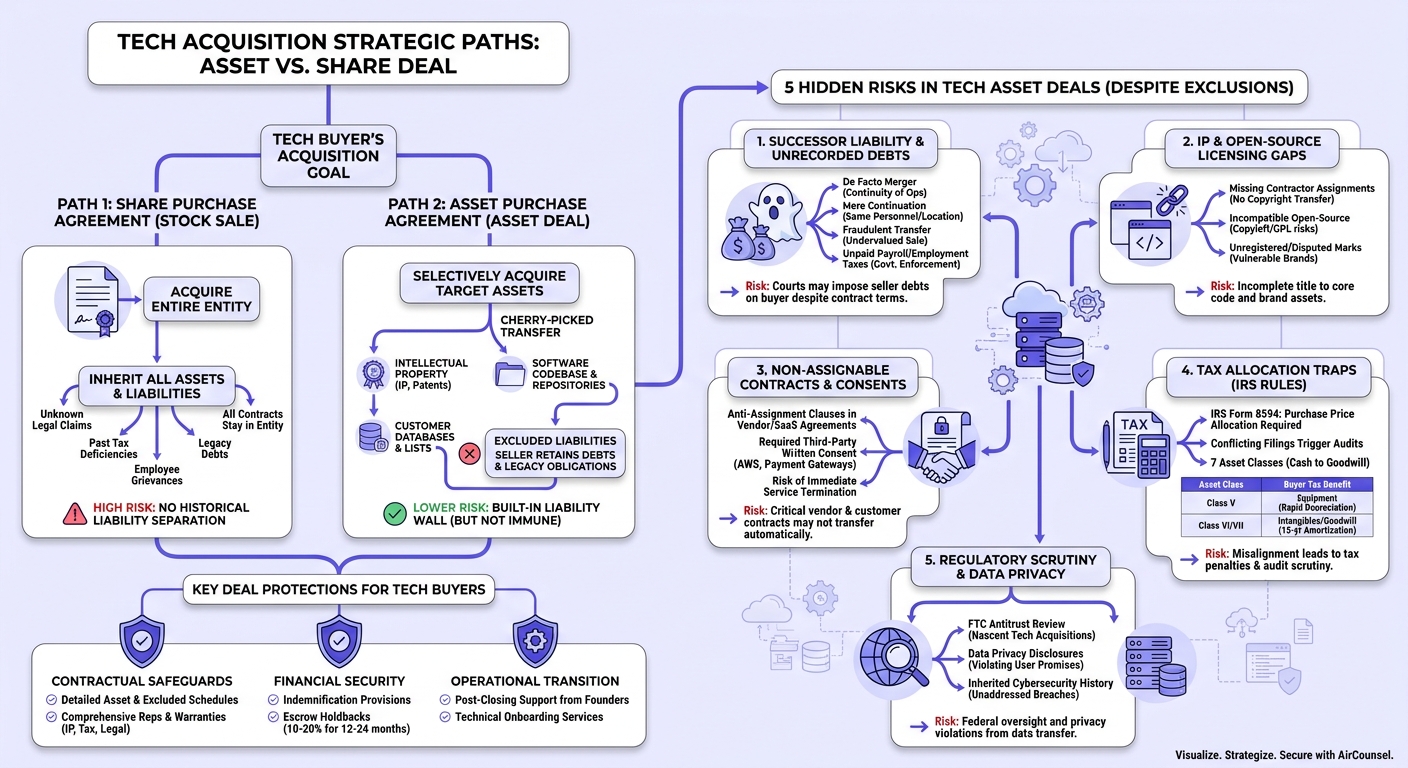
Asset Purchase vs. Share Purchase Agreement: Strategic Differences
When buying a business in the United States, your acquisition structure dictates your legal risk exposure and post-closing obligations. In a stock sale executed via a share purchase agreement or Custom Sale of Stock Agreement, you purchase equity directly from the company's shareholders. You inherit the target company's entire balance sheet, including unknown legal claims, past tax deficiencies, and existing employee grievances.
In contrast, an asset purchase agreement (APA) allows a buyer to cherry-pick specific intellectual property, customer databases, software codebases, and hardware while explicitly leaving target company debts with the seller.
Despite this built-in separation, acquiring tech assets carries hidden legal and operational risks that can undermine your deal value if left unaddressed.
1. Successor Liability and Unrecorded Debts
The primary legal reason buyers avoid a share purchase agreement is to insulate themselves from historical liability. Under general common law, an asset purchaser does not automatically assume the seller's debts. However, state and federal courts apply several "successor liability" exceptions that can make a buyer responsible for past obligations:
- De Facto Merger: If the transaction mirrors a corporate merger—such as keeping identical management, continuity of ownership, and dissolving the seller shortly after closing—courts may treat the purchase as an entity acquisition.
- Mere Continuation: If the purchasing entity maintains the same personnel, location, and core operations without a meaningful break, liability for pre-existing claims can follow the assets.
- Fraudulent Transfer: If the asset purchase price is below fair market value and leaves the seller insolvent to escape creditors, courts can void the transaction or hold the buyer liable.
- Unpaid Employment and Payroll Taxes: Federal agencies and state labor boards frequently enforce successor liability for unpaid payroll taxes, employee misclassification penalties, and wage-and-hour violations regardless of contract terms.

2. Intellectual Property and Open-Source Licensing Gaps
In a tech acquisition, software and intellectual property represent the primary value. An asset deal requires confirming that the seller owns clean, unencumbered title to every line of code, patent, and brand asset.
Common IP title defects include:
- Missing Contractor Assignments: Independent contractors own their copyright by default under US law unless they signed an explicit written assignment. You should verify every past contributor signed a Custom IP Assignment Agreement.
- Incompatible Open-Source Software (OSS): Proprietary software containing "copyleft" licenses (such as GPL v3) can legally obligate your company to release proprietary source code publicly.
- Unregistered or Disputed Marks: Failing to confirm federal trademark registration status with the USPTO can leave your newly acquired product vulnerable to infringement disputes.
3. Non-Assignable Contracts and Third-Party Consents
In a share purchase agreement, contracts often stay within the target entity unless an agreement contains a strict "change of control" clause. In an asset purchase, every customer contract, vendor subscription, and cloud infrastructure lease must be individually assigned to your acquiring entity.
Many commercial SaaS agreements, API licenses, and enterprise vendor contracts include explicit anti-assignment provisions. If you close an asset acquisition without obtaining prior written consent from crucial vendors (such as AWS, payment gateways, or key enterprise accounts), those agreements can terminate immediately, causing costly service disruptions.
4. Tax Allocation Traps Under IRS Rules
Asset transactions provide a major tax benefit over stock sales: the buyer receives a "stepped-up" basis in the acquired assets, enabling accelerated depreciation and amortization deductions.
Under IRS guidelines for selling a business, both buyer and seller must report the agreed purchase price allocation across 7 specific asset classes using IRS Form 8594.
| Asset Class | Typical Items Included | Buyer Tax Preference |
|---|---|---|
| Class I | Cash and general deposit accounts | Neutral |
| Class II & III | Actively traded securities, accounts receivable | High recovery speed |
| Class IV | Inventory and stock-in-trade | Immediate cost of goods recovery |
| Class V | Equipment, hardware, computers, furniture | Rapid depreciation (MACRS) |
| Class VI | Section 197 intangibles (patents, software, licenses) | 15-year straight-line amortization |
| Class VII | Goodwill and going-concern value | 15-year straight-line amortization |
Failing to agree on this allocation in the definitive agreement can lead to conflicting tax filings, triggering audit scrutiny from both state revenue departments and the IRS.
5. Regulatory Scrutiny and Data Privacy Liabilities
Federal antitrust oversight applies to asset acquisitions as well as entity mergers. The Federal Trade Commission Merger Guidelines emphasize that acquisitions of nascent technology, patents, or specialized data sets can face antitrust review if they substantially lessen market competition.
Additionally, transferring user databases involves consumer privacy compliance:
- Data Privacy Disclosures: If the seller's privacy policy promised users their information would never be shared or transferred, transferring those records during an asset sale without proper opt-in notices can violate FTC enforcement rules.
- Cybersecurity History: Buyers can inherit enforcement actions if the acquired asset database was compromised in an unaddressed, undisclosed historical data breach.
Key Deal Protections for Tech Buyers
To eliminate exposure when executing an acquisition, your contract must contain balanced risk-shifting provisions.
Essential Contractual Safeguards Checklist
- Detailed Asset & Excluded Asset Schedules: Explicitly itemize every code repository, domain name, hardware unit, and social account transferred, alongside a clear exclusion of legacy company liabilities.
- Comprehensive Reps & Warranties: Require the seller to certify full IP ownership, absence of open-source contamination, full tax compliance, and zero pending legal claims.
- Indemnification & Escrow Holdbacks: Reserve 10% to 20% of the total purchase price in an escrow account for 12 to 24 months post-closing to cover breach of warranty claims or unrecorded debts.
- Post-Closing Transition Support: Require key founders to provide onboarding and technical transition services to prevent platform downtime.
Secure Your Tech Acquisition with AirCounsel
Closing a tech asset acquisition without experienced legal review exposes your business to hidden debts, lost software rights, and avoidable tax penalties. AirCounsel provides fixed-fee, attorney-led acquisition drafting and contract review so you can close with complete confidence.
Order a tailored Custom Asset Purchase Agreement or protect your transaction terms with professional Negotiation Support. If you already have a draft on the table, use our rapid Review of your Contract or Legal Document to spot hidden liability transfer risks before signing.
Frequently Asked Questions
What liabilities can still follow a buyer in an asset purchase agreement?
Under US law, successor liability doctrines can transfer unpaid wage claims, workers' compensation liabilities, product liability claims, and delinquent state and federal employment taxes to an asset purchaser if the business operations continue without substantial change.
How do assignment and consent requirements affect tech asset deals?
Unlike stock purchases, an asset purchase requires transferring contracts individually. Many vendor agreements, cloud hosting terms, and enterprise client contracts contain anti-assignment clauses that require prior written consent before the asset sale can legally take effect.
What should a buyer check for in software, IP, and open-source ownership?
Buyers must confirm a clean chain of title by auditing contractor invention assignments, proprietary source code ownership, trademark registrations, and open-source license terms (such as GPL licenses) that could compromise proprietary software codebases.
How does an asset purchase agreement differ from a share purchase agreement for tax and liability purposes?
A share purchase agreement transfers the entire legal entity, including all historical balance-sheet liabilities, with no tax basis step-up. An asset purchase allows selective liability exclusion and permits the buyer to step up asset bases for enhanced post-closing tax depreciation.
Recommended
Need Legal Assistance?
Our expert legal team is ready to help you navigate complex legal matters with confidence.