Why You Need an Attorney to Review a Contract in the USA: Protecting Startup IP and NDAs

In the competitive American business landscape, small businesses make up 99.9% of all U.S. businesses, but early legal shortcuts frequently prevent startups from ever reaching scale. When launching a new venture, hiring an attorney to review contract in usa business matters is crucial for avoiding costly disputes over core intellectual property and confidential information.
Too many founders rely on generic online templates for Proprietary Information and Inventions Agreements (PIIAs) or standard Non-Disclosure Agreements (NDAs). Unfortunately, these standard forms rarely account for state-level nuances, present-assignment rules, or the distinct statutory requirements governing independent contractors versus full-time employees.
A single broken clause can taint your chain of title, scare off angel investors, or render your confidential business details entirely unprotected. Investing in a professional review before signing or distributing documents safeguards your company's equity, secures your proprietary technology, and provides legal certainty as you scale.
Table of Contents
- Quick Summary
- The High Cost of Skipping Contract Review
- Why Proprietary IP Assignment Agreements Are Critical
- Non-Disclosure Agreements: Common Flaws in Startup Templates
- Comparison: Boilerplate Templates vs. Attorney-Reviewed Contracts
- Step-by-Step Action Plan to Secure Your Legal Assets
- Get Fast, Expert Legal Protection Today
- Frequently Asked Questions
- Recommended
Quick Summary
| Takeaway | Explanation |
|---|---|
| Chain of Title Integrity | Unbroken documentation of ownership transfers is mandatory for securing venture capital, bank financing, and successful acquisitions. |
| Work-Made-for-Hire Limits | Independent contractors retain default ownership of created assets under US copyright law unless a valid written assignment explicitly states otherwise. |
| Present Assignment Wording | Contracts must state that the assignor "hereby assigns" rights now, rather than "agrees to assign" rights in the future. |
| NDA Enforceability | Overly restrictive NDAs can be invalidated by US courts, while overly narrow NDAs leave trade secrets unprotected. |
| Fixed-Fee Efficiency | Modern legal review eliminates expensive hourly billing while delivering actionable feedback within 2 business days. |
The High Cost of Skipping Contract Review
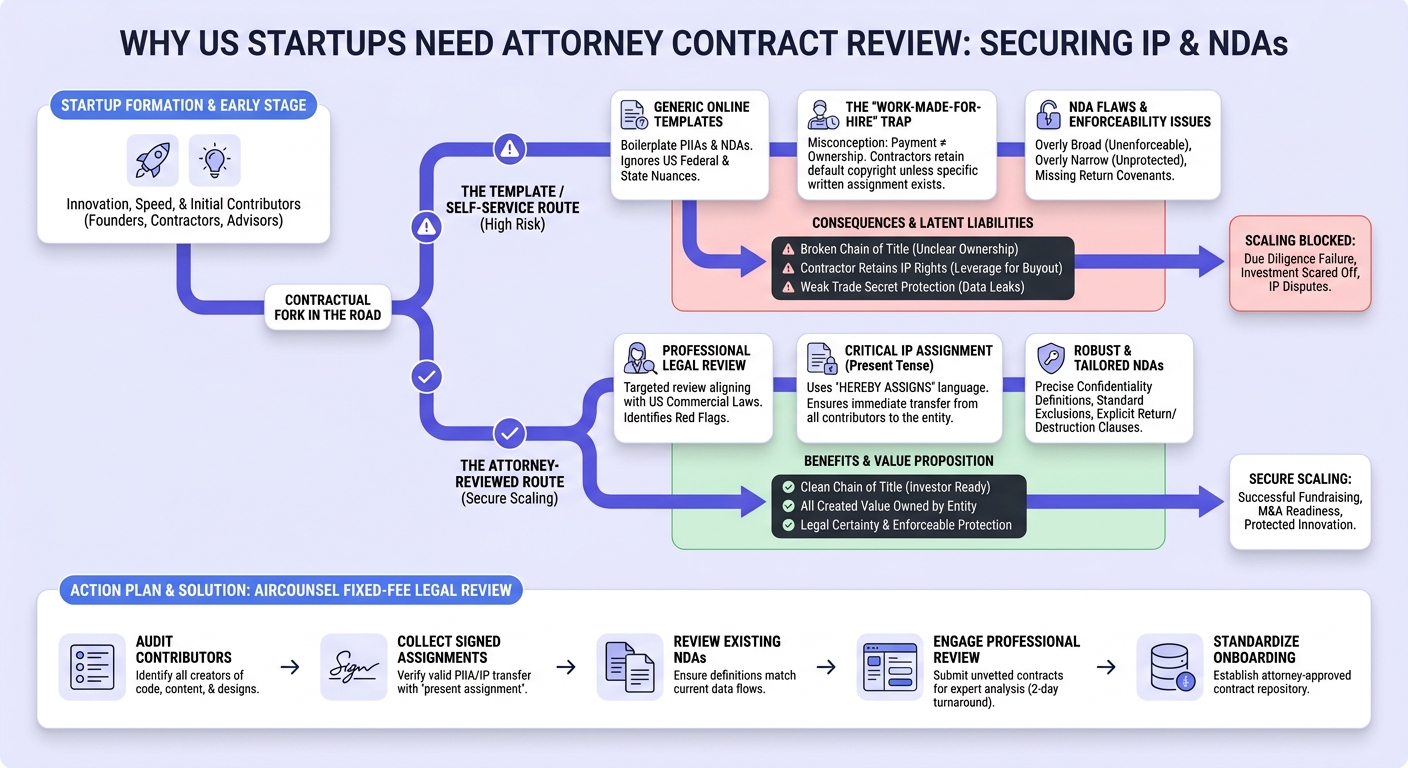
When early-stage companies build software, develop novel products, or onboard freelance talent, speed is often prioritized over legal structure. However, executing unvetted contracts creates latent liabilities that emerge during crucial milestones, such as Series A due diligence or acquisition discussions.
Investors and buyers conduct rigorous legal audits. If an outside contractor who built your foundational codebase never signed an airtight assignment, that contractor technically retains rights to the software. Resolving these issues retroactively gives the counterparty immense leverage to demand significant buyouts or equity stakes.
Engaging an attorney to review your core documents prevents these bottlenecks. A targeted review aligns your operational realities with US federal and state commercial laws, ensuring that all created value remains firmly inside your business entity.
Why Proprietary IP Assignment Agreements Are Critical
An Intellectual Property (IP) assignment agreement transfers all inventions, source code, designs, algorithms, and brand assets created by an individual or vendor directly to the corporate entity. Without this document, original creators retain default ownership under US federal statutes.

Understanding Chain of Title
Chain of title refers to the historical, unbroken record of ownership transfers for an asset. In intellectual property law, maintaining this record is non-negotiable.
According to formal guidelines maintained by the USPTO on ownership and assignment, clean documentation is required to establish legal standing and assert patent or trademark protections. A gap in the chain means your company cannot legally enforce its patent rights or file clean title transfers without extensive, expensive curative filings.
The Work-Made-for-Hire Trap in US Law
A frequent misconception among founders is assuming that paying an independent contractor automatically confers corporate ownership of the deliverables. Under federal copyright regulations outlined by the U.S. Copyright Office, the "work-made-for-hire" doctrine applies automatically only to direct W-2 employees acting within the scope of their employment.
For contractors and advisors, US law dictates that ownership remains with the author unless:
- The deliverable falls into a narrow set of statutory categories.
- There is an express, signed written agreement transferring ownership.
- The contract contains explicit "present assignment" phrasing (e.g., "hereby assigns all right, title, and interest").
If your contractor agreements lack these exact mechanisms, you may hold only a non-exclusive license to use the work rather than true ownership. You can prevent this by securing a deal-specific Custom Independent Contractor / Consulting Agreement or an explicit Custom IP Assignment Agreement.
Non-Disclosure Agreements: Common Flaws in Startup Templates
Non-Disclosure Agreements are essential for sharing confidential concepts with prospective partners, employees, and suppliers. However, using unreviewed internet templates introduces significant risks.
Overly Broad vs. Narrow Confidentiality Definitions
An NDA must strike a precise balance between comprehensive protection and legal enforceability:
- Overly Broad Terms: NDAs that classify everything as confidential—including publicly accessible data or general industry knowledge—risk being thrown out by US judges as unreasonable restraints on trade.
- Overly Narrow Terms: Templates that require every confidential communication to be marked in writing with "CONFIDENTIAL" within 30 days can leave verbal disclosures or informal Slack exchanges unprotected if founders fail to follow the administrative protocol.
Missing Exclusions and Return Covenants
Enforceable US NDAs require standard carve-outs, such as exclusions for information already known to the recipient, independently developed without access to the disclosures, or required to be produced by court order.
Additionally, many boilerplate agreements fail to include robust return or destruction clauses. A well-drafted NDA mandates that upon termination of talks, the recipient must either destroy or return all source files, roadmaps, and customer lists within a specific timeframe (typically 10 to 30 days) and provide written certification of compliance.
Comparison: Boilerplate Templates vs. Attorney-Reviewed Contracts
| Feature | Standard Online Template | Attorney-Reviewed Agreement |
|---|---|---|
| Assignment Language | Often uses future tense ("agrees to assign"), risking voided transfers | Uses precise present-tense assignment ("hereby assigns") |
| Worker Classification | Frequently confuses 1099 contractors with W-2 employees | Explicitly addresses statutory contractor requirements |
| Governing Law & Venue | May designate unfavorable or arbitrary state jurisdictions | Tailored to your primary place of business and state statutes |
| Due Diligence Ready | Leaves gaps that require expensive re-papering during fundraising | Built to withstand scrutiny by institutional investors and auditors |
| Cost Profile | Free upfront, but can cost $10,000+ in dispute resolution | Low, fixed upfront pricing with clear risk identification |
Step-by-Step Action Plan to Secure Your Legal Assets
- Audit All Contributors: List every founder, employee, contractor, agency, and informal advisor who has contributed code, graphics, architecture, or content to your product.
- Collect Signed Assignments: Verify that every contributor has executed a valid PIIA or IP transfer agreement containing present assignment language.
- Review Existing NDAs: Examine all active confidentiality agreements to ensure definitions match your current data flows and trade secret priorities.
- Engage Professional Review: Submit any unvetted or high-stakes contracts to a licensed attorney to identify red flags, ambiguous liabilities, and missing warranties.
- Standardize Onboarding Forms: Establish a reliable, attorney-approved repository of contracts for all future hires and business partnerships.
Get Fast, Expert Legal Protection Today
Securing your business shouldn't involve unpredictable legal fees or weeks of waiting. Whether you are onboarding a new technical lead, signing a vendor deal, or sharing sensitive business strategies with investors, having your agreements professionally evaluated eliminates hidden liabilities before they harm your company.
AirCounsel provides transparent, fixed-price legal solutions tailored specifically for modern founders and growing businesses. Protect your venture by ordering a comprehensive Review of your Contract or Legal Document to catch critical red flags within two business days, or instantly Ask a U.S Attorney a Question to get fast, actionable guidance on your most pressing legal concerns.
Frequently Asked Questions
What happens if a founder or contractor never signs an IP assignment agreement?
If an individual contributor creates code, branding, or product architecture without signing a formal assignment, they remain the legal copyright owner under US law. This creates a severe ownership dispute, clouding your company's chain of title and preventing investors from funding the business until the rights are formally assigned or purchased.
Are startup NDAs enforceable in the U.S. if they are broad or use a template?
NDAs that are excessively broad or attempt to restrict standard industry knowledge can be declared void by US courts. To remain enforceable, an NDA must clearly define confidential information, include reasonable time limitations, incorporate statutory exclusions, and avoid acting as a covert non-compete clause.
Can a startup lose ownership of code, designs, or inventions without a proper assignment?
Yes. Paying an invoice or having a verbal agreement does not legally transfer copyright or patent rights under US federal statutes. Without an executed written contract containing explicit assignment wording, the creator retains title, leaving the startup with only an implied, limited license to use the work.
When should a startup have an attorney review an NDA or IP assignment contract?
You should have an attorney review your contracts before any proprietary code or trade secrets are disclosed, and prior to paying any independent contractor or employee. An early review ensures all paperwork is enforceable and due-diligence ready from day one.
Recommended
Need Legal Assistance?
Our expert legal team is ready to help you navigate complex legal matters with confidence.