How to Coordinate with a USA Franchise Review Lawyer When Securing Retail Territory Leases

When launching a brick-and-mortar retail franchise, your commercial lease and your franchise agreement are inseparable. Signing a retail lease before your franchise documentation is cleared can lock you into long-term financial liabilities for a site the franchisor might reject. Engaging an experienced franchise review lawyer to review both agreements simultaneously ensures your territory protections, operational terms, and lease obligations work in harmony.
According to the U.S. Census Bureau, limited-service franchise restaurants represented about 54% of all fast-food restaurants in the United States, nearly 70% of sales, and about 73% of employment in that sector. Across retail and food service, franchise commitments involve significant capital and multi-year obligations. A synchronized legal review protects that capital by reconciling mandatory franchisor requirements with aggressive commercial landlord terms.
Navigating federal disclosure requirements while negotiating retail commercial real estate requires careful coordination. Here is how to synchronize your Franchise Disclosure Document (FDD) diligence with retail territory lease negotiations to eliminate costly contractual blind spots.
Table of Contents
- Quick Summary
- Why Franchise and Lease Reviews Must Happen Together
- FTC Franchise Rule Timelines and Lease Negotiations
- Key Lease Clauses That Clash with Franchise Agreements
- Comparison: Franchise Covenants vs Retail Lease Terms
- Step-by-Step Coordination Checklist
- Common Pitfalls and How to Avoid Them
- Protect Your Investment with Coordinated Legal Review
- Frequently Asked Questions
- Recommended
Quick Summary
| Takeaway | Explanation |
|---|---|
| Dual Legal Review | Reviewing your franchise agreement without cross-referencing your lease risks operational default on day one. |
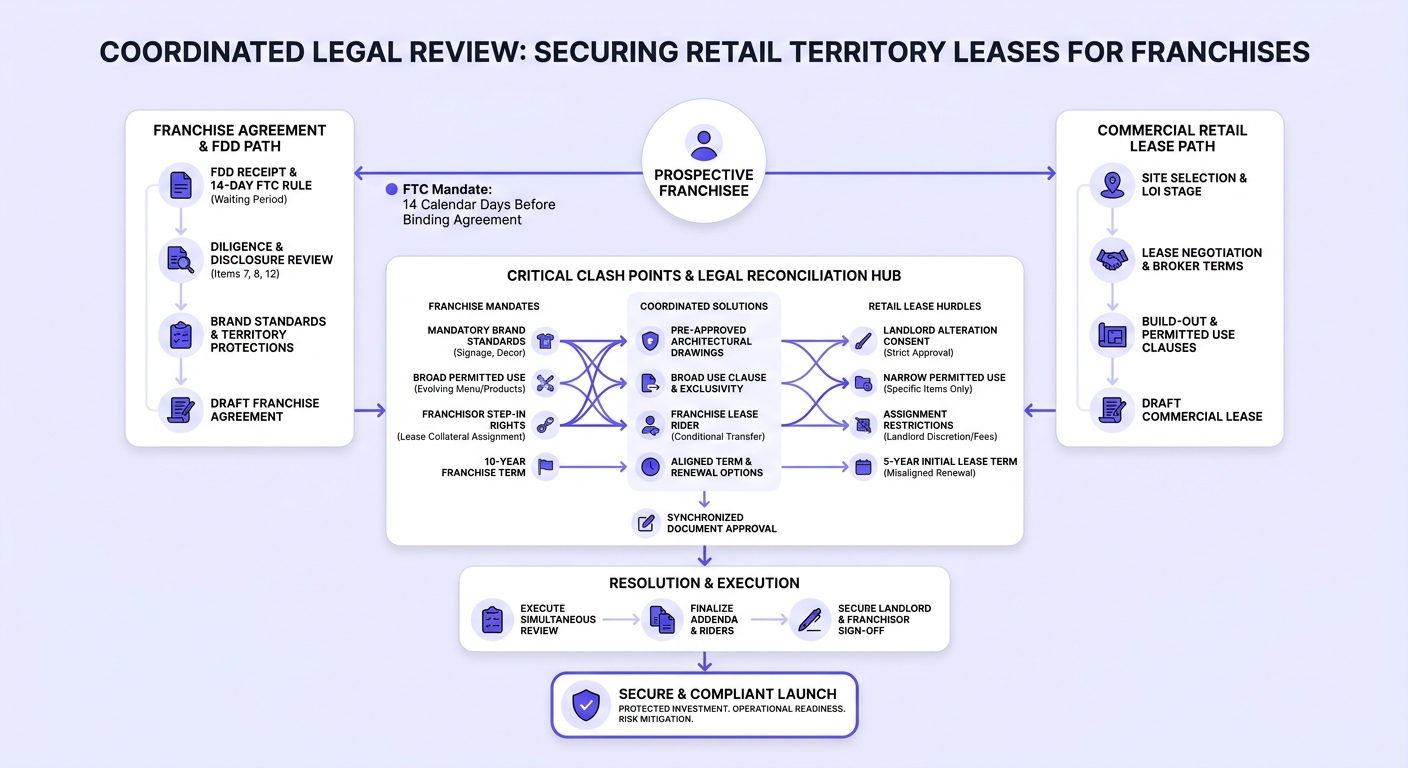
| FTC 14-Day Rule | Federal law mandates receiving the FDD at least 14 calendar days before signing or paying franchise fees. |
| Territory Alignment | Item 12 of the FDD must match the exact geographical protections granted in your retail trade area. |
| Assignment Provisions | Landlords must agree in advance to franchisor step-in rights and collateral assignments of the lease. |
| Term Synchronization | The initial commercial lease term and options should align with the standard 10-year franchise term. |
Why Franchise and Lease Reviews Must Happen Together
Franchisees frequently treat site selection and franchise onboarding as separate milestones. In practice, they are legally interdependent. A franchisor must formally approve your physical premises, but the franchisor will not execute the lease for you. If you sign a retail lease before your franchise agreement is finalized, you risk paying thousands in monthly rent for a property your brand will not authorize.
Conversely, signing a franchise agreement without knowing your real estate terms can expose you to unrealistic build-out deadlines. If your landlord delays delivery of the space, you could default under your franchise development schedule before you even open your doors. A franchise review lawyer evaluates these documents in tandem, ensuring cross-default clauses, insurance limits, and construction timelines are fully compatible.
Before executing property contracts, operators should understand the hidden risks of signing a commercial lease when operating under strict third-party brand standards.
FTC Franchise Rule Timelines and Lease Negotiations
Under the FTC Franchise Rule (codified at 16 CFR Part 436), franchisors must provide prospective franchisees with an FDD at least 14 calendar days before any binding agreement is signed or money changes hands.
This 14-day statutory waiting period is the critical window for retail diligence. While reviewing the 23 mandatory disclosure items, your attorney will focus heavily on sections that directly impact real estate:
- Item 7 (Initial Investment): Outlines estimated leasehold improvements, security deposits, and real estate acquisition costs.
- Item 8 (Restrictions on Sources of Products and Services): Dictates required contractors, architectural specifications, signage, and equipment vendors.
- Item 12 (Territory): Defines your exclusive territory, radius restrictions, and whether the franchisor can open alternative distribution channels (such as kiosks or grocery placements) nearby.
While federal rules set the baseline, franchise registration states (such as California, New York, and Illinois) impose supplementary filing and disclosure mandates. A coordinated legal review confirms state compliance while your commercial broker finalizes letter of intent (LOI) terms.
Key Lease Clauses That Clash with Franchise Agreements
Commercial retail leases are designed to protect property owners, while franchise agreements favor franchisor brand control. Without strategic negotiation, the tenant-franchisee gets caught in the middle.
Permitted Use and Exclusivity
Retail leases typically contain narrow "permitted use" clauses specifying exactly what goods or services you can sell. However, franchise systems regularly evolve their menus or product lines. Your lease must allow you to sell any items authorized by the franchisor now or in the future. Additionally, your lawyer should negotiate exclusivity within the shopping center to prevent the landlord from leasing adjacent space to a direct brand competitor.
Assignment and Franchisor Step-In Rights
Almost all franchise systems require a standard Lease Rider or Collateral Assignment of Lease. This document gives the franchisor the right to assume the lease if the franchisee defaults, preserving the retail location for the brand. Commercial landlords often resist automatic assignments without extensive credit checks or transfer fees. Your attorney must ensure the landlord pre-approves franchisor step-in rights without releasing you into immediate personal liability.
Term Alignment and Renewal Windows
A standard franchise agreement lasts 10 years, whereas retail leases are commonly structured as 5-year initial terms with 5-year renewal options. If your lease expires before your franchise term—and you lack guaranteed renewal options at predictable market rates—you could lose your location while remaining liable for franchise royalties and liquidated damages.
Build-Out and Brand Standards
Franchisors enforce strict architectural plans, interior finishes, and exterior signage packages. If local zoning ordinances or shopping center covenants prohibit required pylon signs or architectural modifications, you cannot operate compliantly. Your lease must include a feasibility contingency allowing you to terminate penalty-free if the franchisor or local municipality rejects your site plans.
Comparison: Franchise Covenants vs Retail Lease Terms
To illustrate how these contracts interact, consider how standard provisions must be reconciled:
| Legal Provision | Franchise Agreement Requirement | Retail Lease Standard Term | Coordinated Solution |
|---|---|---|---|
| Permitted Use | Any current or future product authorized in the brand operations manual. | Narrowly defined to specific menu items or services. | Broad permitted use clause referencing the franchisor's evolving brand standards. |
| Transfer / Assignment | Mandatory right for franchisor or approved buyer to assume premises. | Landlord sole discretion, assignment fees, and net-worth tests. | Pre-negotiated Lease Rider granting conditional transfer rights to qualified operators. |
| Signage & Alterations | Strict requirement to display trademarked signs and proprietary decor. | Landlord approval required for all exterior changes and structural work. | Landlord pre-approves standard franchise architectural drawings and trade dress. |
| Operating Hours | Mandatory minimum operating hours (e.g., 7 days/week, 14 hours/day). | Center-wide core retail hours set by property management. | Express carve-out ensuring compliance with the franchisor's mandatory schedule. |
Step-by-Step Coordination Checklist
Securing a retail territory requires disciplined execution across multiple parties. Follow these steps to ensure legal harmony:
- Step 1: Form the Operating Entity: Protect personal assets by completing your USA Entity and Company Formation before signing letters of intent or deposit agreements.
- Step 2: Collect All Primary Disclosures: Gather the current FDD, franchise agreement exhibits, brand construction manuals, and the draft retail lease.
- Step 3: Execute Simultaneous Document Review: Engage counsel for an integrated Franchise Agreement and FDD Review to identify conflicting territorial and operational restrictions.
- Step 4: Draft the Franchise Lease Rider: Ensure your real estate attorney or franchise counsel attaches the franchisor's required tripartite addendum to the master commercial lease.
- Step 5: Secure Landlord and Franchisor Sign-Off: Do not pay the initial franchise fee or deliver a lease security deposit until both parties have approved the overlapping covenants in writing.
Common Pitfalls and How to Avoid Them
- Personal Guarantees Without Caps: Both franchisors and landlords routinely demand unlimited personal guarantees. Negotiate rolling burn-off provisions or monetary caps on personal exposure once the unit hits profitability milestones.
- Ignoring Radius Restrictions: Signing a lease near the outer boundary of your protected territory can trigger disputes if the franchisor licenses an adjacent territory to another multi-unit operator. Review our guide on multi-unit operator due diligence for territory planning strategies.
- Overlooking De-identification Obligations: If your franchise agreement terminates, you are legally required to remove all brand trademarks, color schemes, and proprietary fixtures. If your lease requires you to leave all leasehold improvements intact for the landlord, you face conflicting contractual mandates.
Protect Your Investment with Coordinated Legal Review

Navigating franchise territory rights alongside aggressive retail leasing terms requires speed, practical precision, and transparent pricing. Missing a single conflicting clause can trigger lease defaults, franchisor disputes, or personal financial exposure.
AirCounsel provides rapid, fixed-fee document reviews by licensed US attorneys. Whether you need a comprehensive Franchise Agreement and FDD Review or a targeted Commercial / Residential Lease Agreement Review, our attorneys deliver redlines and actionable negotiation points in plain English within 2 business days.
Frequently Asked Questions
When should a franchise review lawyer get involved in a retail lease negotiation?
A franchise review lawyer should be engaged during the Letter of Intent (LOI) stage, well before executing a binding commercial lease or paying the non-refundable franchise fee. Early involvement ensures that lease contingencies, permitted use clauses, and franchisor approval requirements are embedded from the start.
What lease terms matter most for a franchised retail location?
The most critical clauses include the permitted use definition, assignment and subletting rights, franchisor step-in riders, exclusive use protections against competitors in the same shopping center, and term renewal options that mirror your franchise agreement.
How does the Franchise Disclosure Document relate to the lease?
The FDD outlines mandatory brand standards, estimated real estate costs (Item 7), territory protections (Item 12), and approved vendor mandates (Item 8). Your lease must accommodate all operational covenants outlined in the FDD to prevent an immediate breach of your franchise agreement.
Can a franchisor restrict territory or require lease approval before the location is finalized?
Yes. Most franchise agreements grant franchisors the absolute right to approve or reject any prospective site and commercial lease. However, franchisor site approval does not guarantee commercial success or protect you against unfavorable lease terms, making independent legal review essential.
Recommended
Need Legal Assistance?
Our expert legal team is ready to help you navigate complex legal matters with confidence.