Franchise Review Lawyer in the USA: Due Diligence Guide for Multi-Unit Operators

Scaling a business portfolio across multiple locations offers significant commercial upside, but it also multiplies your contractual liability. Before committing hundreds of thousands of dollars to multi-unit development schedules, consulting an experienced franchise review lawyer in the USA ensures you uncover hidden liability, restrictive covenants, and one-sided fee structures buried inside complex disclosure documents.
According to the Federal Trade Commission, prospective franchisees must receive a standardized 23-item Franchise Disclosure Document (FDD) at least 14 days before signing any binding contract or paying any initial fees.
While single-unit buyers often focus on immediate startup costs, multi-unit operators must evaluate long-term territory exclusivity, mandatory remodel schedules, cross-default mechanisms, and succession rights. This due diligence checklist outlines how to evaluate legal risk and protect your capital before signing multi-site commitments.
Table of Contents
- The Legal Baseline: FTC Rules and FDD Anatomy
- High-Risk FDD Items for Legal Review
- Multi-Unit Contract Review Checklist
- Verifying Brand Reality and Operational Support
- Costs, Timelines, and Negotiation Dynamics
- When to Hire a Franchise Review Lawyer
- Secure Your Multi-Unit Franchise Investment
- Frequently Asked Questions
- Recommended
Quick Summary
| Takeaway | Explanation |
|---|---|
| 14-Day Mandatory Review | Federal law grants a mandatory 14-day statutory waiting period after receiving the FDD before signing or funding. |
| Multi-Unit Territory Risk | Multi-site deals require strict geographic carving, explicit development milestones, and rights of first refusal. |
| Item 19 Scrutiny | Financial Performance Representations are optional; unverified financial representations must be vetted against franchisee data. |
| Cross-Default Traps | Poorly drafted agreements allow a default at one operational unit to trigger termination across your entire development territory. |
| Legal Counsel Role | A dedicated attorney spots operational traps, negotiates addenda, and caps personal guarantee exposure. |
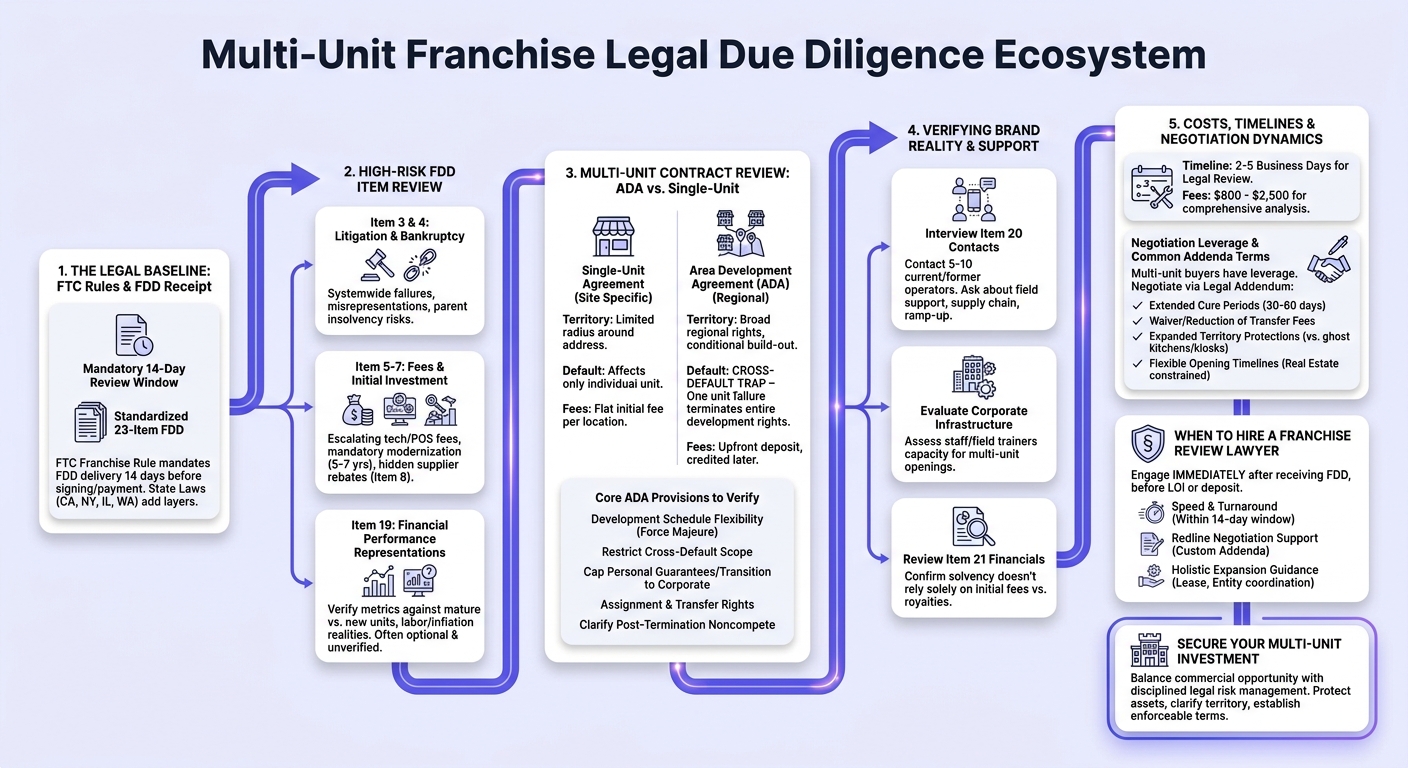
The Legal Baseline: FTC Rules and FDD Anatomy
The Federal Trade Commission (FTC) regulates the offer and sale of franchises across all 50 states through the FTC Franchise Rule. This framework mandates that franchisors provide prospective buyers with an FDD containing 23 distinct disclosure sections.
Certain states—such as California, New York, Illinois, and Washington—impose additional franchise registration requirements and statutory relationship laws that grant greater franchisee protections against unfair termination.
Understanding these regulatory layers is crucial:
- Federal Baseline: Sets minimum disclosure rules, mandatory financial declarations, and the 14-day disclosure period.
- State Registration Laws: Require state regulatory approval before a franchisor can market units in that jurisdiction.
- State Relationship Laws: Limit the franchisor’s ability to terminate agreements without good cause and impose mandatory cure windows.
High-Risk FDD Items for Legal Review
Every section of the FDD warrants attention, but multi-unit operators should direct primary legal scrutiny toward specific items that dictate long-term profitability and operational control.
Item 3 and Item 4: Litigation and Bankruptcy
Item 3 details pending and historical litigation involving the franchisor, its affiliates, and key executives. A high volume of disputes involving systemwide operational failures, misrepresentation claims, or territory disputes signals institutional instability. Item 4 outlines recent bankruptcy filings, revealing whether the parent company or its leadership faces insolvency risks that could derail brand marketing and operational support.
Item 5 to Item 7: Fees and Initial Investment
These sections disclose initial franchise fees, ongoing royalties, advertising fund contributions, and estimated total launch costs per unit. For multi-unit buyers, pay particular attention to:
- Technology and POS Fees: Variable or escalating software mandates that add unbudgeted operational overhead.
- Mandatory Modernization Clauses: Requirements to remodel or re-image locations every 5 to 7 years at your sole expense.
- Supplier Rebates (Item 8): Hidden revenue streams where the franchisor receives kickbacks on required inventory purchases.
Item 19: Financial Performance Representations
Franchisors are not legally required to provide sales or profit data. If they do, it appears in Item 19. Multi-unit buyers must evaluate whether the disclosed metrics represent company-owned units or mature franchise locations, whether low-performing locations were excluded from averages, and if unit-level labor and supply chain inflation are accurately reflected.

Multi-Unit Contract Review Checklist
When scaling beyond a single location, you typically execute two distinct contracts: an Area Development Agreement (ADA) granting development rights for a region, and individual Franchise Agreements for each specific site.
| Legal Term | Single-Unit Agreement | Multi-Unit / Area Development Agreement |
|---|---|---|
| Territory Exclusivity | Limited radius around a single physical address. | Broad regional territory conditioned on strict build-out deadlines. |
| Default Impact | Affects only the individual store location. | Risk of cross-default terminating future development rights. |
| Fee Structure | Flat initial fee paid per location opened. | Upfront development deposit credited toward subsequent openings. |
| Renewal Terms | Standard 5- to 10-year renewal conditions. | Phased renewals requiring ongoing capital commitments per site. |
When reviewing these agreements, verify the following core provisions:
- Development Schedule Flexibility: Ensure clear force majeure language covers supply chain disruptions, construction delays, and permitting bottlenecks without triggering forfeiture of development deposits.
- Cross-Default Provisions: Restrict cross-defaults so that an operational dispute or lease issue at Location A does not permit the franchisor to cancel rights to Locations B, C, and D.
- Personal Guarantees: Limit personal liability. Strive to negotiate a cap on personal exposure or transition to corporate guarantees once performance milestones are met.
- Assignment and Transfer Rights: Secure permissions to restructure your operational entities or sell minority equity to passive investors without franchisor vetoes.
- Noncompete Enforceability: Clarify post-termination noncompete scopes to prevent overly broad geographic restrictions that impede your future commercial ventures.
Verifying Brand Reality and Operational Support
Due diligence requires looking beyond the franchisor's promotional materials to verify real-world unit economics and systemwide support capacity.
- Interview Item 20 Contacts: Contact at least 5 to 10 current and former operators listed in Item 20. Inquire about actual corporate field support, supply chain reliability, and average ramp-up times.
- Evaluate Corporate Infrastructure: Determine if the franchisor maintains sufficient operational staff and field trainers to support simultaneous multi-unit openings.
- Review Item 21 Financials: Have a professional examine the franchisor’s balance sheet to confirm they do not rely solely on initial franchise fees rather than ongoing royalty streams for solvency.
Costs, Timelines, and Negotiation Dynamics
While franchisors often claim their standard franchise agreement is non-negotiable, multi-unit buyers hold significantly more leverage than single-unit applicants. Well-capitalized operators committing to multiple sites can often negotiate modifications via a tailored legal addendum.
Legal reviews for multi-unit transactions typically take 2 to 5 business days. Professional legal fees typically range from $800 to $2,500 for comprehensive contract analysis and redlining, depending on transaction complexity. Addressing these terms upfront avoids costly litigation, territory loss, and uncapped personal liabilities down the road.
Common negotiable terms include:
- Extended cure periods for operational defaults (e.g., 30 to 60 days instead of 10 days).
- Waivers or reductions of transfer fees during internal corporate restructurings.
- Expanded geographic territory protections against alternative distribution channels (such as ghost kitchens or airport kiosks).
- Flexible timelines for opening subsequent units if commercial real estate inventory is constrained.
When to Hire a Franchise Review Lawyer
Engaging legal counsel should happen immediately after receiving the initial FDD and before signing any letter of intent (LOI) or wiring deposit funds.
Retaining a dedicated legal professional ensures you receive:
- Speed and Turnaround: Fast identification of high-risk clauses within your statutory 14-day review window.
- Redline Negotiation Support: Custom addenda drafted to amend oppressive clauses, protect your entity structure, and cap liabilities.
- Holistic Expansion Guidance: Coordination between your franchise agreements, lease negotiations, and corporate holding entities.
Secure Your Multi-Unit Franchise Investment
Navigating multi-unit franchise transactions requires balancing commercial opportunity with disciplined legal risk management. Securing experienced legal oversight helps protect your personal assets, clarify territory exclusivity, and establish enforceable terms before you commit your capital.
AirCounsel provides transparent, fixed-fee legal solutions designed for ambitious entrepreneurs. Get a comprehensive, fast-turnaround Franchise Agreement and FDD Review to identify hidden risks, leverage expert Negotiation Support to secure key contractual concessions, and ensure your commercial leases are sound with a dedicated Commercial / Residential Lease Agreement Review.
This article provides general information and is not legal advice.
Frequently Asked Questions
What should a multi-unit buyer look for in a Franchise Disclosure Document?
Multi-unit buyers should focus on Item 3 (litigation history), Item 7 (realistic initial investment ranges), Item 8 (supplier restrictions and rebates), Item 12 (territory rights and carveouts), Item 19 (financial performance representations), and Item 20 (franchisee turnover rates). Reviewing these items helps evaluate system stability, genuine operating costs, and expansion viability.
How long do I have to review an FDD before signing or paying?
Under the FTC Franchise Rule, you must receive the FDD at least 14 calendar days before signing any binding franchise agreement or paying any money to the franchisor or its affiliates. Some state laws grant additional statutory review windows, making early legal engagement essential.
What red flags in a franchise agreement matter most for multi-unit operators?
Critical red flags include strict cross-default clauses, inflexible development schedules that trigger territory forfeiture without cure periods, uncapped personal guarantees, unilateral franchisor changes to operating manuals, and ambiguous territory protections that permit online or kiosk encroachment.
Do I need a lawyer to review a franchise purchase before I expand into multiple units?
Yes. Multi-unit commitments involve substantial financial obligations spanning multiple commercial leases, staffing requirements, and development milestones. A specialized franchise attorney identifies one-sided terms, drafts protective addenda, and ensures your corporate entities shield you from personal liability.
Can franchise agreements and development schedules be negotiated in the US?
Yes. While franchisors rarely change standard terms for single-unit buyers, multi-unit operators committing to develop entire territories often have the commercial leverage to negotiate development deadlines, transfer terms, cure periods, and personal guarantee limitations via an addendum.
Recommended
- LLC Operating Agreement – Structure your multi-unit franchise holding entity with tailored governance and liability protections.
- USA Entity and Company Formation – Form compliant operating companies and subsidiaries for each franchise location.
- Custom Contract Drafter – Draft legally enforceable business contracts, terms, and policies tailored to US law.
Need Legal Assistance?
Our expert legal team is ready to help you navigate complex legal matters with confidence.