How a Contract Review Lawyer Solves Deadlocks in Your Delaware LLC Operating Agreement

As an entrepreneur, choosing Delaware to establish your startup offers incredible statutory flexibility, corporate stability, and robust shielding of assets. According to data published by the Small Business Administration, 99.9% of U.S. businesses are small businesses, and a massive volume of these entities register in Delaware. But structural flexibility can become a critical hazard if equal business partners find themselves in a deadlock without a pre-negotiated dispute resolution track.
If your governing documents lack deadlock mediation, you risk running your venture straight into a wall of expensive litigation or forced dissolution. Partnering with a dedicated contract review lawyer is the most protective step you can take to bridge these gaps. A specialized lawyer can dissect your current framework, highlight dangerous silence on tie-breakers, and write custom path-to-resolution mechanisms into your agreements before minor operational disagreements turn into corporate divorces.
Table of Contents
- Understanding LLC Deadlocks and Why They Matter
- The Risks of Omitting Deadlock Mediation in Delaware LLCs
- What Delaware Default Law Says When Agreements are Silent
- The Role of a Contract Review Lawyer: What to Look For
- Step-by-Step Guide to Amending Your Operating Agreement
- Summary of Deadlock Escalation Paths
- Protect Your Venture with AirCounsel
- Frequently Asked Questions
- Recommended
Quick Summary
| Takeaway | Explanation |
|---|---|
| Deadlock Risk | A 50/50 division on vital choices halts your company's banking, product growth, and operations. |
| Silent Agreements | Omitting mediation clauses leaves you dependent on hostile lawsuits or worst-case liquidations. |
| Delaware Default Law | The Delaware Court of Chancery will order judicial dissolution only if execution of operations is impossible. |
| Mitigation Strategy | A contract review lawyer edits governance terms to insert multi-stage escalations and mandatory mediation. |
| Ease of Amendment | Agreements can be quickly amended with expert guidance if all current members agree to the new clauses. |
Understanding LLC Deadlocks and Why They Matter
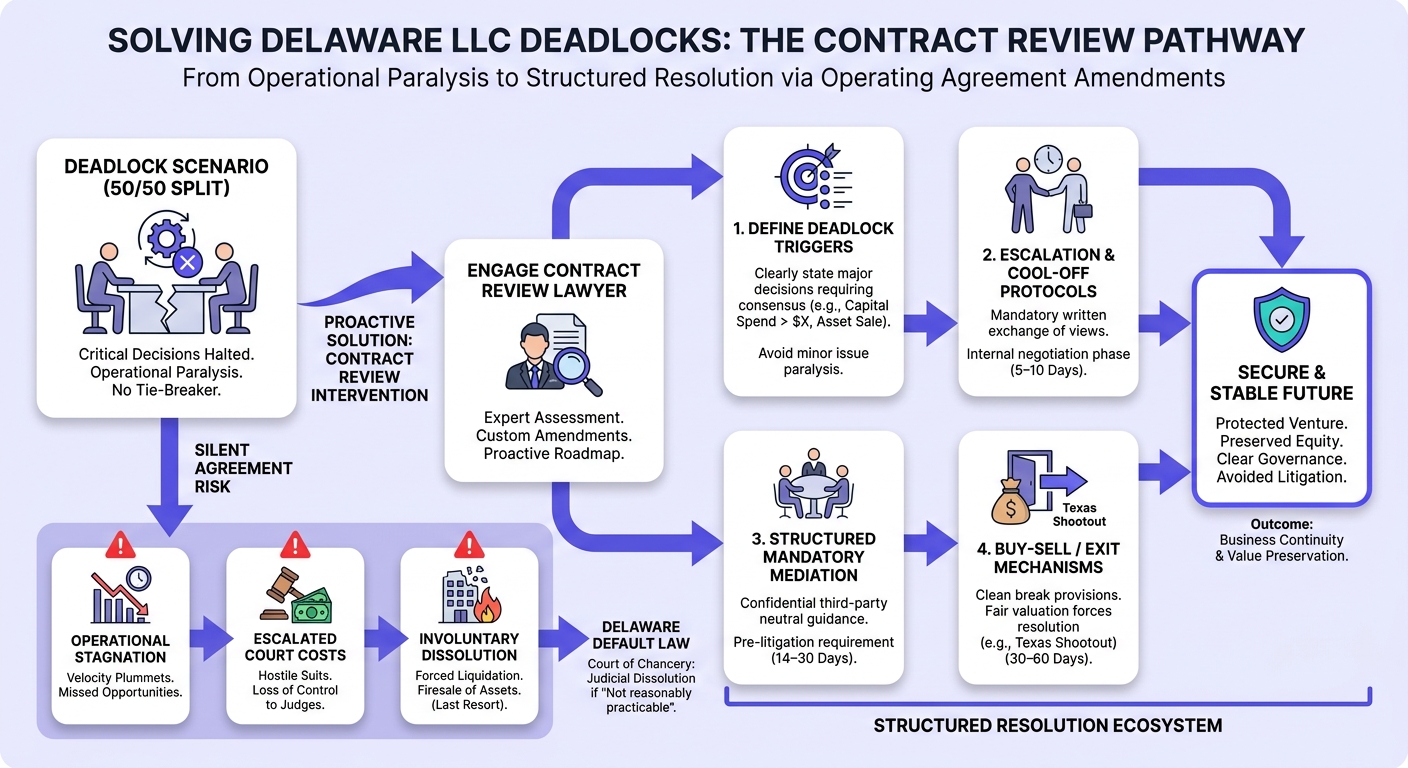
A corporate deadlock occurs when managing members or directors split evenly on critical, strategic decisions. In 50/50 ownership frameworks or multi-member boards with even voting allocations, this lack of a tie-breaker leads to complete operational paralysis.
Major business decisions—such as securing credit lines, hiring high-level management, modifying product directions, or choosing to sell off physical or intellectual assets—normally require majority or supermajority consensus. When relationships sour or visions diverge, equal partners can find themselves in an endless pattern of vetoes. Lacking structured procedures to bypass these blockages, daily administrative velocity plummets, strategic bills remain unpaid, and the legal entity risks complete collapse.
The Risks of Omitting Deadlock Mediation in Delaware LLCs
Your operating agreement acts as the supreme manual for running your enterprise. When those governing files neglect to lay out how to navigate equal divisions of decision-making power, you risk:
- Escalated Court Costs: Lacking a structured contract track, frustrated members often initiate hostile suits to assert leverage instead of working through a neutral mediator.
- Relinquished Control: Judges do not understand your business model. Leaving key outcomes up to courts hands your firm’s survival over to outside parties.
- Operational Stagnation: Competitors outpace deadlocked entities quickly, and key vendors or accounts often depart due to obvious administrative instability.
- Involuntary Wind-Ups: Incurring massive legal and dissolution fees to wind down a highly profitable, viable brand is the unfortunate reality for silent partnerships.
What Delaware Default Law Says When Agreements are Silent
The Delaware Limited Liability Company Act prioritizes "freedom of contract," enabling founders to draft near-custom environments for corporate governance. However, if your agreement remains totally silent on deadlock mediation, Delaware's default rules do not offer any easy, pre-packaged administrative fixes.
If members cannot reach agreement on vital business decisions, a member can petition the Delaware Court of Chancery for judicial dissolution under Delaware Code Title 6, Section 18-802. The court will assess if carrying on operations remains "practicable," but it views judicial dissolution as a catastrophic remedy of last resort.
If dissolution is granted, an outside administrator liquidates corporate assets, pays off immediate creditors, and splits the remaining scraps among owners. This typically ends in a firesale of software, brands, and infrastructure, ensuring founders receive only a tiny fraction of what the company was actually worth.
The Role of a Contract Review Lawyer: What to Look For
To avoid the disaster of judicial dissolution, you should instruct a qualified legal professional to assess and strengthen your corporate governance documents. A specialized contract review lawyer will evaluate your agreement and construct a proactive roadmap to break deadlocks gracefully.
Deadlock Triggers and Definition
Your operating agreement must clearly state what issues qualify as tie-breaking triggers. Minor operational issues should not halt regular systems, so triggers are typically reserved for major decisions (e.g., spending over a specific capital threshold or selling intellectual property) that fail to pass after consecutive votes.
Escalation and Negotiation Protocols
A robust amendment includes a mandatory "cool-off" phase. This requires disagreeing members to meet, present formal data on their respective visions in writing, and participate in formal internally managed negotiations before escalating to outside counsel.
Structured Mediation Clauses
Mediation is a confidential, structured process where an independent, third-party neutral works with split partners to settle. Your contract review lawyer will draft terms that make mediation mandatory prior to initiating litigation, keeping your commercial affairs totally confidential.
Buy-Sell and Exit Mechanisms
If mediation fails, a clean exit mechanism is essential. Provisions like a "Texas Shootout" clause—where one partner makes an offer to buy out the other, and the receiving partner must either sell their share or buy the other's share at that exact price—force realistic valuations and break the tie definitively without court drama.
Step-by-Step Guide to Amending Your Operating Agreement
Correcting gaps in your agreement is simple if you address them before a direct dispute begins. Follow this structured process:
- Step 1: Locate Existing paperwork: Collect your initial Delaware Certificate of Formation, all written operating drafts, and any member resolutions.
- Step 2: Have an Open Dialogue: Approach co-owners with the intent of protecting the company's value. Frame deadlock mediation clauses as insurance for the organization's survival rather than an adversarial move.
- Step 3: Secure Legal Drafting Support: Retain an attorney to construct customized clauses that integrate with your entity. For high-quality, customized agreements, purchasing a dedicated LLC Operating Agreement service ensures you meet strict state standards.
- Step 4: Execute Your Amendments: All members must sign and date the formal amendment, following your existing agreement's amendment protocols.
- Step 5: File Safely: Archive physical and digital signed copies in your corporate binder and cloud storage systems immediately.
Summary of Deadlock Escalation Paths
| Phase | Dispute Resolution Step | Goal | Typical Timeline |
|---|---|---|---|
| Phase 1 | Internal Cool-Off & Written Negotiation | Direct resolution between founders | 5–10 Days |
| Phase 2 | Mandatory Mediation | Neutral third-party guided compromise | 14–30 Days |
| Phase 3 | Buy-Sell Provision Activation | One partner exits with fair compensation | 30–60 Days |
| Phase 4 | Litigation / Judicial Dissolution | Legal winding up of entity (last resort) | 6–18 Months |
Protect Your Venture with AirCounsel
Protecting your legal entity from structural collapse should not be an administrative headache. Leaving deadlock resolution out of your Delaware LLC operating agreement is a massive, avoidable risk that leads to expensive court battles and damaged owner equity.

At AirCounsel, we offer transparent, upfront fixed pricing to secure your business assets. Our licensed attorneys can help you refine your current governing files with a detailed Review of your Contract or Legal Document starting from just $250. Alternatively, if you need a fresh, bulletproof agreement custom-tailored to Delaware standards, order our tailor-made LLC Operating Agreement package today to secure your company's stable future.
This article provides general information and is not legal advice.
Frequently Asked Questions
What happens if my Delaware LLC operating agreement does not mention mediation for deadlocks?
If your agreement is silent, you have no contractual way to force your partner to mediate. If you reach an impasse on major decisions, you are left with two options: negotiate informally or file a lawsuit in Delaware court requesting judicial dissolution, which is often slow and highly destructive of company value.
Can a court force mediation if the operating agreement is silent?
While a judge in the Delaware Court of Chancery has the authority to order parties to participate in mediation during a pending lawsuit, they cannot force an out-of-court settlement. Relying on a court to mandate mediation is far more expensive and stressful than having a pre-agreed mediation clause in place.
Does Delaware law let members dissolve an LLC when they are deadlocked?
Yes, under Delaware Code Section 18-802, a member can petition the Court of Chancery for judicial dissolution. The court will grant this only if it is no longer "reasonably practicable" to carry on the business in conformity with the operating agreement.
Should I have a contract review lawyer update my operating agreement before a dispute starts?
Absolutely. It is much easier and cheaper to agree on dispute resolution mechanisms when partners are on good terms. Once an active dispute begins, partners rarely agree to modify their agreements, making amendment impossible without mutual consent.
Recommended
- Review of your Contract or Legal Document – Secure comprehensive feedback and identify hidden risks in your existing business documents in just 2 business days.
- LLC Operating Agreement – Work with licensed U.S. lawyers to receive a custom-tailored governance agreement designed to protect your entity.
- Negotiation Support – Get flexible, on-demand legal support from U.S. attorneys to resolve contract disputes and deal terms.
Need Legal Assistance?
Our expert legal team is ready to help you navigate complex legal matters with confidence.