The Founder’s Exit: How Shareholders Agreements and Purchase Agreements Protect Your Startup’s Equity

For startup founders, building a company is an exercise in mutual trust. You pick your early co-founders because of a shared vision, complementary skills, and sheer determination. Yet, co-founder dynamics can change, and unforeseen departures represent one of the single biggest threats to early-stage businesses.
Ensuring that your business can survive a founder's exit requires robust corporate governance. Inside state laws, a company's internal bylaws govern daily operations, but custom transactional mechanisms—like equity buybacks and share purchase agreements—ultimately determine how ownership actually transfers during a breakup or exit.
In fact, as of 2024, Delaware was the state of incorporation for 68.2% of US IPOs, according to the Delaware Division of Corporations. Following Delaware corporate governance standards reveals that structured equity repurchases and precise, deal-specific agreements are absolutely critical for startups nationwide, regardless of which state you choose for your business structure.
Table of Contents
- Quick Summary
- Equity Control: Why Shareholders Agreements Matter
- Key Purchase Agreement Mechanics at Exit
- The Power of Vesting and Good vs Bad Leavers
- Protecting Core Assets: IP and Restrictive Covenants
- Preventing Deadlock: Drag-Along and Tag-Along Rights
- Founder Checklist: Aligning Your Legal Stack
- Get Expert Legal Protection for Your Equity
- Frequently Asked Questions
- Recommended
Quick Summary
| Takeaway | Explanation |
|---|---|
| Equity Control | Governs how, when, and to whom founder shares can be sold or transferred. |
| Vesting Schedules | Ensures founders earn their equity over time, protecting remaining partners if someone departs early. |
| Transfer Restraints | Limits external stock sales through mechanisms like the Right of First Refusal (ROFR). |
| IP Protection | Directly ties founder equity and payouts to the absolute assignment of intellectual property to the entity. |
| Clean Execution | Uses clean, deal-specific corporate agreements to execute exits without litigation. |
Equity Control: Why Shareholders Agreements Matter
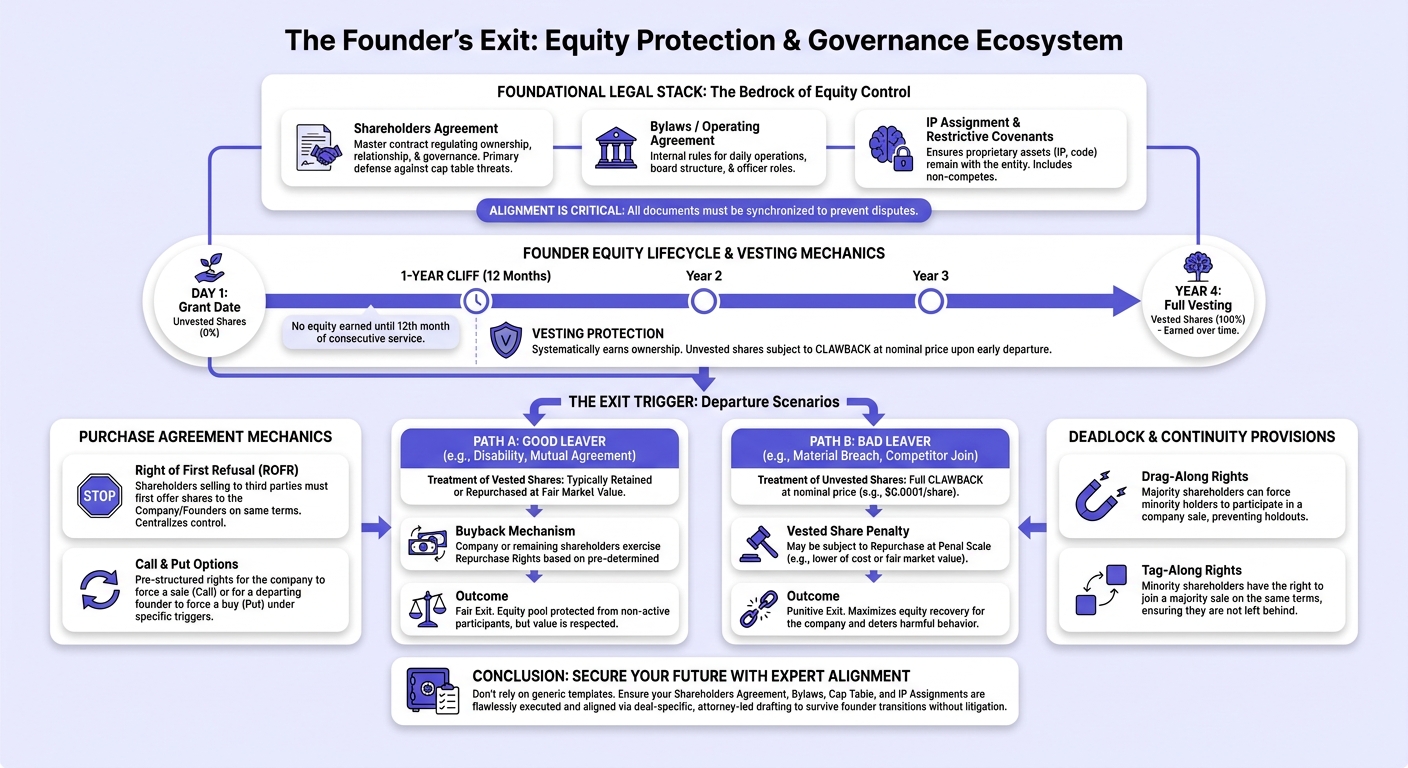
According to legal concepts aggregated by Cornell Law School's Legal Information Institute, a shareholders agreement is a contract among a company's shareholders that regulates their relationship, stock ownership, and business governance. If you are operating a startup or a growing small business, it acts as the primary defense against unexpected changes on your capitalization table.
Without a clear agreement in place, a departing founder can walk away with their entire original equity stake, leaving you with less equity to incentivize a replacement or attract venture capital. This scenario often forces remaining founders to renegotiate at a severe disadvantage.
An effective agreement bridges the gap between state-level entity formation principles and actual day-to-day operations. When a founder departs, the primary mechanics designed to retrieve those shares relies on custom corporate purchase agreements. These legally binding transactional documents outline the physical terms, price structure, and conditions under which the company repurchases the departing operator's stock.
Key Purchase Agreement Mechanics at Exit
Managing the transfer of stock during a founder's exit requires a deliberate set of contract terms. The goal is simple: keep ownership centralized within the active team and prevent unwanted third parties from acquiring a vote in corporate affairs.
Right of First Refusal
A Right of First Refusal (or ROFR) requires any shareholder who wishes to sell their shares to a third party to first offer those same shares to the company or the remaining shareholders under the same terms.
- Centralized Control: This prevents external parties from suddenly obtaining vital cap table stakes.
- Fair Valuation: The transaction operates on a verified third-party offer, ensuring the departing party receives market value.
Buyback and Repurchase Rights
Forced buyback rights allow the company to unilaterally purchase a departing founder's shares under predetermined triggers, such as resignation or termination. These options are structured in advance through specific share repurchase terms so there is no debate about whether the transaction can occur.
If your business is structured as a corporation, you will need professional governance tools to execute these options cleanly. Utilizing a tailored structure like our Custom Sale of Stock Agreement ensures the purchase price mechanics, representations, and closing conditions comply with federal and state guidelines. For businesses operating as limited liability companies, these equity mechanics must be directly integrated into your primary LLC Operating Agreement to verify enforceability.
The Power of Vesting and Good vs Bad Leavers
Vesting forms the bedrock of modern startup equity structures. When founders agree to a vesting schedule, they are systematically earning their ownership stake over a set duration of active work or milestones.
How Vesting Protects Team Alignment
According to corporate standards defined by global legal consensus on vesting, a standard schedule typically operates on a 4-year term with a 1-year cliff. This means no equity is earned until the 12th month of consecutive service.
If a founder walks away after 9 months, the company's repurchase options allow for the complete clawback of their unvested shares, usually at a nominal price of $0.0001 per share or their initial purchase price. This protects your equity pool from being diluted by non-active participants.
Good Leaver versus Bad Leaver Rules
The price and percentage of shares the company can buy back often depend heavily on the circumstances surrounding the founder's departure.
- Good Leavers: These are individuals who depart due to circumstances outside their control, such as disability, illness, or a mutually agreed-upon reduction in force. They are typically allowed to retain all vested shares, while unvested shares are repurchased at a fair market value.
- Bad Leavers: These are individuals who exit due to material breach of contract, fraud, or resigning voluntarily to work for a direct competitor. A company often maintains the right to claw back all unvested shares and, in some jurisdictions, buy back even vested shares at a penal scale (e.g., historical face value rather than fair market value).
State level legal rules and contract drafting determine how these terms are enforced. It is essential to spell out these definitions clearly to reduce the likelihood of costly post-separation disputes.
Protecting Core Assets: IP and Restrictive Covenants
Equity value inside a startup or SMB rarely lies purely in the cash balances; it lives in the brand, its technology, and its strategic assets. A clean exit protocol ensures these proprietary items stay with the entity.
- Invention Assignment: Ensure all founders sign a comprehensive Intellectual Property (IP) assignment agreement upon joining the company. This guarantees that all code, designs, and ideas created during their tenure remain asset-owned by the business.
- Confidentiality Provisions: Standard exit provisions should state that a departing individual is legally bound to return all company physical assets, customer records, and secret methodologies.
- Non-Compete and Solicitation Standards: While the FTC’s regulatory environment on non-compete rules continues to evolve under federal updates, narrow restrictive covenants linked directly to equity buyouts are traditionally evaluated under distinct, more permissive state laws.
Preventing Deadlock: Drag-Along and Tag-Along Rights
A standard founder departure shouldn't stall the physical growth of the startup. A well-constructed shareholders agreement implements rules governing how major strategic changes occur after key people have left.
- Drag-Along Rights: If the board of directors and a defined supermajority of shareholders vote to sell the startup or its major holding assets, drag-along rights force minority holders to participate in the transaction. This prevents a disgruntled, exited co-founder from holding a major corporate transaction hostage.
- Tag-Along Rights: These clauses protect minority shareholders by allowing them to join a transaction if a majority founder decides to sell their stake. The buyer must extend the exact same terms to the minority holders, ensuring they are not left behind.
Founder Checklist: Aligning Your Legal Stack
To ensure that your exit plans move forward seamlessly under state laws, you must keep all corporate governance documents in alignment.
| Cover Document | Alignment Goal | Key Clause to Verify |
|---|---|---|
| Shareholders Agreement | Establishes the master equity structure. | Vesting, good/bad leaver triggers, and valuation formulas. |
| Bylaws or LLC Agreement | Establishes formal governance and officer removal rules. | Voting thresholds, Board seat additions, and quorum requirements. |
| Cap Table Ledger | Coordinates total shares issued and option pools. | Standardized authorized pools and option grant expirations. |
| IP Assignment Forms | Confirms ownership of core technologies. | Retroactive transfer of IP and background technology exclusions. |
Get Expert Legal Protection for Your Equity
Securing founder equity is not an administrative task you can leave to generic internet templates. When partnerships change, small loopholes can quickly lead to expensive legal disputes, cap table blockages, or lost funding opportunities. Safeguarding your company requires precise, attorney-led contract drafting tailored to your specific business model.
At AirCounsel, we deliver professional, flat-fee solutions to help founders define key equity and asset protections without the burden of billable hours or high traditional retainer fees. Whether you want to customize an internal stock mechanics plan or draft deal-specific purchase documents, our team of licensed US corporate attorneys is ready to protect your company's future.

Get started with AirCounsel today:
- Access our Custom Sale of Stock Agreement to establish clear equity terms for departures or cash investments.
- Utilize our comprehensive Custom Contract Drafter to tailor unique founder exit and transition agreements.
- Build your fundamental corporate guidelines with our custom-drafted LLC Operating Agreement package.
This article provides general information and is not legal advice.
Frequently Asked Questions
What happens to a founder’s shares when they leave the company?
The outcome depends entirely on your corporate agreements. If you have a formal shareholders agreement with vesting schedules, the company can typically buy back any unvested shares at cost. The fate of any vested shares will depend on your specific buyback rights, good/bad leaver clauses, and right of first refusal rules. Without these agreements in place, the departing founder is generally entitled to keep all of their original shares, which can lead to severe cap table issues.
Do shareholders agreements usually include buyback or repurchase rights?
Yes. Robust shareholders agreements in startups and small businesses almost always include buyback provisions. These terms allow the business or the remaining founders to repurchase shares from a departing officer or employee. This keeps ownership concentrated within the active team and prevents critical shares from being transferred to external competitors or uninvoiced third parties.
How do vesting schedules protect the company if a founder exits early?
Vesting schedules require founders and early employees to earn their equity over time through continuous service. If a founder decides to leave the company before their equity has fully vested, the company retains the right to buy back all unvested shares for a nominal fee. This prevents early departures from walking away with large stakes in the business before they have contributed to its long-term growth.
What is the difference between a shareholders agreement and an operating agreement or bylaws?
Bylaws are mandatory internal rules that outline how a corporation is run, covering items like board seats, annual meetings, and officer roles. An operating agreement serves a similar purpose for an LLC. Conversely, a shareholders agreement is a private contract among the owners themselves. It details specific shareholder rights, restrictions on transfer rules, buyback protocols, and other transactional mechanics that govern equity transfers.
Recommended
- Custom Sale of Stock Agreement – Secure of deal-specific stock transfers with a professional, attorney-drafted agreement.
- Custom Contract Drafter – Tailor complex founder separation, vesting, and employment agreements for your startup.
- Custom LLC Operating Agreement – Define membership structures and buyback provisions for growing US-based LLCs.
Need Legal Assistance?
Our expert legal team is ready to help you navigate complex legal matters with confidence.