The FTC Compliance Checklist for Startup Website Terms of Service

Launching a startup is a thrilling milestone, but safeguarding your digital storefront is critical to your long-term success. As you build your platform, your website Terms of Service (ToS) act as the binding contract between your business and your users. However, generic templates found online often fail to address federal regulations. To avoid costly regulatory mistakes, smart founders turn to a professional contract review service to ensure their terms stand up to federal scrutiny.
The Federal Trade Commission (FTC) actively monitors online businesses for unfair or deceptive business practices. Given that 99.9% of US businesses operate as small businesses or startups according to the SBA Office of Advocacy, federal regulators pay close attention to consumer-facing digital agreements. A poorly drafted ToS can expose your business to massive fines, class-action lawsuits, and branding damage.
This compliance checklist will help you identify consumer-protection risks, align your website's terms with your actual business practices, and determine when to leverage professional legal review.
Table of Contents
- Quick Summary
- Why the FTC Cares About Your Website Terms of Service
- The FTC Compliance Checklist for Startup Website Terms of Service
- Aligning Your Terms of Service with Your Marketing and Site Flow
- When State Laws Complicate Federal Rules
- How a Contract Review Service Minimizes Legal Risk
- Protect Your Startup with Expert Legal Support
- Frequently Asked Questions
- Recommended
Quick Summary
| Takeaway | Explanation |
|---|---|
| Clear Disclosures | Your Terms of Service must clearly display critical terms like pricing, billing intervals, and cancellation steps. |
| Marketing Alignment | Your online checkout process and marketing copy must match the ToS; conflicting statements raise FTC flags. |
| No Dark Patterns | Avoid manipulative design choices (e.g., hidden fees or pre-checked agreement boxes) during checkout. |
| State Compliance | State laws (such as California's Auto-Renewal Law) often impose stricter rules than federal guidelines. |
| Expert Review | Using a flat-fee contract review service catches compliance errors before you officially launch. |
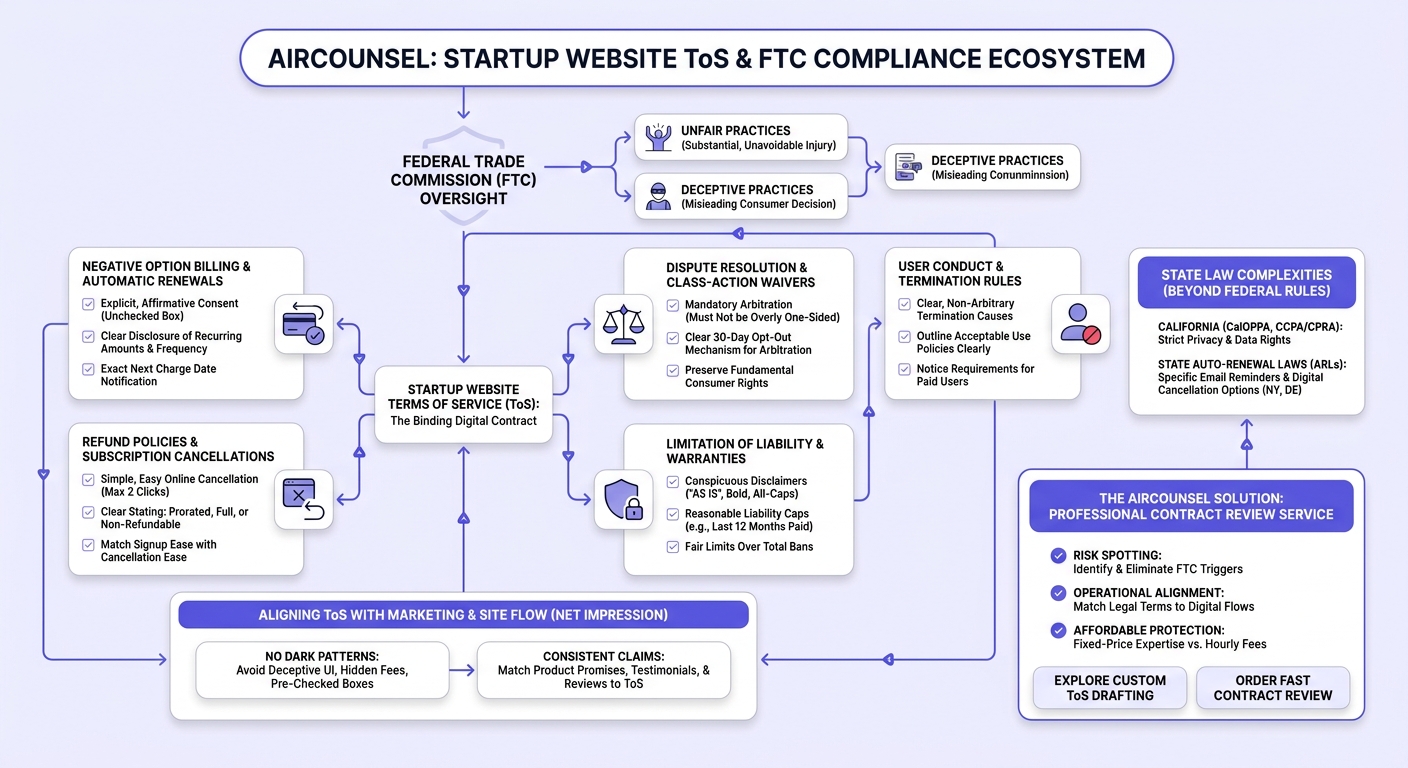
Why the FTC Cares About Your Website Terms of Service
The FTC is the primary federal consumer protection agency in the United States. Under Section 5 of the FTC Act, the commission has broad authority to police "unfair or deceptive acts or practices." Startups frequently make the mistake of thinking the FTC only targets Fortune 500 companies, but small businesses are equally subject to enforcement action.
Unfair vs Deceptive Practices
- Deceptive practices: Occur when a business misleads a consumer, and that representation influences the consumer's buying decision. For example, claiming "cancel anytime with one click" in your marketing but burying a complex 30-day notice requirement in your ToS is a classic deceptive practice.
- Unfair practices: Occur when an activity causes substantial, unavoidable consumer injury without offsetting benefits. Imposing unexpected fees or using "dark patterns" to trap users in recurring subscriptions falls into this category.
Learn more about these definitions directly on the FTC Business Guidance Portal.
The FTC Compliance Checklist for Startup Website Terms of Service
To help you evaluate your website’s legal terms, review this essential checklist of high-risk clauses.

Negative Option Billing and Automatic Renewals
If your website uses a subscription model, "negative option billing" occurs when a consumer’s silence or inaction is interpreted as acceptance of a charge. The FTC heavily regulates this area.
- Requirement: You must obtain explicit, affirmative consent (like an un-checked checkbox) before charging a user's payment method.
- Clear Terms: Your ToS must clearly lay out the recurring billing amount, the frequency of charges, and the exact date of the next charge.
Refund Policies and Subscription Cancellations
Vague refund policies are a top source of consumer complaints and regulatory enforcement.
- The Simple Rule: It must be just as easy to cancel a subscription as it was to sign up. If a user can join online in two clicks, they should be able to cancel online in two clicks.
- Disclosure: Clearly state whether refunds are prorated, fully refundable, or non-refundable.
Dispute Resolution and Class-Action Waivers
Most startups include mandatory arbitration and class-action waivers to limit litigation costs.
- FTC Focus: While generally enforceable, these clauses must not be overly one-sided or structured in a way that deprives consumers of their fundamental rights.
- Opt-Out: Providing a clear mechanism for users to opt out of arbitration within 30 days of signing up can protect your clause from being struck down as unconscionable.
Limitation of Liability and Warranties
Startups naturally want to minimize their liability if something goes wrong with their software or service.
- Reasonableness: Disclaimers of warranties (e.g., "as is" and "as available") must be displayed in a conspicuous manner, often using bold, all-caps text.
- Fair Limits: Setting a reasonable cap on liability—such as the amount the user paid you in the last 12 months—is more likely to be enforced than a total ban on all claims.
User Conduct and Termination Rules
Your ToS must state when and why you can terminate a user's account.
- Broad vs. Arbitrary: While you need the right to ban bad actors, arbitrary termination without cause or notice (especially for paying users) can trigger unfairness claims. Outline acceptable use policies clearly.
To help visualize compliance, compare these common website mistakes with their compliant alternatives:
| High-Risk Clause (Avoid) | Compliant Alternative (Target) |
|---|---|
| "We may change pricing at any time without notice." | "We will provide at least 30 days' advance notice of any price changes." |
| "All sales are final, no cancellations allowed." | "Cancel easily via your dashboard; recurring fees cease immediately." |
| Hidden dispute resolution clauses buried in tiny font. | Conspicuous arbitration notice with a 30-day opt-out provision. |
Aligning Your Terms of Service with Your Marketing and Site Flow
Your terms cannot exist in a vacuum. The FTC evaluates the "net impression" of your website. If your landing page says "Try Free for 14 Days" but your checkout flow automatically signs the user up for a paid annual plan without a conspicuous warning, your business is non-compliant.
- No Dark Patterns: Avoid deceptive user interface designs that trick users into actions they did not intend, such as pre-selecting paid add-ons.
- Consistent Claims: Match product claims and user reviews. Do not display exaggerated testimonials if your ToS disclaims that those results are highly atypical. For compliance details on reviews, refer to the FTC Endorsement Guides.
When State Laws Complicate Federal Rules
While the FTC sets the federal baseline, individual states often enforce stricter rules.
- California (CalOPPA & CCPA/CPRA): Imposes strict guidelines on user privacy and data rights.
- State Auto-Renewal Laws (ARLs): States like California, New York, and Delaware require specific email reminders before a subscription auto-renews, along with easy-to-use digital cancellation options.
To handle these multi-state complexities, founders often hire a local attorney or use an online platform to ask a US attorney a question regarding state-specific disclosures.
How a Contract Review Service Minimizes Legal Risk
Attempting to copy-paste terms from a competitor is a dangerous shortcut. A competitor's business model might differ, or their terms could be outdated and non-compliant. This is where a professional contract review service delivers immense value.
A dedicated legal review ensures:
- Risk Spotting: An attorney can identify and eliminate clauses that could trigger FTC enforcement or consumer litigation.
- Operational Alignment: Your written contract will perfectly match your digital checkout flow and subscription mechanics.
- Affordable Protection: With fixed-price legal platforms, you get attorney expertise without the unpredictable hourly fees of traditional law firms.
Protect Your Startup with Expert Legal Support
Navigating federal consumer protection laws shouldn't distract you from growing your business. By securing a flat-fee, professional legal review, you protect your assets, ensure transparency, and build lasting trust with your customers.
Whether you need a comprehensive review of your contract or want a custom-built document tailored to your software, AirCounsel connects you with experienced US attorneys at clear, upfront rates. Ready to safeguard your website terms?
Explore our Custom Application, Software or Website Terms of Service drafting service, or order a fast Review of your Contract or Legal Document to catch compliance issues before they cost you.
This article provides general information and is not legal advice.
Frequently Asked Questions
Does the FTC require startup websites to have Terms of Service?
The FTC does not explicitly mandate that every website have a "Terms of Service" document. However, if you sell products, offer subscriptions, or collect user data, having a clear and enforceable ToS is practically essential to define your rules, limit your liability, and comply with broader federal consumer protection and deceptive marketing standards.
What Terms of Service clauses create FTC risk for startups?
The highest risk areas include hidden fees, pre-checked auto-renewal boxes, complicated or hidden cancellation procedures, retroactive changes to terms without notifying users, and deceptive claims regarding refunds. The FTC actively targets businesses that make it difficult for users to stop recurring billing.
How do website claims and Terms of Service need to match?
Your marketing claims, checkout descriptions, and the text in your ToS must be completely consistent. If your homepage promises a "lifetime guarantee" but your ToS states that all warranties are disclaimed and services can be terminated at any time, the FTC may deem your homepage marketing deceptive.
When should a startup use a contract review service instead of drafting terms alone?
You should use a contract review service if you are launching a SaaS product, handling consumer payments, using subscription models, or operating in highly regulated fields. A professional review helps you avoid the severe compliance mistakes that frequently occur when using generic internet templates.
Recommended
Need Legal Assistance?
Our expert legal team is ready to help you navigate complex legal matters with confidence.