5 Hidden Escalation Clauses a Contract Review Attorney Flags in USA Commercial Office Leases

Signing a commercial office lease is one of the largest financial commitments a growing company makes. While founders often focus on the headline base rent, hidden rent escalation mechanics buried in the fine print can compound occupancy costs by tens of thousands of dollars over a multi-year term. Engaging an experienced contract review attorney before executing a lease helps business owners identify these financial traps early.
According to data tracked by the U.S. Bureau of Labor Statistics, commercial real estate operating expenses and inflation indices can fluctuate by more than 5% to 8% annually, creating severe cash-flow volatility for tenants on uncapped lease agreements. When landlords pass these costs directly through to tenants without clear limits, standard office space quickly becomes an unpredictable operational liability.
Unlike residential leases that enjoy statutory consumer protections, commercial agreements in the United States operate under standard contract law. Courts assume commercial parties possess equal bargaining sophistication, meaning you are strictly bound to whatever language you sign. Having a dedicated legal professional review your draft agreement ensures you spot hidden formulas, negotiate protective caps, and maintain budget certainty.
Table of Contents
- What Is an Escalation Clause in a Commercial Lease?
- 5 Hidden Escalation Clauses Lawyers Look Out For
- Comparison of Common Rent Escalation Structures
- Negotiation Strategies to Control Occupancy Costs
- Protect Your Business with Professional Lease Review
- Frequently Asked Questions
- Recommended
Quick Summary
| Takeaway | Explanation |
|---|---|
| Base Rent Is Deceptive | Total occupancy costs often increase substantially through pass-through operational fees and index adjustments. |
| No Statutory Safety Net | Commercial leases in the US lack standard consumer rent protections; terms are governed strictly by the signed contract. |
| Audit Rights Are Vital | Without explicit audit and accounting provisions, tenants cannot verify landlord operating expense calculations. |
| Caps Prevent Budget Shocks | Negotiating cumulative or annual expense caps limits year-over-year rent inflation. |
| Pre-Signing Review Is Essential | Modifying contract language before signing is straightforward; renegotiating terms after execution is rarely possible. |
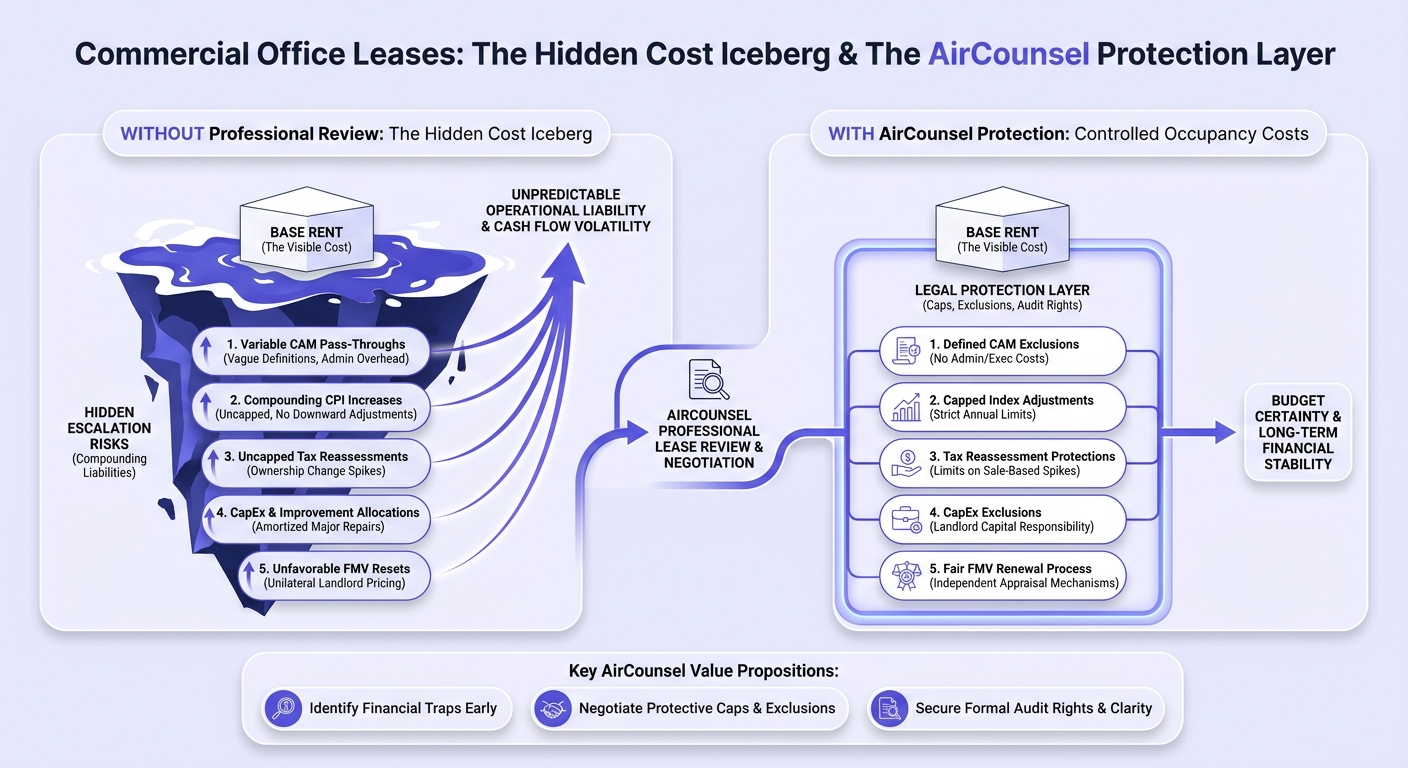
What Is an Escalation Clause in a Commercial Lease?
An escalation clause is a provision within a commercial lease that allows the landlord to increase base rent or pass along rising operational expenses during the lease term. Landlords incorporate these mechanisms to protect their property yields against inflation, property tax increases, and higher utility costs.
In full-service gross leases, the landlord pays operating costs out of your base rent. However, most modern office spaces use modified gross or triple-net (NNN) structures. In these arrangements, tenants pay a baseline rent plus their proportionate share of building expenses.
To understand broader lease liability and contract mechanics, you can read our guide on why signing a commercial lease without legal oversight carries hidden risks. Without rigorous drafting, minor wording shifts in these definitions transfer uncontrollable landlord financial risks directly onto your small business balance sheet.
5 Hidden Escalation Clauses Lawyers Look Out For

When evaluating lease drafts, an attorney focuses on clause mechanics that quietly convert fixed overhead into volatile liabilities. Below are the five most common escalation structures that require thorough scrutiny.
1. Variable Operating Expense (CAM) Pass-Throughs
Common Area Maintenance (CAM) clauses obligate tenants to pay their proportionate share of shared building costs, including lobby maintenance, security, landscaping, and management fees.
The primary danger lies in vague expense definitions. Broad catch-all phrases like "all costs associated with the operation and maintenance of the property" allow landlords to pass along administrative overhead, executive travel, marketing expenses, or broker commissions. A thorough contract review attorney ensures these definitions explicitly exclude landlord-specific business expenses.
2. Compounding CPI and Inflation-Linked Increases
Some leases tie annual rent bumps to the Consumer Price Index (CPI). While this sounds equitable on paper, poorly drafted CPI clauses can rapidly inflate costs:
- Uncapped Adjustments: When inflation spikes, your rent increases at the exact same rate without a ceiling.
- Compounding Floors: Many leases state rent will increase by "the greater of 4% or CPI." If inflation drops to 1%, you still pay 4%; if inflation reaches 8%, you pay 8%.
- No Downward Adjustments: These clauses operate as one-way ratchets, ensuring rent never decreases during deflationary cycles.
3. Uncapped Real Estate Tax Reassessments
Commercial properties are subject to periodic municipal tax reassessments. If the landlord sells the building or undertakes major structural renovations, the local tax authority may sharply increase property taxes.
Under a standard real estate pass-through clause, tenants bear this tax burden proportionately. If your lease lacks language limiting exposure to ownership-change reassessments, your annual tax contribution could double overnight through no fault of your own.
4. Capital Expenditure and Building Improvement Allocations
Routine repairs are normal operating expenses, but capital expenditures (such as replacing an HVAC system, installing a new roof, or completing seismic retrofits) should remain the landlord's long-term capital investment.
Landlords frequently attempt to amortize large capital improvements and bill them back to current tenants as operating costs. Legal oversight ensures capital expenditures are either excluded outright or strictly limited to improvements that directly reduce existing operating expenses, amortized over their full useful life.
5. Unfavorable Fair Market Value (FMV) Renewal Resets
Extension and renewal options offer stability for growing teams, but their pricing mechanics are often heavily landlord-favored.
Vague "Fair Market Value" reset clauses without clear appraisal processes or independent arbitration mechanisms leave you vulnerable. If the landlord determines FMV unilaterally at renewal, you face the difficult choice between accepting inflated rent or incurring substantial moving and relocation expenses.
Comparison of Common Rent Escalation Structures
Understanding the operational differences between common escalation models helps you select and negotiate terms that match your company's risk profile:
| Escalation Type | How Rent Increases Are Calculated | Tenant Risk Level | Primary Recommended Safeguard |
|---|---|---|---|
| Fixed Annual Step | Predictable dollar or percentage increase (e.g., 3% annually). | Low | Confirm whether percentage increases compound annually or calculate on initial base rent. |
| CPI-Linked Escalation | Rent adjusts based on regional or national inflation indices. | Medium to High | Negotiate a strict annual cap (e.g., maximum 3.5% increase regardless of index). |
| Base Year Expense Stop | Tenant pays increases over a specified base year operating cost. | Medium | Verify that the base year reflects full building occupancy (grossed-up calculation). |
| Triple Net (NNN) Direct Pass | Tenant pays proportionate share of all taxes, insurance, and CAM. | High | Insert comprehensive expense exclusions, annual CAM caps, and audit rights. |
| Hybrid / Percentage Rent | Base rent plus a percentage of gross revenues over a threshold. | Very High | Exclude non-operating revenue streams and establish clear revenue verification rules. |
Negotiation Strategies to Control Occupancy Costs
Negotiating an office lease requires proactive deal structuring before the final document is signed. The U.S. Small Business Administration emphasizes that sound lease management is foundational to long-term small-business survival. Use these actionable strategies during contract negotiations:
- Demand Controllable Operating Expense Caps: Insist that controllable expenses (such as routine janitorial, landscaping, and administrative fees) cannot increase by more than 4% to 6% per year on a cumulative basis.
- Gross-Up the Base Year: In modified gross leases, require the landlord to "gross up" the base year operating costs to reflect 95% or 100% building occupancy. This prevents artificial expense spikes when building occupancy increases in later years.
- Secure Formal Audit Rights: Ensure your contract grants you the right to inspect the landlord's books and records annually. Include a provision requiring the landlord to reimburse audit costs if an overcharge exceeds 3% to 5%.
- Define Explicit Exclusions: Add a detailed schedule of excluded costs to the lease, explicitly barring structural repairs, leasing commissions, executive salaries, and advertising costs.
- Establish Clear Notice Timelines: Require the landlord to provide annual escalation estimates at least 30 to 60 days before the new billing period begins, accompanied by itemized accounting statements.
Protect Your Business with Professional Lease Review
Navigating multi-year commercial lease agreements requires balancing operational speed with ironclad legal protection. A single ambiguous clause in an operating expense pass-through can turn a seemingly affordable lease into a serious financial drain. Professional legal review gives you clear visibility into every financial trigger before you execute.
AirCounsel provides rapid, fixed-fee legal support tailored for entrepreneurs, founders, and small-business operators. Our licensed attorneys identify costly clauses, provide actionable redlines, and ensure your commercial agreements protect your long-term capital:
- Get expert feedback and risk identification with our Commercial / Residential Lease Agreement Review.
- Protect your wider operations with our comprehensive Review of your Contract or Legal Document.
- Secure active deal-closing assistance through on-demand Negotiation Support.
Frequently Asked Questions
What is an escalation clause in a commercial office lease?
An escalation clause is a provision that permits the landlord to increase your rent or pass through increases in building operating costs, property taxes, or inflation indices throughout your lease term.
Which rent increase terms are easiest to miss in a commercial lease review?
Operating expense pass-throughs and capital expenditure amortization clauses are the most frequently overlooked. These clauses can significantly increase your monthly payment beyond the listed base rent without appearing in the main payment schedule.
Can a landlord raise rent during the lease term if the lease has no escalation clause?
No. In fixed-term commercial leases without an escalation clause or pass-through provision, the landlord cannot unilaterally increase your base rent until the lease term expires, unless explicitly authorized elsewhere in the contract.
What should a tenant ask a contract review attorney to check before signing an office lease?
Ask your attorney to verify base-year gross-up calculations, confirm caps on controllable common area maintenance (CAM) fees, review real estate tax reassessment allocations, ensure strong annual expense audit rights, and remove hidden capital improvement pass-throughs.
Recommended
Need Legal Assistance?
Our expert legal team is ready to help you navigate complex legal matters with confidence.