How Can You Copyright a Name? A Guide to Trademark and Brand Protection

As a founder launching a new venture, protecting your brand identity is one of your most critical tasks. Many business owners head to major search engines asking: how can you copyright a name? The short answer is that US intellectual property law does not permit you to copyright a corporate name, brand name, or slogan.
According to the USPTO, over 730,000 trademark applications are submitted annually, proving that trademarks—not copyrights—are the standard legal tool businesses use to secure exclusive rights to their commercial identities.
Understanding the differences between trademarks and copyrights will save you valuable time, protect your investments, and build a legally sound foundation for your business.
Table of Contents
- Why Copyright is the Wrong Tool for Names
- The Decision Tree: Trademark vs. Copyright
- Key Brand Identifiers: Legal Name, DBA, and Trademark
- The Four-Step Path to Protect Your Business Name
- Do Not Skip the IP Assignment Clause
- Common Brand Protection Pitfalls for Founders
- Timelines and Costs for Brand Protection
- Secure Your Brand with AirCounsel Today
Quick Summary
| Takeaway | Explanation |
|---|---|
| Names Cannot Be Copyrighted | Under US law, names, short phrases, and titles do not qualify for copyright protection. |
| Trademarks Secure Your Brand | Federal trademark registration is the correct legal tool to prevent competitors from using your business name. |
| LLC Registration is Insufficient | Registering a corporate entity with a state does not grant nationwide trademark rights. |
| IP Assignment is Non-Negotiable | If a contractor or employee drafts your brand assets, you must secure a written contract transferring ownership. |
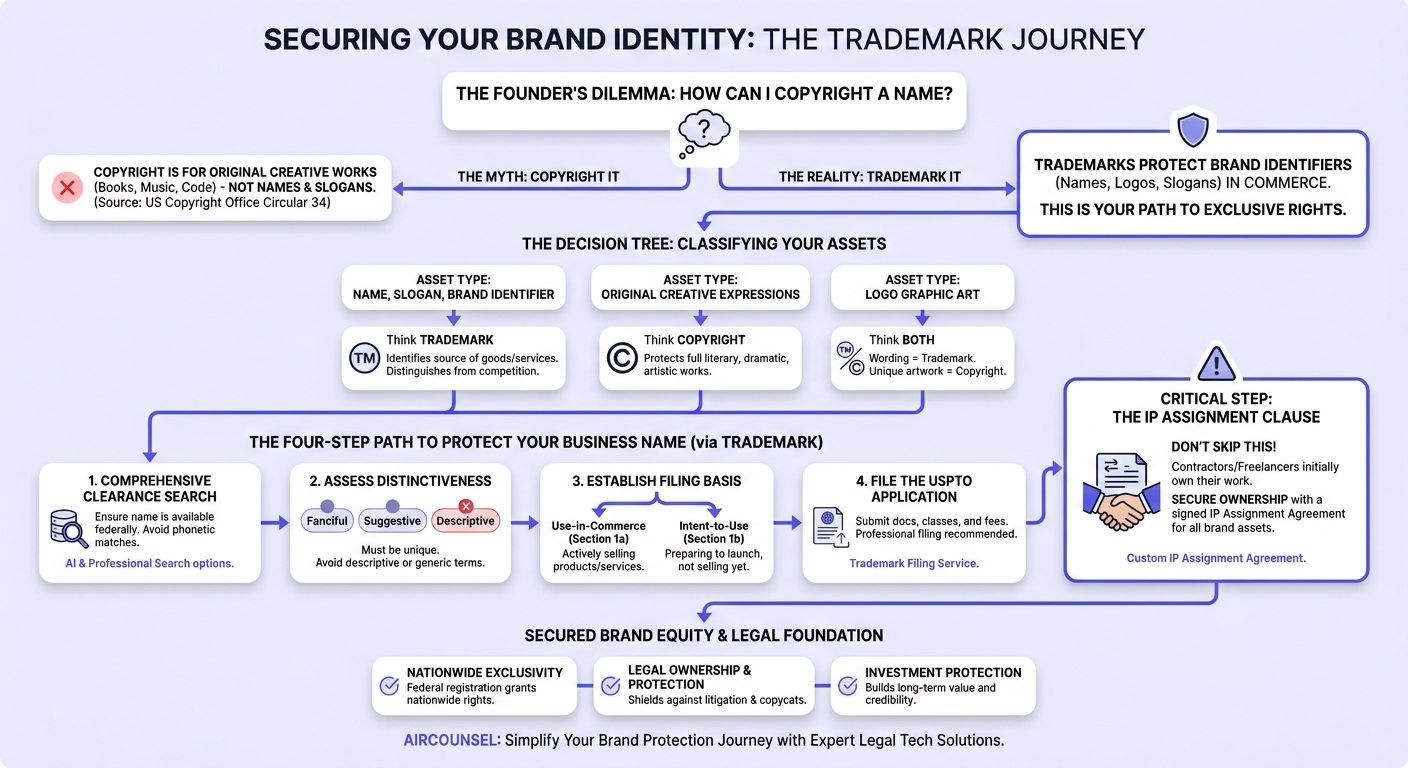
Why Copyright is the Wrong Tool for Names
Federal statutory guidelines outline what falls under copyright protection. Under US intellectual property laws, copyright is reserved for original works of authorship fixed in a tangible medium of expression (such as written books, musical arrangements, recorded video, or software source code).
According to US Copyright Office Circular 34, copyright registration does not extend to names, titles, short phrases, or slogans. The federal government excludes these assets from copyright protection to keep common words and short expressions free for public and commercial use.
If you are trying to establish exclusive rights to your company's name, brand assets, or marketing catchphrases, you must look to trademark law instead.
The Decision Tree: Trademark vs. Copyright
Developing a brand identity involves producing several types of assets. Determining whether you need trademark support or copyright filings depends on the nature of what you have built.

Use this quick decision tree to categorize your assets:
- Name, Slogan, or Brand Identifier: Think Trademark. Trademarks are phrases, symbols, designs, or words used to identify the source of goods or services and distinguish them from competitors.
- Original Creative Expressions: Think Copyright. Copyrights protect full literary, dramatic, musical, and artistic works.
- Logo Graphic Art: Think Both. While the wording in a logo is protected via trademark registration, the highly stylized artwork or unique illustrations in the logo can occasionally be registered with the US Copyright Office.
For a deeper dive into how these intellectual property classes protect your company, consult the USPTO Trademark, Patent, or Copyright Guide.
Key Brand Identifiers: Legal Name, DBA, and Trademark
Many founders mistakenly believe that registering their company name makes it legally safe from copycats. In reality, US corporate registration is split across distinct categories:
- Legal Entity Name: The legal moniker registered with your state during company formation. It prevents another regional filer from establishing an LLC or corporation under that exact name in your state, but offers zero protection outside your borders.
- DBA (Doing Business As): A trade name registration that allows you to operate under an alternate name, but provides absolutely no proprietary rights or trademark protection.
- Domain Name: Your digital URL. Buying a domain keeps others from owning that specific web address, but does not prevent a competitor from using your brand name in their actual business operations.
- Registered Trademark: The gold standard of brand protection. Federal registration grants exclusive nationwide rights to use your brand name in connection with specific commercial products or services.
The Four-Step Path to Protect Your Business Name
Securing a federal trademark protects your brand equity and ensures competitors cannot dilute your message.
Step 1: Perform a Comprehensive Clearance Search
Before submitting your application and paying non-refundable fees, ensure your prospective name is not already active in the federal database. You can start this verification for free using a Free AI Trademark Search.
If you require full professional verification, an attorney-curated Trademark Search will identify phonetic matches and similar marks that might cause your application to be rejected.
Step 2: Assess Distinctiveness
The USPTO rejects applications for marks that are descriptive or generic. To secure approval, your brand name must fall into a distinctive category:
- Fanciful/Arbitrary: Made-up words (like Exxon) or real words applied to unrelated products (like Apple for mobile phones).
- Suggestive: Marks that hint at a consumer benefit without explicitly describing it (like Greyhound for bus transit).
Step 3: Establish a Filing Basis
You must indicate your filing basis on the application:
- Use-in-Commerce (Section 1a): Select this option if your brand is already actively selling products or services using the name in US interstate commerce.
- Intent-to-Use (Section 1b): Select this option if you are preparing to launch your business but have not officially sold goods or services under the brand name yet.
Step 4: File the USPTO Application
Submit your documentation, select your trademark classes, and pay the regulatory fees. To skip the heavy lifting and ensure complete legal accuracy, you can use a professional Trademark Filing Service.
Do Not Skip the IP Assignment Clause
When launching a business, founders often hire freelance designers or external agencies to draft their logos, design their website assets, or help brainstorm company names.
Under basic US copyright and contract statutes, authorship rights initially belong to the person who did the creative work. If you do not have a signed written contract containing an intellectual property assignment clause, the developer or designer legally retains ownership of your brand architecture.
To secure your corporate assets, you must require every vendor, advisor, contractor, and employee to sign an agreement explicitly transferring all intellectual property rights to your business entity. You can easily execute this using a Custom IP Assignment Agreement or draft comprehensive contractor documentation using an advisor-backed Custom Contract Drafter.
Common Brand Protection Pitfalls for Founders
- Relying solely on local business registration: Believing that registering an LLC protects your name across the US is a costly mistake. You can read more about forming your business safely via USA Entity and Company Formation.
- Failing to check for descriptive terms: Attempting to register names that describe what you sell (like "Fast Laundry Services") will result in an immediate rejection from trademark examiners.
- Using trademark symbols incorrectly: You can only use the official registered symbol (®) after the USPTO formally approves your trademark. Before then, you must use the standard TM symbol.
Timelines and Costs for Brand Protection
Protecting your brand involves different timelines and investments depending on your strategy:
| Process | Estimated Timeline | Typical Cost |
|---|---|---|
| AI Brand Clearance Search | Instant | $0 |
| Professional Trademark Search Report | 1-2 business days | $60 |
| Initial Trademark Application Filing | 3-5 business days | $995 + USPTO fees |
| USPTO Application Review Period | 8-12 months | Included in filing fee |
| Custom IP Assignment Agreement | 3 business days | $700 |
Secure Your Brand with AirCounsel Today
Do not risk your brand equity by relying on weak corporate legal arrangements or general templates. Ensuring that you own your intellectual property assets from the start shields your business from costly litigation, domain disputes, and copycats.
AirCounsel helps founders secure their brand assets legally, quickly, and affordably with transparent, flat upfront pricing.
Whether you need to verify name availability, complete a federal trademark application, or secure ownership of your logo, our team is ready to guide you. Initiate your brand protection journey by scheduling an Online Consultation or connect directly with an expert to Ask a U.S Attorney a Question.
This article provides general information and is not legal advice.
Frequently Asked Questions
Can you copyright a business name in the United States?
No, the US Copyright Office does not allow copyright registrations for names, slogans, short phrases, or titles. To protect corporate names, you must apply for trademark protection.
What is the difference between a copyright and a trademark for a name?
Copyright protects creative works of authorship (such as books, graphic art, and music). Trademarks specifically protect commercial assets like brand names, logos, and slogans that identify the source of goods or services in commerce.
Does forming an LLC protect my business name automatically?
No. Forming an LLC only registers your name within that specific state and restricts other regional filers from using it. It does not grant nationwide commercial exclusivity and will not protect you if you infringe on a federal trademark.
Do I need an IP assignment clause if I hire a freelancer to create my logo or brand name?
Yes. Under US intellectual property laws, the creative independent contractor owns the initial copyright to any work they produce. To make your company the sole legal owner of the brand name or logo, they must execute a written IP assignment agreement.
Recommended
Need Legal Assistance?
Our expert legal team is ready to help you navigate complex legal matters with confidence.