How to Instruct a Franchise Attorney on USPTO Trademark Filing for Your Expanding Brand

When an emerging brand prepares to scale through multi-unit licensing or franchising, intellectual property becomes its most valuable commercial asset. Under the Federal Trade Commission (FTC) regulations, Item 13 of the Franchise Rule mandates that franchisors disclose the federal registration status of all principal commercial trademarks in their disclosure documents before signing prospective franchisees.
Retaining an experienced franchise attorney to structure your United States Patent and Trademark Office (USPTO) filings ensures your brand is protected nationwide. Without a clear strategy, minor errors in ownership, filing bases, or descriptions of goods and services can invalidate your protection or stall your expansion.
Directing your attorney effectively requires understanding the core filing decisions, how trademark law intersects with franchise regulations, and what operational details your counsel needs to build an enforceable IP portfolio.
Table of Contents
- Quick Summary
- Why Brand Expansion Demands a Franchise-Focused Trademark Strategy
- Key Trademark Decisions to Coordinate with Your Franchise Attorney
- The Intersection of USPTO Filings and the FTC Franchise Rule
- Common Trademark Filing Mistakes in Multi-Unit Expansion
- Founder Checklist: Preparing Your Brand Intake for Counsel
- Protect Your Brand Assets Before Scaling
- Frequently Asked Questions
- Recommended
Quick Summary
| Takeaway | Explanation |
|---|---|
| Filing Basis Strategy | Use Section 1b (Intent-to-Use) to reserve brand rights ahead of multi-state rollouts. |
| Ownership Structuring | Assign trademark ownership to a dedicated IP holding entity or franchisor company. |
| FTC Rule Intersection | Pending applications must be disclosed in Item 13 of your Franchise Disclosure Document (FDD). |
| Class Coverage | Cover existing commercial operations and future franchise administration service classes. |
| Clearance First | Run comprehensive USPTO and common law clearance searches before filing to prevent conflicts. |
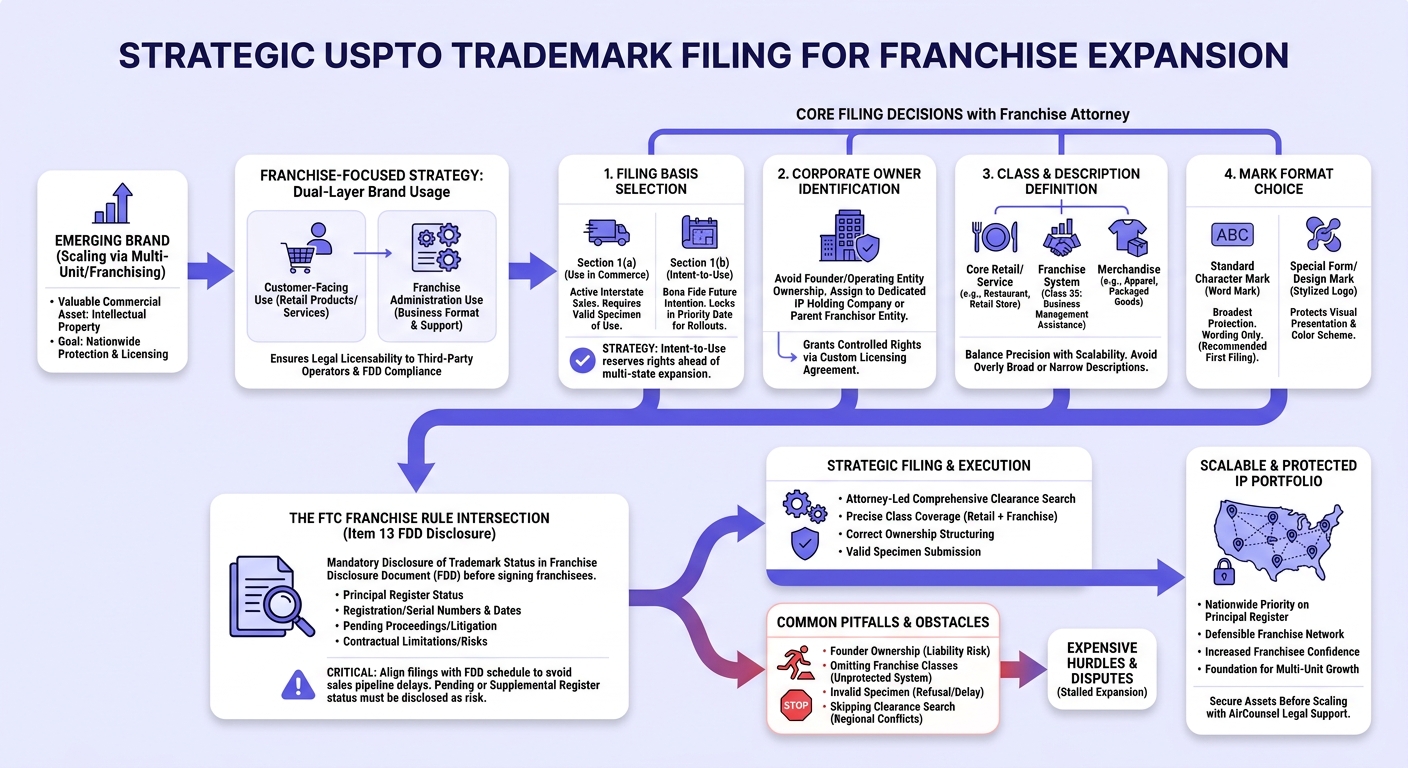
Why Brand Expansion Demands a Franchise-Focused Trademark Strategy
Standard commercial trademark filings protect a company selling products or services directly to consumers. However, expanding through a franchise or license model introduces a dual layer of brand usage:
- Customer-Facing Use: The core products or retail services provided to end consumers under the mark.
- Franchise Administration Use: The business format, operational support, and franchise management services provided to third-party operators.
A franchise attorney evaluates not only whether your mark meets USPTO Application Guidelines for current sales, but also whether the resulting registration can be legally licensed to independent operators across multiple states.
A thorough strategy establishes nationwide priority on the Principal Register, shielding your network from regional competitors and giving future franchisees confidence in the brand's legal defensibility.

Key Trademark Decisions to Coordinate with Your Franchise Attorney
To ensure your trademark applications support your long-term growth, you must coordinate four foundational decisions with legal counsel before submitting paperwork to the USPTO.
1. Selecting the Correct Filing Basis (Section 1a vs. Section 1b)
The USPTO allows applicants to file under two primary bases:
- Section 1(a) (Use in Commerce): Applicable if your brand is already actively selling goods or rendering services across state lines under the mark. You must provide a valid specimen of use and state the date of first use anywhere and in interstate commerce.
- Section 1(b) (Intent-to-Use): Applicable if you have a bona fide intention to use the mark in commerce but have not yet launched sales under that specific name or class. This locks in your filing priority date while you finalize branding, store build-outs, or franchise marketing.
For multi-unit brands planning regional rollouts, an Intent-to-Use application protects your expansion territories before public announcements alert potential copycats.
2. Identifying the Right Corporate Owner
A common structural mistake is filing the trademark under an individual founder's name or under an operating entity that carries retail liabilities.
When establishing a scalable brand, intellectual property should generally reside in an IP holding company or the parent franchisor entity. The owning entity then grants controlled rights to operating units or franchisees via a formal Custom Licensing Agreement. Instruct your attorney on your corporate entity structure so the applicant name matches your asset protection strategy.
3. Defining Classes and Descriptions of Goods and Services
Trademarks are categorized under international trademark classes (the Nice Classification system). For an expanding brand, you must balance precision with future scalability:
- Core Retail/Service Classes: For example, Class 43 for restaurant services or Class 35 for retail store services.
- Franchise System Classes: Class 35 covers "franchising services, namely, offering business management assistance in the establishment and operation of [your business type]."
- Merchandise Classes: If you plan to sell branded apparel (Class 25) or packaged goods (Class 29/30), these require separate classifications and fee allocations.
Filing overly broad descriptions can trigger USPTO Office Actions or vulnerability to non-use cancellations, while overly narrow descriptions leave gaps for competitors.
4. Choosing the Mark Format (Word Mark vs. Design Mark)
Your attorney will advise whether to file a standard character mark (word mark), a stylized logo (design mark), or both:
- Standard Character Mark: Protects the wording itself regardless of font, size, color, or layout. This provides the broadest protection and allows you to update logos without refiling.
- Special Form/Design Mark: Protects the specific visual presentation, color scheme, and graphic logo.
For most expanding brands, counsel will recommend securing the standard character word mark first, followed by secondary filings for core visual logos.
The Intersection of USPTO Filings and the FTC Franchise Rule
Under the FTC Franchise Rule Compliance Guide, franchisors must make strict disclosures regarding their intellectual property in Item 13 of the Franchise Disclosure Document (FDD).
Item 13 requires you to state:
- Whether the principal mark is registered on the USPTO Principal Register.
- All registration or serial application numbers and filing dates.
- Any pending opposition proceedings, cancellations, or material litigation affecting the mark.
- Any contractual limitations or infringement risks that could impact a franchisee's right to operate.
If your mark is only registered on the Supplemental Register or remains in an unexamined application status, you must disclose this risk to prospective buyers. Aligning your trademark filings with your FDD Filing Service schedule ensures your franchise sales pipeline opens without regulatory delays.
Common Trademark Filing Mistakes in Multi-Unit Expansion
Failing to align trademark filings with corporate growth creates expensive hurdles during due diligence or dispute enforcement.
| Filing Pitfall | Business & Legal Impact | Prevention Strategy |
|---|---|---|
| Filing in Founder's Personal Name | Complicates licensing agreements and creates personal tax or asset exposure. | Assign ownership to a parent IP holding company or franchisor LLC. |
| Omitting Franchise Administration Classes | Leaves business management and multi-unit licensing services unprotected. | Include Class 35 franchising management descriptions alongside retail classes. |
| Submitting Invalid Specimen of Use | Triggers USPTO refusals and delays registration timelines by 6–12 months. | Provide actual point-of-sale displays, transactional websites, or service receipts. |
| Skipping Common Law Clearance | Uncovers regional unregistered users after signing franchise leases. | Commission an attorney-led comprehensive search before filing applications. |
Founder Checklist: Preparing Your Brand Intake for Counsel
Before meeting with your legal counsel to draft your USPTO applications, compile the following operational records:
- Entity Formation Documents: State certificates and EIN records for the exact holding entity intended to own the marks.
- High-Resolution Brand Assets: Clean black-and-white and color files of word marks, logos, and slogans.
- Commercial Use Timeline: Exact dates of first use anywhere and first use in interstate commerce (such as sales across state borders or services rendered to interstate travelers).
- Legitimate Proof of Use: Menus, signage, invoices, marketing materials, and active checkout URLs showing the mark associated directly with the services.
- Multi-State Growth Map: A list of target states where you plan to open corporate locations or license franchises over the next 12 to 24 months.
Sharing these details upfront allows your attorney to quickly conduct a preliminary Trademark Search and submit clean, defensible filings.
Protect Your Brand Assets Before Scaling
Securing federal trademark protection is a necessary prerequisite for rolling out any multi-unit or franchise system. By engaging counsel early, you avoid costly brand rebranding battles, protect your franchisees, and ensure full compliance with federal disclosure standards.
AirCounsel provides transparent, fixed-fee legal support from licensed US attorneys. Protect your brand identity with an attorney-led Trademark Filing package, or establish the complete legal framework for your expansion with a customized Custom Franchise Agreement.
Frequently Asked Questions
What should a franchise attorney handle in a USPTO trademark filing for an expanding brand?
A franchise attorney handles the end-to-end IP strategy, including comprehensive clearance searches, selecting proper international classes (such as Class 35 for franchise administration), drafting descriptions of goods and services, identifying the correct corporate owner, and filing under the appropriate statutory basis.
Should the trademark be filed by the founder, the operating company, or a franchise entity?
Trademarks should typically be filed and owned by an IP holding entity or the franchisor corporation, rather than an individual founder or a retail operating subsidiary. This shields the brand from operating liabilities and streamlines licensing across corporate and franchised locations.
Can a brand file a trademark before it starts using the mark in commerce?
Yes. Under Section 1(b) of the Trademark Act, a business can file an Intent-to-Use application if it has a bona fide intention to use the mark in interstate commerce. This secures your filing priority date while you finalize store build-outs and launch preparation.
What are the most common USPTO filing mistakes that delay trademark registration for growing brands?
The most common mistakes include filing under the wrong entity, submitting unacceptable specimens of use, selecting inaccurate classifications, and failing to conduct a clearance search for preexisting regional common law users.
Recommended
Need Legal Assistance?
Our expert legal team is ready to help you navigate complex legal matters with confidence.