The USA Business Owner's Actionable Checklist for Issuing Formal Legal Demand Letters with a Business Lawyer

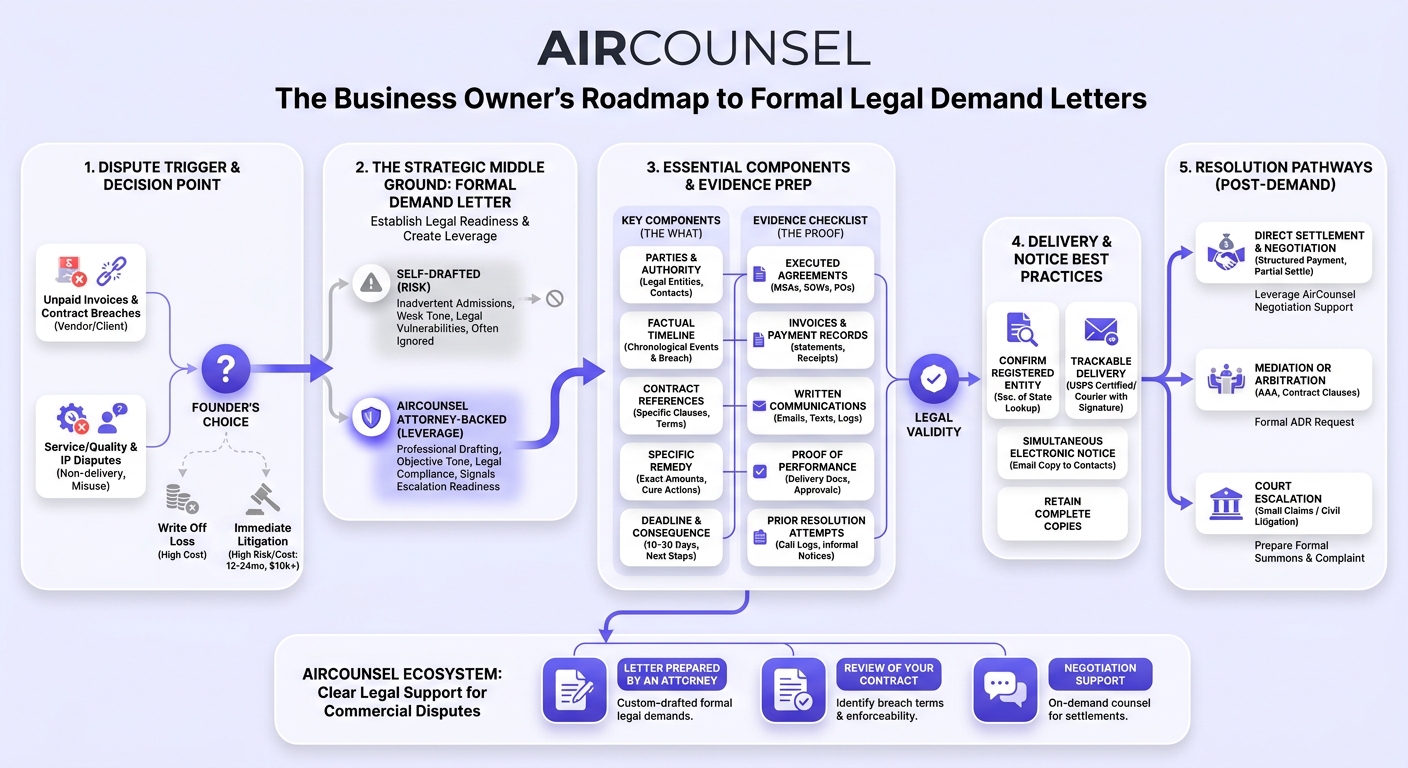
Commercial disputes happen in every growing enterprise, whether an unpaid client invoice, a vendor breach, or intellectual property misuse. When standard payment reminders and casual emails fail, founders face an immediate choice: write off the loss, enter costly court battles, or find a strategic middle ground.
Working with an experienced business lawyer to issue a formal demand letter provides that strategic middle ground. According to legal research surveys, nearly 60% of all small businesses experienced significant legal events in recent years, yet 54% never sought attorney assistance, often assuming legal intervention is too slow or expensive.
A well-crafted legal demand letter sets clear expectations, outlines legal claims without making inadvertent admissions, and creates necessary leverage to settle disputes before formal litigation begins.
Table of Contents
- Quick Summary
- What Is a Formal Business Demand Letter
- When to Send a Demand Letter Versus Escalating to Court
- Essential Components of an Effective Demand Letter
- Evidence and Documentation Checklist
- US Delivery Best Practices
- Why Involving a Business Lawyer Protects Your Leverage
- What to Do When the Recipient Ignores Your Demand
- Resolve Your Commercial Disputes with Clear Legal Support
- Frequently Asked Questions
- Recommended
Quick Summary
| Takeaway | Explanation |
|---|---|
| Primary Purpose | A formal demand letter clearly sets out legal and factual claims, requests specific performance or payment, and establishes a hard deadline before escalation. |
| Strategic Advantage | It signals legal readiness, often prompting prompt settlement discussions without paying tens of thousands in court fees. |
| Evidence Foundation | Demands require clean documentation, including signed agreements, invoices, communication logs, and verified delivery receipts. |
| Professional Drafting | Involving legal counsel prevents unintended liability admissions, preserves contractual claims, and sets an objective tone. |
| Next Escalation | If ignored, the sender can pivot to structured mediation, binding arbitration, small claims court, or civil litigation. |
What Is a Formal Business Demand Letter
A formal demand letter is an official document sent from one commercial party to another, detailing a legal breach and demanding specific remediation within a firm timeframe. Unlike an everyday overdue invoice notification, a demand letter serves as pre-litigation correspondence that creates an evidentiary record of notice.
Businesses commonly utilize demand letters for:
- Unpaid Invoices: Collecting outstanding commercial debts and service fees.
- Contractual Breach: Addressing failure to perform milestone services, material delivery lapses, or unauthorized cancellations.
- Service and Quality Disputes: Demanding refunds, account credits, or project completion when deliverables fall below agreed standards.
- Intellectual Property (IP) Misuse: Issuing cease-and-desist notifications for trademark infringement, copyright theft, or proprietary data misuse.
- Commercial Property Disputes: Resolving commercial lease violations, security deposit withholding, or equipment recovery.
In many US jurisdictions, demonstrating that you made a good-faith effort to resolve the dispute out of court by sending a clear demand is mandatory or strongly favored prior to filing a lawsuit.
When to Send a Demand Letter Versus Escalating to Court
A demand letter is appropriate when open communication breaks down but you want to avoid immediate litigation costs. Litigation routinely takes 12 to 24 months and thousands of dollars in legal fees, which may outweigh the amount in dispute. The U.S. Small Business Administration notes that small enterprises must manage cash flow and operational risk carefully, making early dispute resolution essential for financial health.
Dispute Arises -> Review Contract & Evidence -> Issue Formal Demand Letter -> Negotiate/Settle OR Escalate (Small Claims / Arbitration / Litigation)
When to Issue a Demand Letter
- You have clear documentation of breach and defined monetary damages.
- The other party has assets or operational continuity and is capable of paying or curing the default.
- You want to preserve a commercial relationship while asserting legal rights.
- Your contract includes mandatory pre-suit notice or dispute resolution clauses.
When to Consider Direct Action or Court Intervention
- Imminent Asset Dissipation: The debtor is actively transferring assets or closing operations.
- Urgent Injunctive Relief: An ex-employee is leaking trade secrets, requiring immediate emergency court restraining orders.
- Impending Statute of Limitations: Your statutory window to file a claim in your state is about to expire.
Essential Components of an Effective Demand Letter
A demand letter must present an objective, factual narrative that leaves no ambiguity regarding what happened, what contract was breached, and what is required to resolve the issue.
| Section | Required Content | Objective |
|---|---|---|
| Parties & Authority | Full legal business names, registered entity structures, and authorized contact points. | Establishes correct legal identity and formal standing. |
| Factual Timeline | Chronological breakdown of dates, agreements executed, services provided, and breach events. | Precludes the counterparty from claiming confusion or lack of notice. |
| Contract References | Specific clause citations (e.g., Section 4 Payment Terms, Section 9 Warranties). | Proves contractual obligations and defined remedies. |
| Specific Remedy | Exact dollar amounts (with breakdown of principal, late fees, interest) or precise cure actions. | Removes guesswork about what settles the dispute. |
| Deadline & Consequence | A realistic deadline (typically 10 to 30 calendar days) and stated next steps upon non-compliance. | Prompts urgent action without making unlawful threats. |

Evidence and Documentation Checklist
Before sending any formal correspondence, assemble all background materials. Solid documentation strengthens your position and speeds up the process if your attorney needs to prepare formal court filings later.
Assemble these critical items:
- Executed Agreements: Master services agreements, purchase orders, statements of work, or signed change orders. If you need clarity on your original terms, utilize a comprehensive Review of your Contract or Legal Document to pinpoint exact default clauses.
- Invoices and Payment Records: Billing statements, partial payment receipts, and bank transaction confirmations.
- Written Communications: Emails, formal letters, and text messages documenting promises, project delivery, or admissions of delay.
- Proof of Performance: Delivery confirmations, client approvals, milestone sign-offs, and quality inspection reports.
- Prior Resolution Attempts: Logs of phone calls, informal reminders, and previous collection emails.
US Delivery Best Practices
How you deliver your demand letter impacts its legal validity. Proving the recipient actually received the notice prevents them from claiming they were unaware of the default.
- Confirm Registered Entity Details: Look up the counterparty's business on the relevant Secretary of State portal to confirm their registered agent and official business address.
- Use Trackable Delivery: Send via USPS Certified Mail with Return Receipt Requested, or an established commercial courier (FedEx/UPS) requiring a signature.
- Provide Simultaneous Electronic Notice: Send an electronic PDF copy via email to the primary decision-maker and their accounting or legal department, noting that physical service was dispatched.
- Retain Complete Copies: Maintain an identical copy of the signed letter, tracking numbers, and delivery confirmation certificates in your permanent dispute file.
Why Involving a Business Lawyer Protects Your Leverage
Entrepreneurs occasionally draft their own demand letters using online templates, but self-drafted letters frequently introduce critical legal vulnerabilities. A qualified attorney adds measurable strategic value:
- Avoiding Inadvertent Admissions: Heated business correspondence sometimes concedes partial fault, waives rights, or misstates statutory damage limits. An attorney preserves all legal remedies.
- Calibrating Tone and Enforceability: Legal demands must remain firm, professional, and compliant with state and federal debt collection and extortion laws.
- Enhancing Authority: Letters printed on formal legal letterhead carry significantly greater weight, signaling to the recipient that you are prepared to escalate.
- Strategic Pre-Litigation Positioning: An attorney aligns the demand with long-term litigation or arbitration strategy, ensuring strict compliance with mandatory notice provisions.
When you need an enforceable, tailored notice, commissioning a formal Letter Prepared by an Attorney ensures your business demands are legally compliant and strategically sound.
What to Do When the Recipient Ignores Your Demand
If your deadline passes without payment or a cure, evaluate the response and select an appropriate escalation path:
- Engage in Direct Settlement Talks: Often, the recipient responds by offering a structured payment plan or partial settlement. You can secure targeted Negotiation Support to finalize an enforceable settlement agreement.
- Mediation or Arbitration: If your original agreement contains an alternative dispute resolution (ADR) clause, submit a formal request for mediation or arbitration with organizations like the American Arbitration Association (AAA).
- Small Claims Court: For disputes under state small claims thresholds (which range from $2,500 to $25,000 depending on your state), you can file an expedited claim without complex formal discovery procedures.
- Civil Court Litigation: For substantial commercial damages, have your legal counsel prepare a formal summons and complaint in state or federal court.
Resolve Your Commercial Disputes with Clear Legal Support
Protecting your business assets, enforcing your contracts, and securing overdue payments does not have to mean entering an expensive, open-ended legal battle. A decisive, attorney-backed demand letter delivers the clarity, speed, and leverage needed to resolve commercial friction on your terms.
AirCounsel provides transparent, fixed-price legal services to help US business owners protect their bottom line. Whether you need an experienced attorney to issue a formal Letter Prepared by an Attorney, perform a strategic Review of your Contract or Legal Document, or provide on-demand Negotiation Support, you get rapid turnaround and actionable legal guidance without hourly billing surprises.
Frequently Asked Questions
What is a formal demand letter in a business dispute?
A formal demand letter is a legal document sent by a business or its attorney outlining a specific legal breach, detailing the damages or remedy required, and giving the recipient a strict deadline to comply before legal escalation occurs.
When should a business owner send a demand letter instead of filing a lawsuit?
A demand letter should be sent whenever you want to resolve a dispute quickly and affordably without court fees, when your contract mandates pre-suit dispute notice, or to create an official evidentiary paper trail showing you attempted good-faith resolution.
Does a demand letter need to be sent by certified mail in the US?
While not strictly required by every state for informal claims, sending your demand letter via USPS Certified Mail with Return Receipt Requested or a trackable signature courier provides verifiable legal proof that the counterparty received your notice.
What should a business lawyer include to make a demand letter more effective?
A lawyer ensures the letter includes correct corporate entity names, clear chronological facts, specific contract clause citations, itemized damages calculations, a defined deadline, and professional language that avoids liability admissions while signaling litigation readiness.
Recommended
- Letter Prepared by an Attorney – Custom-drafted formal legal letters and demand notices prepared by licensed US attorneys.
- Review of your Contract or Legal Document – Fast, fixed-fee contract review to identify breach terms and enforceability clauses.
- Negotiation Support – On-demand legal counsel to help negotiate settlements and commercial deal terms.
Need Legal Assistance?
Our expert legal team is ready to help you navigate complex legal matters with confidence.