Lease Agreement Review: The Essential Tenant Checklist Before You Sign

America’s roughly 44 million renter households sign new or renewed leases each year, often without fully understanding what they’re agreeing to, according to the U.S. Census Bureau.
A careful lease agreement review before you sign can save you thousands of dollars in surprise charges, protect your rights if something goes wrong, and help you avoid being trapped in a place that doesn’t work for you.
This guide walks you through a practical, tenant-focused lease agreement review process under USA law—what to check, what’s negotiable, and when it’s worth getting an attorney to look everything over for you.
Table of Contents
- Quick Summary
- What Is A Lease Agreement Review?
- Why Reviewing Your Lease Before Signing Matters
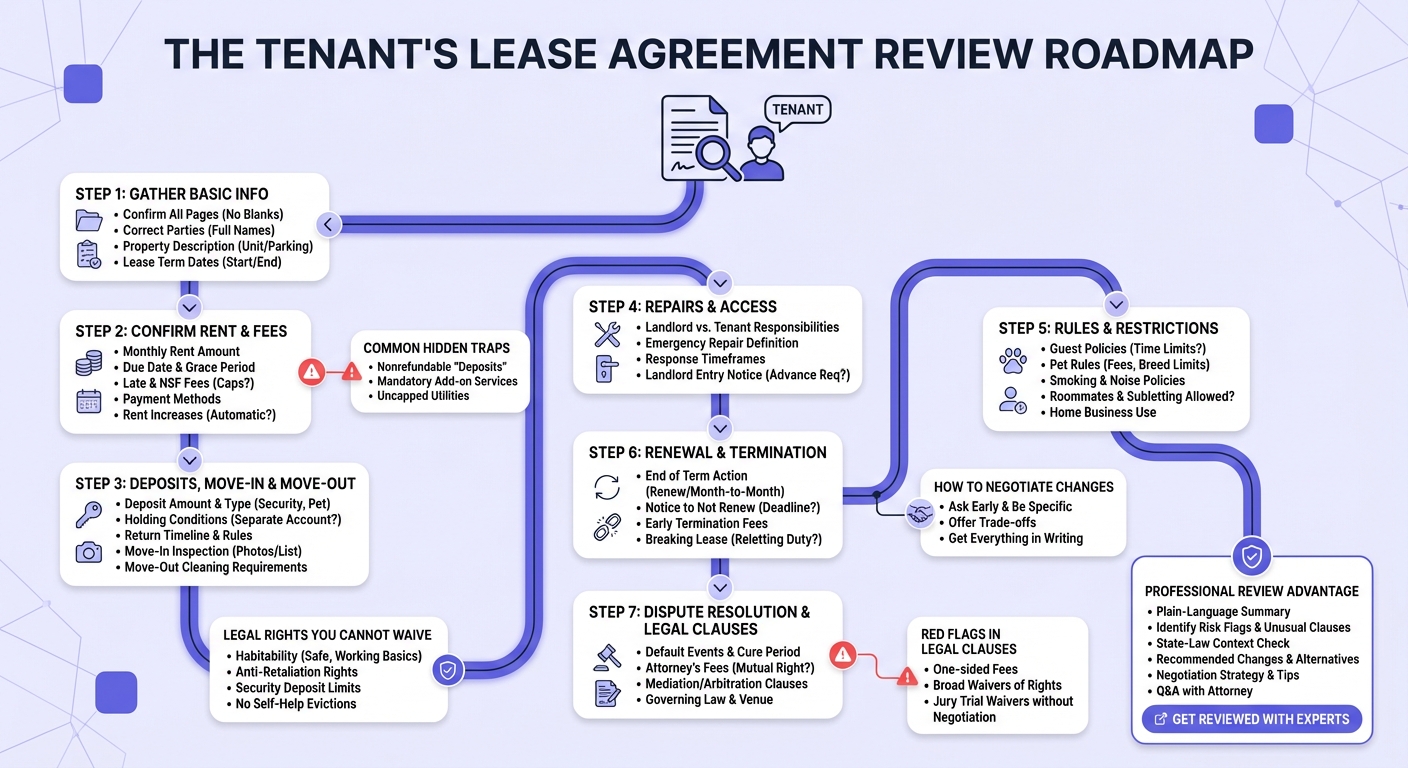
- Step-By-Step Lease Agreement Review Checklist
- Step 1: Gather Your Lease And Basic Info
- Step 2: Confirm Rent, Fees, And Payment Terms
- Step 3: Understand Deposits, Move-In, And Move-Out
- Step 4: Repairs, Maintenance, And Access To The Unit
- Step 5: Rules, Restrictions, And Use Of The Property
- Step 6: Renewal, Termination, And Early Exit
- Step 7: Dispute Resolution, Defaults, And Legal Clauses
- Common Hidden Traps In Residential Leases
- Legal Rights Tenants Usually Cannot Waive
- How To Negotiate Changes Before You Sign
- What A Professional Lease Agreement Review Includes
- Costs, Timelines, And When To Call A Lawyer
- Get Your Lease Agreement Reviewed With AirCounsel
- Frequently Asked Questions
- Recommended
Quick Summary
| Takeaway | Explanation |
|---|---|
| Always do a full lease agreement review before signing | Even “standard” leases can hide fees, harsh penalties, and one-sided terms you’re stuck with later. |
| Focus on money, obligations, and exit terms | Double-check rent, deposits, utilities, repairs, and what happens if you want (or need) to leave early. |
| Document the property condition at move-in | A detailed checklist and photos can protect your deposit and limit disputes over damage. |
| Some rights cannot legally be waived | State law often protects basic habitability and anti-retaliation rights, even if the lease says otherwise. |
| Most leases are negotiable at the edges | You may not change everything, but you can often adjust key terms like fees, renewal rules, and minor policies. |
| A lawyer review is low-cost risk insurance | For a fraction of one month’s rent, a professional review can flag red flags and give you negotiation leverage. |
What Is A Lease Agreement Review?
A lease agreement review is a careful, clause-by-clause look at your rental contract to understand:
- What you’re legally promising to do.
- What your landlord is (and isn’t) promising.
- How money, repairs, and risk are allocated.
- How you can end or extend the lease.
You can review a lease yourself using a checklist like this one, or you can have an attorney review your lease and explain the fine print before you sign. A professional review is especially helpful for:
- Long-term leases (12+ months).
- High-rent or high-deposit units.
- Situations involving roommates, pets, or home businesses.
- Landlords who use custom or very long lease forms.
Why Reviewing Your Lease Before Signing Matters
Once you sign, you are usually bound by the lease terms—even if you didn’t read them carefully.
A solid review reduces your risk of:
- Unexpected fees (pet, parking, amenities, “administrative” fees).
- Being charged for repairs you thought the landlord covered.
- Losing your deposit over vague “damage” claims.
- Being locked in with harsh early-termination penalties.
- Landlords entering your unit without proper notice.
- Disputes about who pays for what when something breaks.
Many state and local consumer agencies, such as Fairfax County’s lease checklist, stress the importance of reading every page of the lease and understanding your responsibilities before signing. A structured lease agreement review is how you do that in a smart, time-efficient way.
Step-By-Step Lease Agreement Review Checklist
Use this section side-by-side with your lease. Mark anything that’s unclear or feels off—you can ask questions or request changes before you sign.
Step 1: Gather Your Lease And Basic Info
Before diving into the fine print, confirm the basics:
- All pages included: Make sure no pages or addenda are missing.
- Correct parties: Your full legal name and the landlord’s legal name or company name.
- Property description: Address, unit number, and any included storage/parking spaces.
- Lease term: Clear start and end dates; check time zone if specified (for move-in/move-out).
Red flags:
- Blanks or handwritten changes that aren’t initialed by both sides.
- Different versions of the lease being passed back and forth—make sure you sign the final, clean version.
Step 2: Confirm Rent, Fees, And Payment Terms
This is where many tenant surprises happen.
Check:
- Monthly rent amount: Matches what was advertised or verbally agreed.
- Due date and grace period: When rent is due, and how many days (if any) before a late fee kicks in.
- Late fees: Amount (flat or percentage) and how often they apply.
- Returned check/NSF fees: How much you’ll pay if a payment bounces.
- Payment method: Online portal, check, auto-debit, or other methods; any processing fees.
- Rent increases: For longer leases or automatic renewals, see if and how rent can increase.
Watch for:
- “Administration,” “processing,” or “convenience” fees added to rent.
- Automatic, recurring “amenity” or “facility” fees you didn’t expect.
- Vague language like “fees as posted from time to time” without a clear schedule or cap.
Step 3: Understand Deposits, Move-In, And Move-Out

Security deposits are a major source of landlord-tenant disputes. States often regulate:
- Maximum deposit amounts.
- How deposits are held.
- Deadlines and rules for returning deposits.
Confirm:
- Deposit amount and type: Security deposit, pet deposit, last month’s rent, key/fob deposits.
- Where the deposit is held (if stated): Some states require separate accounts or interest.
- Conditions for withholding: What counts as damage vs. normal wear and tear.
- Timeline for return: Many states set deadlines (for example, 14–60 days after move-out).
Move-in and move-out:
- See if the lease mentions a move-in inspection or property condition checklist.
- Many universities and tenant guides, like the UC Santa Cruz rental condition checklist, recommend documenting every room at move-in.
- Check what cleaning level is required at move-out and whether “professional cleaning” is mandatory.
Practical tip:
- Do a full walk-through at move-in, take timestamped photos/videos, and send a written list of issues to the landlord so it is on record.
Step 4: Repairs, Maintenance, And Access To The Unit
Who fixes what—and how fast—matters for your comfort and wallet.
Key questions:
- Landlord’s responsibilities: Structure, plumbing, heating, electrical, major appliances.
- Tenant’s responsibilities: Light bulbs, air filters, lawn care, snow removal, minor repairs.
- Emergency repairs: What counts as an emergency and who you contact.
- Timeframes: Any promised response or repair times.
Access to the unit:
- Check when and how the landlord can enter—inspections, repairs, showings.
- Most states require advance notice (often 24 hours) except in emergencies, but leases vary.
Red flags:
- Clauses that say you’re responsible for “all repairs” regardless of cause.
- Unlimited landlord entry with no notice requirement.
- Penalties if you request repairs “too often” or at all.
Step 5: Rules, Restrictions, And Use Of The Property
These clauses control your day-to-day life in the unit.
Look for:
- Guest policies: How long guests can stay before they must be added to the lease.
- Roommates/subletting: Whether it’s allowed and what approvals are needed.
- Pets: Allowed or prohibited; fees, deposits, and pet rent; breed/weight limits.
- Smoking: Inside the unit, on balconies, or on the property.
- Noise/quiet hours: Rules that could trigger warnings or lease violations.
- Home business use: If you work from home or run a side business, ensure the lease allows it (and local zoning permits it).
You want these rules to be:
- Clear.
- Reasonable.
- Enforced equally (as stated in the lease).
Step 6: Renewal, Termination, And Early Exit
Your exit options are some of the most important parts of a lease.
Confirm:
- End of term: Does the lease automatically renew, go month-to-month, or end unless renewed?
- Notice to not renew: How far in advance you must give written notice (30, 60, or 90 days).
- Early termination clause: Fees, conditions, and what happens to your deposit.
- Breaking the lease: Whether you must help find a replacement tenant (reletting) or pay a set fee.
Watch for:
- Automatic renewal with long notice periods, like 90+ days.
- Early termination fees that exceed a few months’ rent or that stack with other penalties.
- Clauses that say you’re responsible for all rent until the lease end, even if the landlord re-rents quickly (laws on this vary by state).
Step 7: Dispute Resolution, Defaults, And Legal Clauses
These sections control what happens if things go wrong.
Check:
- Default events: What counts as a lease violation and what your cure period is.
- Attorney’s fees: Whether only one side can recover fees if they win a dispute.
- Mediation/arbitration: Whether you must go to arbitration instead of court.
- Governing law and venue: Usually the state where the property sits.
Table: Key Legal Clauses To Check
| Clause Type | What To Confirm | Common Red Flags |
|---|---|---|
| Attorney’s Fees | Whether the right to recover fees is mutual (both landlord and tenant) | Only landlord can recover attorney’s fees, even if you win. |
| Waiver Of Rights | That you are not waiving basic rights protected by state law | “Tenant waives all rights under any landlord-tenant law” or similar broad waivers. |
| Jury Trial Waiver | That you understand and agree to any waiver of jury trial | Forced waiver without explanation or option to negotiate. |
| Liquidated Damages | That preset damages (fees) are reasonable, not punitive | Huge “liquidated damages” for small violations (e.g., $1,000 for one late payment). |
| Indemnity | How far your obligation to protect the landlord from claims goes | You indemnify landlord for their negligence or building code violations. |
If anything feels one-sided or unclear, flag it for discussion or professional review.
Common Hidden Traps In Residential Leases
Even friendly landlords or “standard” forms can include harsh terms. Common traps:
- Nonrefundable “deposits”: A “cleaning deposit” or “pet deposit” described as nonrefundable is essentially a fee—understand what you’ll never get back.
- Mandatory add-on services: Required cable/internet packages, “valet trash,” or amenity fees you cannot opt out of.
- Overbroad damage clauses: You pay for any damage “however caused,” including by the landlord’s contractors or building systems.
- Uncapped utilities: “Utility bill-back” without explaining how your share is calculated.
- Automatic rent hikes: Built-in annual increases without a clear cap or formula.
- One-sided renewal rights: Landlord can end or raise rent with short notice; you must give long notice or pay big penalties.
A methodical lease agreement review helps you catch these before they become expensive problems.
Legal Rights Tenants Usually Cannot Waive
Landlord-tenant law is mostly state-specific, but most US states:
- Require rentals to be habitable (safe, with working heat, water, and basic facilities).
- Restrict retaliation (landlords punishing you for complaining to authorities).
- Set rules for security deposits (limits, deadlines for return, itemized deductions).
- Limit self-help evictions (landlords locking you out or shutting off utilities).
If your lease says you waive all rights under state landlord-tenant law, that language is often not enforceable—but it still creates confusion, and some clauses may be upheld.
Because these protections vary by state and city, it is wise to get state-specific guidance before assuming a clause is invalid.
How To Negotiate Changes Before You Sign
Most tenants are surprised to learn: leases are often negotiable, especially on smaller points.
You are more likely to succeed if you:
- Ask early: Raise changes before you sign or pay deposits.
- Stay specific: Propose clear edits (e.g., “Cap late fees at $50 per month”).
- Offer trade-offs: For example, agree to a slightly longer term in exchange for better early-termination terms.
- Get everything in writing: Email confirmations and revised lease pages, not just verbal promises.
Commonly negotiable items:
- Pet fees or pet rent.
- Parking details.
- Notice periods for non-renewal.
- Caps on late fees or admin charges.
- More time to cure minor defaults.
Less negotiable:
- Base rent in high-demand markets.
- Core building rules (no smoking, occupancy limits).
- Legal compliance terms landlords need to keep.
For higher-stakes situations, using a service like AirCounsel’s Negotiation Support can give you strategy and talking points, or even let an attorney negotiate directly for you.
What A Professional Lease Agreement Review Includes
An attorney-led lease agreement review typically goes beyond a quick skim. It can include:
- Plain-language summary: What the lease really says about money, obligations, and risk.
- Risk flags: Which clauses are unusual, harsh, or risky in your situation.
- State-law context: How your state’s landlord-tenant laws interact with the lease terms.
- Recommended changes: Specific edits or alternative wording to propose.
- Negotiation tips: What to push on, what to let go, and how to phrase requests.
- Q&A time: A chance to ask “what if” questions (roommates, job changes, subletting, etc.).
With AirCounsel’s Commercial / Residential Lease Agreement Review, you upload your lease, choose timing, and get a detailed, attorney-prepared report—without hourly billing or surprise costs.
Costs, Timelines, And When To Call A Lawyer
Typical Costs And Timelines
Every provider differs, but for context:
- Cost range: Many lease reviews for tenants start around $200–$400, depending on length and complexity.
- Turnaround: 1–3 business days is common; same-day or rush review is often available for an added fee.
- Value: Catching just one major issue (like a harsh early-termination fee) can save you many times the review cost.
With AirCounsel:
- Commercial / Residential Lease Agreement Review starts from $250, with clear fixed pricing by page count.
- You can add optional consultation time if you want to talk things through live.
When It’s Especially Smart To Get Legal Help
Consider hiring an attorney if:
- The lease is long or heavily customized (20+ pages, lots of addenda).
- You are signing a high-rent or luxury unit, or providing a large deposit.
- You are renting in a new state or city and are unsure about local rules.
- You have unusual circumstances: home-based business, many roommates, nontraditional income, or immigration concerns.
- You have already had disputes with the landlord or management before signing.
For quick, focused questions, AirCounsel’s Review of Your Contract or Legal Document or Ask a U.S Attorney a Question can give you targeted guidance without a full-blown engagement.
Get Your Lease Agreement Reviewed With AirCounsel
A lease is more than paperwork—it is a binding roadmap for your daily life and your housing budget. One careful lease agreement review now can prevent months or years of stress, surprise fees, and avoidable disputes.
AirCounsel connects you with experienced US landlord-tenant attorneys who review your lease in plain English, flag risks, and suggest realistic changes—fast, confidentially, and at transparent fixed prices. Upload your lease, choose your turnaround time, and get clear, actionable guidance before you sign.
- Protect yourself with our dedicated Commercial / Residential Lease Agreement Review.
- For broader contract questions beyond housing, use Review of Your Contract or Legal Document.
- If you want ongoing, all-around legal support (for leases, job offers, and more), consider the All-Access Legal Membership (USA).
Frequently Asked Questions
What should I look for when reviewing a lease agreement as a tenant?
Focus on the “big five”: rent and fees, deposits, repairs and maintenance, rules and restrictions, and termination/renewal terms. Make sure amounts and dates match what you were told, understand what fees are nonrefundable, confirm who fixes what, and know how and when you can leave or renew. Flag anything you don’t understand or that seems one-sided and get clarification in writing.
How can I spot potentially unfair or illegal lease clauses?
Look for very broad waivers (for example, “tenant waives all rights under state law”), clauses that make you pay for all repairs or damage no matter the cause, huge late fees, or rules allowing the landlord to enter anytime without notice. Some states limit these terms or make them unenforceable. If you see sweeping or confusing language, that is a good moment to have an attorney review the lease.
Who is responsible for repairs and maintenance according to most U.S. leases?
Typically, landlords handle structural, plumbing, heating, electrical systems, and major appliances, while tenants handle minor items like light bulbs and keeping the unit clean. But leases vary, and some try to shift more responsibility to tenants. Your lease should clearly spell out who is responsible for what; if it does not, ask for clarification or state-specific legal advice before signing.
Is it possible to negotiate terms in a standard lease agreement before signing?
Often, yes. Many landlords will adjust at least some terms—such as pet rules, parking, minor fees, or notice periods—especially if you are a strong applicant or signing a longer lease. Be polite, specific, and prepared with alternative wording. If the landlord refuses every change and the lease is heavily one-sided, that is a signal to think carefully before committing.
What if my landlord says “everyone signs this, it’s non-negotiable”?
You can still ask questions and request clarification in writing. Even if the form itself does not change, you might get a side letter or email confirmation about how a clause will be applied. And “non-negotiable” does not override state landlord-tenant laws—unlawful terms are often unenforceable. When a landlord insists on harsh terms and offers no flexibility, having an attorney review the lease helps you decide whether the risk is worth it.
Should I sign a lease before having an attorney review it?
In general, you’re safer getting a review before you sign. Once you sign, changing terms becomes much harder. If the landlord is pressuring you to sign immediately, ask for a short period (even 24 hours) to review. Many services, like AirCounsel’s lease review, can turn around an analysis within 1–2 business days or faster if you choose an express option.
Recommended
- Learn how to protect yourself in other key agreements with our Review of Your Contract or Legal Document.
- If you expect ongoing legal questions about housing, jobs, or your business, explore the All-Access Legal Membership (USA).
- For additional real estate-related protection, consider a dedicated Real Estate Contract Review when you move from renting to buying.
Need Legal Assistance?
Our expert legal team is ready to help you navigate complex legal matters with confidence.