How to Work with a US Contract Lawyer to Negotiate Commercial Triple Net Leases

Signing a commercial real estate lease is one of the largest financial commitments a business owner will ever make. In a triple net lease (NNN), the financial stakes multiply because the tenant assumes responsibility not only for base rent, but also for property taxes, building insurance, and common area maintenance. Without seasoned legal oversight, unexpected operating expenses or hidden structural repair obligations can jeopardize company cash flow.
Engaging an experienced contract lawyer before signing an initial letter of intent (LOI) or landlord-drafted lease agreement ensures that your liabilities are strictly bounded. According to commercial real estate data, US office leasing activity rose 16% year-over-year to 62.4 million square feet, reflecting an active commercial market where tenants must balance rapid deal execution with stringent risk management.
Whether you are securing your first retail storefront, expanding warehouse space, or leasing corporate office facilities, this guide outlines how to leverage a contract attorney to redline standard landlord agreements, cap pass-through expenses, and protect your company assets.
Table of Contents
- Quick Summary
- Understanding the Commercial Triple Net (NNN) Lease
- Why Work with a Contract Lawyer on Commercial Leases
- Critical NNN Lease Clauses to Audit and Redline
- Step-by-Step Lease Review and Negotiation Process
- State Law Variations and Enforceability
- Common Tenant Mistakes When Signing NNN Leases
- Protect Your Business with Professional Lease Review
- Frequently Asked Questions
- Recommended
Quick Summary
| Takeaway | Explanation |
|---|---|
| NNN Expense Shifting | Triple net leases shift property taxes, insurance, and CAM costs to tenants alongside base rent. |
| Expense Cap Necessity | Tenants must negotiate annual caps on controllable operating expenses to prevent runaway pass-through charges. |
| Capital Expense Exclusion | Roof, foundation, and major structural replacements should remain landlord capital obligations, not tenant CAM expenses. |
| Assignment Flexibility | Subletting and assignment provisions require explicit release mechanisms during mergers, acquisitions, or entity restructuring. |
| Fixed-Fee Counsel | Retaining counsel under transparent fixed pricing provides fast redlines without open-ended hourly fees. |
Understanding the Commercial Triple Net (NNN) Lease
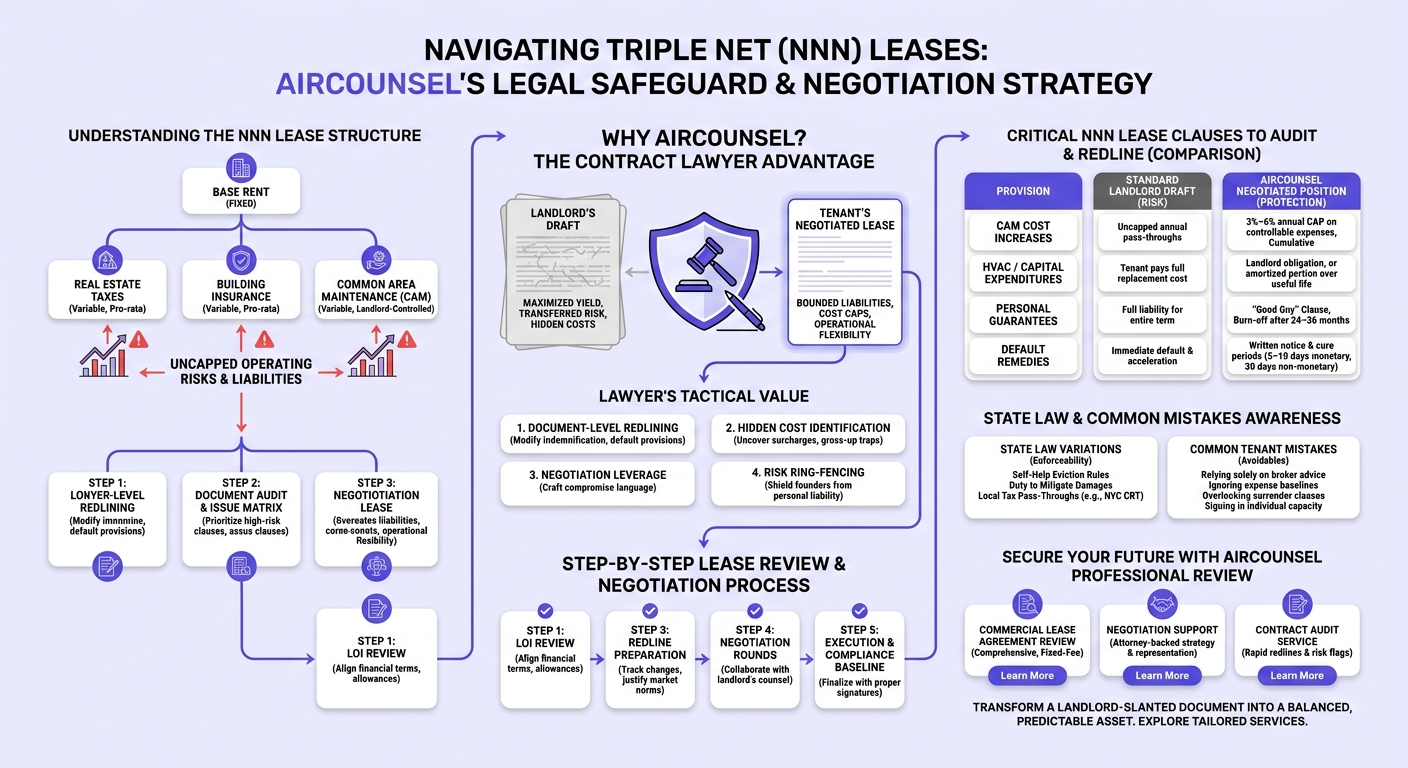
A triple net lease is a commercial real estate agreement where the tenant agrees to pay a base monthly rent plus three net operating expense categories:
- Real Estate Taxes: The tenant's pro-rata share of local property and municipal taxes assessed against the building.
- Building Insurance: Property, casualty, and general liability coverage carried by the building owner.
- Common Area Maintenance (CAM): Ongoing operating costs for parking lots, lobbies, landscaping, security, and utility infrastructure.
According to legal definitions from the Cornell Law School Legal Information Institute, net lease structures assign ongoing operational burdens directly to tenants in exchange for lower headline base rent rates. However, if the lease document does not define precisely what constitutes a legitimate maintenance expense, landlords may attempt to invoice tenants for major building upgrades, administrative management fees, or capital improvements.
Before committing capital, founders should also review the U.S. Small Business Administration guidance on selecting commercial facilities to ensure zoning and operational costs align with business cash flow.
Why Work with a Contract Lawyer on Commercial Leases
Landlord lease forms are drafted by institutional real estate attorneys with a single objective: maximizing landlord net yield and transferring operating risk to the tenant. Real estate brokers facilitate deal matchmaking, but they cannot give legal advice or craft custom protective clauses.
A dedicated contract attorney delivers specific tactical advantages:
- Document-Level Redlining: Direct modification of aggressive indemnification, surrender, and default provisions.
- Hidden Cost Identification: Uncovering administrative surcharges, gross-up calculation traps, and unmetered utility allocations.
- Negotiation Leverage: Crafting compromise language that protects tenant interests while keeping negotiations collaborative and moving toward execution.
- Risk Ring-Fencing: Ensuring your operating entity shields founders from individual liability through properly structured entity signatures.
To understand the full spectrum of vulnerabilities found in standard agreements, read our guide on commercial lease contract review risks in the USA.

Critical NNN Lease Clauses to Audit and Redline
Commercial lease negotiation requires focused review of provisions that dictate long-term liability. A contract attorney prioritizes the following clauses during an audit.
Common Area Maintenance (CAM) and Controllable Cost Caps
Landlords calculate CAM by multiplying total property operating expenses by the tenant's proportionate share of rentable square footage. Without boundaries, your CAM expenses can spike unpredictably year over year.
Key safeguards to negotiate include:
- Controllable Expense Caps: Limit annual increases on controllable expenses (security, janitorial services, landscaping) to 3%–6% per year on a cumulative, compounded basis.
- Audit Rights: Retain the right to inspect landlord books and expense ledgers annually at the tenant's expense, shifting audit costs back to the landlord if an overcharge exceeding 3%–5% is discovered.
- Gross-Up Clause Adjustments: When a building is not fully occupied, adjust CAM allocations so the tenant only pays for normalized operating costs rather than subsidizing vacant suites.
Capital Expenditures vs. Routine Maintenance
Standard landlord templates frequently blur the distinction between routine maintenance and capital replacements. If an HVAC system fails in Year 4 of a 5-year lease, an unedited agreement may force the tenant to fund a $35,000 replacement.
Your contract attorney will redline the agreement to:
- Exclude Capital Expenditures: Expressly exclude foundation, exterior wall, structural column, and roof replacements from CAM pass-throughs.
- Amortize Necessary Replacements: Require that any capital repairs legally permitted as CAM items be amortized over their useful life under Generally Accepted Accounting Principles (GAAP), with the tenant only paying for the portion falling within their remaining lease term.
Personal Guarantees and Assignment Rights
Small businesses and early-stage companies are routinely asked to provide personal guarantees. If the business defaults, the founder's personal assets become vulnerable.
Negotiation targets include:
- Good Guy Clauses: Limit personal guarantor liability to the date the tenant vacates the space, leaves it in broom-clean condition, and surrenders keys after providing 60–90 days notice.
- Rolling or Burn-Off Guarantees: Structure the personal guarantee to expire automatically after 24 to 36 months of timely, uninterrupted rent payments.
- Permitted Transfers: Ensure the tenant can assign the lease or sublease the premises to an affiliate, parent company, or merger successor without requiring landlord consent or triggering termination penalties.
Default Remedies and Cure Periods
Landlord drafts often treat a single missed payment or technical paperwork delay as an immediate default allowing lease termination and acceleration of all remaining rent.
A protective redline enforces:
- Notice and Cure Periods: At least 5–10 business days written notice for monetary defaults and 30 days written notice for non-monetary defaults before penalties apply.
- Mitigation of Damages: Requiring the landlord to use commercially reasonable efforts to re-let the space to mitigate damages if a default occurs.
| Lease Provision | Standard Landlord Draft | Tenant-Favorable Negotiated Position |
|---|---|---|
| CAM Cost Increases | Uncapped annual pass-throughs | 4%–5% annual cap on controllable expenses |
| HVAC Failure | Tenant pays full cost of replacement | Landlord replaces; tenant pays amortized portion only |
| Audit Rights | Silent or strictly prohibited | Annual audit rights with landlord penalty for overbilling |
| Subletting/Assignment | Absolute landlord discretion; profit recapture | Permitted transfers to affiliates; reasonable consent standard |
| Monetary Default | Immediate default without formal notice | 5–10 business days written notice and cure window |
| Personal Guarantee | Full liability for entire term | Burn-off after 24 months of on-time payments |
Step-by-Step Lease Review and Negotiation Process
Working with legal counsel follows a systematic process designed to preserve deal momentum while systematically closing legal vulnerabilities:
- Step 1: Letter of Intent (LOI) Review: Align basic financial terms, space delivery conditions, tenant improvement (TI) allowances, and renewal rights before drafting the formal lease.
- Step 2: Document Audit and Issue Matrix: The attorney reviews the landlord's primary lease agreement, rules and regulations, and exhibits, assembling a prioritized list of high-risk clauses.
- Step 3: Redline Preparation: Counsel prepares a formal redline version using tracked changes, adding margin comments that justify requested revisions based on market norms.
- Step 4: Negotiation Rounds: The attorney collaborates with your broker and the landlord's legal team to resolve contested provisions, such as indemnification caps and repair duties.
- Step 5: Execution and Compliance Baseline: Finalize execution copies with proper entity signatures and maintain an abstract of critical compliance dates (tax filings, option deadlines, insurance renewals).
State Law Variations and Enforceability
While commercial lease drafting principles apply across the United States, enforcement standards vary significantly by state:
- Self-Help Eviction Rules: Most US jurisdictions prohibit commercial landlords from locking out tenants without judicial process, but certain states allow limited contractual self-help remedies if explicitly drafted.
- Duty to Mitigate: In states like California, Texas, and New York, statutory rules or case law govern whether a landlord must actively market a vacated suite to mitigate losses after a tenant breach.
- Local Tax Pass-Throughs: State-level real property transfer taxes, commercial rent taxes (such as New York City's CRT), and local municipal assessments require state-specific carve-outs in net lease definitions.
A qualified lawyer ensures that governing law and venue clauses keep dispute resolution within your local jurisdiction rather than the landlord's corporate home state.
Common Tenant Mistakes When Signing NNN Leases
Founders often fall into predictable traps during commercial leasing:
- Relying Exclusively on Broker Advice: Commercial brokers are transaction agents focused on closing; they are not insured or licensed to draft legal protections or evaluate liability exposure.
- Ignoring Operating Expense Baselines: Failing to request the previous 3 years of actual CAM, tax, and insurance bills before signing.
- Overlooking Surrender Clauses: Agreeing to remove all tenant improvements and restore the space to original base-building condition at lease termination, which can cost tens of thousands of dollars.
- Signing in an Individual Capacity: Failing to list the exact legal entity name on the signature block, accidentally binding the business owner personally.
Secure Expert Lease Negotiation Support
Entering a commercial triple net lease without seasoned legal review exposes your business to unbounded maintenance bills, rigid operating restrictions, and personal financial risk. Having a dedicated legal partner redline your agreement transforms a landlord-slanted document into a balanced, predictable commercial asset.
AirCounsel provides rapid, attorney-led contract reviews and negotiation support under transparent, fixed pricing. Our licensed US attorneys redline commercial leases, audit operating expense terms, and safeguard your operational flexibility without open-ended hourly fees.
Explore our tailored real estate and commercial agreement services:
- Protect your space with our Commercial / Residential Lease Agreement Review.
- Secure attorney-backed deal representation with our Negotiation Support.
- Have any standard agreement audited using our Review of your Contract or Legal Document service.
Frequently Asked Questions
What is a triple net lease and what costs does a tenant usually pay?
A triple net lease (NNN) is a commercial real estate agreement where the tenant pays a base rent plus three additional operating expense categories: property taxes, building insurance, and common area maintenance (CAM). These ongoing costs are typically billed monthly alongside base rent on a pro-rata basis.
Why should a business use a contract lawyer before signing a commercial lease?
Landlord leases are drafted by real estate attorneys to shift maximum operational and financial risk to the tenant. A contract attorney reviews the agreement to cap operating expenses, eliminate structural repair liabilities, modify aggressive default remedies, and prevent unnecessary personal guarantees.
Which triple net lease terms are most important to negotiate?
The most critical terms include controllable CAM expense caps, exclusions for structural and capital replacements, audit rights for operating expenses, assignment and subletting flexibility, reasonable notice and cure periods, and personal guarantee limitations.
How is a commercial lease different from a residential lease in the US?
Residential leases are heavily regulated by state and local tenant-protection statutes governing security deposits, habitability, and eviction procedures. Commercial leases have minimal statutory protections; US courts treat commercial parties as sophisticated business entities, meaning the signed contract dictates virtually all legal rights and liabilities.
Recommended
- Commercial / Residential Lease Agreement Review - Comprehensive, fixed-fee lease review by licensed US attorneys.
- Negotiation Support - Flexible attorney hours for deal strategy, emails, and direct negotiations.
- Review of your Contract or Legal Document - Rapid attorney redlines and risk flags for commercial agreements.
Need Legal Assistance?
Our expert legal team is ready to help you navigate complex legal matters with confidence.