6 Essential Clauses for Your USA Software License Agreement to Protect Proprietary Algorithms

For modern software founders and technology companies, your proprietary algorithms are the lifeblood of your business. However, protecting these underlying formulas requires careful contract planning and registration with the united states copyright office to secure your legal rights.
According to research published by the USPTO, intellectual property-intensive industries support over 45 million American jobs, highlighting the massive economic value tied to proprietary technology. If your software license agreements lack precise language, you risk losing control of your intellectual property (IP), facing unauthorized reverse-engineering, or getting tied up in costly ownership disputes.
Table of Contents
- Quick Summary
- The Role of the United States Copyright Office in Software Protection
- Clause 1: Grant of Rights
- Clause 2: Intellectual Property Ownership
- Clause 3: Strict Restrictions on Reverse Engineering
- Clause 4: Exclusivity and Territory Limitations
- Clause 5: Indemnification and Liability Allocation
- Clause 6: Termination and Right to Retrieval
- Common Mistakes When Licensing Software Algorithms
- Secure Your Software IP with AirCounsel
- Frequently Asked Questions
- Recommended
Quick Summary
| Takeaway | Explanation |
|---|---|
| Copyright Registration | Registering your source code protects your literal expression under federal US law. |
| Strict Restrictions | Always include robust non-decompilation and reverse-engineering clauses. |
| IP Ownership | Explicitly state that licensing the software never transfers ownership of underlying algorithms. |
| Custom Contracts | Standard templates fail to protect complex SaaS pipelines; custom drafting is required. |
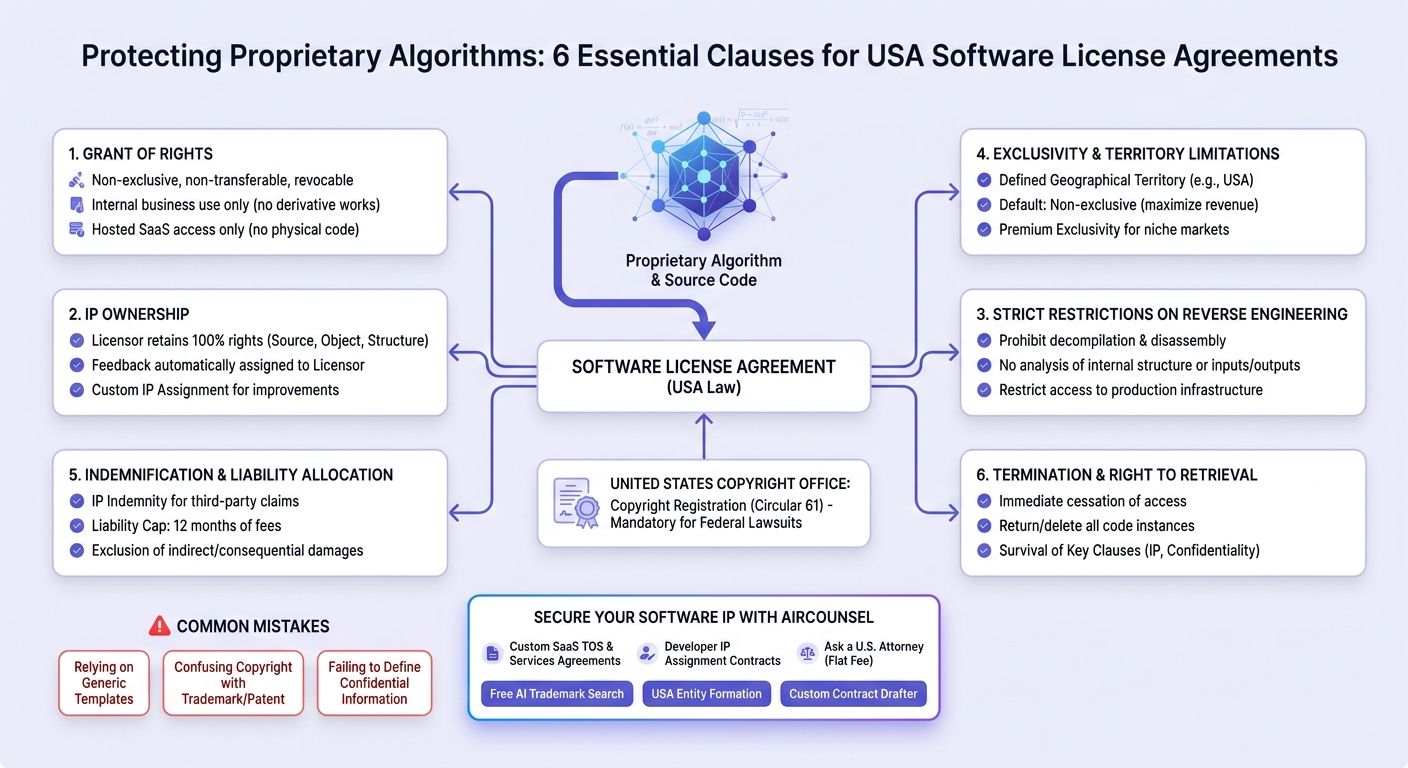
The Role of the United States Copyright Office in Software Protection
Before drafting your commercial license, it is essential to understand what copyright protects. The united states copyright office registers "literary works," a category that legally encompasses computer programs, source code, and object code under Title 17 of the US Code.
While copyright does not protect the abstract functional idea or math behind your algorithm—which is the domain of patent law—it does protect your specific, creative expression of that code. Registering your software program through the united states copyright office, specifically following their guidelines in Circular 61 for Copyright Registration of Computer Programs, provides statutory advantages. It establishes a public record of ownership and is a mandatory prerequisite for filing a copyright infringement lawsuit in federal court.

Clause 1: Grant of Rights
The Grant of Rights clause defines exactly what the licensee can and cannot do with your software. For algorithm-heavy products, you must state that the license is non-exclusive, non-transferable, and revocable.
- Scope of Use: Restrict usage to internal business operations only.
- Derivative Works: Explicitly prohibit the licensee from modifying, adapting, or building derivative works based on your proprietary algorithm.
- SaaS vs On-Premise: If your software is hosted, specify that no license to the physical code is granted—only access to the hosted environment.
Clause 2: Intellectual Property Ownership
A common legal pitfall is assuming that the term "license" automatically protects your ownership. Your agreement must feature an explicit, unambiguous IP ownership clause stating that the licensor retains 100% of all intellectual property rights.
- Ownership Statement: Clarify that the source code, object code, structure, sequence, and proprietary algorithms remain the sole property of your company.
- Feedback Loop: State that any suggestions, feedback, or enhancements provided by the licensee automatically assign to your company without compensation. For structured transfers, using a Custom IP Assignment Agreement ensures your company owns all derivative improvements.
Clause 3: Strict Restrictions on Reverse Engineering
To safeguard the math and logic behind your proprietary algorithm, you must legally lock down the code. Trade secret protection relies on keeping your processes secret, meaning reverse engineering must be strictly forbidden.
- Decompilation Ban: Prohibit decompiling, disassembling, or reverse engineering any portion of the software.
- Observation Restraints: Deny the licensee the right to analyze the software's internal structure, inputs, and outputs to replicate the algorithm's functional behavior.
- Access Limits: Restrict direct access to production databases or behind-the-scenes server infrastructure where the algorithm runs.
Clause 4: Exclusivity and Territory Limitations
Setting clear territorial and commercial boundaries prevents a competitor from locking up your proprietary algorithm in a specific market or geographical area.
- Territory: Define whether the licensing rights apply globally, within the USA, or only within specific regions.
- Exclusivity: Default to a non-exclusive license so you can monetize the same algorithm across multiple clients. If you grant exclusivity, charge a premium and restrict it to a highly specific industry niche.
Clause 5: Indemnification and Liability Allocation
Algorithm errors can lead to major operational failures for your clients. Your contract must manage these financial risks through structured liability caps and indemnification scopes.
- IP Indemnity: Promise to defend the licensee if a third party claims your software violates their trademark or copyright.
- Liability Cap: Limit your total financial liability to the amount of licensing fees paid to you over the prior 12-month period.
- Exclusion of Damages: Ensure you are not held liable for indirect, incidental, or consequential damages resulting from algorithmic computational errors.
Clause 6: Termination and Right to Retrieval
What happens when the business relationship ends? Your termination clause must outline the immediate cessation of software access and the return of confidential code.
- Action upon Termination: Require the licensee to immediately uninstall, delete, or return all instances of your software.
- Deactivation Rights: Reserve the right to remotely disable access to API endpoints or hosted instances of your algorithm.
- Survival Provisions: Specify that key clauses—such as IP Ownership, Confidentiality, and Restrictions on Reverse Engineering—permanently survive the termination of the contract.
Common Mistakes When Licensing Software Algorithms
When reviewing standard contracts, legal teams frequently spot fatal security gaps. Avoid the following mistakes when preparing your commercial licensing agreements:
- Relying on Generic Forms: Standard internet templates do not contain the highly specific reverse-engineering blocks or backend API rules needed to protect proprietary algorithms.
- Confusing Trademark, Patent, and Copyright: Do not rely solely on a trademark. While tools like a Free AI Trademark Search can protect your product’s name, protecting the actual code requires copyright registration with the united states copyright office and watertight contracts.
- Failing to Define Confidential Information: Your algorithm must be explicitly defined as a trade secret and confidential material, forcing the licensee to treat it with extreme security.
Secure Your Software IP with AirCounsel
Protecting your proprietary algorithms from exploitation requires professional drafting. Off-the-shelf templates leave your business vulnerable to reverse engineering, ownership disputes, and intellectual property theft.
AirCounsel provides fast, high-quality, and transparently priced legal contracts prepared by US-licensed attorneys. Protect your technology today with our specialized services:
- Need a complete commercial agreement? Get a custom-drafted SAAS Application Terms of Service or a comprehensive Custom Services Agreement tailored to your backend systems.
- Are you working with developers to build your code? Ensure your company owns the final output with a Website Design/Software Development and/or Maintenance Agreement.
- Have a quick legal issue to resolve? Ask a U.S Attorney a Question and receive a fast, confidential email response for a flat $100 fee.
This article provides general information and is not legal advice.
Frequently Asked Questions
What clause in a software license agreement protects my proprietary algorithms from being reverse engineered?
The Restrictions on Reverse Engineering clause is the primary shield. It legally prohibits the licensee from decompiling, disassembling, translating, or otherwise attempting to discover the underlying source code or mathematical models behind your software.
Do I need to register my software with the united states copyright office before licensing it?
You are not strictly required to register before licensing, as copyright protection exists the moment your code is written. However, registering with the united states copyright office is highly recommended because you must have a registration certificate to sue for copyright infringement in US federal courts.
How does the exclusivity clause affect my ability to license the same algorithm to multiple clients?
An exclusivity clause limits your sales pipeline. If you grant a client an "exclusive" license, you cannot license that specific software or algorithm to other companies within the defined territory or industry. For maximum revenue, strive to issue non-exclusive licenses.
What are the legal consequences of exceeding the scope of a software license that includes proprietary algorithms?
When a licensee exceeds their licensed scope (such as installing the code on unauthorized servers or bypassing seat limits), it constitutes both a breach of contract and federal copyright infringement. This allows the licensor to seek damages, injunctions, and potentially statutory damages under US copyright law.
Recommended
- Free AI Trademark Search – Instantly check the availability of your software's name against federal databases.
- USA Entity and Company Formation – Establish a legal corporate entity to hold your software IP.
- Custom Contract Drafter – Have licensed attorneys draft fully customized business agreements for your team.
Need Legal Assistance?
Our expert legal team is ready to help you navigate complex legal matters with confidence.