5 State Privacy Law Traps a Contract Lawyer Must Address in Your 2026 US App Privacy Policy

Launching a mobile application in the United States requires navigating an increasingly complex web of state-level privacy statutes. While many founders rely on generic website templates, mobile apps collect distinct data types—such as persistent device identifiers, precise geolocation, and granular telemetry—that require tailored legal disclosures.
Failing to align your app disclosures with evolving consumer protection standards can trigger substantial statutory penalties and app store removal. In fact, regulatory frameworks like the California Consumer Privacy Act (CCPA/CPRA) require that businesses update their privacy policy at least once every 12 months to ensure ongoing compliance and clear consumer notice.
Working with an experienced contract lawyer ensures that your app-facing privacy documentation accurately maps technical data flows to state-mandated disclosures. A specialized legal professional helps you eliminate regulatory traps, satisfy platform distribution guidelines, and establish strong consumer trust before public rollout.
Table of Contents
- Quick Summary
- Why Mobile App Privacy Policies Require Specialized Legal Review
- Trap 1: Conflating Website and Mobile Application Data Flows
- Trap 2: Ignoring State-Specific Consumer Rights and Opt-Out Links
- Trap 3: Vague Disclosures for Ad Tech, SDKs, and Data Retention
- Trap 4: Overlooking COPPA and Strict Protections for Minors
- Trap 5: Missing Just-in-Time Notices at Collection
- App Privacy Review Framework for 2026
- How a Contract Lawyer Protects Your Launch
- Secure Your App with Attorney-Drafted Legal Policies
- Frequently Asked Questions
- Recommended
Quick Summary
| Takeaway | Explanation |
|---|---|
| Mobile Data Discrepancies | Device telemetry, background location, and hardware identifiers require dedicated app disclosures rather than basic website language. |
| Mandatory State Disclosures | States like California, Virginia, and Colorado require specific notices, consumer rights mechanics, and opt-out pathways. |
| Third-Party SDK Risk | Analytics and ad networks embedded in your code share data that state regulators classify as a "sale" or "targeted sharing." |
| Data Retention Timelines | Modern privacy rules mandate disclosing explicit retention periods or criteria for every collected category of personal information. |
| Fixed-Fee Drafting | A contract lawyer can draft tailored app policies quickly, eliminating ambiguity and avoiding regulatory penalties. |
Why Mobile App Privacy Policies Require Specialized Legal Review
A privacy policy is not merely a static terms page—it is a binding public disclosure and legal representation of how your company collects, processes, and shares personal data. Under US law, misrepresenting data practices in a privacy policy constitutes an unfair or deceptive trade practice under Section 5 of the FTC Act, enforced by the Federal Trade Commission.
In the absence of a single overarching federal data privacy statute, states have enacted individual consumer privacy frameworks. When an app is available for download across the US, it must satisfy the strictest overlapping requirements of these state laws. A qualified contract lawyer reviews your data architecture and translates software functionalities into precise, legally enforceable terms.
To understand other contractual hazards common in tech ventures, read our guide on contract traps a business lawyer helps startups avoid.
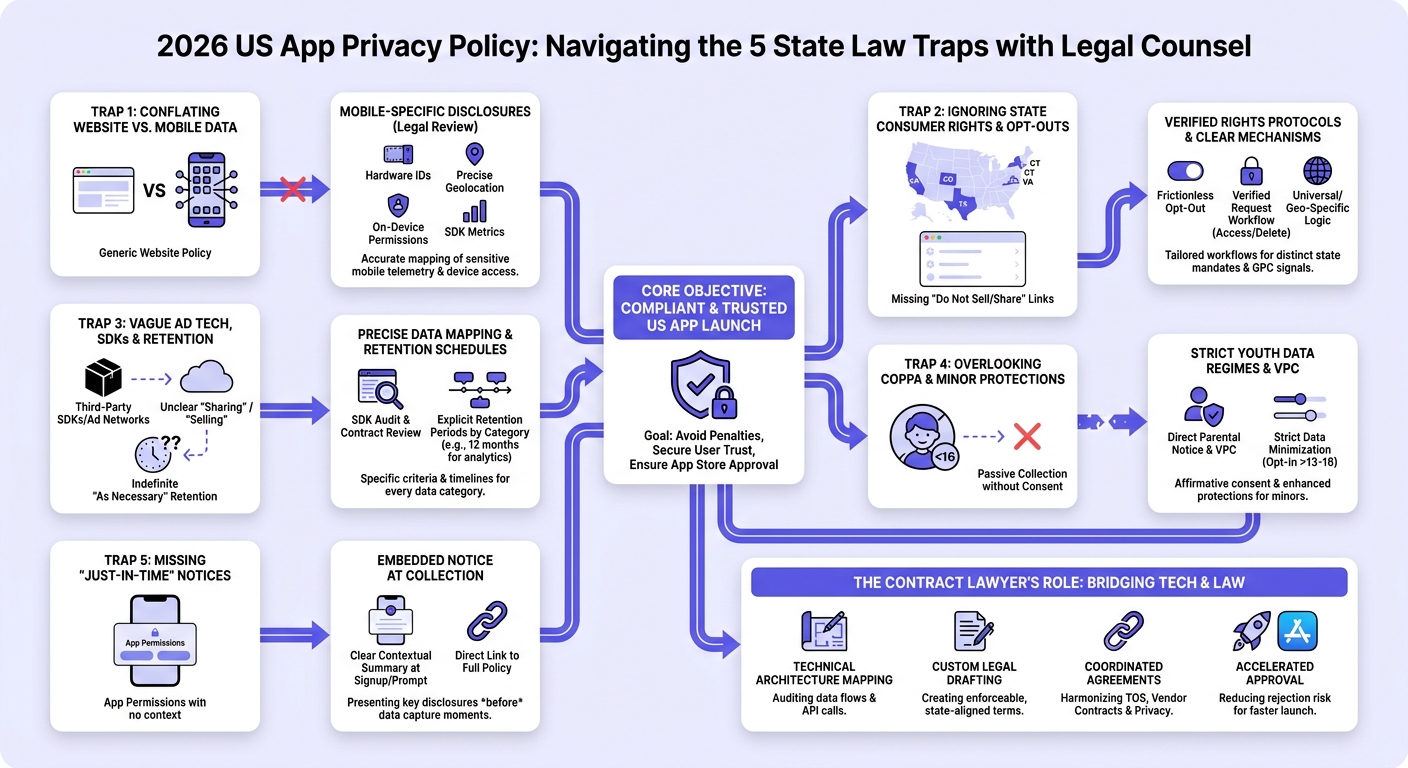
Trap 1: Conflating Website and Mobile Application Data Flows
Many early-stage startups copy their marketing website privacy policy into their iOS or Android mobile application build. This creates immediate compliance vulnerability because mobile devices capture deeply sensitive data streams that standard browser sessions rarely touch.
Key mobile-specific data elements that require explicit disclosure include:
- Hardware and Device Identifiers: Unique device IDs (IDFA/GAID), MAC addresses, operating system builds, and network carrier information.
- Precise Geolocation: Continuous background or foreground GPS data, which triggers sensitive data classifications under state laws.
- On-Device Permissions: Access to photo libraries, contacts, camera feeds, microphones, and health or biometric hardware.
- Diagnostic and Performance Metrics: Crash logs, interaction rates, and session recordings captured by mobile software development kits (SDKs).
If your privacy policy only addresses standard browser cookies while your mobile app captures persistent hardware IDs and location pings, your policy is legally inaccurate.
Trap 2: Ignoring State-Specific Consumer Rights and Opt-Out Links
State privacy laws across jurisdictions such as California, Virginia, Colorado, Connecticut, and Texas grant consumers distinct rights regarding their personal data. These rights include access, deletion, correction, data portability, and the right to opt out of targeted advertising, data sales, or automated profiling.
Under rules enforced by the California Privacy Protection Agency, apps must provide straightforward methods for users to submit verified consumer requests without excessive friction.
Common compliance traps include:
- Missing "Do Not Sell or Share My Personal Info" Links: Failing to provide accessible toggles or links inside the app settings menu.
- Unverified Request Workflows: Lacking an established protocol for verifying consumer identity before releasing or deleting stored data.
- Restricting Rights by Geography: Attempting to deny basic access rights to non-California users without clear internal processing logic.
Trap 3: Vague Disclosures for Ad Tech, SDKs, and Data Retention
Mobile apps depend heavily on third-party software development kits (SDKs) for analytics, crash reporting, authentication, and monetization. Under broad state privacy definitions, passing device IDs or user engagement data to third-party ad networks constitutes "sharing" or "selling" data for cross-context behavioral advertising.

Furthermore, state regulations require businesses to disclose their data retention period for each category of personal information collected, or the precise criteria used to determine that period. Policies that state data will be retained "as long as necessary" without specific criteria routinely fail regulatory scrutiny.
Trap 4: Overlooking COPPA and Strict Protections for Minors
If your app appeals to younger audiences or knowingly collects information from children under 13, you must comply with the federal Children's Online Privacy Protection Act (COPPA). In addition, state statutes provide enhanced protections for minors aged 13 through 16, requiring affirmative opt-in consent before selling or sharing their information.
Key obligations for handling minor data include:
- Direct Parental Notice: Delivering detailed privacy disclosures directly to parents before collecting minor data.
- Verifiable Parental Consent (VPC): Implementing compliant consent mechanisms prior to data capture.
- Strict Data Minimization: Prohibiting conditioning a child's participation on disclosing more personal data than reasonably necessary.
Trap 5: Missing Just-in-Time Notices at Collection
Under comprehensive state frameworks, businesses must provide consumers with a "Notice at Collection" at or before the moment personal data is gathered. In a mobile app environment, this means presenting clear, concise summaries when requesting device permissions rather than relying solely on a link tucked away in an account settings submenu.
Your contract lawyer will ensure that in-app modal dialogues, registration screens, and permission prompts align perfectly with the overarching disclosures contained in your formal privacy documentation.
App Privacy Review Framework for 2026
Before launching or updating an app on major application stores, review your operational practices against this core compliance framework:
| Review Area | Regulatory Requirement | Implementation Standard |
|---|---|---|
| Notice at Collection | Present categories of data collected and purpose prior to capture | Embed privacy links on sign-up screens and OS permission dialogues |
| SDK Audit | Identify all third-party code capturing user identifiers | Document data sharing agreements and ad tech transfer mechanisms |
| Opt-Out Mechanisms | Provide frictionless opt-outs for data sales and targeted ads | Include in-app toggle settings and respect Global Privacy Controls (GPC) |
| Retention Disclosures | Define distinct retention timelines for each data category | Publish concrete operational retention schedules in plain English |
| Consumer Request Channels | Provide toll-free numbers, web forms, or in-app request paths | Establish a 45-day response timeline with internal verification protocols |
How a Contract Lawyer Protects Your Launch
Hiring an experienced contract lawyer bridges the gap between engineering reality and regulatory compliance. Instead of relying on rigid, boilerplate generators that miss key SDK integrations, an attorney:
- Maps Your Technical Architecture: Audits your user registration flows, database storage, and external API calls to reflect true data handling.
- Drafts Custom Privacy Terms: Creates legally enforceable disclosures that align with both federal expectations and individual state mandates.
- Coordinates Related App Agreements: Harmonizes your privacy disclosures with user-facing terms of use and vendor agreements.
- Accelerates App Store Approval: Reduces rejections from Apple App Store and Google Play review teams triggered by incomplete privacy declarations.
Secure Your App with Attorney-Drafted Legal Policies
Launching your application without verified legal terms exposes your venture to state enforcement actions, statutory fines, and app store takedowns. AirCounsel connects founders with licensed US attorneys who deliver clear, comprehensive legal protections with transparent, fixed pricing.
Protect your digital product by ordering a Custom Application, Software or Website Privacy & Cookies Policy tailored to your exact tech stack. Pair your privacy terms with robust Custom Application, Software or Website Terms of Service or have an existing draft audited via our Review of your Contract or Legal Document service.
Frequently Asked Questions
What state privacy laws apply to my app privacy policy in the US?
If your mobile application is accessible to residents across the US, you must generally comply with the privacy laws of the states where your users reside. Key statutes include California (CCPA/CPRA), Virginia (VCDPA), Colorado (CPA), Connecticut (CTDPA), Utah (UCPA), and several newer state laws entering into force through 2026. Structuring your policy to meet the strictest standards protects your business nationwide.
Does my app need a separate privacy policy if I already have one for my website?
Yes, in most cases. Mobile apps collect unique device data—including hardware identifiers, push notification tokens, and sensor data—that standard websites do not process. While you can maintain a unified overarching document, it must contain dedicated sections detailing mobile-specific data collection, permissions, and third-party SDK behaviors.
What disclosures must be included for California users under CCPA/CPRA?
California requires disclosing the categories of personal information collected, sources of collection, commercial purposes for collecting or sharing, categories of third parties receiving data, and explicit retention periods. You must also detail consumer rights (such as access, deletion, and correction) and provide a clear mechanism to opt out of data sales or cross-context behavioral advertising.
How often should an app privacy policy be reviewed or updated?
You should review your app privacy policy at least once every 12 months to maintain regulatory compliance. Additionally, you must update the policy whenever you introduce new features, integrate new third-party analytics or monetization SDKs, alter your data retention practices, or expand into new geographic jurisdictions.
Can a contract lawyer review my mobile SDK integrations?
Yes. A contract lawyer can review your list of integrated SDKs and API vendors to determine whether their data capture practices constitute a third-party "sale" or "sharing" under applicable state privacy frameworks, ensuring your policy discloses those relationships accurately.
Recommended
Need Legal Assistance?
Our expert legal team is ready to help you navigate complex legal matters with confidence.