5 State Registration Traps a Franchise Attorney Identifies in Annual FDD Renewals

Expanding a franchise system across the United States requires navigating dual layers of federal disclosure mandates and state-level franchise registration laws. According to data highlighted by the U.S. Small Business Administration Office of Advocacy, there are 851,000 franchise establishments in the United States, reflecting both the immense commercial power of the franchise model and the strict regulatory scrutiny franchisors face each year.
Under the Federal Trade Commission (FTC) Franchise Rule, every franchisor must update its Franchise Disclosure Document (FDD) within 120 days of its fiscal year-end. However, having an updated federal FDD is not enough to continue selling franchises in registration states like California, New York, or Illinois.
When filing deadlines are missed or state-specific addenda are omitted, franchisors face mandatory sales shutdowns, costly rescission offers, and regulatory fines. Retaining a qualified franchise attorney ensures your annual renewal filings satisfy both federal guidelines and state examiners without disrupting your sales pipeline.
Table of Contents
- Federal FTC Rules vs State Franchise Registration Laws
- 5 Critical State FDD Renewal Traps to Avoid
- Multi-State Franchise Renewal Checklist and Timeline
- How a Franchise Attorney Protects Your Sales Pipeline
- Streamline Your Annual FDD Filings with AirCounsel
- Frequently Asked Questions
- Recommended
Quick Summary
| Takeaway | Explanation |
|---|---|
| Dual Compliance Levels | The FTC regulates federal franchise disclosure, but approximately 14 states require independent state registration or review before offers or sales can occur. |
| Annual 120-Day Clock | Federal rules require FDD updates within 120 days of fiscal year-end (April 30 for calendar year filers), but state renewal dates often differ. |
| Blackout Risk | Missing a state renewal deadline creates a legal "dark period" where all advertising, offers, and franchise sales must halt immediately. |
| State Addenda Mandates | Registration states require specific contractual modifications covering dispute resolution, post-term non-competes, and termination rights. |
| Attorney Pre-Screening | Working with a franchise lawyer prevents filing rejections, reduces regulatory comment letters, and protects your franchise fee revenues. |
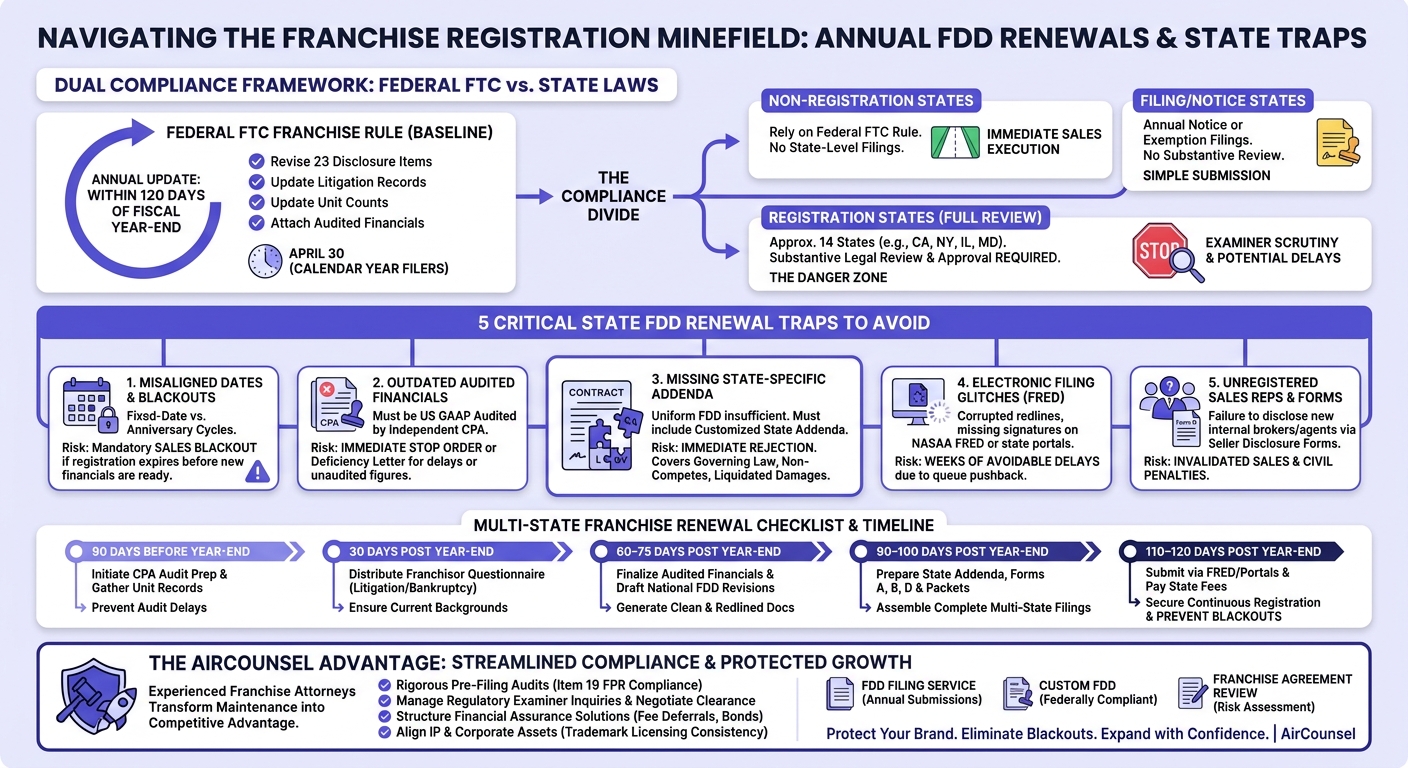
Federal FTC Rules vs State Franchise Registration Laws
Franchisors often assume that once their annual disclosure document is updated under federal rules, they can immediately execute agreements with prospective franchisees across all 50 states. This is a common and expensive misconception.

The FTC 120-Day Annual Update Baseline
The Federal Trade Commission requires every franchisor to update its disclosure document within 120 calendar days after the close of its fiscal year. For franchisors operating on a standard calendar year ending December 31, the federal deadline is April 30. During this period, franchisors must revise all 23 disclosure items, incorporate updated litigation records, update system-wide unit counts, and attach newly audited financial statements.
Registration States vs Filing and Non-Registration States
Franchise regulation across the US falls into three distinct tiers:
- Registration States (Full Review): States such as California, New York, Illinois, Maryland, Minnesota, Virginia, and Washington require franchisors to submit their FDD for substantive regulatory review and approval before offering or selling franchises.
- Filing/Notice States: States such as Florida, Michigan, Texas, and Utah require annual notice filings or business opportunity exemption filings, generally without substantive manual document examination.
- Non-Registration States: The remaining states do not require state-level filings, relying strictly on the federal FTC Franchise Rule framework.
Because registration states conduct in-depth legal reviews, examiners can issue comment letters or deficiency notices that pause your registration until amendments are approved.
5 Critical State FDD Renewal Traps to Avoid
Navigating annual state filings requires pinpoint precision. A single procedural mistake can stall multi-unit deals and expose leadership to state enforcement actions.
1. Misaligned Expiration Dates and Blackout Periods
Federal compliance operates on a 120-day cycle, but state registration renewal deadlines vary significantly:
- Fixed-Date States: Some states tie renewals directly to 120 days post-fiscal year-end or a statutory calendar date.
- Anniversary States: Other jurisdictions tie your registration expiration to exactly one year from the date your prior registration was approved.
If an anniversary date arrives before your new audited financials are ready, your registration expires. This triggers a mandatory blackout period where you cannot legally offer, negotiate, or sell franchises in that state until an initial application or late renewal is fully processed.
2. Outdated Audited Financial Statements
Registration state examiners scrutinize Item 21 financial statements. Under standard rules, financial statements must be audited by an independent certified public accountant (CPA) using US GAAP standards.
If an audit is delayed or if the franchisor submits unaudited interim figures without proper state-specific phased-in exemptions, examiners will immediately issue a stop order or deficiency letter.
3. Missing State-Specific Addenda and Disclosures
A uniform national FDD cannot be filed in registration states without customized state addenda. State franchise relationship laws override standard terms in your core Custom Franchise Agreement.
Common state addenda modifications include:
- Governing Law and Venue: States like California and Illinois restrict franchisors from forcing local franchisees to litigate disputes exclusively outside the franchisee's home state.
- Post-Termination Covenants: States regularly limit the enforceability of broad non-compete clauses.
- Liquidated Damages: Certain regulators require disclaimers regarding the collection of accelerated future royalties upon early contract termination.
Failing to attach the correct state addendum will result in immediate rejection by state regulators.
4. Electronic Filing System Glitches via NASAA FRED
Most franchise registration states process filings electronically through the North American Securities Administrators Association (NASAA) Electronic Depository (FRED) system or specialized state portals (such as New York's AG filing portal or California's DFPI system).
Submitting corrupted redlines, missing signature pages, or selecting incorrect filing categories on FRED can push your submission to the back of the examiner review queue, creating weeks of avoidable delays.
5. Unregistered Sales Representatives and Form Changes
Many registration states require franchisors to file Franchise Seller Disclosure Forms (Form D) for every internal broker, executive, or external sales agent interacting with prospective buyers.
If your franchise sales team expanded or restructured during the past 12 months and new representatives were not disclosed on state filings, regulators can invalidate completed sales and impose civil monetary penalties.
Multi-State Franchise Renewal Checklist and Timeline
A structured multi-state renewal process prevents lapses and protects ongoing negotiations.
| Timeline Milestone | Core Action Item | Regulatory Objective |
|---|---|---|
| 90 Days Before Year-End | Initiate CPA audit preparation and gather Item 20 unit closure/transfer records. | Prevents Item 21 audit delays and speeds up annual document redlining. |
| 30 Days Post Year-End | Distribute franchisor questionnaire to officers and directors for Item 2 litigation and bankruptcy updates. | Ensures all Item 2 executive backgrounds and Item 3 disclosures are current. |
| 60–75 Days Post Year-End | Finalize audited financial statements and draft national FDD revisions with a legal team. | Generates clean and redlined documents required for state examiners. |
| 90–100 Days Post Year-End | Prepare state addenda, Form A (Uniform Franchise Registration Application), Form B (Certifications), and Form D (Seller Forms). | Assembles complete multi-state filing packets before statutory deadlines. |
| 110–120 Days Post Year-End | Submit state renewal filings via FRED or state portals; pay state registration fees. | Secures continuous registration and prevents sales blackouts. |
How a Franchise Attorney Protects Your Sales Pipeline
Retaining an experienced franchise attorney transforms annual FDD maintenance from an operational bottleneck into a competitive growth advantage.
A dedicated legal professional:
- Conducts Rigorous Pre-Filing Audits: Verifies that Item 19 Financial Performance Representations (FPRs) strictly comply with NASAA guidelines, reducing exposure to regulatory audits and franchisee misrepresentation claims.
- Manages Regulatory Examiner Inquiries: Drafts formal response letters and negotiates prompt clearance when state examiners challenge specific contract provisions.
- Structures Financial Assurance Solutions: If an emerging franchisor does not meet state net worth benchmarks, counsel negotiates fee deferrals, escrow agreements, or surety bonds so registrations are approved without halting operations.
- Aligns IP and Corporate Assets: Ensures your federally registered trademarks managed through Trademark Filing services match the licensing structures outlined in Item 13.
Streamline Your Annual FDD Filings with AirCounsel
Managing multi-state franchise compliance requires speed, precision, and transparent costs. AirCounsel connects emerging and established franchisors with experienced US attorneys who understand the intricacies of annual renewals, state-specific addenda, and electronic regulatory portals.
Whether you need a full Custom Franchise Disclose Document (FDD) prepared from scratch, routine annual registration submissions through our FDD Filing Service, or an expert Franchise Agreement and FDD Review, our network provides rapid turnaround times and clear, fixed pricing. Protect your brand, eliminate sales blackouts, and expand your franchise system with confidence.
Frequently Asked Questions
Which states require franchise registration or notice filings before an annual FDD can be used?
Approximately 14 registration states require formal registration and approval before offering or selling franchises, including California, Hawaii, Illinois, Indiana, Maryland, Minnesota, New York, North Dakota, Rhode Island, South Dakota, Virginia, Washington, and Wisconsin. Several additional states (including Florida, Michigan, Texas, and Utah) require notice filings or one-time business opportunity filings.
Do all franchise offerings need state review, or only certain jurisdictions?
Only registration states conduct substantive manual reviews of your FDD and franchise agreement. In non-registration states, you must comply fully with the federal FTC Franchise Rule, but you do not submit filings to state regulators.
What documents are typically required for an annual FDD renewal filing?
A complete renewal submission typically requires the updated clean FDD, a redlined version showing changes from the prior year, Form A (Uniform Franchise Registration Application), Form B (Certification), Form C (Consent to Service of Process), Form D (Franchise Seller Disclosure Form), state-specific addenda, audited financial statements, and required state filing fees.
What happens if a franchisor misses a state renewal deadline or submits an incomplete filing?
If a franchisor misses a renewal deadline or files an incomplete application that causes registration expiration, all franchise marketing, negotiations, and sales in that state must cease immediately. Continuing to sell during an expired registration violates state law and may trigger state enforcement fines, mandatory rescission offers to franchisees, and civil liability.
Recommended
- FDD Filing Service – Multi-state FDD registration, renewal, and annual filing management by licensed US franchise attorneys.
- Custom Franchise Disclose Document (FDD) – Federally compliant FDD preparation covering all 23 FTC items with fixed pricing.
- Franchise Agreement and FDD Review – Comprehensive risk assessments and contract redlines for franchisors and franchisees.
Need Legal Assistance?
Our expert legal team is ready to help you navigate complex legal matters with confidence.