The US Seed Stage Legal Checklist: Custom Contract Drafting for Compliant SAFE Notes

Launching a startup in today's shifting financial landscape requires speed and strategic precision. For many founders raising their seed rounds, the Simple Agreement for Future Equity (SAFE) is the instrument of choice. However, as macroeconomic conditions fluctuate, standard templates can expose your cap table to extreme risk, making professional custom contract drafting essential to protect your equity.
According to the SBA 2024 Small Business Profile, small businesses make up 99.9% of US businesses, representing the engine of innovation. Yet when these emerging companies seek early-stage venture funding, a single poorly drafted clause in a capital-raise document can trigger massive, unexpected dilution during future priced rounds.
Table of Contents
- Quick Summary
- Understanding SAFEs vs Convertible Notes
- Key Terms to Customize in Your SAFE Note
- US Compliance and Documentation Requirements
- The Impact of High Interest Rates on Seed-Stage Drafting
- Common SAFE Drafting Pitfalls to Avoid
- When to Use Templates vs Custom Contract Drafting
- Secure Your Funding Compliance with AirCounsel
- Frequently Asked Questions
- Recommended
Quick Summary
| Takeaway | Explanation |
|---|---|
| Instrument Choice | SAFEs avoid debt-like mechanics but require careful mathematical customization. |
| Critical Danger | High interest rates push investors to demand higher discount rates and lower valuation caps. |
| Compliance Is Key | Even early-stage SAFEs are considered securities and must comply with federal and state laws. |
| Customization Value | Tailored drafting prevents cascading cap table dilution and misaligned investor expectations. |
Understanding SAFEs vs Convertible Notes
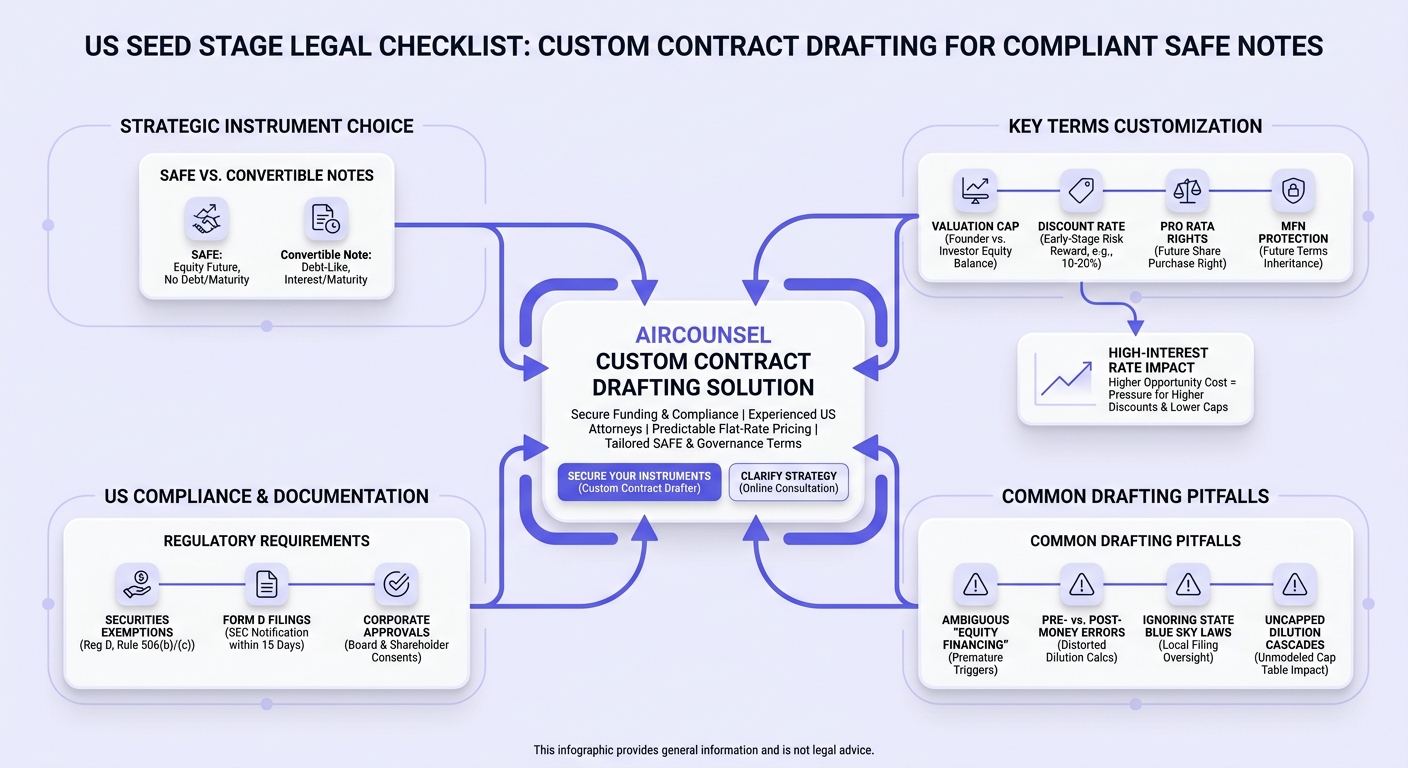
The SAFE was introduced by Y Combinator to offer a faster, simpler alternative to debt-based financing. Unlike a convertible note, a standard SAFE is not a debt instrument. It has no interest rate, no maturity date, and stands outside traditional lender regulations.
If your seed round leans toward traditional structured debt or bridge financing rather than equity conversion rights, creating a robust Custom Loan Agreement may be the more appropriate regulatory path. However, for fast-growing startups seeking to defer valuation negotiations until their Series A, SAFEs remain the gold standard.
Key Terms to Customize in Your SAFE Note
Valuation Cap
- Definition: The maximum valuation at which an investor's SAFE converts into priced equity shares.
- Strategic Impact: Setting this cap too low dilutes the founder's ownership aggressively, while setting it too high may discourage seed-stage investors in a tightening capital market.
Discount Rate
- Definition: The percentage discount (often 10% to 20%) applied to the future Series A share price.
- Strategic Impact: Ensures early-stage risk is rewarded. Incorporating both a cap and a discount rate requires precise language to define which conversion formula triggers under given conditions.
Pro Rata Rights
- Definition: The right of the investor to purchase enough shares in subsequent rounds to maintain their overall ownership percentage.
- Strategic Impact: Historically standard for major investors, granting these rights automatically to minor participants can complicate future Series A negotiations and crowd the cap table.
Most Favored Nation Protection
- Definition: A clause ensuring that if subsequently issued SAFEs have better terms, the early investor inherits those terms.
- Strategic Impact: While helpful for closing a fast initial check, an unmonitored "Most Favored Nation" (MFN) clause restricts your future fundraising flexibility.
US Compliance and Documentation Requirements
Even though SAFEs defer formal equity issuance, the SEC classifies them as securities. Compliance during private seed rounds must be prioritized to avoid costly enforcement actions or transactional rescissions.
- Securities Exemptions: Startups must qualify under federal private offering exemptions, most commonly Regulation D (specifically Rule 506(b) or Rule 506(c)), to avoid full public registration requirements.
- Form D Filings: If relying on Regulation D, founders must file a Form D with the SEC within 15 days of the first sale of the security.
- Corporate Approvals: Prior to receiving capital and executing a SAFE, your company board of directors and shareholders must formally certify consents authorizing the instrument and reserving future shares.
For more details on exempt capital structures, review the SEC Frequently Asked Questions About Exempt Offerings.
The Impact of High Interest Rates on Seed-Stage Drafting
The era of zero-percent interest rates has shifted. In a high-interest-rate environment, capital carries a higher opportunity cost. Seed-stage investors expect favorable risk-adjusted returns to offset secure yields they can find elsewhere.
This environment changes how SAFE notes are negotiated:
| Drafting Metric | Zero-Rate Era Target | High-Rate Era Benchmark |
|---|---|---|
| Valuation Caps | Broad, highly founder-favorable | Narrower, tied to performance indices |
| Discount Rates | Standardized at 20% | Increasing pressure for 25% or higher |
| Maturity Mechanics | Exclusively non-debt conversions | Hybrid demands for guaranteed redemption clauses |
Common SAFE Drafting Pitfalls to Avoid
- Ambiguous Definitions of "Equity Financing": Failing to explicitly designate minimum thresholds or types of capital raises that trigger Conversion Events leads to premature conversions or investor disputes.
- Pre-Money vs Post-Money Calculative Errors: Mixing older pre-money SAFE templates with newer post-money models in the same fundraising round distorts dilution calculations, severely impacting founder equity.
- Ignoring State Blue Sky Laws: Although federal rules exempt many private transactions, local state filings or notice fees are frequently overlooked by self-directed founders.
- Uncapped Dilution Cascades: Issuing continuous SAFEs without modeling their combined visual impact on your capitalization table before a priced round closes.
When to Use Templates vs Custom Contract Drafting
Generic online templates are designed to serve average market assumptions. While helpful for a single, small check from an angel investor, they often lead to systemic errors during structured rounds.
- Unusual Investor Classes: Working with strategic corporate partners or international entities often requires custom tax and governance variations.
- Multi-Investor Synced Terms: Grouping several investors under a cohesive, synchronized structure ensures uniform investor treatment and lower administration costs over time.
- Protecting Founder Intellectual Property: Ensuring that the money raised does not give investors immediate, direct leverage over proprietary designs is critical, particularly when hiring contractors under a Custom Independent Contractor / Consulting Agreement at the same time.
For rounds requiring custom provisions, relying on a professional Custom Contract Drafter guarantees that your strategic deal points are translated into clear, compliant, and enforceable language.
Secure Your Funding Compliance with AirCounsel
Closing your seed round should be a milestone to celebrate, not a vector for cap table disputes. By partnering with AirCounsel, you get direct access to experienced US attorneys who can deliver compliant capital-raise documentation aligned perfectly with your funding expectations.
Our approach focuses on speed, strategic clarity, and predictable flat-rate pricing. Whether you need a tailormade SAFE note, state compliance monitoring, or custom governance terms, our services help you protect equity and minimize overhead.

- Get started with our Custom Contract Drafter to tailor your seed instruments securely.
- Ready to clarify your funding strategy first? Schedule an Online Consultation with our specialists today.
This article provides general information and is not legal advice.
Frequently Asked Questions
What is the difference between a SAFE and a convertible note?
A SAFE represents an agreement for future equity without standard debt properties like maturity dates or accruing interest rates. A convertible note behaves like a loan that converts to equity at a future date upon specified fundraising triggers.
Which SAFE terms are most important to customize in a seed round?
The valuation cap, discount rate, and pro rata rights are the most influential parameters to customize, as they directly dictate how much ownership is diluted when the SAFE converts.
Do SAFEs need to comply with US securities laws?
Yes, the SEC classifies SAFEs as securities. Startups must ensure these instruments qualify for private offering exemptions under state and federal legislation, including filing a Form D when applicable.
When should a founder use custom contract drafting instead of a standard SAFE template?
A founder should opt for custom drafting when negotiating with strategic partners, coordinating multiple capital tiers, implementing modern custom covenants, or seeking protection during highly capitalized seed rounds where standard template models could lead to unintended equity dilution.
Recommended
Need Legal Assistance?
Our expert legal team is ready to help you navigate complex legal matters with confidence.