When to Hire a Corporate Lawyer for Your Small Business

60% of small businesses face a lawsuit at some point during their life cycle (NFIB estimate). For many owners, that risk only becomes real after something has already gone wrong.
A corporate lawyer is not just for Fortune 500 companies. For a growing small business in the USA, the right attorney can quietly prevent disputes, protect your assets, and keep you compliant so you can focus on revenue instead of legal fires.
This guide breaks down when you actually need a corporate lawyer, what they do for small businesses, what it typically costs, and how to work with one efficiently—so you’re investing in protection, not just paperwork.
Table of Contents
- Quick Summary
- What Is a Corporate Lawyer for Small Businesses?
- When a Small Business Should Hire a Corporate Lawyer
- Key Risks of Going Without a Corporate Lawyer
- How Corporate Lawyers Work: Scope, Costs, and Timelines
- How to Work With a Corporate Lawyer Efficiently
- Common Mistakes Business Owners Make With Legal Counsel
- Get Practical Corporate Legal Support With AirCounsel
- Frequently Asked Questions
- Recommended
Quick Summary
| Takeaway | Explanation |
|---|---|
| Hire a corporate lawyer early, not after a crisis | The best time is before signing major contracts, bringing on partners/investors, or hiring your first employees, not during a dispute. |
| Small businesses face real legal risk | High lawsuit rates, compliance obligations, and contract disputes can threaten cash flow and personal assets. |
| A corporate lawyer focuses on the business itself | They handle entity choice, contracts, equity, compliance, IP, and deals—not criminal cases or divorces. |
| Costs are manageable if you’re proactive | Fixed-fee work and focused consultations often cost less than fixing expensive mistakes later. |
| You don’t need a full-time lawyer | Most small businesses use on-demand or membership-style legal support for predictable, recurring needs. |
| Good preparation lowers your legal bill | Clear documents, goals, and questions help your lawyer work faster and keep costs under control. |
What Is a Corporate Lawyer for Small Businesses?
A “corporate lawyer” (often called a business lawyer) is an attorney who focuses on the legal needs of businesses—whether they are corporations, LLCs, partnerships, or sole proprietorships.
At a high level, a corporate lawyer helps you:
- Choose and form the right business entity
- Draft and negotiate contracts
- Comply with federal, state, and local laws
- Structure relationships with co-founders, investors, and partners
- Protect and license intellectual property (IP)
- Buy, sell, or reorganize a business
Unlike:
- Trial litigators, who primarily go to court, and
- General practitioners, who might handle everything from traffic tickets to divorces,
a corporate lawyer is focused on transactions, risk prevention, and business compliance.
According to the Small Business Administration’s guide to staying legally compliant, small businesses must navigate multiple layers of regulations (licenses, permits, tax registrations, employment rules). A corporate lawyer helps you map those requirements to your actual operations so you don’t accidentally run afoul of them.
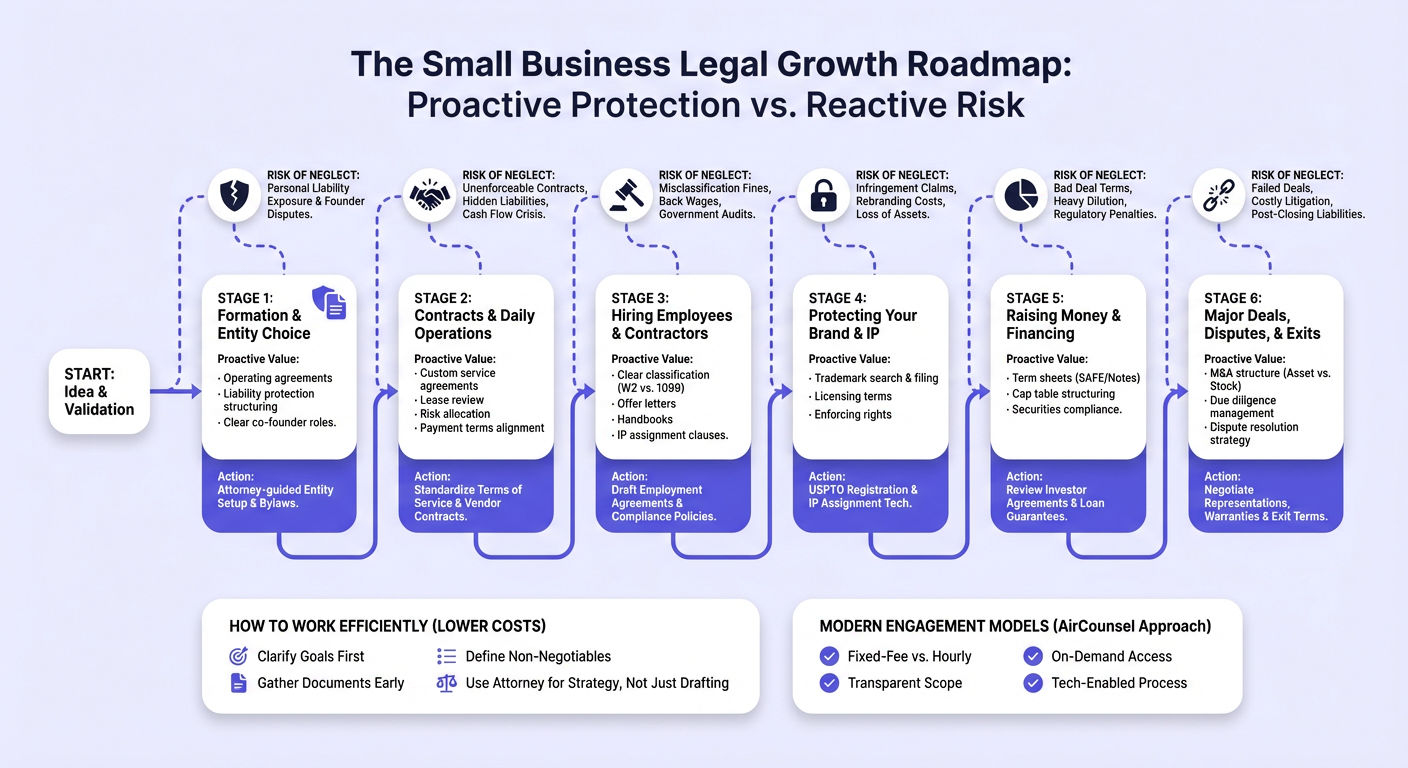
When a Small Business Should Hire a Corporate Lawyer
You don’t need a corporate lawyer on payroll to benefit from one. Most small businesses do best with targeted legal support at key moments in the business lifecycle.

Stage 1: Formation and Choosing the Right Entity
This is the first major decision that can either protect or expose you.
A corporate lawyer can help you:
- Decide between an LLC, C corporation, S corporation, or partnership
- Understand liability protection and tax trade-offs at a high level (in coordination with your CPA)
- Draft or review your operating agreement, bylaws, or shareholder agreements
- Allocate ownership, voting rights, and profit distributions among co-founders
- Ensure filings (articles of organization/incorporation, EIN, initial resolutions) are correctly done
If you’re forming an LLC or corporation, attorney-guided services like AirCounsel’s Entity Formation Services can help you set up your structure correctly from day one, instead of relying on bare-bones templates.
Hire a lawyer here if:
- You have co-founders or outside investors
- You’re investing significant personal savings
- You want clear rules for decision-making and exits
Stage 2: Contracts and Daily Operations
Once money starts moving, contracts rule everything.
A corporate lawyer can:
- Draft your core agreements (client services, vendor contracts, NDAs, leases)
- Review contracts others send you and explain hidden risks in plain English
- Create standard terms of service or service agreements you can reuse
- Align payment terms and scope so you’re not working for free or over-delivering
This is where many disputes (and lawsuits) come from—vague or lopsided contracts.
You might use a lawyer to:
- Create a custom services agreement you can send to every client
- Review a landlord’s commercial lease before you sign
- Standardize your purchase orders, sales terms, or software license terms
Stage 3: Hiring Employees and Contractors
Bringing in people adds a new layer of risk and regulation.
A corporate lawyer helps you:
- Decide who can be a contractor vs. who must be an employee (misclassification is costly)
- Draft employment agreements, offer letters, and handbooks
- Add non-disclosure, non-solicitation, and IP assignment clauses
- Comply with state-specific wage, overtime, and leave laws (which vary widely)
Missteps here can trigger back pay, penalties, and government audits.
When to call a lawyer:
- Before hiring your first employee
- When using long-term or high-value independent contractors
- When terminating an employee in a sensitive situation
Stage 4: Protecting Your Brand and IP
Your name, logo, software, content, and product designs can quickly become your most valuable assets.
A corporate lawyer (often with IP experience) can:
- Run a trademark search before you invest in a brand
- File a trademark with the USPTO and respond to office actions
- Draft IP assignment agreements and license terms
- Help you respond to infringement or enforce your rights
The USPTO’s trademark basics overview shows that registration includes multiple steps (examination, publication, possible oppositions). Having counsel involved improves your chances of a clean registration and avoids self-inflicted errors.
If you’re about to invest heavily in branding or launch a product nationally, consider using an attorney-led service such as AirCounsel’s Trademark Search before you print thousands of boxes or run ads.
Stage 5: Raising Money, Investors, and Loans
Any time you’re selling equity or taking on significant debt, you’re stepping into regulated territory.
A corporate lawyer can:
- Explain the difference between equity, convertible notes, and SAFEs
- Draft or review investor term sheets and subscription agreements
- Structure founder vesting and cap tables
- Help you comply with securities exemptions and filings
- Review business loan agreements and personal guarantees
You especially want counsel if:
- An investor is sending you a complex set of documents
- A lender is asking for a personal guarantee or blanket lien
- You’re fundraising from many individuals (friends and family rounds)
Stage 6: Major Deals, Disputes, and Exits
As you grow, new inflection points appear:
- Buying another business
- Selling your company or key assets
- Entering a big distribution or licensing deal
- Facing a serious dispute or threatened lawsuit
Here, a corporate lawyer helps you:
- Structure the deal (asset vs. stock sale, licensing vs. assignment)
- Negotiate key terms, representations, warranties, and indemnities
- Manage due diligence and closing checklists
- Try to resolve disputes early, including negotiation or settlement strategies
- Coordinate with litigators if a lawsuit can’t be avoided
This is where having an existing relationship with a corporate lawyer pays off—you’re not scrambling to educate someone new while the clock is ticking.
Key Risks of Going Without a Corporate Lawyer
Skipping a corporate lawyer might feel like saving money. In reality, it often just delays and multiplies costs.
Common risks include:
- Personal liability exposure: Poorly formed entities, missing operating agreements, or commingling funds can pierce your liability shield.
- Unenforceable or one-sided contracts: Template agreements can leave out key protections (limitation of liability, clear scope, dispute procedures).
- Employee and contractor misclassification: Federal and state agencies can assess back wages, penalties, and taxes for misclassified workers.
- Regulatory fines and shutdowns: Missing licenses, permits, or registrations can lead to penalties or forced closure, as highlighted in the SBA’s legal compliance guidance.
- IP problems: You might invest in a brand that infringes someone else’s rights, or lose rights because you never obtained proper assignments from contractors.
- Bad investor or partner deals: Signing investor documents you don’t fully understand can dilute you heavily, limit your control, or create painful exit terms.
The National Federation of Independent Business’s Legal Center underscores how frequently small businesses face disputes and regulatory pressure. A relatively small investment in preventive advice can avoid problems that threaten the entire company.
How Corporate Lawyers Work: Scope, Costs, and Timelines
What a Corporate Lawyer Actually Does
In practice, a corporate lawyer for small businesses might:
- Form your LLC or corporation and prepare governance documents
- Act as outside “general counsel” on an as-needed basis
- Draft and negotiate key contracts (clients, vendors, employees, leases)
- Set up standard templates you can reuse safely
- Advise on compliance, policies, and risk management
- Help with fundraising, investor relations, and board governance
- Coordinate with specialists (tax, IP litigation, employment litigation) when needed
Think of them as your strategic legal partner, not just a document drafter.
Typical Cost Structures
Every firm sets its own prices, but small business–focused corporate lawyers generally use one or more of these models:
| Engagement Type | What It Covers | Typical Pricing Approach |
|---|---|---|
| Entity formation and governance | LLC/corporation formation, operating agreement/bylaws, initial resolutions | Often fixed-fee packages; some include state fees. |
| Contract drafting | Custom client, vendor, or services agreements | Flat fee per contract or per project; sometimes with included revisions. |
| Contract review and negotiation | Reviewing and redlining agreements others send you | Hourly or tiered flat fees based on length/complexity. |
| Ongoing advisory support | Recurring legal questions, document review, strategy | Hourly, retainer, or membership-style models. |
| Major deals (M&A, large financings) | Buying/selling a business, big investor rounds | Usually hourly or larger fixed-fee project quotes. |
Platforms like AirCounsel emphasize transparent, fixed pricing for common corporate work (formation, operating agreements, contract drafting and review), so you know the cost before you commit.
How Long Do Common Matters Take?
Timelines vary by state, complexity, and how organized your information is, but roughly:
- Entity formation: 1–2 weeks from intake to fully formed, though some states/processes can be faster with rush filing.
- Custom contract drafting: 2–5 business days for a first draft, plus time for your feedback and negotiations.
- Contract review: 1–3 business days for a detailed review, depending on length.
- Trademark filing: Attorney preparation may take a few days, but USPTO review and registration can take many months.
- Investment rounds or business purchases: Several weeks to several months, depending on diligence and negotiation rounds.
Your responsiveness (e.g., quickly providing documents, answering questions, and consolidating feedback) is one of the biggest drivers of speed.
How to Work With a Corporate Lawyer Efficiently
You’ll get more value and keep costs in check if you treat your lawyer as part of your strategic team and prepare well.
Practical tips:
- Clarify your goals first: Are you trying to close a deal fast, minimize risk, preserve relationships, or all of the above?
- Gather relevant documents: Existing contracts, prior agreements, emails outlining the deal, your internal policies.
- Create a simple background summary: 1–2 pages that describe your business model, key players, and what’s changing.
- List your non-negotiables: Payment terms, IP ownership, termination rights, equity percentage, board seats, etc.
- Ask for plain English explanations: Good corporate lawyers can explain risk and options in clear language, with recommendations.
- Use templates strategically: Have your lawyer create reusable templates (e.g., NDAs, services agreements) so you don’t pay to reinvent the wheel.
If you prefer lightweight, on-demand help, services like AirCounsel’s Online Consultation or focused Review of your Contract or Legal Document can give you targeted feedback without a long-term commitment.
Common Mistakes Business Owners Make With Legal Counsel
Avoid these frequent missteps:
- Waiting until something breaks: Calling a lawyer only after receiving a demand letter, employee complaint, or investor dispute is almost always more expensive than preventive work.
- Using random templates from the internet: Templates may not reflect your state law, industry, or deal structure—and opposing parties often push their own forms anyway.
- Assuming all lawyers are interchangeable: A criminal defense attorney or personal injury lawyer is not the right person to structure your equity or redline a SaaS contract.
- Hiding bad facts from your lawyer: If your attorney doesn’t know the real risks, they can’t protect you effectively.
- Chasing the cheapest option without context: The lowest upfront quote isn’t always cheapest if key issues are missed or work is delayed.
- Not asking for scope and budget clarity: You should understand what’s included, what’s not, and how changes will be billed.
The goal is not “lawyering everything to death,” but having a trusted advisor you can call before you sign, hire, fire, raise, or sell.
Get Practical Corporate Legal Support With AirCounsel

A good corporate lawyer should give you clarity, not confusion. With AirCounsel, you get fast, business-focused legal support from US-licensed attorneys, with fixed pricing, clear timelines, and practical recommendations—so you can move deals forward confidently.
Whether you’re forming an entity, standardizing your contracts, or gearing up for growth, options like our Entity Formation Services, Review of your Contract or Legal Document, and all-inclusive All-Access Legal Membership (USA) give you the right level of support without unpredictable hourly bills.
Frequently Asked Questions
What does a corporate lawyer do for small businesses?
A corporate lawyer helps small businesses handle formations, contracts, compliance, equity, and deals. They draft and review agreements, advise on hiring and policies, help protect your IP, and structure relationships with partners and investors so you can operate and grow with less legal risk.
When is the best time to hire a corporate lawyer?
The best time is before a major inflection point: forming your entity, signing your first big client contract or lease, hiring employees, raising money, or buying/selling a business. You don’t need them for every small decision, but you do want them involved before you make commitments that are hard or expensive to unwind.
Can I handle business legal issues without a corporate lawyer?
For very simple situations, you can sometimes get by with basic templates and government resources. But as soon as you’re signing custom contracts, adding partners, hiring, or taking on real risk, handling everything yourself becomes risky. Many DIY decisions (especially around equity, IP, and employment) only show their downsides years later, when they are costly to fix.
How much does a corporate lawyer cost for small businesses?
Costs vary by state, complexity, and lawyer experience. Common work like entity formation, operating agreements, or standard contract drafting is often available on a fixed-fee basis, while complex deals and negotiations are more often billed hourly. Modern platforms like AirCounsel publish transparent, flat pricing for common corporate services so you know the cost upfront.
What is the difference between a corporate lawyer and a general attorney?
A general attorney might handle a wide range of personal and business matters. A corporate lawyer focuses specifically on business law—entities, contracts, governance, equity, and transactions. For most business issues (formation, contracts, investors, IP), a corporate lawyer’s specialized experience is more valuable than hiring a generalist.
Do I need a corporate lawyer if I have an accountant?
Accountants and tax professionals focus primarily on tax reporting and financial records. A corporate lawyer focuses on legal rights, responsibilities, and risk allocation in your contracts and structure. They complement each other: your lawyer and accountant often work together to optimize structure and keep you compliant.
Recommended
Need Legal Assistance?
Our expert legal team is ready to help you navigate complex legal matters with confidence.