Data Privacy as a Competitive Advantage: Mastering the Australian Privacy Principles

Building a startup or scaling a small company requires earning the trust of your customers, partners, and investors. In Australia, this trust is built on how you handle personal data under the australian privacy principles (APPs). Far from being a mere paper exercise, modern data compliance is a high-value tool that sets your company apart from competitors.
According to reports from the Office of the Australian Information Commissioner (OAIC), malicious or criminal attacks account for 70% of all notified data breaches in Australia. This stark reality means robust privacy protocols are no longer optional—they are a core business defense.
By proactively managing your data liabilities, you avoid severe regulatory penalties and clear the path for enterprise procurement deals. When enterprise buyers review your vendor profiles, having a mature privacy posture makes you the easiest vendor to greenlight.
Table of Contents
- What Are the Australian Privacy Principles?
- Who Must Comply: Thresholds and Exceptions
- The Core APP Obligations for High-Growth Businesses
- Common Compliance Gaps for Founders and SMBs
- Five Practical Steps to Secure Your Compliance
- Costs and Timelines of Professional Compliance
- Secure Your Privacy Infrastructure with AirCounsel
- Frequently Asked Questions
- Recommended
Quick Summary
| Takeaway | Explanation |
|---|---|
| The APPs Framework | 13 principles under the Privacy Act 1988 governing how businesses collect, store, use, and secure personal information. |
| Who They Apply To | Businesses with over $3 million in annual turnover, plus health service providers and businesses trading in personal data. |
| Competitive Advantage | Robust data management unlocks enterprise enterprise sales, builds customer trust, and speeds up the procurement process. |
| Key Risks | Substantial penalties from the OAIC, severe reputation damage, and complete customer churn in the event of a breach. |
| How to Start | Audit your data collection practices, build a custom privacy policy, and implement vendor agreements. |
What Are the Australian Privacy Principles?
The 13 Australian Privacy Principles (APPs) are the cornerstone of the privacy protection framework in the Privacy Act 1988. Administered by the OAIC, these rules govern the entire lifecycle of personal information, which includes any details that can identify an individual.
The principles do not prescribe rigid checklists. Instead, they are principle-based, allowing your business to scale its controls based on the sensitivity of the data you manage. Under the Privacy Act, your business is legally expected to take reasonable, proactive steps to protect individuals' right to control their private details.
Who Must Comply: Thresholds and Exceptions
In Australia, the Privacy Act generally applies to organisations with an annual turnover of more than $3 million. However, the law captures many startups, SaaS platforms, and small businesses well before they reach this revenue figure.
Your small business must fully comply with the APPs if you fall into any of the following categories:
- Health Service Providers: This includes gyms, medical practices, mental health apps, and digital wellness platforms.
- Data Traders: Any business that trades in personal information for a benefit, such as selling marketing lists or exchanging customer databases.
- Contractors: Businesses that serve as service providers to Australian Commonwealth Government agencies.
- Credit Reporting Bodies: Businesses that process consumer credit histories or evaluate creditworthiness.
Even if your business qualifies for the small business exemption, you will inevitably face contract terms from enterprise clients requiring you to maintain an APP-compliant data posture. In practice, mature data governance is a prerequisite for doing business in the modern economy.
The Core APP Obligations for High-Growth Businesses
While all 13 APPs matter, founders and small business operators should prioritize several critical areas to keep their operations protected and compliant:
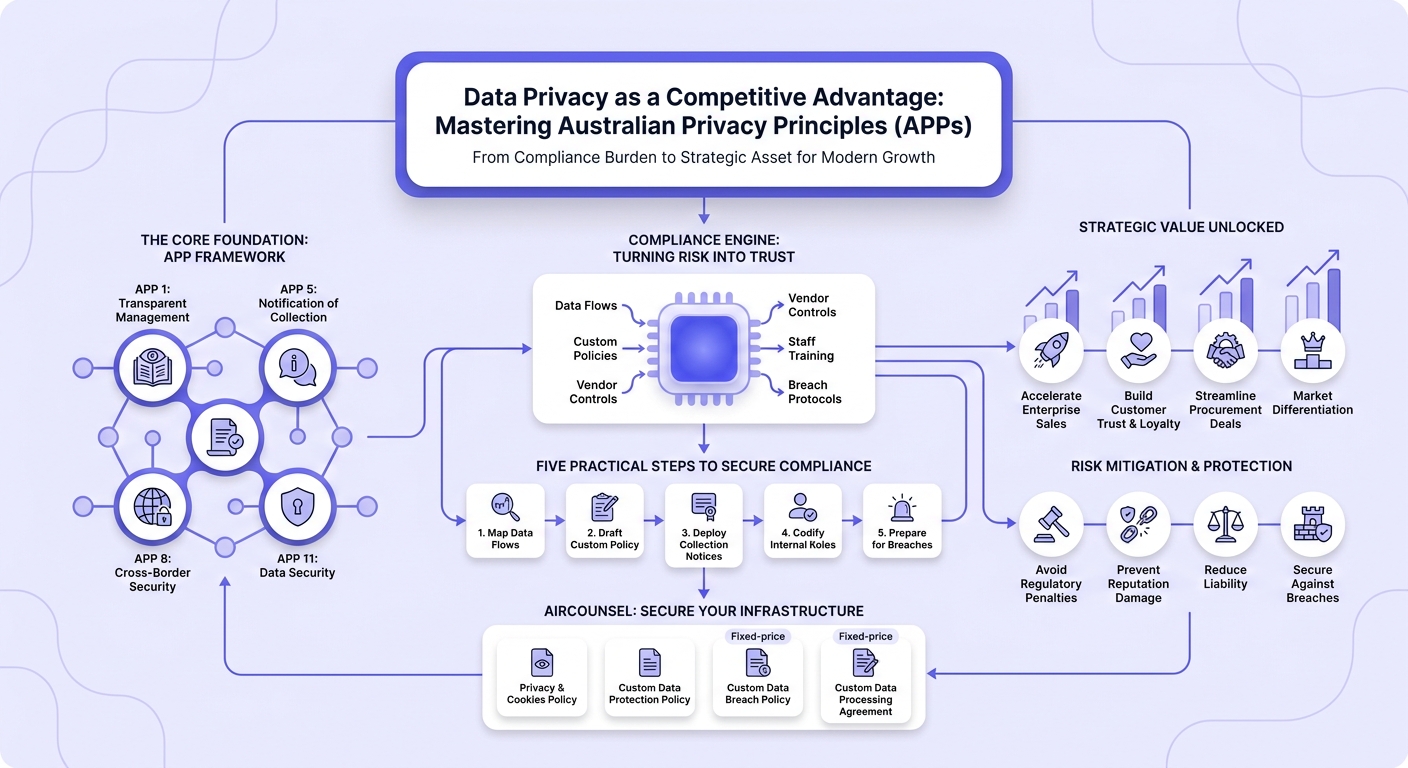
- APP 1: Open and Transparent Management: You must have a clearly written, accessible privacy policy detailing how your company manages personal information.
- APP 5: Notification of Collection: When you collect information directly from your users, you must provide a "collection notice" that explains why you are gathering the data and how it will be shared.
- APP 8: Cross-Border Disclosures: If you store customer data on overseas cloud servers or use international SaaS tools, you must ensure those offshore entities protect the data in accordance with the APPs.
- APP 11: Security of Personal Information: You are required to take active steps to protect the information you hold from misuse, interference, loss, and unauthorized access.
Ensuring compliance with these primary principles protects your operational assets and demonstrates corporate responsibility.
Common Compliance Gaps for Founders and SMBs
Many early-stage companies and growing businesses inadvertently expose themselves to steep legal liabilities. The most frequent compliance errors include:
- Using Stolen or Generic Templates: Copying another website's privacy policy often causes critical compliance failures, as the policy will not accurately reflect your actual data collection practices.
- Over-Collection of Data: Collecting unnecessary customer data increases your security risk profile. If you do not need the data for your business functions, do not collect it.
- Lacking Vendor Controls: Sharing customer details with third-party software tools without a proper Custom Data Processing Agreement leaves your company vulnerable if that vendor suffers a data breach.
- Ignoring Data Deletion: Failing to destroy or de-identify personal information when it is no longer required is a direct violation of APP 11.2.
Five Practical Steps to Secure Your Compliance
Achieving compliance does not have to paralyze your business operations. Following a structured roadmap can secure your business quickly:
- Map Your Data Flows: Identify exactly what personal data you collect, where it is stored, who can access it, and when it is scheduled for deletion.
- Draft a Custom Privacy Policy: Publish a tailored document outlining your handling of data on your website. Use the Privacy & Cookies Policy service to ensure your public declarations align with Australian law.
- Deploy Collection Notices: Present brief, highly readable data collection notices at every point of user entry (e.g., checkout pages or subscription forms).
- Codify Internal Roles: Minimize internal security risks by deploying a Custom Data Protection Policy to instruct your staff on safe handling practices.
- Prepare for Breaches: Under the OAIC's Notifiable Data Breaches scheme, you must have an incident protocol in place. Prepare your team with a professional Custom Data Breach Policy.
Costs and Timelines of Professional Compliance
Protecting your enterprise should not be expensive or slow. By avoiding hourly bills and choosing fixed-price legal packages, you can secure comprehensive protection with predictable costs.
| Service Product | Practical Value | Standard Timeline | Base Price (AUD) |
|---|---|---|---|
| Privacy & Cookies Policy | External policy for app and web compliance. | 3 Business Days | $1,200 |
| Custom Data Protection Policy | Internal workforce workflows and training. | 3 Business Days | $1,000 |
| Custom Data Breach Policy | Playbook and incident response templates. | 3 Business Days | $1,000 |
| Custom Data Processing Agreement | B2B compliance contract for clients and vendors. | 3 Business Days | $1,000 |
Secure Your Privacy Infrastructure with AirCounsel
Unlocking brand trust, avoiding regulatory penalties, and speed-running enterprise security assessments require customized, professionally drafted legal documents. Generic templates put your intellectual property and financial health at risk.
At AirCounsel, we pair your modern business with licensed local lawyers who deliver custom, high-quality legal solutions on a fixed-fee basis. Protect your business, clarify your internal policies, and secure your market position today.

Ready to launch compliant policies and accelerate your sales cycles?
- Get a tailored customer-facing disclaimer with our Privacy & Cookies Policy draft.
- Establish secure internal protocols with a Custom Data Protection Policy.
- Set up clear rules for B2B transactions using our Custom Data Processing Agreement.
This article provides general information and is not legal advice.
Frequently Asked Questions
What are the Australian Privacy Principles and who has to follow them?
The Australian Privacy Principles (APPs) are 13 statutory guidelines under the federal Privacy Act 1988. They govern how organizations collect, use, disclose, secure, and provide access to personal information. They legally apply to private businesses with an annual turnover exceeding $3 million, as well as all health service providers, credit agencies, government contractors, and businesses that buy or sell personal data.
Does a small business in Australia need a privacy policy?
Yes. While smaller businesses under the $3 million threshold are technically exempt from the federal Privacy Act under specific circumstances, there are several reasons why most growing businesses still need one. Enterprise business clients will contractually require you to follow the APPs before signing vendor agreements. Additionally, digital platforms like Google, Apple, and various payment processors require an app-level privacy policy to access their ecosystems.
What are the most common APP compliance mistakes for startups and SMBs?
The most common mistakes include copying and pasting another business's privacy policy, holding patient or customer data indefinitely without a clear retention schedule, failing to sign data-sharing protocols with foreign hosting platforms, and failing to train employees on internal security practices.
What should a business do first if it collects personal information online?
Your business must first map its data collection pipeline. You should identify exactly what information is collected, where it is transferred, and who has access to it. Once mapped, publish a tailored, compliant privacy policy visible to visitors on your website and insert active collection notices at every key touchpoint on your platform.
Recommended
Need Legal Assistance?
Our expert legal team is ready to help you navigate complex legal matters with confidence.