Equipment Lease Defaults in Australia: Essential Clauses for Your Business Contract Review

Signing an equipment lease or commercial asset finance agreement allows small businesses to scale operations without massive upfront capital expenditure. However, standard-form leasing agreements often contain aggressive default triggers, harsh repossession rights, and debt acceleration mechanisms that can threaten your company's cash flow. Conducting a thorough business contract review before signing ensures you identify buried risk factors before an unexpected disruption triggers a catastrophic default.
Under Australian corporate law, standard-form contracts issued by major financiers are heavily weighted in favour of the lessor. According to regulatory guidance from ASIC, small business unfair contract term protections apply to businesses employing fewer than 100 people or with an annual turnover under $10 million, capping financial product transactions at $5 million.
Understanding your legal rights under Australian legislation—and knowing which clauses to redline—can mean the difference between negotiating a manageable cure period and facing immediate equipment repossession or personal liability.
Table of Contents
- Quick Summary
- Why Equipment Leases Carry High Default Risk
- Key Default Clauses to Analyse
- Unfair Contract Terms Protections in Equipment Finance
- Personal Guarantees and Direct Director Exposure
- Equipment Lease Review Checklist for Australian SMBs
- Secure Your Equipment Contracts Today
- Frequently Asked Questions
- Recommended
Quick Summary
| Takeaway | Explanation |
|---|---|
| Non-Monetary Defaults | Lessors often include broad triggers like minor reporting delays or material adverse change clauses. |
| Cure Periods | You must ensure contracts provide at least 14 to 30 business days to remedy breaches before termination. |
| Unfair Contract Terms | Australian law penalises unfair terms in standard-form small business contracts, voiding one-sided termination clauses. |
| Debt Acceleration | Default clauses often demand the entire remaining lease term balance immediately upon breach. |
| Personal Guarantees | Directors frequently sign guarantees that expose personal assets to commercial leasing debts. |
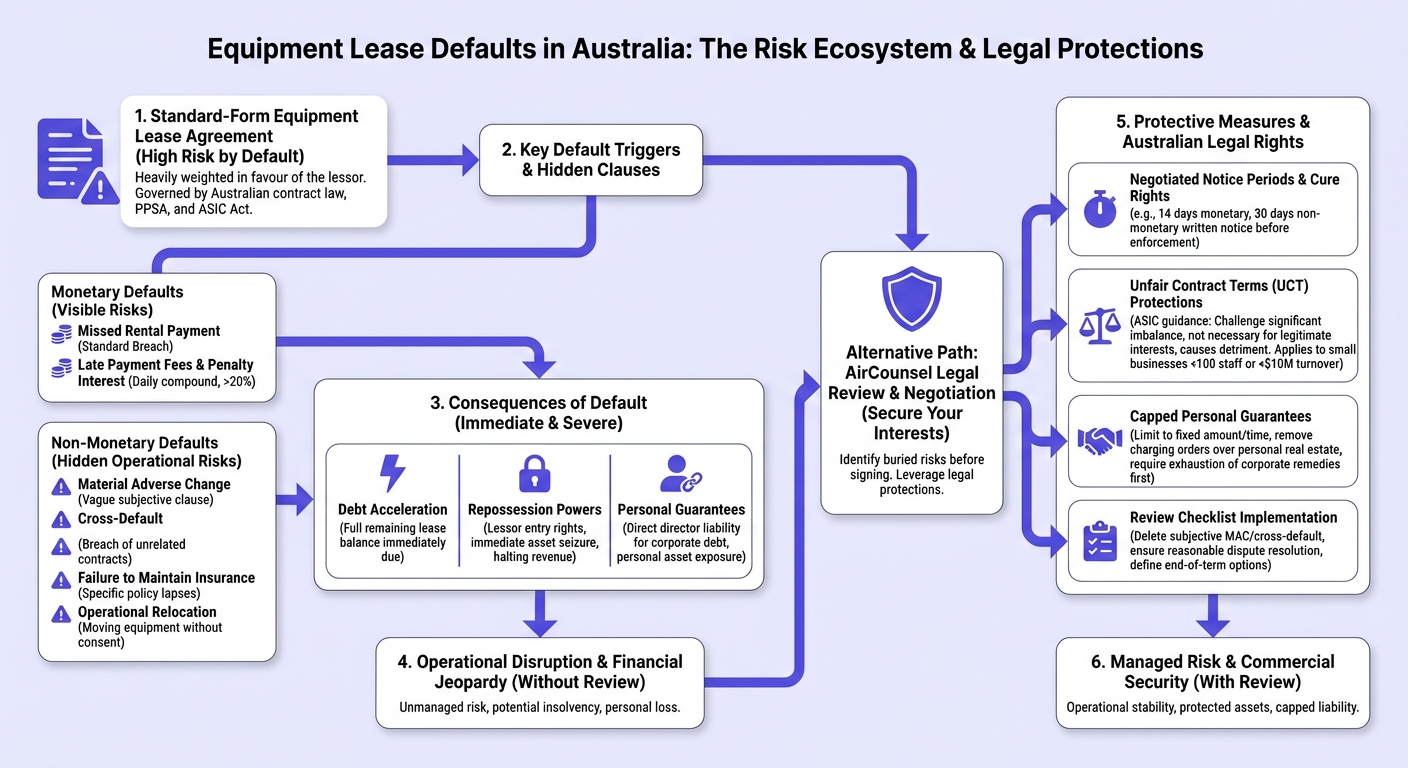
Why Equipment Leases Carry High Default Risk
Equipment leases are rarely neutral documents. Lessors and asset financiers draft these agreements primarily to protect their security interest in the underlying machinery, vehicle, or technology asset. If a dispute arises or cash flow tightens, the lessor will rely on contractual default powers to secure the asset or demand full payment.
Unlike commercial property leases that are governed by state-specific retail and commercial tenancy legislation, equipment leases are largely governed by the general principles of Australian contract law, the Personal Property Securities Act 2009 (CPSA), and the Australian Securities and Investments Commission Act 2001 (ASIC Act). Consequently, the contract text dictates your exposure. A comprehensive contract review ensures your business is not bound to unworkable operational restrictions.

Key Default Clauses to Analyse
When reviewing an equipment lease, you should examine specific sections that define what constitutes a breach and how the lessor can respond.
Monetary vs Non-Monetary Events of Default
A monetary default occurs when your business fails to make a required lease payment by the due date. These are standard and expected. However, non-monetary defaults present significant operational hazards.
Lessor contracts often classify the following as non-monetary defaults:
- Material Adverse Change (MAC): A vague clause allowing the lessor to declare a default if they believe your financial standing has deteriorated.
- Cross-Default: A trigger that states a breach of any other agreement (such as an unrelated bank loan or supplier contract) automatically triggers a default under the equipment lease.
- Failure to Maintain Insurance: Lapsing on specific policy requirements, even briefly, without causing actual loss.
- Operational Relocation: Moving the equipment to another premises without prior written consent from the lessor.
Notice Periods and Cure Rights
An equitable contract must provide a reasonable "cure period" (time to fix a mistake). High-risk agreements state that missing a payment or committing a technical breach results in an immediate default without warning.
During your contract review, negotiate for a mandatory written notice requirement of at least 14 business days for monetary breaches and 30 business days for non-monetary breaches before any remedies can be enforced.
Acceleration and Default Interest
When a default occurs, lessors frequently enforce debt acceleration. This makes every future rental payment across the remainder of the multi-year lease term immediately due and payable.
Compounding this issue, default interest rates can exceed 20% per annum, calculated daily. Under Australian law, clauses that impose excessive penalties rather than a genuine pre-estimate of damage may be challenged as unenforceable penalties, but preventing these terms during negotiation is far less costly than litigating them later.
Repossession Powers and Entry Rights
Standard equipment lease terms often grant the lessor broad authority to enter your business premises without notice to dismantle and repossess equipment. If the equipment is central to your daily operations (such as manufacturing tools, POS systems, or medical devices), repossession immediately halts revenue. Ensure any repossession rights require formal default notices, expired cure periods, and reasonable access protocols during standard business hours.
Unfair Contract Terms Protections in Equipment Finance
In Australia, the Unfair Contract Terms (UCT) regime under the Australian Consumer Law and the ASIC Act provides essential protections for small businesses entering standard-form contracts. If you want to understand how regulatory updates impact your agreements, read our guide on the 7 hidden risks an Australian contract review lawyer can catch under the unfair contract terms regime.
Under current legislation, a term in a small business standard-form contract is deemed unfair if it:
- Causes a significant imbalance in the parties' rights and obligations;
- Is not reasonably necessary to protect the legitimate interests of the advantaged party; and
- Would cause financial or other detriment to the small business if applied or relied upon.
Courts and regulators actively target clauses that allow lessors to unilaterally terminate agreements, repossess assets for minor non-monetary breaches, or impose uncapped indemnities.
Personal Guarantees and Direct Director Exposure
Asset financiers routinely require company directors to execute a personal guarantee and indemnity alongside the corporate lease agreement.
If your business defaults and cannot pay accelerated lease balances, the lessor can pursue you personally. This puts personal savings, residential property, and personal credit ratings at risk. When negotiating an equipment lease, always seek to:
- Cap the personal guarantee to a fixed dollar amount or a specific number of months of rent.
- Remove clauses that create a charging order over personal real estate.
- Require the lessor to exhaust all remedies against the corporate entity and repossessed equipment before enforcing claims against the individual guarantor.
Equipment Lease Review Checklist for Australian SMBs
Use this practical matrix when assessing equipment finance proposals:
| Lease Category | High-Risk Red Flag | Recommended Position |
|---|---|---|
| Payment Grace Period | Immediate default on the due date | Minimum 7 to 14 business days written notice |
| Non-Monetary Triggers | Vague "Material Adverse Change" clauses | Delete subjective MAC and cross-default clauses |
| End-of-Term Options | Automatic multi-year rollover if notice missed | Fixed purchase option or 30-day return window |
| Maintenance Duties | Sole liability for manufacturer defects | Offset rent if equipment fails due to vendor fault |
| Dispute Resolution | Immediate litigation in lessor's home state | Mandatory mediation before court proceedings |
Secure Your Equipment Contracts Today
Navigating equipment finance agreements without professional legal oversight exposes your business to unmanaged repossession risks, unfair penalty interest, and unexpected personal liability. Getting clear, fixed-price legal guidance before you sign protects your commercial interests and keeps your operational assets safe.
AirCounsel provides rapid, transparent legal services tailored for Australian founders and small businesses. If you are assessing an incoming lease document, our experienced Australian solicitors can conduct a comprehensive Review of your Contract or Legal Document to identify hidden default traps within 2 business days. If you need bespoke documentation drafted for your own operations, consider our Custom Equipment / Movables Lease Agreement service to ensure full compliance with Australian commercial law.
Frequently Asked Questions
What counts as a default under an equipment lease in Australia?
A default includes both monetary breaches, such as failing to pay rent on time, and non-monetary breaches. Non-monetary triggers can include failing to maintain insurance, attempting to relocate equipment without permission, insolvency events, or breaching subjective material adverse change clauses.
Can a lessor repossess equipment immediately after a missed payment?
Under standard contract terms, lessors often draft immediate repossession powers. However, enforceable contracts typically require formal written notice and an opportunity to remedy the breach. Furthermore, repossession clauses triggered by minor, non-monetary events may breach Australia's Unfair Contract Terms laws.
Are personal guarantees common in Australian equipment lease contracts?
Yes, financiers frequently require directors of proprietary limited companies (Pty Ltd) to sign personal guarantees. This makes the director personally liable for all lease payments and default costs if the business fails to pay.
Can a small business challenge unfair lease terms in Australia?
Yes. Under the ASIC Act and Australian Consumer Law, small businesses employing fewer than 100 staff or generating under $10 million in annual turnover can challenge unfair terms in standard-form contracts, rendering those clauses void and exposing the drafting party to statutory penalties.
Recommended
Need Legal Assistance?
Our expert legal team is ready to help you navigate complex legal matters with confidence.