How to Remove a Director from a South African Pty Ltd: Legal Steps and Section 71 Compliance

When an executive director stops performing, acts against company interests, or creates an irreconcilable boardroom deadlock, shareholders and co-founders must act swiftly to protect their business. Understanding how to remove a director under South African law ensures you can resolve leadership disputes without violating statutory rights or incurring expensive litigation.
Under Section 71 of the Companies Act 71 of 2008, a simple majority of more than 50% of voting rights is all shareholders require to remove a director from office by ordinary resolution. This statutory right is an unalterable provision of company law, meaning your Memorandum of Incorporation (MOI) or private contracts cannot strip shareholders of this core governance power.
However, having the voting power is only half the battle. If your company bypasses strict procedural rules—such as mandatory notice periods and the director's right to state their defense—the removal decision can be overturned by the High Court. This guide walks you through the lawful removal pathways, statutory procedures, and post-removal filings required in South Africa.
Table of Contents
- Quick Summary
- The Legal Framework: Section 71 Explained
- Path 1: Shareholder Removal by Ordinary Resolution
- Path 2: Board Removal for Misconduct or Incapacity
- Path 3: Companies Tribunal for Small Boards
- Step-by-Step Guide to Removing a Director
- Director Removal vs. Employment Termination
- Common Pitfalls and How to Avoid Them
- Get Fixed-Price Support for Director Removal
- Frequently Asked Questions
- Recommended
Quick Summary
| Takeaway | Explanation |
|---|---|
| Primary Statutory Route | Section 71 of the Companies Act 71 of 2008 empowers shareholders to remove any director by ordinary resolution (>50% vote). |
| Board-Initiated Removal | Boards with 3 or more directors may remove a peer only for statutory grounds: disqualification, incapacity, or gross neglect/dereliction. |
| Small Board Thresholds | If a company has fewer than 3 directors, the board cannot remove a director; an aggrieved director or shareholder must apply to the Companies Tribunal. |
| Mandatory Due Process | The affected director must receive advance written notice and a formal opportunity to make representations before any vote takes place. |
| CIPC Filing Deadline | You must lodge Form CoR 39 with the Companies and Intellectual Property Commission (CIPC) within 10 business days after removal. |
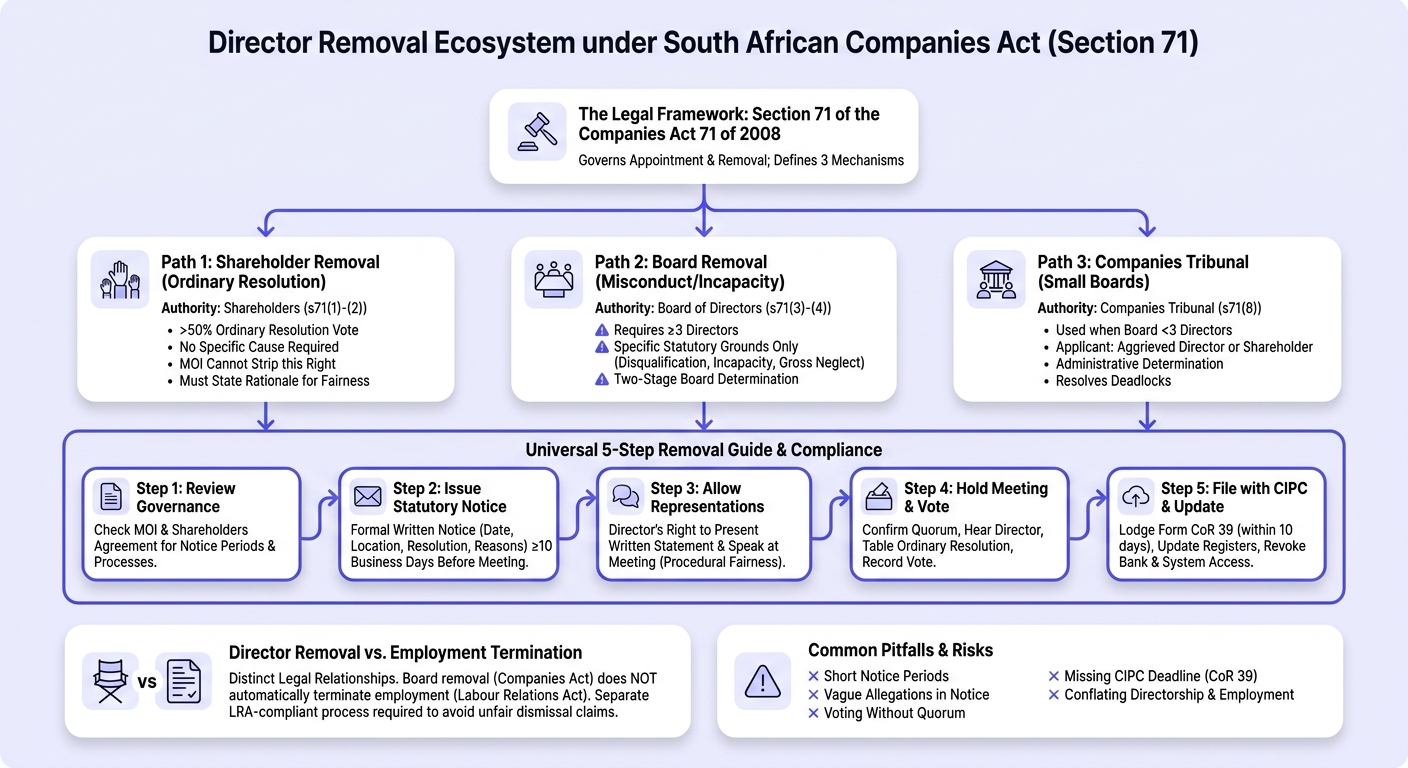
The Legal Framework: Section 71 Explained
In South Africa, the appointment and removal of company directors is governed by Section 71 of the Companies Act. The law distinguishes clearly between three separate removal mechanisms based on who initiates the action and the size of the board.
Understanding these avenues is critical. While shareholders enjoy broad discretion to remove a director without needing to prove common-law misconduct, a board of directors has much narrower statutory authority.
                    ┌───────────────────────────────┐
                    │  Director Removal Pathways   │
                    │      (Companies Act s71)      │
                    └──────────────┬────────────────┘
                                   │
         ┌─────────────────────────┼─────────────────────────┐
         ▼                         ▼                         ▼
┌──────────────────┐      ┌──────────────────┐      ┌──────────────────┐
│   Shareholders   │      │   Board Route    │      │Tribunal Route    │
│  (s71(1)-(2))    │      │   (s71(3)-(4))   │      │  (s71(8))        │
│                  │      │                  │      │                  │
│ • Ordinary res   │      │ • Board >= 3     │      │ • Board < 3      │
│ • >50% vote      │      │ • Specific fault │      │ • Director/      │
│ • No cause req   │      │ • Notice + heard │      │   shareholder    │
│ • Notice + heard │      │ • Court review   │      │   applies        │
└──────────────────┘      └──────────────────┘      └──────────────────┘
Path 1: Shareholder Removal by Ordinary Resolution
Shareholders hold the ultimate authority over board composition. Under Section 71(1), a director may be removed by an ordinary resolution adopted at a shareholders meeting by the persons entitled to exercise voting rights in an election of that director.
Key rules governing shareholder removals include:
- Voting Threshold: A simple majority (more than 50% of votes cast) is required, unless the company's Memorandum of Incorporation sets a higher standard for ordinary resolutions.
- Unalterable Right: The MOI, a shareholders agreement, or an employment contract cannot strip shareholders of this statutory right. Any clause stating a director is "irremovable" is void.
- Grounds Not Strictly Required: Shareholders do not need to prove legal wrongdoing or physical incapacity under Section 71(1). However, natural justice and CIPC operational guidelines dictate that shareholders must state the rationale to allow the director a meaningful opportunity to respond.
To avoid costly governance disputes, businesses should formalize voting protocols using a Custom Shareholders Agreement alongside their MOI.
Path 2: Board Removal for Misconduct or Incapacity
Under Section 71(3), the board of directors may remove a fellow director without shareholder intervention, but only if the company has at least 3 directors and specific statutory grounds are proven.
The board can only remove a director if it determines that the individual has:
- Become ineligible or disqualified under Section 69 of the Companies Act (such as insolvency, fraud conviction, or being prohibited by court order).
- Become incapacitated to the extent that they cannot perform the functions of a director, and are unlikely to regain capacity within a reasonable time.
- Neglected, or been derelict in the performance of, the functions of a director.
Board removal is a two-stage determination. First, the board must evaluate the allegations and find that the ground exists. Second, the board must pass a resolution confirming the removal. The affected director has 20 business days to apply to a High Court to review the board's decision.
Path 3: Companies Tribunal for Small Boards
Many South African small businesses operate with only 1 or 2 directors. If a Pty Ltd has fewer than 3 directors, the board lacks the legal quorum and authority to remove a fellow director under Section 71(3).
In this scenario:
- If the company has shareholders willing to vote, the shareholder removal route (Section 71(1)) remains the fastest and cleanest option.
- If the board is deadlocked (for example, two 50% shareholder-directors) or shareholders cannot act, any director or shareholder may apply directly to the Companies Tribunal under Section 71(8) for an administrative determination on removal.

Step-by-Step Guide to Removing a Director
Executing a director removal requires strict adherence to corporate formalities. Follow these 5 practical steps to maintain complete legal compliance.
Step 1: Review Governance Documents (MOI & Agreements)
                   │
                   ▼
Step 2: Issue Statutory Notice of Meeting & Proposed Resolution
                   │
                   ▼
Step 3: Provide Right to Make Representations (Written/Oral)
                   │
                   ▼
Step 4: Convene Meeting and Table the Ordinary Resolution
                   │
                   ▼
Step 5: Lodge Form CoR 39 with CIPC & Update Company Registers
Step 1: Review Governance Documents and Shareholder Rights
Before issuing any formal communications, examine your company's constitutional documents:
- Memorandum of Incorporation (MOI): Check notice periods for shareholder meetings (the default under Section 62 is 10 business days for a private company, but your MOI may require more).
- Shareholders Agreement: Verify whether specific dispute resolution mechanisms, pre-emptive buyout triggers, or bad-leaver clauses apply. For deeper background on structuring these rules, read our guide on why your Pty Ltd needs a shareholders agreement in South Africa.
Step 2: Issue Statutory Notice of the Meeting
Under Section 71(2), the director concerned must receive formal written notice of the proposed meeting and resolution.
The notice must:
- State the date, time, and location (or virtual link) of the meeting.
- Explicitly state that a resolution to remove the director will be proposed.
- Include a statement setting out the reasons for the proposed removal with sufficient detail to enable the director to prepare a defense.
- Meet statutory notice timelines (at least 10 business days before the meeting for a private company, unless all voting shareholders waive notice).
Step 3: Allow the Director to Make Representations
Procedural fairness is non-negotiable. The Companies Act gives the affected director the right to:
- Present a written statement to the company before the meeting, which must be circulated to all voting shareholders or board members.
- Speak and make representations personally or through a legal representative at the meeting before the resolution is put to a vote.
Denying the director a reasonable opportunity to be heard is the single most common reason removals are declared invalid in court.
Step 4: Hold the Meeting and Table the Resolution
At the meeting:
- Confirm that a valid quorum is present in terms of your MOI and the Companies Act.
- Allow the director to make their verbal or written representations.
- Put the motion to a formal vote.
- Record the exact voting tallies in the minutes using a compliant Template Shareholder Resolution for the Removal of a Director.
Step 5: File Notice with CIPC and Update Records
Once the resolution passes, the removal takes immediate legal effect. However, statutory compliance requires several post-removal administrative actions within strict statutory timelines:
| Action Required | Governing Rule / Target | Timeline |
|---|---|---|
| Lodge Form CoR 39 | CIPC online portal | Within 10 business days |
| Update Director Register | Internal company records (Section 24) | Immediately |
| Revoke Bank Mandates | Company bankers and financial institutions | Within 24–48 hours |
| Revoke System Access | Internal IT, payroll, and email systems | Immediately post-vote |
| Notify SARS & Key Parties | South African Revenue Service (Public Officer status) | Within 21 business days |
You can streamline this statutory filing using our specialized Company Director Appointment and/or Removal service.
Director Removal vs. Employment Termination
A director who is also an employee (such as a Managing Director or CEO) holds two distinct legal relationships with the company:
- Corporate Office: Governed by the Companies Act 71 of 2008.
- Employment Contract: Governed by the Labour Relations Act 66 of 1995 (LRA).
Removing an executive from the board of directors under Section 71 does not automatically terminate their employment contract. If you dismiss the individual as an employee without following standard labour law procedures (such as incapacity inquiries, disciplinary hearings, or operational requirements consultations), your company faces substantial exposure to unfair dismissal claims at the CCMA or Labour Court.
Always separate the company-law removal resolution from your employment termination proceedings.
Common Pitfalls and How to Avoid Them
When removing a director, avoid these frequent legal traps:
- Short Notice: Failing to provide the mandatory 10 business days notice to both the shareholders and the affected director.
- Vague Allegations: Providing insufficient detail in the removal notice, preventing the director from preparing a meaningful defense.
- Voting Without Quorum: Convening a meeting that fails to meet the quorum requirements specified in your MOI.
- Ignoring CIPC Deadlines: Failing to lodge Form CoR 39 within 10 business days, leaving public registers inaccurate and exposing remaining directors to compliance penalties.
- Conflating Employment and Directorship: Assuming board removal eliminates salary or employment obligations without a separate LRA-compliant dismissal process.
Get Fixed-Price Support for Director Removal
Navigating board disputes and regulatory filings requires absolute precision. A procedural misstep can lead to protracted litigation, frozen bank accounts, and severe governance disruption.
AirCounsel provides transparent, fixed-price legal solutions drafted by experienced South African corporate attorneys:
- Get ready-to-file documentation with our Template Shareholder Resolution for the Removal of a Director.
- Ensure seamless CIPC compliance with our end-to-end Company Director Appointment and/or Removal service.
- If you face a deadlocked board or complex shareholder dispute, book an Online Consultation with an Attorney for fast, actionable legal advice.
Frequently Asked Questions
Can shareholders remove a director in a South African Pty Ltd without giving reasons?
While shareholders do not need to prove common-law misconduct under Section 71(1), procedural fairness and CIPC regulations require that the notice of meeting state the reasons for the proposed removal. This allows the director to exercise their statutory right to make representations before shareholders cast their votes.
What notice and meeting rights does the director have before removal?
The affected director is entitled to receive written notice of the meeting and proposed resolution at least 10 business days in advance (for a private company). The director also has the statutory right to present a written statement and speak in person or through an attorney before the resolution is voted on.
When can the board remove a director instead of shareholders?
The board can only remove a director under Section 71(3) if the board consists of at least 3 directors and has determined that the individual is disqualified/ineligible, permanently incapacitated, or has neglected or been derelict in their duties. The board cannot remove a director simply due to strategic disagreements.
What happens if the company has fewer than three directors?
If a company has fewer than 3 directors, the board cannot exercise board-level removal powers under Section 71(3). The removal must either be carried out by shareholders passing an ordinary resolution under Section 71(1) or via an application to the Companies Tribunal under Section 71(8).
Recommended
- Company Director Appointment and/or Removal – End-to-end statutory CIPC filing and document drafting handled by South African corporate attorneys.
- Template Shareholder Resolution for the Removal of a Director – Fully compliant, attorney-drafted shareholder resolution template ready for immediate implementation.
- Online Consultation with an Attorney – Book a confidential 30-minute legal strategy session to resolve founder disputes and board deadlocks.
Need Legal Assistance?
Our expert legal team is ready to help you navigate complex legal matters with confidence.