Why Your Pty Ltd Needs a Shareholders Agreement in South Africa

Starting a business in South Africa with co-founders is an exciting milestone, but without clear rules, early alignment can quickly turn into costly conflict. Obtaining a comprehensive, localized shareholders agreement template south africa small businesses can rely on is the most proactive step you can take to dictate how decisions are made, how equity is divided, and what happens when someone wants to leave.
According to the Companies and Intellectual Property Commission (CIPC), South Africa has over 2.6 million registered companies, making early legal and governance planning vital for small business longevity. Failing to establish these rules early often results in severe post-exit regret and frozen operations when disagreements arise.
By drafting a balanced agreement before outside investment or partner departures change your business dynamics, you protect your ownership rights and secure the company's financial future.
Table of Contents
- Understand the What and Why: Shareholders Agreements vs. MOI
- 6 Core Controls Your South African Shareholders Agreement Template Must Cover
- The Safe Separation of Roles: Shareholder vs. Director
- Aligning with South African Law and the Companies Act
- Practical Drafting Checklist for SMBs
- Common Mistakes That Lead to Post-Exit Regret
- Secure Your Startup Governance Today
- Frequently Asked Questions
- Recommended
Quick Summary
| Takeaway | Explanation |
|---|---|
| Prevent Post-Exit Regret | Lay down exit and transition rules early, before leverage shifts during negotiation. |
| Statutory Supremacy | The South African Companies Act and your MOI legally override conflicting shareholder terms. |
| Essential Controls | Your template must explicitly cover tag-along, drag-along, and first-refusal pre-emptive rights. |
| Director vs. Shareholder | Keep operational employment roles separate from equity ownership to protect the Pty Ltd. |
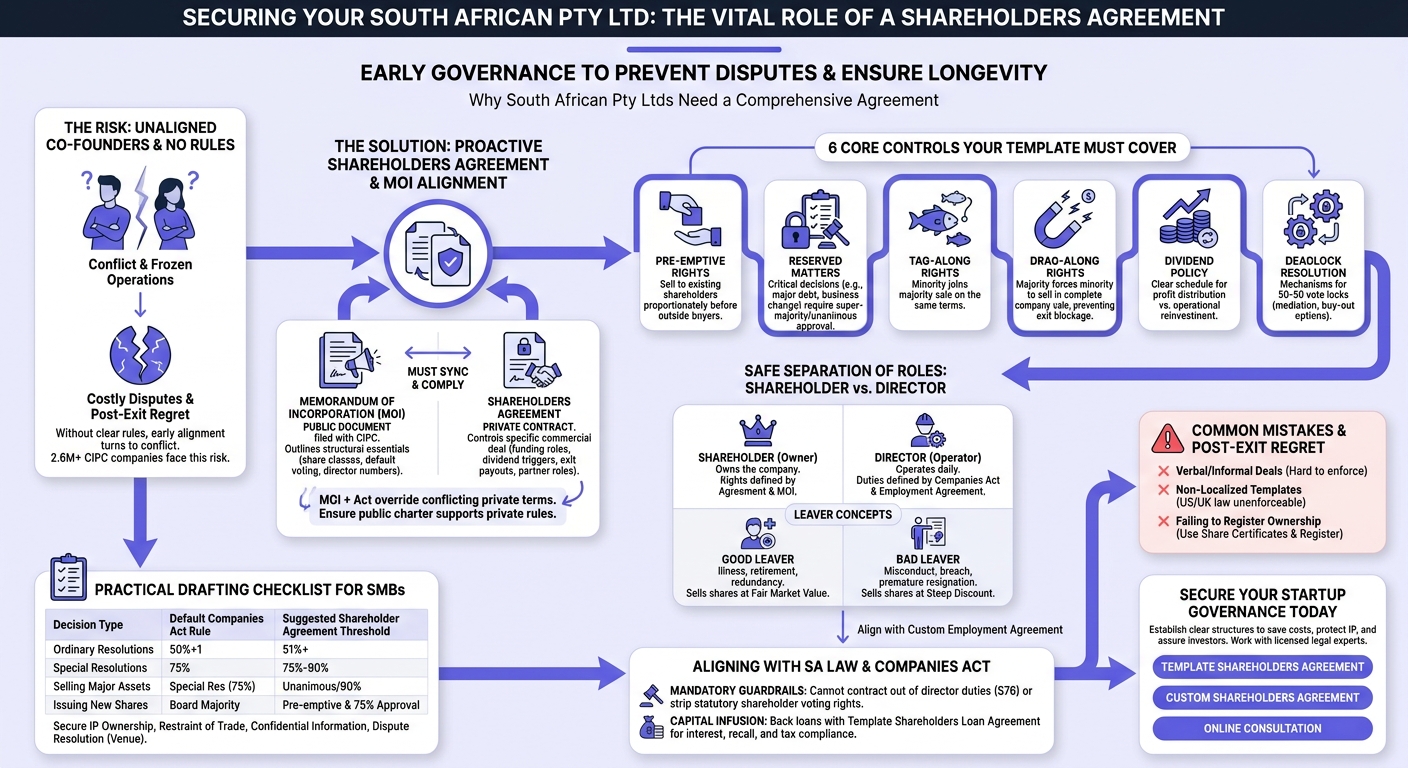
Understand the What and Why: Shareholders Agreements vs. MOI
In South Africa, a private company's governance structure rests on two primary pillars: the Memorandum of Incorporation (MOI) and the shareholders agreement. Many founders mistakenly assume that completing CIPC business registration makes a private agreement unnecessary.
The MOI is a public document filed directly with the CIPC. It outlines structural essentials such as share classes, default voting rules, and basic director numbers.
Conversely, a shareholders agreement is a private contract. It controls the specific, confidential commercial deal between partners, including detailed funding roles, dividend triggers, and exit payouts.
Under Section 15(7) of the South African Companies Act 71 of 2008, if there is a conflict between your MOI and your shareholders agreement, the MOI or the Act takes precedence. This makes syncing the two elements highly critical. If you have custom exit or funding rules, you must also obtain a custom Memorandum of Incorporation to ensure your public charter supports your private agreement.
6 Core Controls Your South African Shareholders Agreement Template Must Cover
Every standard South African governance template should be customized to include these six protective controls:
- Pre-emptive Rights: Before any shareholder can sell their equity to an outside buyer, they must offer those shares to the existing shareholders proportionately.
- Reserved Matters: A list of critical decisions (such as changing the business's commercial focus or taking on major debt) that require a super-majority or unanimous approval.
- Tag-Along Rights: If a majority shareholder sells their stake to an external party, minority shareholders have the right to join the transaction on the exact same terms.
- Drag-Along Rights: If a majority of shareholders agree to a complete company sale, they can force the minority shareholders to sell their shares to the new buyer, preventing a single owner from blocking an exit.
- Dividend Policy: A clear schedule detailing when profits are distributed to equity holders versus when they of necessity scale back into operational cash flow.
- Deadlock Resolution: Outlining what happens if voters are locked 50-50 on critical paths, with options varying from mediation to buy-out mechanisms.

The Safe Separation of Roles: Shareholder vs. Director
A common mistake is failing to differentiate between who owns the company (the shareholders) and who operates it on a daily basis (the directors). It is entirely possible to be fired as an employee or removed as a director while still retaining significant equity ownership.
To manage this, your template must define good leaver and bad leaver concepts:
- Good Leaver: A shareholder who departs due to illness, retirement, or redundancy, allowing them to sell their shares back to the company at full fair market value.
- Bad Leaver: A shareholder who is terminated for misconduct, breaches key restraint clauses, or resigns prematurely. They are usually forced to sell their shares back to the remaining founders at a steep discount.
To formalize these boundaries and protect individual operational duties, make sure your executive team signs a custom employment agreement that clearly works in tandem with your equity rules.
Aligning with South African Law and the Companies Act
Your business documents must respect the mandatory guardrails of local law. For instance, you cannot contract out of a director's legal duties as defined by Section 76 of the Companies Act, nor can you strip shareholders of their statutory right to vote on fundamental structural changes.
Similarly, if your business requires a capital infusion from its owners, you should back your transactional ledger with a clear template shareholders loan agreement to determine interest rates, recall dates, and repayment precedence under national tax structures.
Practical Drafting Checklist for SMBs
As you build out your governance framework, refer to the table below to balance default South African statutory thresholds with customized partner controls:
| Decision Type | Default Companies Act Rule | Suggested Shareholder Agreement Threshold |
|---|---|---|
| Ordinary Resolutions | 50% + 1 vote | 51% (or more for key actions like hiring C-suite) |
| Special Resolutions | 75% | 75% (or elevated to 80%-90% for high-impact changes) |
| Selling Major Assets | Special Resolution (75%) | Unanimous or super-majority (e.g., 90%) |
| Issuing New Shares | Director Board majority | Pre-emptive check & 75% shareholder approval |
Beyond voting ratios, you must also secure:
- Intellectual Property (IP) Ownership: Ensure all IP developed by founders or contractors belongs to the company, not the individual.
- Restraint of Trade: Establish geographic and time limits preventing departing shareholders from starting a competing firm.
- Confidential Information: Create robust, ongoing protections for client databases and processes.
- Dispute Resolution: Specify the legal venue (such as standard arbitration in Johannesburg or Cape Town) to resolve internal conflicts swiftly.
Common Mistakes That Lead to Post-Exit Regret
We regularly assist South African founders who are struggling to repair operational issues because of three major mistakes:
- Verbal or Informal Understandings: relying on "handshake deals" or casual WhatsApp agreements which are incredibly difficult to enforce when relations sour.
- Using Non-Localized Templates: Downloading general US or UK contracts that cite structural frameworks like Delaware law or HMRC regulations, rendering them vulnerable and unenforceable under South African courts.
- Failing to Register Ownership Records: Not issuing formal certificates or keeping a physical security record. Make sure you utilize share certificates and share registers to prevent ownership disputes down the line.
Secure Your Startup Governance Today
Establishing clear governance structures early will save you significant legal costs, protect your intellectual property, and assure potential investors that your business is safe to fund. Working with licensed legal experts ensures your paperwork is bulletproof under current South African business regulations.
At AirCounsel, we help you get organized quickly, professionally, and at a flat, transparent price. Protect your founder relationships and your commercial assets today.
You can purchase our template shareholders agreement to establish immediate, compliant baselines, or secure a battle-tested custom shareholders agreement built from scratch for your specific business requirements. If you have immediate legal questions, you can also schedule an online consultation with an attorney in moments.
This article provides general information and is not legal advice.
Frequently Asked Questions
What should a South African shareholders agreement template include for founder-led companies?
It should explicitly cover pre-emptive purchasing rights, decision voting thresholds, tag-along and drag-along exit options, clear rules for dividend distributions, deadlock resolution paths, and leaver policies.
How is a shareholders agreement different from a company’s memorandum of incorporation?
The MOI is a public document that lists basic statutory administrative rules. The shareholders agreement is a confidential private contract that tracks commercial partnerships, exit values, and financing obligations. Under South African law, the MOI takes precedence if the two documents conflict.
Do director service agreements need to match the shareholders agreement?
Yes. It is vital to align employment rights, exit clauses, and leaver definitions in your service agreements with the buyout terms mapped out in your equity agreement to prevent legal loops.
What happens if a shareholder wants to exit or is removed from the business?
The exiting owner must offer their equity to existing shareholders first under pre-emptive rules. If they are classified as a bad leaver under the contract, they may be forced to forfeit or sell their stock at a discounted valuation.
Recommended
Need Legal Assistance?
Our expert legal team is ready to help you navigate complex legal matters with confidence.