What Happens When a South African Co-Founder Leaves Without a Founder Vesting Schedule?

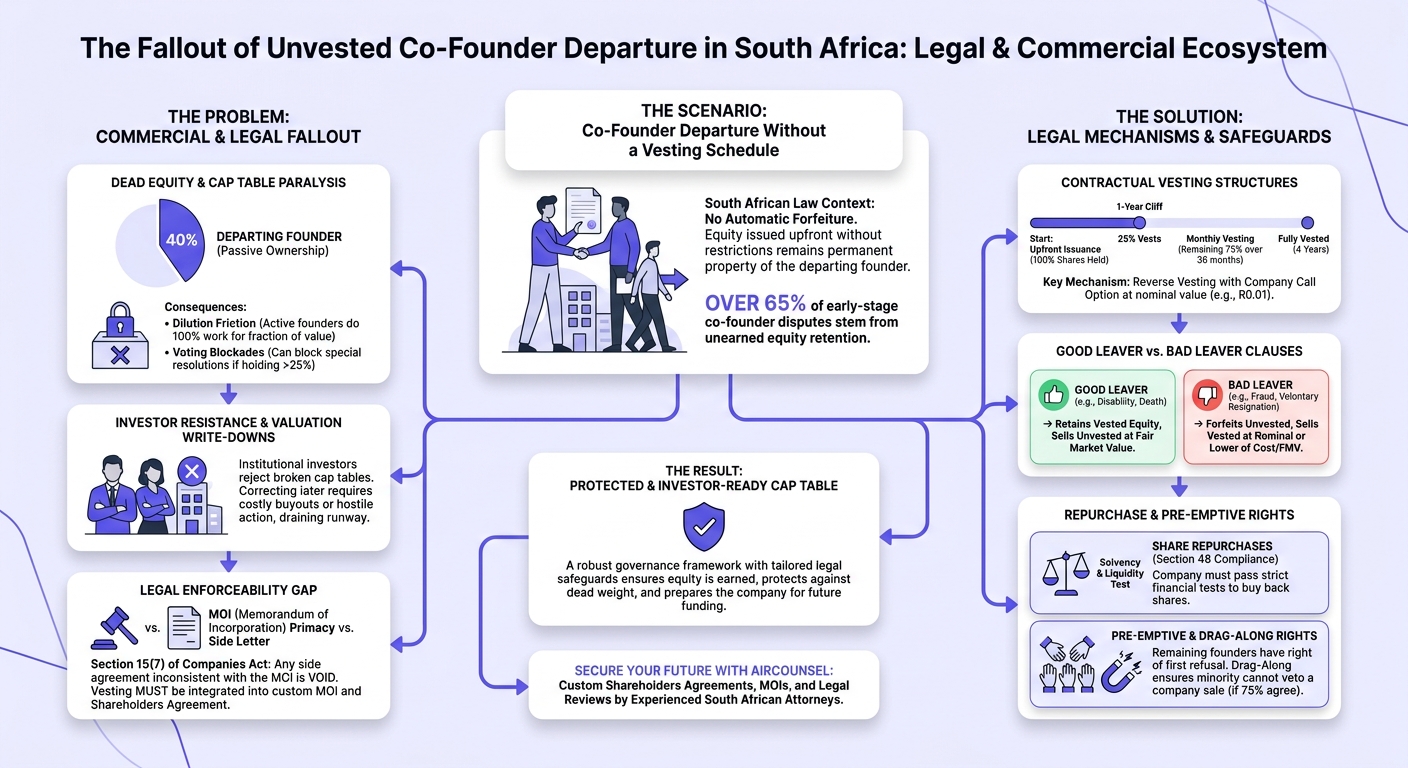
Launching a venture requires massive commitment, but what happens when one co-founder departs just a few months after incorporation? According to venture ecosystem research, over 65% of early-stage co-founder disputes stem from unearned equity retention when a founder exits prematurely. Without a formal founder vesting schedule, a departing founder can walk away owning 30%, 40%, or 50% of the company's issued shares while contributing zero ongoing work.
In South Africa, startup equity does not automatically revert to the company upon resignation. If shares were issued fully upfront and no clawback or repurchase mechanics exist in your company constitution, the departing co-founder retains outright ownership of their equity.
This guide outlines the legal and commercial fallout of an unvested founder departure under South African law, how the Companies Act governs equity disputes, and the exact steps you can take to safeguard your cap table.
Table of Contents
- Quick Summary
- How Founder Equity Works Under South African Law
- The Reality of an Unvested Co-Founder Departure
- Legal Mechanisms to Recover Shares or Mitigate Damage
- Step-by-Step Action Plan When a Founder Resigns Early
- Comparison: Departing With vs. Without a Founder Vesting Schedule
- Common Mistakes When Implementing Founder Equity Controls
- Protect Your Startup with Tailored Legal Safeguards
- Frequently Asked Questions
- Recommended
Quick Summary
| Takeaway | Explanation |
|---|---|
| No Automatic Forfeiture | Under South African law, equity granted without vesting restrictions remains the permanent property of the departing founder. |
| MOI Governs Consistency | Any private vesting deal must align with the company's Memorandum of Incorporation (MOI); conflicting clauses are void under the Companies Act. |
| Dead Equity Cripples Growth | Passive shareholders with significant stakes deter angel investors and venture capital firms from providing future funding rounds. |
| Repurchase Requires Solvency | Repurchasing shares from an exiting founder under Section 48 requires the company to pass strict solvency and liquidity tests. |
| Contractual Solutions Exist | Reverse vesting, good/bad leaver terms, and tailored pre-emptive rights protect the cap table if documented early. |
How Founder Equity Works Under South African Law
When entrepreneurs incorporate a private company—a (Pty) Ltd—in South Africa, initial shares are typically issued at nominal value during setup. Without explicit contractual restrictions, share ownership is unconditional and absolute.

The Contractual Nature of Vesting in South Africa
South African company law does not contain a default, statutory founder vesting framework. Unlike some jurisdictions where statutory mechanisms provide default corporate repurchase rights, vesting in South Africa is purely contractual.
Founders must deliberately create vesting mechanisms via contract. This is usually executed through a "reverse vesting" structure:
- Upfront Issuance: The founder holds 100% of their allocated shares immediately to enjoy voting rights and tax simplicity.
- Company Call Option: The company or remaining founders hold an irrevocable option to repurchase unvested shares at nominal value (e.g., R0.01 per share) if the founder ceases to provide active services before a predefined timeline.
- Standard Schedule: A typical structure spans 4 years with a 1-year cliff, meaning 25% vests after 12 months, and the remainder vests monthly over the next 36 months.
The Companies Act 71 of 2008 and MOI Primacy
A common trap for startup founders is signing a standalone founder vesting agreement or private side letter without checking their constitutional documents.
Under Section 15(7) of the Companies Act 71 of 2008, any provision within a shareholder agreement that is inconsistent with the Act or the company's Memorandum of Incorporation (MOI) is void to the extent of the inconsistency. If your MOI allows unrestricted share transfers, a side agreement attempting to force a share forfeiture can be rendered legally unenforceable.
To enforce vesting mechanics, your governance rules must be integrated into both a custom Memorandum of Incorporation and a legally binding custom Shareholders Agreement.
The Reality of an Unvested Co-Founder Departure
When a co-founder leaves an early-stage business without a vesting agreement, the commercial fallout is immediate and severe.
Dead Equity and Cap Table Paralysis
The departing founder retains their shares, creating "dead equity." Dead equity refers to shares held by passive individuals who no longer contribute code, sales, management, or funding.
- Dilution Friction: The remaining founders must perform 100% of the operational work while capturing only a fraction of the value created.
- Voting Blockades: If the exiting founder holds 25% or more of voting rights, they can block special resolutions required for major corporate actions, such as amending the MOI, issuing specific classes of shares, or approving fundamental transactions.
Investor Resistance and Valuation Write-Downs
Institutional investors, including South African venture capital firms and angel networks, routinely reject startups with broken cap tables.
- Investors will not inject capital if a non-contributing ex-founder owns a 30% or 40% equity block.
- Correcting this issue later requires costly buyouts, hostile share cancellations, or complex corporate restructuring that drains runway and delays fundraising.
Legal Mechanisms to Recover Shares or Mitigate Damage
If you are structuring your business or attempting to resolve an unexpected departure, several commercial legal mechanisms provide essential protection.
Good Leaver vs. Bad Leaver Clauses
A well-structured agreement distinguishes between the circumstances of a founder's departure:
- Bad Leaver: A founder fired for gross negligence, fraud, material breach of the shareholders agreement, or one who resigns voluntarily within the initial cliff period. Bad leavers typically forfeit all unvested equity and must sell their vested shares back at either nominal value or the lower of cost and fair market value.
- Good Leaver: A founder who departs due to permanent disability, critical illness, death, or agreed mutual separation. Good leavers generally retain their vested equity and can sell unvested equity at fair market value determined by an independent auditor.
Share Repurchases and Section 48 Compliance
When a company exercises a repurchase right on unvested shares, it must comply with Section 48 and Section 4 of the Companies Act 71 of 2008:
- Solvency and Liquidity Test: The company's board must reasonably conclude that the company's assets will exceed its liabilities and that the company can pay its debts as they become due over the next 12 months post-buyback.
- Authorisation in the MOI: The company's MOI must explicitly authorize the acquisition of its own shares.
Pre-Emptive Rights and Drag-Along Provisions
If the company cannot directly repurchase the shares due to liquidity constraints, pre-emptive rights allow remaining co-founders to purchase the exiting partner's shares in proportion to their existing holdings. Additionally:
- Drag-Along Rights: Ensure that if 75% of shareholders agree to sell the company to an acquirer, the departing minority shareholder cannot veto the transaction.
- Lock-In Provisions: Restrict founders from encumbering, pledging, or transferring their shares to outside third parties for a fixed operational period.
Step-by-Step Action Plan When a Founder Resigns Early
If an active co-founder resigns and you do not have clear contractual terms in place, execute the following steps immediately before taking unilateral action.
- Step 1: Audit Constitutional Documents and Agreements: Review your company's registered MOI, any signed subscription agreements, and founder resolutions. Verify whether share transfer restrictions, rights of first refusal, or dispute mechanisms exist.
- Step 2: Inspect the Securities Register: Confirm the number of issued shares, share certificate numbers, and whether director appointments need modification with the Companies and Intellectual Property Commission (CIPC).
- Step 3: Calculate Actual Contributions vs. Stated Equity: Quantify what the departing founder contributed in sweat equity, capital, and intellectual property. This objective baseline supports commercial buyout negotiations.
- Step 4: Engage in Structured Negotiation: Attempt to negotiate a formal separation and share transfer agreement. Offer a nominal cash settlement, royalty arrangement, or partial equity retention in exchange for the surrender of unearned shares.
- Step 5: Obtain Legal Review Before Repurchase: Do not attempt to cancel share certificates unilaterally. Seek a professional Contract / Legal Document Review to ensure compliance with the Companies Act and avoid costly unfair prejudice litigation.
Comparison: Departing With vs. Without a Founder Vesting Schedule
| Feature | With Vesting Schedule | Without Vesting Schedule |
|---|---|---|
| Equity Recovery | Automatic right to buy back unvested shares at nominal value (e.g., R0.01). | Founder keeps 100% of issued shares regardless of tenure. |
| Cap Table Health | Preserves equity pool for replacement hires and future investors. | Severely compromised; creates dead equity that blocks venture funding. |
| Dispute Resolution | Predetermined buyout formula and good/bad leaver classifications. | Often requires expensive mediation, deadlock resolutions, or court action. |
| Director Removal Impact | Directorship removal does not leave unearned shareholding intact. | Director removal leaves the ex-founder with full shareholder rights and voting power. |
| Legal Costs at Exit | Minimal; standardized transfer paperwork and board approvals. | Substantial; high legal fees for negotiated buyouts or restructuring. |
Common Mistakes When Implementing Founder Equity Controls
- Relying Solely on Standard Off-the-Shelf MOIs: Default CIPC MOI templates contain no vesting schedules, leaving startups completely vulnerable to unvested departures.
- Ignoring Section 15(7) Inconsistencies: Drafting private vesting agreements that contradict the registered MOI makes the vesting clause unenforceable under South African company law.
- Omitting Intellectual Property (IP) Assignment: Forgetting to combine vesting with an explicit IP assignment clause means the departing co-founder might retain ownership of core source code, designs, or proprietary models.
- Failing to Track Time and Milestones: Not issuing clear board minutes or failing to update the securities register as vesting milestones are achieved.
- No Written Good/Bad Leaver Definitions: Ambiguous departure terms trigger lengthy court disputes over whether a resignation was voluntary or forced.
Protect Your Startup with Tailored Legal Safeguards
Do not wait until a co-founder conflict emerges to fix your equity architecture. AirCounsel provides startup founders with fast, attorney-drafted contracts at transparent, fixed prices.
Whether you need a robust governance framework or an urgent legal review of your current cap table, our experienced South African commercial attorneys ensure your corporate documents are fully enforceable and investor-ready.
Secure your company today with our Custom Shareholders Agreement, upgrade your foundation with a Custom Memorandum of Incorporation, or book an Online Consultation with an Attorney to review your equity strategy.
This article provides general information and is not legal advice.
Frequently Asked Questions
What happens to a co-founder's shares in South Africa if there is no vesting schedule?
If there is no vesting schedule, reverse vesting option, or contractual clawback clause in place, the departing co-founder remains the legal owner of 100% of their issued shares. The company and remaining founders cannot force the individual to surrender their equity simply because they ceased active operational work.
Can a South African startup force a departing co-founder to give back shares without a vesting clause?
No. Under South African law, shares are private property. A company cannot unilaterally confiscate, cancel, or repurchase a shareholder's equity without a specific statutory ground, court order, or clear contractual right set out in the Memorandum of Incorporation or Shareholders Agreement.
Do the shareholders agreement and MOI control founder equity in South Africa?
Yes. The Memorandum of Incorporation (MOI) is the primary constitutional document under the Companies Act 71 of 2008, while the Shareholders Agreement governs operational relationships between shareholders. For equity and vesting terms to be fully enforceable, both documents must be aligned without contradictory clauses.
How can founders protect the company if a co-founder resigns early?
Founders should implement a reverse vesting agreement tied to a 4-year schedule with a 1-year cliff, incorporate good and bad leaver provisions, secure pre-emptive purchase rights, and ensure comprehensive intellectual property assignment terms are signed prior to commencing operations.
Recommended
Need Legal Assistance?
Our expert legal team is ready to help you navigate complex legal matters with confidence.