TCPA and CPA Compliance: The South African eCommerce Terms Checklist

Launching or scaling an online store in South Africa requires balancing commercial growth with strict regulatory compliance. While international operators often worry about US regulations like the tcpa when running automated direct marketing campaigns, South African merchants face their own rigorous consumer protection framework under local statutes.
According to data presented by the National Consumer Commission, roughly 30% of goods bought online are returned, compared with 8.9% in brick-and-mortar retail. This elevated return volume means that poorly drafted website terms, unclear delivery disclosures, and non-compliant refund clauses create immediate financial and operational risks for digital brands.
Securing your online storefront with robust terms of service ensures regulatory alignment, clarifies customer expectations, and protects your bottom line before you process your first transaction.
Table of Contents
- South African eCommerce Legal Framework
- Mandatory Online Disclosures Under ECTA and CPA
- Direct Marketing: TCPA Standards vs POPIA and CPA
- Drafting Compliant Refund and Return Policies
- Pre-Contract Disclosures and Advertising Rules
- Step-by-Step Terms Audit for Founders
- Protect Your Online Store with AirCounsel
- Frequently Asked Questions
- Recommended
Quick Summary
| Takeaway | Explanation |
|---|---|
| Core Legal Baseline | Online stores must comply with the CPA, ECTA, and POPIA for sales, returns, and customer data. |
| Direct Marketing Consent | Digital communications require explicit opt-in consent and clear opt-out mechanics under local laws. |
| 7-Day Cooling-Off Period | Section 44 of ECTA mandates an unconditional cancellation window for most consumer transactions. |
| Required Business Details | Merchants must display registered entity names, physical addresses, contact emails, and full pricing. |
| Unfair Contract Terms | Website terms cannot waive statutory warranties or exclude liability for gross negligence. |
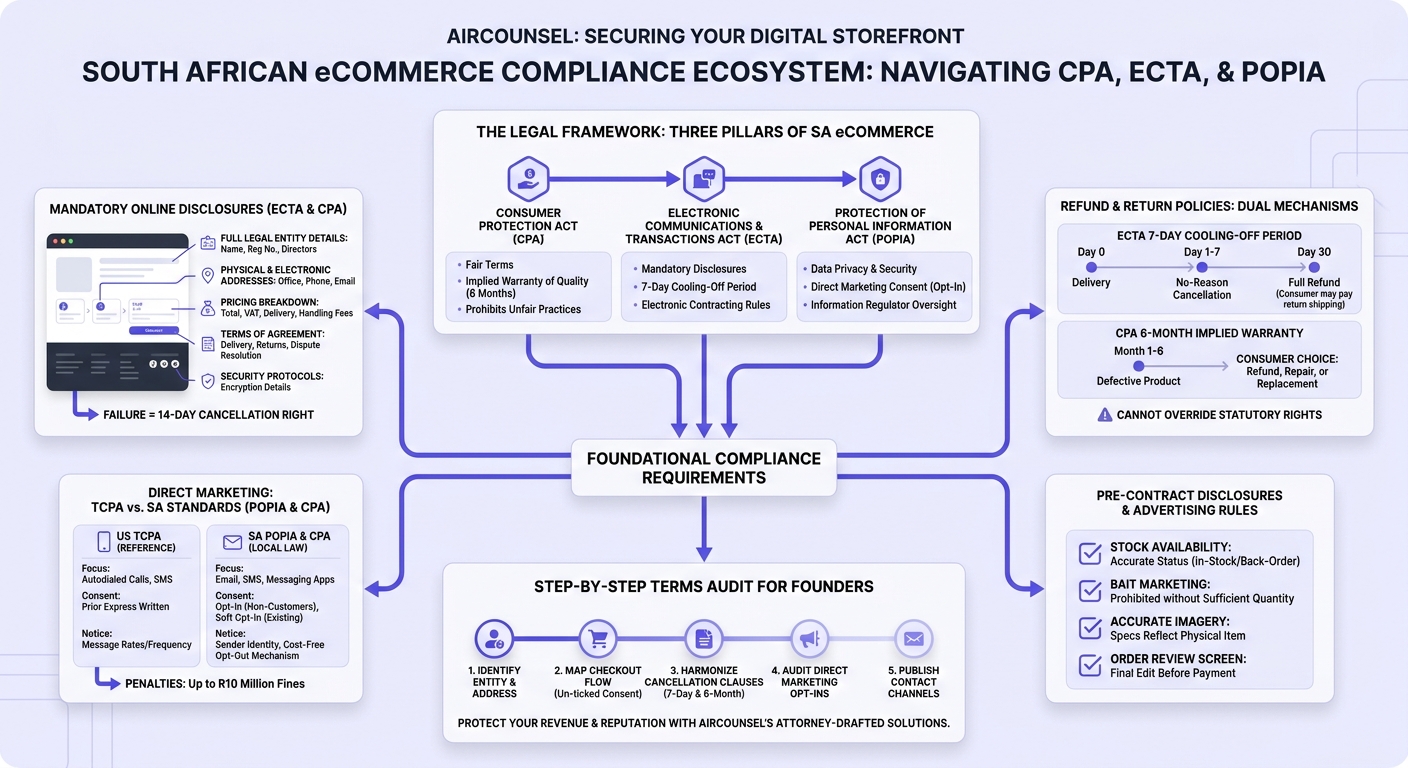
South African eCommerce Legal Framework
Three primary statutes govern online retail in South Africa:
- The Consumer Protection Act 68 of 2008 (CPA): Establishes baseline consumer rights, prohibits unfair contract terms, and governs implied warranties of quality.
- The Electronic Communications and Transactions Act 25 of 2002 (ECTA): Outlines mandatory pre-sale disclosures, electronic contracting rules, and statutory cooling-off periods.
- The Protection of Personal Information Act 4 of 2013 (POPIA): Regulates how customer personal information is collected, stored, and utilized for direct marketing.
Online merchants must draft terms that satisfy all three statutes simultaneously. For instance, businesses selling subscription software or recurring services can explore how digital product contracts intersect with privacy in our guide on SaaS Compliance & Data Protection in South Africa.
For official statutory texts, merchants can review the Consumer Protection Act 68 of 2008 and the Electronic Communications and Transactions Act published by the South African Government.

Mandatory Online Disclosures Under ECTA and CPA
Section 43 of ECTA requires web stores to provide essential disclosures before a customer enters into an agreement. Failing to display these details gives the consumer the legal right to cancel the transaction within 14 days of receipt.
Every South African eCommerce platform must display:
- Full Legal Entity Details: Registered company name, registration number, and names of directors.
- Physical and Electronic Addresses: Physical business address, customer service phone numbers, and official email addresses.
- Pricing and Payment Breakdown: Total price including VAT, itemized delivery charges, handling fees, and payment methods accepted.
- Terms of Agreement: Clear terms for delivery timelines, return policies, and dispute resolution.
- Security Protocols: Details of the encryption and security mechanisms used to protect payment card data.
Direct Marketing: TCPA Standards vs POPIA and CPA
In international commerce, businesses often consult the tcpa (Telephone Consumer Protection Act) to manage automated messaging and telemarketing consent. In South Africa, direct digital marketing via SMS, automated calls, and email is governed by Section 69 of POPIA alongside Section 11 of the CPA.
Understanding these distinctions helps founders set up lawful customer acquisition funnels:
| Feature | US TCPA Framework | South African POPIA / CPA Framework |
|---|---|---|
| Primary Focus | Restricting autodialed calls, pre-recorded messages, and commercial SMS. | Regulating electronic direct marketing across email, SMS, and messaging apps. |
| Consent Model | Prior express written consent for marketing communications. | Opt-in consent required for non-customers; soft opt-in allowed for existing customers. |
| Pre-Contract Notice | Mandatory disclosures regarding message rates and frequency. | Sender identity disclosure and an immediate, cost-free opt-out mechanism required. |
| Statutory Penalties | Private right of action with statutory damages per violation. | Administrative fines up to R10 million or enforcement notices by the Information Regulator. |
To maintain compliance, ensure your checkout and lead-generation flows utilize a compliant Template Direct Marketing Consent Form and a comprehensive Template Website Privacy Policy.
Drafting Compliant Refund and Return Policies
South African eCommerce stores face two distinct return mechanisms: statutory cooling-off rights under ECTA and defective product remedies under the CPA.
1. ECTA 7-Day Cooling-Off Period
Under Section 44 of ECTA, consumers can cancel any electronic transaction within 7 days of receiving the goods without reason or penalty. The merchant must refund the full purchase price within 30 days, although the consumer may be required to cover the direct cost of returning the goods if clearly stated in the terms.
2. CPA Implied Warranty of Quality
Under Section 56 of the CPA, goods carry an automatic 6-month implied warranty of quality. If a product fails or proves defective within 6 months, the consumer has the legal right to choose between:
- A full refund of the purchase price.
- A free repair of the item.
- A replacement with an equivalent product.
Terms of service cannot legally override this right, and clauses claiming "no returns under any circumstances" are void and unenforceable under South African law. Guidance from the National Consumer Commission underscores that misleading return terms expose stores to regulatory sanction.
Pre-Contract Disclosures and Advertising Rules
The CPA strictly prohibits misleading, fraudulent, or deceptive commercial representations. Your online storefront terms and checkout flows must respect these core advertising standards:
- Stock Availability: Disclose whether products are in stock or back-ordered before payment confirmation.
- Bait Marketing: Do not advertise goods at a discount unless you have reasonable quantities available.
- Accurate Imagery: Ensure product specifications, dimensions, and materials reflect the physical item accurately.
- Order Review Screen: Provide an opportunity for consumers to review, edit, or cancel their order before finalizing the payment step.
Step-by-Step Terms Audit for Founders
Follow these steps to ensure your online terms are robust and legally enforceable:
- Step 1: Identify Your Legal Entity: Confirm your terms list your registered (Pty) Ltd or sole proprietorship details, registration number, and physical office address.
- Step 2: Map Your Checkout Flow: Ensure your checkout page features an un-ticked checkbox requiring customers to accept your terms before payment.
- Step 3: Harmonize Cancellation Clauses: Align your return policy with both ECTA's 7-day cooling-off rule and the CPA's 6-month quality warranty.
- Step 4: Audit Direct Marketing Opt-Ins: Implement clear consent checkboxes for promotional newsletters and SMS updates.
- Step 5: Publish Contact Channels: Ensure customer support contact details, complaint procedures, and physical delivery terms are visible in your website footer.
Using an attorney-drafted Template eCommerce Website Terms of Service ensures these statutory requirements are integrated without friction.
Protect Your Online Store with AirCounsel
Launching an eCommerce store should not expose your business to avoidable regulatory fines or chargeback disputes. Clear, transparent terms protect your revenues, streamline order fulfilment, and reassure your customers that they are dealing with a legitimate enterprise.
AirCounsel offers transparent, fixed-price legal solutions drafted by experienced South African attorneys. Whether you need a standard contract package or an expert review of your checkout workflows, our digital legal services provide speed, certainty, and peace of mind.
Get started with an attorney-crafted Template eCommerce Website Terms of Service or order an expert Contract / Legal Document Review today.
Frequently Asked Questions
What website terms are required for an eCommerce business in South Africa?
An online store must maintain Terms of Service, a Privacy Policy, and a Returns and Refund Policy. These documents must disclose full company registration details, physical contact addresses, accurate pricing with VAT, delivery terms, and clear dispute resolution procedures in compliance with ECTA and the CPA.
How do the Consumer Protection Act and ECTA affect online refunds and cancellations?
ECTA provides a mandatory 7-day cooling-off period allowing buyers to return non-exempt goods for any reason within 7 days of delivery. Additionally, the CPA provides a statutory 6-month implied warranty on all goods, entitling customers to a refund, repair, or replacement if goods are defective.
Do South African online stores need to disclose full pricing, business details, and delivery terms?
Yes. Section 43 of ECTA mandates the disclosure of total item costs, all applicable taxes, delivery fees, accepted payment methods, registered business names, and physical office locations before the transaction is concluded.
Can an eCommerce business limit returns, warranties, or liability in its terms?
No. An online store cannot contract out of statutory consumer protections. Terms that attempt to disclaim the CPA 6-month warranty of quality, exclude liability for gross negligence, or force consumers to waive statutory cooling-off rights are legally void and unenforceable.
Recommended
Need Legal Assistance?
Our expert legal team is ready to help you navigate complex legal matters with confidence.