Why Startups Rely on Law Firms in South Africa for MOI Updates Under the Companies Amendment Act

When building a high-growth company, your constitutional documents set the ground rules for ownership, voting, and investor rights. In South Africa, the Memorandum of Incorporation (MOI) serves as the supreme governing contract of every registered entity. With major statutory updates introduced by the Companies Amendment Act 16 of 2024, emerging businesses can no longer afford to leave their constitutional documents on autopilot.
According to economic data from TIPS, formal small businesses contributed 19% of GDP and 33% of employment in 2023, highlighting how foundational small and mid-sized enterprises are to the national economy. Yet, many early-stage companies launch with a generic, off-the-shelf standard MOI that fails to protect shareholder rights or reflect current legislation.
Navigating statutory amendments, share restructurings, and regulatory filings requires precision. Leading startups frequently work with top commercial law firms in South Africa and digital-first legal platforms to overhaul their founding documents, align internal governance with external compliance rules, and prepare for institutional fundraising.
Table of Contents
- What Is a Memorandum of Incorporation (MOI)?
- Key Changes in the Companies Amendment Act
- Trigger Events: When Startups Must Amend Their MOI
- Step-by-Step Statutory Process to Amend an MOI
- Risks of Relying on an Outdated Standard MOI
- MOI Amendment Timeline and Legal Costs
- Streamlining Governance With Modern Legal Services
- Frequently Asked Questions
- Recommended
Quick Summary
| Takeaway | Explanation |
|---|---|
| Core Document | The MOI overrides shareholder agreements in any direct conflict under South African law. |
| Amendment Act Impact | Clarifies effective dates of MOI amendments, beneficial ownership disclosures, and filing timelines. |
| Key Triggers | Fundraising, issuing new share classes, changing director powers, and onboarding equity partners. |
| Statutory Process | Requires board approval, a shareholder special resolution (75%), and filing Form CoR15.2 with CIPC. |
| Fixed-Fee Solutions | Modern platforms eliminate unexpected hourly billing for MOI redrafts and filings. |
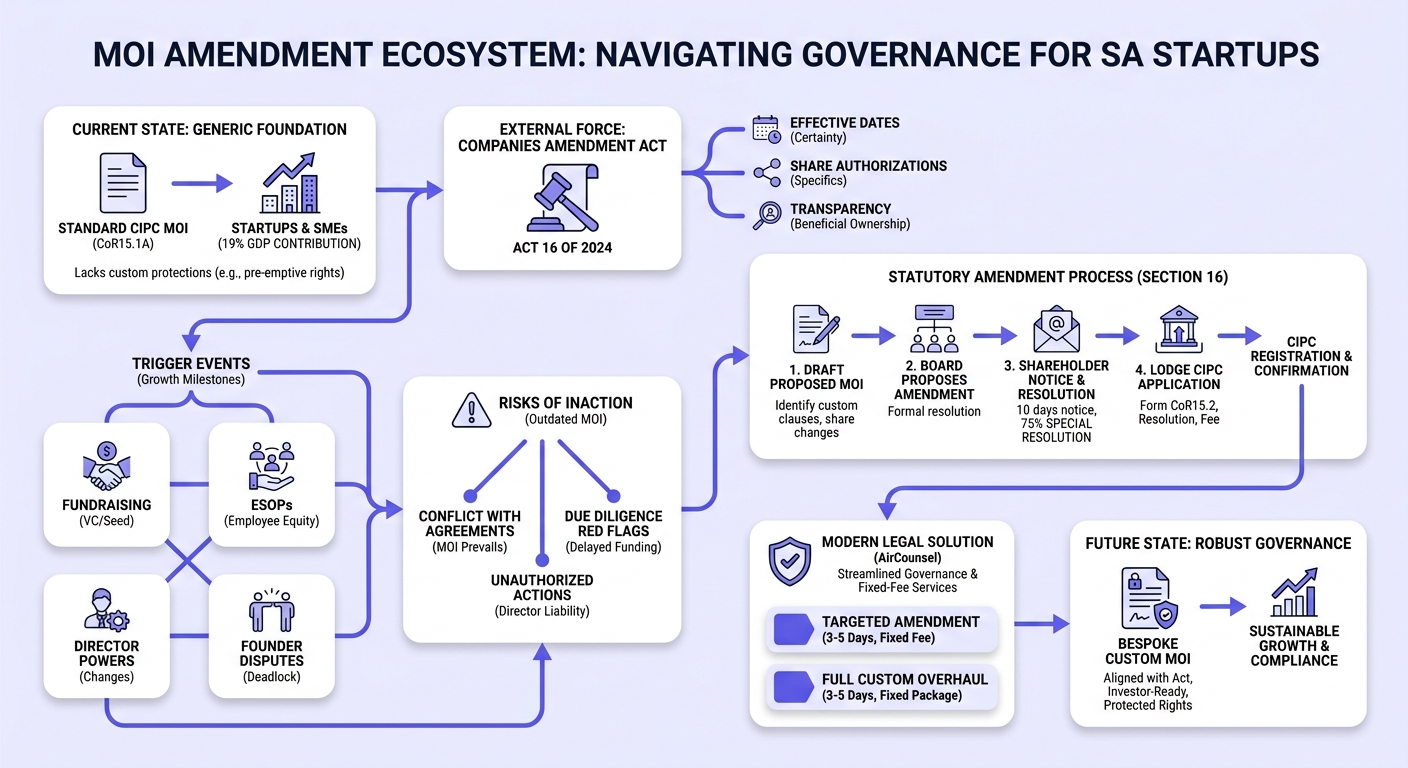
What Is a Memorandum of Incorporation (MOI)?
The Memorandum of Incorporation (MOI) is the primary constitutional document of any private company ((Pty) Ltd) in South Africa. Governed by the Companies Act 71 of 2008, the MOI defines the company's scope of authority, outlines director duties, establishes shareholder rights, and regulates corporate actions.
Under Section 15(7) of the Companies Act, any provision inside a private agreement—such as a shareholders agreement—that contradicts the MOI or the Act itself is void to the extent of the inconsistency. While a Custom Shareholders Agreement is vital for setting confidential commercial terms, the MOI remains the public-facing, enforceable anchor of your corporate structure.
Startups frequently register using the standard template provided by the Companies and Intellectual Property Commission (CIPC), known as the standard form CoR15.1A. While this default document suffices for simple single-director businesses, it lacks standard protections required by growing ventures, such as pre-emptive share rights, customized voting thresholds, and drag-along/tag-along mechanics.
Key Changes in the Companies Amendment Act
The Companies Amendment Act introduces sweeping reforms to reduce administrative red tape while tightening governance and transparency requirements for South African enterprises.
1. Effective Dates of MOI Amendments
Historically, ambiguity existed around the exact date when an MOI amendment took legal effect—specifically whether it applied upon shareholder resolution adoption or upon registration by CIPC. The statutory updates refine these filing mechanics to establish clear legal certainty for commercial transactions.
2. Share Issues and Director Authorizations
The amended framework clarifies the administrative procedures regarding share capital adjustments. When issuing new equity to investors, your MOI must clearly specify authorized share counts, preferences, and dilution protections. Companies must coordinate their amendments with board resolutions like the Template Directors Resolution for the Issuing of New Shares to ensure strict statutory compliance.
3. Public Disclosure and Transparency
The new legislative environment reinforces beneficial ownership reporting and corporate accountability. Maintaining a clean, fully compliant MOI ensures your entity meets regulatory scrutiny during banking reviews, tenders, and institutional audit cycles.

Trigger Events: When Startups Must Amend Their MOI
Amending an MOI is not merely an administrative exercise; it is a vital step triggered by specific milestones in a company’s lifecycle:
- Raising Seed or Venture Capital: Institutional investors generally require bespoke share classes (such as preference shares) with liquidation preferences, anti-dilution clauses, and board observation rights.
- Issuing Employee Share Options (ESOP): Implementing employee equity plans requires creating authorized unissued shares and modifying transfer restrictions.
- Changing Director Powers: The default MOI gives directors broad authority. Founders often wish to restrict certain actions (e.g., incurring major debt or selling core assets) without supermajority shareholder approval.
- Resolving Founder Disagreements: If your initial structure lacks deadlock-breaking mechanisms or pre-emptive rights, updating to a Custom Memorandum of Incorporation prevents operational paralysis.
Step-by-Step Statutory Process to Amend an MOI
Amending an MOI requires strict adherence to the formal statutory sequence laid out under Section 16 of the Companies Act.
[Draft Proposed MOI]
       │
       ▼
[Board Proposes Amendment]
       │
       ▼
[Shareholder Notice (10 Business Days)]
       │
       ▼
[Pass Special Resolution (75% Majority)]
       │
       ▼
[Submit CoR15.2 + Fee to CIPC]
       │
       ▼
[CIPC Registration & Confirmation]
Step 1: Draft the Alterations
Identify the specific restrictive conditions, authorized share capital changes, or governance clauses required. A licensed commercial attorney ensures terms do not contradict the Companies Act.
Step 2: Convene the Board and Notify Shareholders
The board of directors must formally resolve to propose the amendment. Written notice of the shareholder meeting, accompanied by the complete proposed text of the new MOI, must be delivered to all shareholders at least 10 business days in advance for a private company.
Step 3: Pass a Special Resolution
Under Section 16(1)(c), an MOI amendment requires a special resolution adopted at a properly constituted shareholder meeting. In most private companies, this requires the support of at least 75% of the voting rights exercised on the resolution.
Step 4: Lodge the Application With CIPC
Submit the formal amendment package to CIPC. The submission must include:
- A completed Form CoR15.2 (Notice of Amendment of Memorandum of Incorporation).
- A certified copy of the special resolution approving the amendment.
- The complete text of the newly adopted custom MOI.
- Proof of payment of the prescribed statutory lodgment fee.
Risks of Relying on an Outdated Standard MOI
Operating with an obsolete or standard CIPC template exposes founders to severe legal and commercial vulnerabilities:
- Conflict with Investor Agreements: If your shareholders agreement grants pre-emptive rights or drag-along powers but the standard MOI contains default statutory restrictions, the MOI prevails in court, undermining your deal.
- Due Diligence Red Flags: Venture capital funds and acquirers conduct thorough legal reviews. Governance defects in your founding documents can delay funding rounds or decrease enterprise valuation. An early Contract / Legal Document Review mitigates these risks before closing.
- Unauthorized Corporate Actions: Actions taken by directors outside the scope of an outdated MOI may be deemed ultra vires (beyond legal power), triggering personal liability for directors.
MOI Amendment Timeline and Legal Costs
Understanding the standard costs and turnarounds helps founders budget effectively when planning structural corporate changes.
| Service Tier | Typical Scope | Estimated Turnaround | Cost Structure |
|---|---|---|---|
| Standard CIPC Template | Default generic clauses, no customized share rights. | 1–3 business days | Low statutory fee |
| Targeted MOI Amendment | Adjusting authorized share capital or specific clauses. | 3–5 business days | Fixed legal fee (from ~R3,000 to R5,000) |
| Full Custom MOI Overhaul | Comprehensive bespoke governance, share classes, and investor rights. | 3–5 business days | Fixed legal fee (approx. R7,200) |
| Comprehensive Venture Package | Combined custom MOI, shareholders agreement, and CIPC filing. | 5–7 business days | Fixed legal package (R12,000 – R20,000) |
Streamlining Governance With Modern Legal Services
Upgrading your corporate governance does not require expensive, open-ended billable hours from traditional legal practices. AirCounsel provides entrepreneurs across South Africa with fixed-fee, attorney-drafted documentation and streamlined CIPC filing services.
Whether you need a full Custom Memorandum of Incorporation, guidance on Private Company Registration – (Pty) Ltd, or an Online Consultation with an Attorney, our South African legal team provides prompt, transparent support tailored to growing ventures.
This article provides general information and is not legal advice.
Frequently Asked Questions
What is an MOI and why does it matter for a South African startup?
An MOI (Memorandum of Incorporation) is the primary constitutional document of a South African company. It defines director powers, shareholder voting rights, and corporate rules. It legally overrides private agreements in the event of a conflict.
When does an MOI amendment become effective after filing with CIPC?
An amendment typically takes effect on the date the Notice of Amendment (Form CoR15.2) is endorsed and accepted by CIPC, or on a later date explicitly specified in the special resolution.
Do all companies need to update their MOI under the Companies Amendment Act?
While not mandatory for every entity immediately, companies issuing new share classes, raising equity, or seeking alignment with recent statutory transparency requirements should review and update their MOI to prevent compliance friction.
What documents are usually needed to amend an MOI?
Amending an MOI requires the newly drafted MOI document, a formal shareholder special resolution passed with at least 75% approval, a completed Form CoR15.2, and payment of the CIPC statutory filing fee.
Can a shareholders agreement override a company MOI?
No. Under Section 15(7) of the South African Companies Act, any clause within a shareholders agreement that is inconsistent with the MOI or the Companies Act is void.
Recommended
- Custom Memorandum of Incorporation — Secure your startup governance with a bespoke MOI drafted by licensed South African attorneys.
- Custom Shareholders Agreement — Establish clear rules for equity transfers, voting, and dispute resolution.
- Online Consultation with an Attorney — Book a 30-minute legal strategy session to review your startup’s compliance and governance setup.
Need Legal Assistance?
Our expert legal team is ready to help you navigate complex legal matters with confidence.