5 Red Flags Commercial Agreements Solicitors Identify in UK Software Licensing Deals for 2026

Software procurement has shifted from simple one-off tool purchases into mission-critical, subscription-led infrastructure. For UK startups, solo founders, and growing small businesses, signing a business-to-business (B2B) software contract without thorough vetting can expose your company to uncapped liabilities, sudden price hikes, and operational disruption.
When corporate buyers and vendors negotiate contracts, experienced commercial agreements solicitors routinely uncover hidden clauses that heavily favor the vendor. Data privacy enforcement has heightened these risks: in a prominent 2025 enforcement action, the UK Information Commissioner's Office levied a £2.31 million fine on 23andMe for failing to implement robust data protections across user systems. This penalty highlights how quickly technical and contract oversights turn into balance-sheet threats.
Understanding what warning signs to look for before putting pen to paper protects your cash flow, your customer data, and your intellectual property. Below, we break down the five most dangerous red flags in modern UK software licensing agreements and provide a checklist to help you negotiate safer terms.
Table of Contents
- Quick Summary
- Software Licences vs SaaS vs Development Contracts
- 5 Critical Warning Signs in UK Software Licensing Deals
- Pre-Signing Checklist for Founders and Operations Leads
- How to Fix High-Risk Clauses Before Signing
- Secure Your Software Deals with AirCounsel
- Frequently Asked Questions
- Recommended
Quick Summary
| Takeaway | Explanation |
|---|---|
| Distinguish Contract Types | Separate pure software licences from cloud hosted SaaS and custom bespoke software builds. |
| Audit Scope Metrics | Watch for vague user definitions and aggressive third-party vendor audit penalties. |
| Secure IP Ownership | Ensure your company retains all rights to your inputs, data, and bespoke integrations. |
| Cap Price Hikes | Limit annual indexation fees and establish realistic notice windows for contract non-renewal. |
| Enforce UK GDPR Alignment | Pair software agreements with mandatory data processing terms to prevent regulatory fines. |
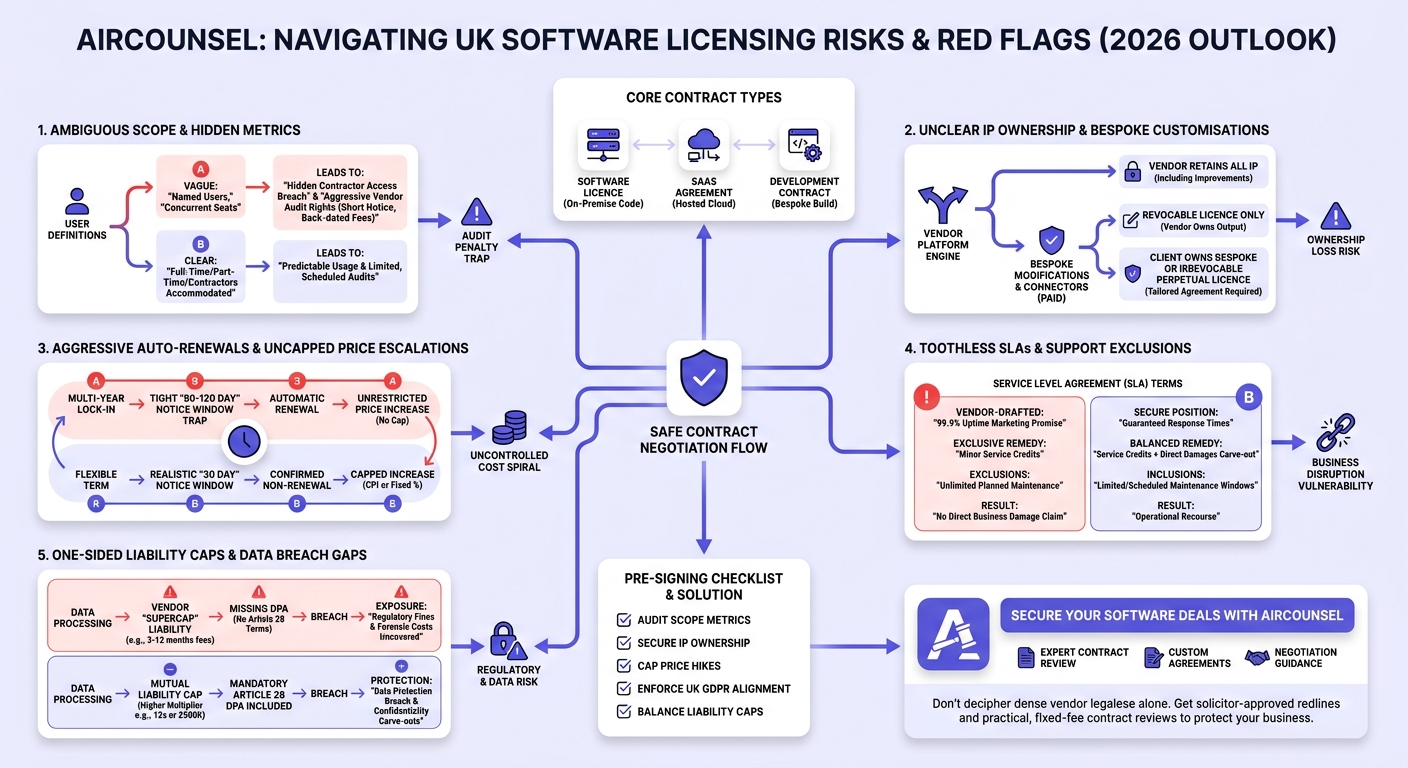
Software Licences vs SaaS vs Development Contracts
Many businesses make the mistake of treating all software contracts as interchangeable documents. Under UK commercial law, an on-premise software licence, a Software-as-a-Service (SaaS) agreement, and a bespoke software development contract carry fundamentally distinct risk profiles.
According to official GOV.UK intellectual property guidance, an IP licence grants permission to use protected assets under defined conditions without transferring underlying ownership. In traditional software licensing, you receive executable code installed on your own servers. In SaaS arrangements, you purchase a remote subscription service where the software vendor hosts, maintains, and manages the infrastructure.
When contracts blur these lines—such as a SaaS provider charging implementation fees for custom configurations without assigning IP rights—small businesses face significant exposure. Identifying whether you are buying a pure licence, a hosted cloud tool, or custom development is the essential first step before reviewing detailed contractual clauses.

5 Critical Warning Signs in UK Software Licensing Deals
Experienced commercial solicitors evaluate agreements across five primary operational dimensions: scope, IP rights, commercials, performance, and legal liabilities.
1. Ambiguous Licence Scope and Hidden User Metrics
A frequent trap in enterprise software agreements is an ill-defined scope of use. Contracts often define usage through "Named Users," "Concurrent Seats," or "Core Processing Units," but fail to specify what happens if an independent contractor, agency, or offshore developer accesses the system.
- Vague seat allocations: If your contract restricts access strictly to "full-time internal employees," giving temporary access to a marketing consultant could technically constitute a material breach.
- Aggressive vendor audit rights: Many standard supplier terms allow vendors to audit your internal IT systems on short notice. If they claim non-compliance, you may be forced to pay back-dated retail licence fees plus audit expenses.
2. Unclear Intellectual Property Ownership and Bespoke Customisations
When software providers configure dashboards, build custom connectors, or create automated workflows for your company, who owns that specific output?
Standard vendor contracts almost always state that any improvements, developments, or modifications to the underlying software remain the exclusive property of the licensor. If you pay £20,000 for bespoke API connectors or custom features, you could find that your company owns nothing more than a revocable licence to use those tools. If you build proprietary features on top of a vendor's engine, secure a tailored Licensing Agreement that explicitly assigns custom project deliverables or guarantees an irrevocable, perpetual usage right.
3. Aggressive Auto-Renewals and Uncapped Price Escalations
Vendors frequently use multi-year lock-ins with tight opt-out conditions to secure recurring revenue at your expense.
- Unrealistic cancellation windows: Some contracts require notice of non-renewal between 90 and 120 days before the anniversary date. Missing this window by a single day can lock your business into another 12-month billing cycle.
- Unrestricted price increases: Watch for clauses allowing the vendor to adjust subscription fees upon renewal without cap. Always negotiate a ceiling linked to the Consumer Price Index (CPI) or a fixed cap (such as a maximum 5% annual increase).
4. Toothless Service Level Agreements and Support Exclusions
If a business-critical software application goes down during peak trading hours, how quickly must the vendor respond, and what financial compensation do you receive?
Many vendor-drafted contracts offer attractive marketing promises of "99.9% uptime" but dilute those commitments inside the fine print. Common red flags include:
- Service credits as exclusive remedy: The agreement states that minor service credits (such as a 5% discount on the next monthly bill) are your sole and exclusive remedy for platform failure, blocking your ability to claim direct business damages.
- Exclusion of planned maintenance: Vendors may exclude unlimited scheduled maintenance windows from uptime calculations, leaving your team without recourse during critical business operations.
5. One-Sided Liability Caps and Data Breach Gaps
When cloud software processes customer contact lists, payment information, or employee records, regulatory compliance is non-negotiable under UK data laws. Under statutory principles enforced by the Information Commissioner's Office, data controllers remain liable for compliance failures across their supply chain.
- Supercaps and exclusions: Vendors routinely try to limit their total aggregate liability to the fees paid by you over the prior 3 to 12 months. If their system suffers a security breach that exposes your proprietary data, a £2,000 liability cap will not cover regulatory fines or forensic recovery costs.
- Missing Data Processing Agreements: Every B2B software agreement involving personal data must include Article 28-compliant processing terms. If your provider does not offer compliant schedules, implement a standalone Custom Data Processing Agreement to preserve compliance.
Pre-Signing Checklist for Founders and Operations Leads
Before signing an agreement or submitting it for formal legal review, run through this practical checklist to isolate high-risk clauses:
- Commercial scope: Does the user definition accommodate full-time employees, part-time staff, and third-party contractors?
- Renewal terms: Is the auto-renewal cancellation window clearly recorded in your company calendar (aiming for 30 days notice)?
- Exit assistance: Does the vendor have a legal duty to return all your business data in an accessible format (e.g., JSON or CSV) within 30 days of termination?
- Liability balance: Is the liability cap mutual, and does it include carve-outs for data protection breaches, confidentiality violations, and gross negligence?
- Governing law: Is the agreement explicitly governed by the laws of England and Wales, with the exclusive jurisdiction of the English courts?
| Contract Term | High-Risk Supplier Term | Balanced Commercial Position |
|---|---|---|
| Notice for Non-Renewal | 90 days before annual renewal | 30 days before contract expiry |
| Audit Rights | On-demand access with client-funded costs | 14 days written notice, during office hours, limited to once per year |
| Liability Cap | Capped at 1x monthly fee paid | Capped at 12x monthly fees or £500,000 for data protection breaches |
| Data Extraction | No transition support; data deleted immediately | 30 days transition support; data returned in standard format free of charge |
How to Fix High-Risk Clauses Before Signing
Navigating software negotiations does not require you to rewrite entire contract templates. Most enterprise vendors expect reasonable redlines from prospective business customers.
- Highlight deal-breakers early: Focus your initial redlines on commercial deal-breakers: liability caps, renewal mechanisms, and data ownership.
- Standardise custom modules: If you are deploying cloud systems or creating proprietary workflows, clarify your baseline terms using SAAS Application Terms of Service.
- Get independent contract verification: Rather than risking expensive disputes, commission a professional Review of a Contract or Legal Document to spot hidden indemnities and receive clear negotiating guidance.
Secure Your Software Deals with AirCounsel
Unfavourable software contracts drain capital, restrict operational flexibility, and create serious regulatory liabilities. You do not need to decipher dense vendor legalese alone or accept one-sided standard terms.
AirCounsel connects entrepreneurs, growing companies, and commercial leaders with qualified UK solicitors who deliver practical, business-focused contract reviews and custom agreements on transparent, fixed-fee terms. Protect your cash flow and secure reliable software agreements before you commit.
Get an expert Sales Contract Review completed with solicitor-approved redlines, or request a complete Review of a Contract or Legal Document to negotiate safer terms for your business today.
Frequently Asked Questions
What is the difference between buying software and licensing software in the UK?
Buying software outright transfers full ownership of the intellectual property code to you. Licensing software grants you a contractual right to use the software under strict conditions, while the vendor retains all underlying intellectual property and copyright ownership.
What are the biggest red flags in a software licence agreement for a small business?
The most dangerous red flags include uncapped annual price increases, tight auto-renewal notification windows (such as 90 days), severe liability caps that leave data breaches uncompensated, and aggressive vendor audit rights.
Who owns the IP in a UK software licensing deal?
In standard licensing agreements, the software vendor retains ownership of all pre-existing and newly generated intellectual property. If your company pays for bespoke modifications or custom integrations, you must ensure the contract explicitly assigns those specific IP rights to you or grants an irrevocable licence.
What should be negotiated before signing a software licence agreement?
You should negotiate the liability cap (specifically creating separate carve-outs for data security breaches), the renewal notification period, guaranteed Service Level Agreement (SLA) response times, and clear data exit assistance upon contract termination.
Recommended
- Review of a Contract or Legal Document — Get fast, fixed-fee contract reviews and actionable redlines from experienced UK solicitors.
- Custom Licensing Agreement — Protect your commercial intellectual property with custom-drafted UK licensing contracts.
- Custom Data Processing Agreement — Ensure your vendor contracts comply fully with UK GDPR Article 28 data protection requirements.
Need Legal Assistance?
Our expert legal team is ready to help you navigate complex legal matters with confidence.