5 Urgent Website Privacy Policy Updates Online Solicitors Recommend for UK Businesses in 2026

Operating a commercial website without an updated privacy policy exposes your business to regulatory fines, customer complaints, and costly disputes. According to official findings from GOV.UK, 99% of small businesses in the UK handle digitized data, yet thousands still rely on outdated privacy templates that fail to reflect modern web technologies.
With increased regulatory scrutiny from the Information Commissioner's Office (ICO) and the rapid rollout of artificial intelligence tools, chatbots, and advanced tracking scripts, yesterday's boilerplate privacy policy is no longer sufficient. UK data protection laws require transparency, proactive disclosure, and granular explanations of how consumer personal data is processed, stored, and shared.
Working with experienced online solicitors allows small-business owners and founders to identify critical compliance gaps rapidly without paying traditional hourly law firm rates. Here are the 5 essential privacy policy updates UK businesses must implement to stay compliant and protect their bottom line in 2026.
Table of Contents
- Quick Summary
- Why UK Website Privacy Policies Need Urgent Updates in 2026
- Update 1: Clarifying Lawful Basis and Processing Purposes
- Update 2: Accounting for AI Widgets, Chatbots, and Modern Analytics
- Update 3: Aligning Cookie Consent Banners with Actual Tracking
- Update 4: Explicit Data Retention Periods and Disposal Rules
- Update 5: Proactive Presentation and Embedded Notice Links
- Website Compliance Audit Checklist
- Why Modern Founders Hire Online Solicitors for Privacy Compliance
- Protect Your Business with Fixed-Fee Legal Support
- Frequently Asked Questions
- Recommended
Quick Summary
| Takeaway | Explanation |
|---|---|
| Regulatory Urgency | The ICO requires explicit, transparent data handling disclosures under UK GDPR and PECR. |
| New Tech Disclosures | Embedded AI assistants, automated chat tools, and analytics require documented lawful bases. |
| Active Delivery | Hosting a hidden footer link is inadequate; privacy notices must appear at data collection points. |
| Cookie Alignment | Privacy notices and cookie banners must match actual tracking scripts running on your site. |
| Fixed-Cost Legal Help | Engaging online solicitors delivers bespoke compliance documents without open-ended hourly fees. |
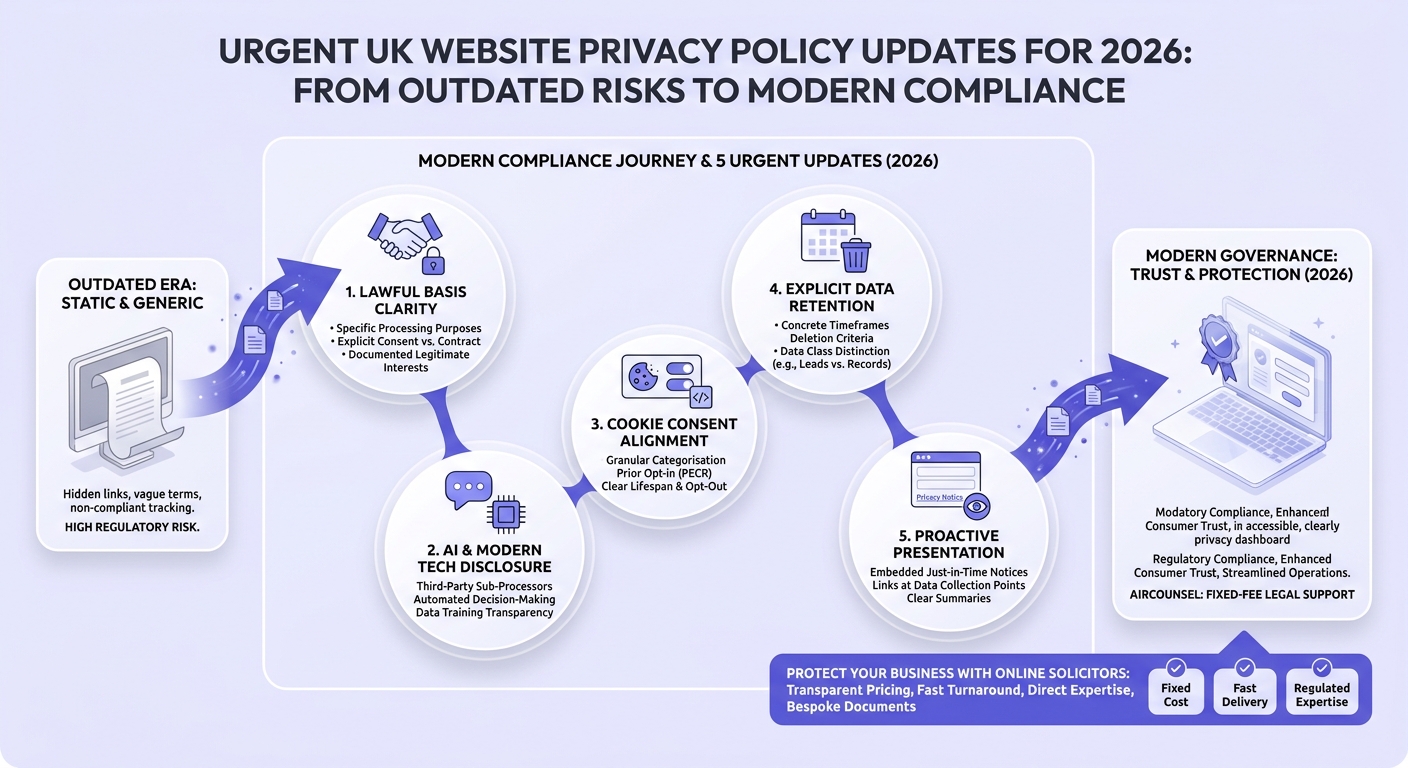
Why UK Website Privacy Policies Need Urgent Updates in 2026
Under the UK General Data Protection Regulation (UK GDPR) and the Privacy and Electronic Communications Regulations (PECR), every business that collects personal data—such as customer names, email addresses, payment details, or IP addresses—must provide clear privacy information.
The Information Commissioner's Office (ICO) emphasizes the "right to be informed," mandating that individuals understand exactly who processes their data and why. Many UK small businesses installed a static template when launching their site and haven't revised it since. However, adding a new email marketing platform, implementing automated customer service tools, or integrating conversion tracking creates immediate compliance liabilities if your public notice remains unchanged.
Failing to maintain accurate terms does not just risk regulatory enforcement; it also undermines customer trust and slows down business transactions. If you manage client agreements alongside consumer data, you can also read our guide on why UK business owners use online solicitors to review commercial contracts to see how integrated legal oversight protects growing enterprises.
Update 1: Clarifying Lawful Basis and Processing Purposes
A generic statement claiming "we process data to improve our services" fails UK GDPR transparency standards. Your privacy policy must pair every distinct data collection activity with a valid lawful basis:
- Consent: Explicit, affirmative agreement from the user (e.g., subscribing to an optional marketing newsletter).
- Contractual Necessity: Processing required to fulfill an agreement (e.g., collecting a delivery address for an ecommerce order).
- Legal Obligation: Processing mandated by law (e.g., retaining transaction records for HMRC accounting compliance).
- Legitimate Interests: Commercial processing that does not override individual rights (e.g., fraud prevention or network security), requiring a documented Legitimate Interests Assessment (LIA).
When reviewing client sites, online solicitors frequently uncover bundled consent clauses where businesses attempt to rely on consent for core service delivery while hiding secondary marketing uses in small print. Your privacy documentation must separate these streams clearly.
Update 2: Accounting for AI Widgets, Chatbots, and Modern Analytics
Recent technological shifts mean website visitors interact with automated systems far more frequently. If your website incorporates generative AI customer support widgets, interactive product recommendation tools, or predictive analytics, your privacy policy must account for:
- Third-Party Sub-Processors: Disclosing whether user prompts or customer queries pass through external AI model providers (e.g., OpenAI, Anthropic, or AWS).
- Automated Decision-Making: Explaining whether profiling or algorithmic scoring affects the pricing, access, or services offered to a visitor.
- Data Training Disclosures: Clarifying whether user inputs are used to train underlying machine learning models or if zero-retention API policies apply.
Pairing your public policies with an Article 28-compliant Custom Data Processing Agreement for your vendors ensures your back-end data flows match your front-end disclosures.
Update 3: Aligning Cookie Consent Banners with Actual Tracking
Discrepancies between cookie consent mechanisms and published privacy policies are among the most common enforcement triggers cited by the ICO. Under PECR, non-essential cookies—such as advertising pixels, heatmaps, and remarketing tags—require prior opt-in consent before firing.

Your privacy documentation must provide comprehensive details regarding your tracking technologies, including:
- Cookie Categorisation: Distinguishing strictly necessary cookies from performance, functional, and targeting cookies.
- Duration and Lifespan: Stating whether cookies expire at the end of a session or persist across multiple visits.
- Opt-Out Mechanisms: Providing an easily accessible method for users to change or withdraw their cookie preferences at any time.
Businesses often solve this by implementing a comprehensive Custom Privacy & Cookies Policy tailored to their exact website technology stack.
Update 4: Explicit Data Retention Periods and Disposal Rules
Vague statements such as "we retain your data as long as necessary" violate UK data minimization principles. The ICO requires businesses to define concrete retention periods or specify the exact criteria used to determine when personal data will be purged.
For example, your policy should clearly distinguish between different data classes:
- Prospective Lead Data: Retained for 12 months following inactive contact, then deleted.
- Ecommerce Transaction Records: Retained for 6 years following the financial year-end to meet statutory HMRC tax requirements.
- Customer Support Tickets: Retained for 24 months to resolve warranty disputes or recurring service inquiries.
Aligning your public notices with an internal Custom Data Protection Policy ensures your operational staff follow the exact deletion schedules published on your website.
Update 5: Proactive Presentation and Embedded Notice Links
Simply placing a "Privacy Policy" link in your website footer is no longer considered sufficient for compliant data collection. The ICO expects privacy disclosures to be delivered proactively at the exact point of data capture.
Make sure your website layout incorporates direct links and plain-English summaries at key touchpoints:
- Contact and Inquiry Forms: Include a direct hyperlink directly beneath the submission button explaining how submitted information is handled.
- Checkout and Payment Pages: Provide a dedicated notice before final payment processing confirming data sharing with payment gateways and fraud prevention providers.
- Account Registration Flows: Ensure users review both the privacy policy and your Application, Software or Website Terms of Service before creating credentials.
Website Compliance Audit Checklist
Use this comparison table to identify whether your current website documentation meets modern standards or requires immediate remediation.
| Compliance Area | Outdated Practice | Compliant 2026 Standard |
|---|---|---|
| Data Collection | Buried link in website footer only | Just-in-time notices embedded at all forms and checkouts |
| Lawful Basis | Broad claim of "business improvement" | Specific UK GDPR lawful basis assigned to each data purpose |
| AI & Automation | Unmentioned third-party AI scripts | Explicit disclosure of AI processors and prompt handling |
| Cookie Control | Implied consent via continued browsing | Granular opt-in banner matching the published cookie schedule |
| Data Retention | Indefinite retention ("as long as needed") | Precise timeframes and scheduled disposal protocols |
| User Rights | Complex legal jargon regarding complaints | Clear explanation of access, rectification, and ICO complaint rights |
Why Modern Founders Hire Online Solicitors for Privacy Compliance
Drafting enforceable, compliant privacy policies requires balancing strict regulatory mandates with practical business operations. Using generic online templates often leaves dangerous blind spots because boilerplate text cannot anticipate your unique data pipelines, international hosting partners, or custom marketing stacks.
Instructing licensed online solicitors provides significant advantages for UK small businesses:
- Upfront Fixed Pricing: Transparent legal costs without unpredictable hourly billing.
- Fast Turnarounds: Custom legal drafting completed and delivered in 2 to 3 business days.
- Direct SRA-Regulated Expertise: Access to qualified solicitors who understand UK GDPR, PECR, and digital product governance.
- Bespoke Protection: Documents drafted to match your specific tech integrations, apps, and third-party vendors.
Protect Your Business with Fixed-Fee Legal Support
Outdated privacy policies and non-compliant cookie practices expose your company to regulatory penalties and erode consumer confidence. Updating your digital compliance documents ensures your business remains fully protected while scaling operations smoothly.
AirCounsel connects UK founders and business owners with qualified online solicitors who deliver custom, fully compliant privacy documentation on transparent, fixed-fee terms. Get your website protected today with a bespoke Custom Privacy & Cookies Policy or establish complete digital governance with our tailored Application, Software or Website Terms of Service.
Frequently Asked Questions
Do UK businesses need a privacy policy on their website?
Yes. If your website collects any form of personal data—including names, email addresses, contact forms, or IP addresses tracked via analytics—UK GDPR and the Data Protection Act 2018 legally require you to provide a clear privacy notice.
What must a UK website privacy policy include under UK GDPR?
Your policy must include your business name and contact details, the types of personal data collected, the specific lawful basis for each processing activity, data retention timeframes, third-party data recipients, international transfer mechanisms, and clear instructions on how users can exercise their statutory data subject rights or complain to the ICO.
How often should a privacy policy be updated?
You should review your privacy policy at least annually, and immediately whenever you introduce new data collection tools, change third-party service providers, adopt AI customer service software, modify your marketing strategies, or alter data retention practices.
Do cookies and consent language need to be listed in the privacy policy?
Yes. You must provide clear and comprehensive information regarding all cookies and tracking technologies used on your site. Many businesses publish this as an integrated privacy and cookies policy or maintain a dedicated cookie schedule linked directly to their consent banner.
Recommended
Need Legal Assistance?
Our expert legal team is ready to help you navigate complex legal matters with confidence.