What Happens if Your US Company Fails to Distinguish Between 1099 vs W2 Workers?

Navigating worker classification can feel like walking a regulatory tightrope for modern founders and small businesses. Choosing between 1099 vs w2 structures is not merely a preference; it is a strict legal determination dictated by federal and state agencies, and getting it wrong can quietly build up a catastrophic financial liability.
In fact, the average cost of a worker misclassification penalty for a small business exceeds $15,000 in back taxes and interest according to audit data. For rapidly scaling startups or bootstrapped businesses, a single class-action lawsuit or Department of Labor (DOL) audit can wipe out years of hard-earned growth.
This article unpacks the major financial, operational, and legal differences between employee and contractor designations, maps out real-world risk metrics, and provides concrete steps to keep your company compliant.
Table of Contents
- The Core Differences: 1099 vs W2
- The Control Tests: How the IRS and DOL Decide
- The Financial and Legal Risks of Misclassification
- The 2026 Reporting Threshold Changes
- Step-by-Step Guide to Verifying Worker Status
- Cost Analysis: True Employee Cost vs Contractor Gross Fee
- Ensuring Compliance: Best Practices for Documentation
- Protect Your Business with Professional Legal Support
- Frequently Asked Questions
- Recommended
Quick Summary
| Takeaway | Explanation |
|---|---|
| Tax Responsibilities | W2 employees require employer tax withholding; 1099 contractors handle their own self-employment taxes. |
| Operational Control | W2 employees perform work under direct corporate supervision; 1099 contractors operate with autonomy. |
| Misclassification Audit Risk | Can result in back payroll taxes, FICA interest, overtime claims, and ongoing corporate litigation. |
| 2026 Threshold Shifts | The 1099-NEC reporting bar shifts to $2,000, but worker classification definitions stay identical. |
| Best Practice | Protect your business with clear custom consulting and employment agreements reviewed by experienced lawyers. |
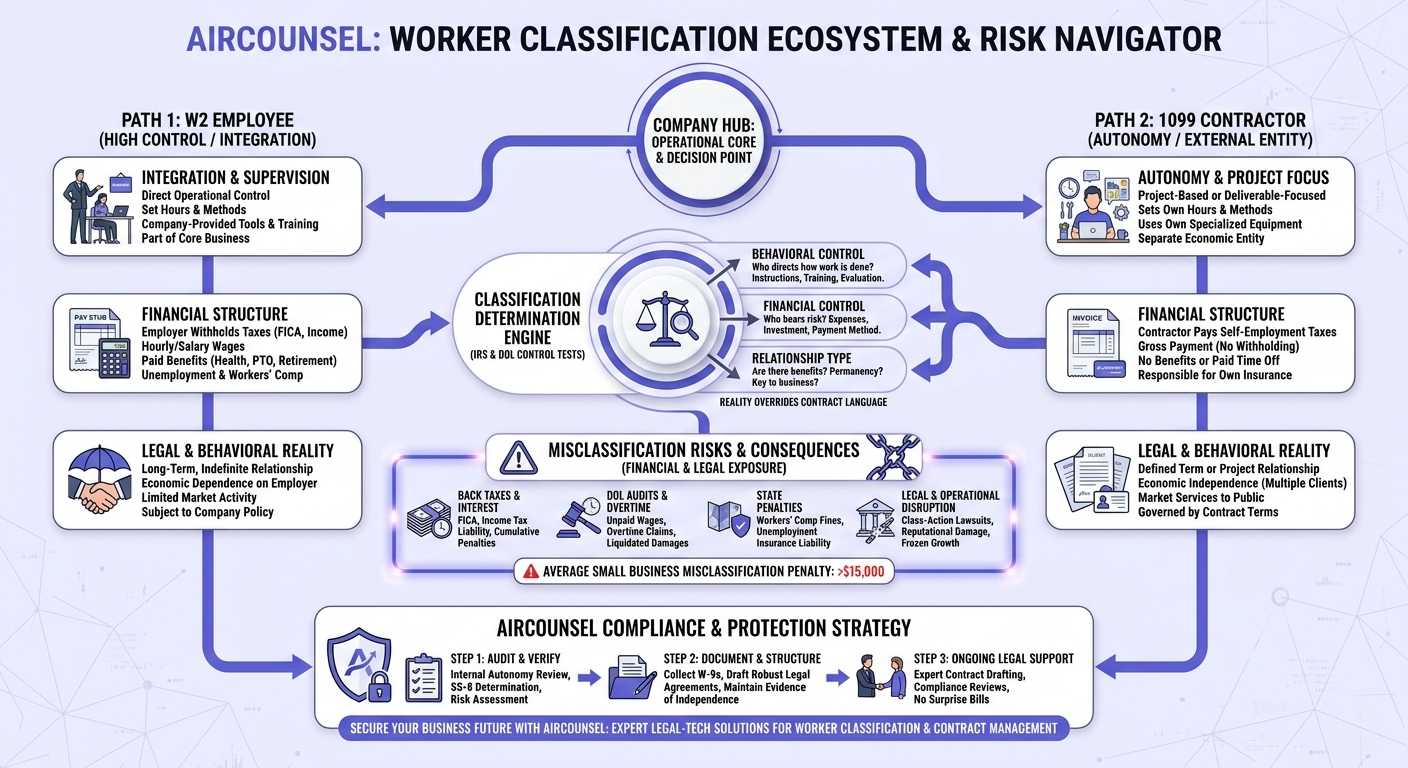
The Core Differences: 1099 vs W2
Understanding how the Government categorizes worker types is essential long before you hand over a contract. The IRS and Department of Labor view worker classification through a distinct binary lens.
- W2 Employee: A worker who performs core integration-related services under the direct operational control of your company. Employers must withhold federal, state, and local income taxes, hand over Social Security and Medicare taxes, pay unemployment taxes, and generally offer company benefits.
- 1099 Contractor: An independent service provider or entity hired block-by-block to complete a specific deliverable. They manage their own workspaces, utilize their own specialized tools, pay their own self-employment taxes, and have legal autonomy over how they accomplish the outcome.
The main difference comes down to the concept of control. Employees operate within the ecosystem of your command structure, while independent contractors operate external businesses that interface with yours.
The Control Tests: How the IRS and DOL Decide
Agencies do not look at what is written on a job title; they look at the real behavioral dynamics of the relationship. To determine classification, authorities use two main assessments.
The IRS Three-Category Control Test
The IRS relies on three primary focus categories to evaluate how much control an employer possesses over a worker. You can review the full criteria on the IRS Worker Classification Page.
- Behavioral Control: Does your business dictate when, where, and how the worker performs the work? Providing specialized software training, requiring set working hours, or specifying explicit work methods leans heavily toward a W2 status.
- Financial Control: Does the business reimburse all expenses, supply core machinery or computers, and prohibit the worker from seeking other market opportunities? If the worker faces no business-loss risk and earns a standardized salary, they are likely a W2 employee.
- Type of Relationship: Are there benefits such as health insurance, retirement contributions, or paid time off? If the job is indefinitely structured and central to the company's daily operational success, it hints strongly at a W2 arrangement.
The DOL Economic Reality Test
Under the Department of Labor, the focus shifts to economic dependence. The central question is: Is the worker economically dependent on your business for their survival, or are they truly in business for themselves? If your company is their sole source of income and they do not market their services to other clients, the DOL will classify them as an employee.
The Financial and Legal Risks of Misclassification
Worker misclassification is not viewed by the government as an innocent clerical oversight. It is treated as tax evasion and labor law non-compliance, pulling your business into high-stakes audits.
- Imposition of Back Taxes: Companies caught misclassifying employees can be held legally responsible for 100% of the FICA taxes they should have paid, plus a percentage of the federal income tax withholdings that went unpaid.
- Unpaid Overtime Liability: Under the Fair Labor Standards Act, workers reclassified as employees can claim back payment for unpaid overtime hours, going back up to three years.
- State-Level Workers' Comp Penalties: Most states require business owners to maintain workers' compensation insurance for employees. Missing this will lead to state audits, heavy statutory fines, and potential personal liability for any workplace injuries.
- FICA Interest and Penalties: Failing to deposit trust fund taxes on time triggers cumulative, non-negotiable interest and accuracy fines from the IRS.
The 2026 Reporting Threshold Changes
A critical shift in federal tax filing is arriving for the 2026 tax year. The legislative reporting threshold for Form 1099-NEC (Non-Employee Compensation) increases from $600 to $2,000.
While this sounds like regulatory relief, it actually presents a quiet compliance trap. Many small business owners mistakenly believe that if they pay an independent contractor less than $2,000, they do not have to worry about the classification rules.
In reality, the behavioral and economic reality tests remain unchanged. If a worker earning $1,500 is found to operate with the lack of independence of a W2 employee during an audit, you still face substantial exposure to misclassification fines.
Step-by-Step Guide to Verifying Worker Status
Before onboarding any new individual or business, follow these steps to secure your operations.
- Step 1: Conduct an Internal Autonomy Audit: Map the worker's operational profile against the behavioral, financial, and relational tests. Make sure they do not rely on your internal systems for general tools, core computers, or operational instructions.
- Step 2: Collect an IRS Form W-9: Secure a signed Form W-9 from the contractor prior to their first assignment. This tax record establishes that the contractor accepts legal responsibility for reporting and paying their own self-employment taxes.
- Step 3: Draft an Authorized Contractor Agreement: Relying on unvetted templates downloaded from the internet leaves you vulnerable. Use an attorney to draft a robust legal framework that clearly outlines the independent relationship.
- Step 4: Request an Official Form SS-8 Review: If you encounter a complex hybrid scenario where classification remains highly ambiguous, you can submit Form SS-8 directly to the IRS and request an official administrative determination.
Cost Analysis: True Employee Cost vs Contractor Gross Fee
Understanding the baseline costs helps founders plan their budgets while managing regulatory risk.
| Expense Category | W-2 Employee | 1099 Contractor |
|---|---|---|
| Average Total Burden | Wages plus an extra 20% to 30% in corporate taxes and benefits. | Simple, flat gross payment tier based on hourly work or milestones. |
| Payroll Taxes (FICA) | The employer pays a mandatory 7.65% share (and matches Medicare and Social Security). | 0% (The contractor is sole-proprietor and pays local self-employment taxes). |
| Mandatory Local Protections | Federal and state unemployment insurance (FUTA/SUTA) alongside workers' comp. | 0% (The contractor handles their own insurance liabilities). |
| Operational Tooling | Laptop, professional design or developer software licenses, and dedicated office desks. | Contractor supplies all of their own primary design equipment and assets. |
Ensuring Compliance: Best Practices for Documentation
To defend against future IRS audits or administrative challenges, you must build a comprehensive paper trail. Do not rely entirely on the language of your contracts; you must support it with matching financial behavior.
Keep signed contractor agreements, individual copies of the contractor's independent business registration, professional invoices specifying project milestones rather than hourly timesheets, and written evidence of their external marketing materials. If a regulatory auditor reviews your files, these documents provide essential proof that the worker is a separate, self-sufficient economic entity.
Protect Your Business with Professional Legal Support
Choosing incorrect worker categories is one of the most expensive shortcuts a growing company can take. If your classification processes are not reviewed by a regulatory legal professional, a routine audit could quickly compromise your personal assets, drain corporate bank accounts, and derail your path to fundraising or expansion.
Don't wait for a costly investigation by the IRS or the Department of Labor. Secure your business and lock down clear, defensible corporate operations with AirCounsel. We provide expert contract drafting, comprehensive legal reviews, and strategic answers with no surprise hourly bills.

Protect your business today by booking an Online Consultation or securing a Custom Independent Contractor / Consulting Agreement today. If you have immediate questions, Ask a U.S Attorney a Question for customized, reliable legal advice.
Frequently Asked Questions
Can I classify a worker as 1099 if I just sign a contract saying they are one?
No. Written independent contractor contracts do not override the actual operational reality of the relationship. Regulatory bodies like the IRS look beyond contract labels to evaluate behavioral control, equipment dependency, and financial integration. If a worker acts like an employee, they will be treated as one in an audit, regardless of any agreement they signed.
What is the new 2026 reporting threshold for 1099-NEC, and does it affect classification?
Effective for the 2026 tax year, companies are only required to file Form 1099-NEC for contractors paid $2,000 or more (an increase from the previous $600 limit). However, this change is strictly a filing requirement. It does not alter, weaken, or change the legal tests used to define worker status.
How do I file Form SS-8 with the IRS to determine worker status?
To receive a formal determination of a worker's status, either the employer or the worker can submit Form SS-8 to the IRS. The agency will review the submitted information regarding control and financial independence, and issue a binding determination. Note that filing this form can sometimes trigger a broader employment tax audit of your business.
What penalties does the DOL impose for misclassifying an employee as a contractor?
The Department of Labor can force your business to pay back wages, unpaid overtime for all hours worked over 40 per week, and liquidated damages equal to the unpaid wages. Extreme cases of intentional or repeat misclassification can also lead to criminal charges and significant civil monetary penalties.
Recommended
Need Legal Assistance?
Our expert legal team is ready to help you navigate complex legal matters with confidence.