Why Telehealth Startups Need an Attorney to Review Contract in USA Clinical Partnerships

Scaling a digital health platform requires clinical alignment, robust technology infrastructure, and strict regulatory precision. Hiring an attorney to review contract in usa telehealth partnerships ensures your commercial and clinical agreements protect your core intellectual property, manage patient data liabilities, and comply with state and federal healthcare laws.
According to federal data tracked on HHS Telehealth, over 76% of US hospitals connect with patients and consulting practitioners using video and remote technology, creating a massive market for digital health startups partnering with established medical groups, health systems, and physician networks.
However, moving quickly to secure clinical partners often tempts founders to sign standard vendor agreements or partner-drafted templates. In healthcare, signing unvetted contracts exposes startups to severe HIPAA non-compliance penalties, state licensing sanctions, and one-sided indemnity obligations that can derail future fundraising rounds.
Table of Contents
- Quick Summary
- High-Stakes Risks in Telehealth Clinical Agreements
- Core Clauses Your Attorney Must Scrutinize
- Data Privacy, HIPAA, and Business Associate Agreements
- Multi-State Compliance and Corporate Practice of Medicine
- Clinical Partnership Contract Red Flags
- Contract Review Costs and Timelines for Startups
- Protect Your Telehealth Business with Fast Legal Review
- Frequently Asked Questions
- Recommended
Quick Summary
| Takeaway | Explanation |
|---|---|
| Regulatory Risk | Clinical contracts must comply with state licensing, anti-kickback statutes, and corporate practice rules. |
| HIPAA Compliance | Handling electronic protected health information (ePHI) requires enforceable Business Associate Agreements. |
| Liability Division | Contracts must clearly separate software uptime liabilities from clinical malpractice claims. |
| Exit Flexibility | Unilateral termination rights protect your startup if a clinical partner fails credentialing standards. |
| Fixed Cost Review | Engaging a specialized healthcare attorney provides transparent, fixed-fee protection before signing. |
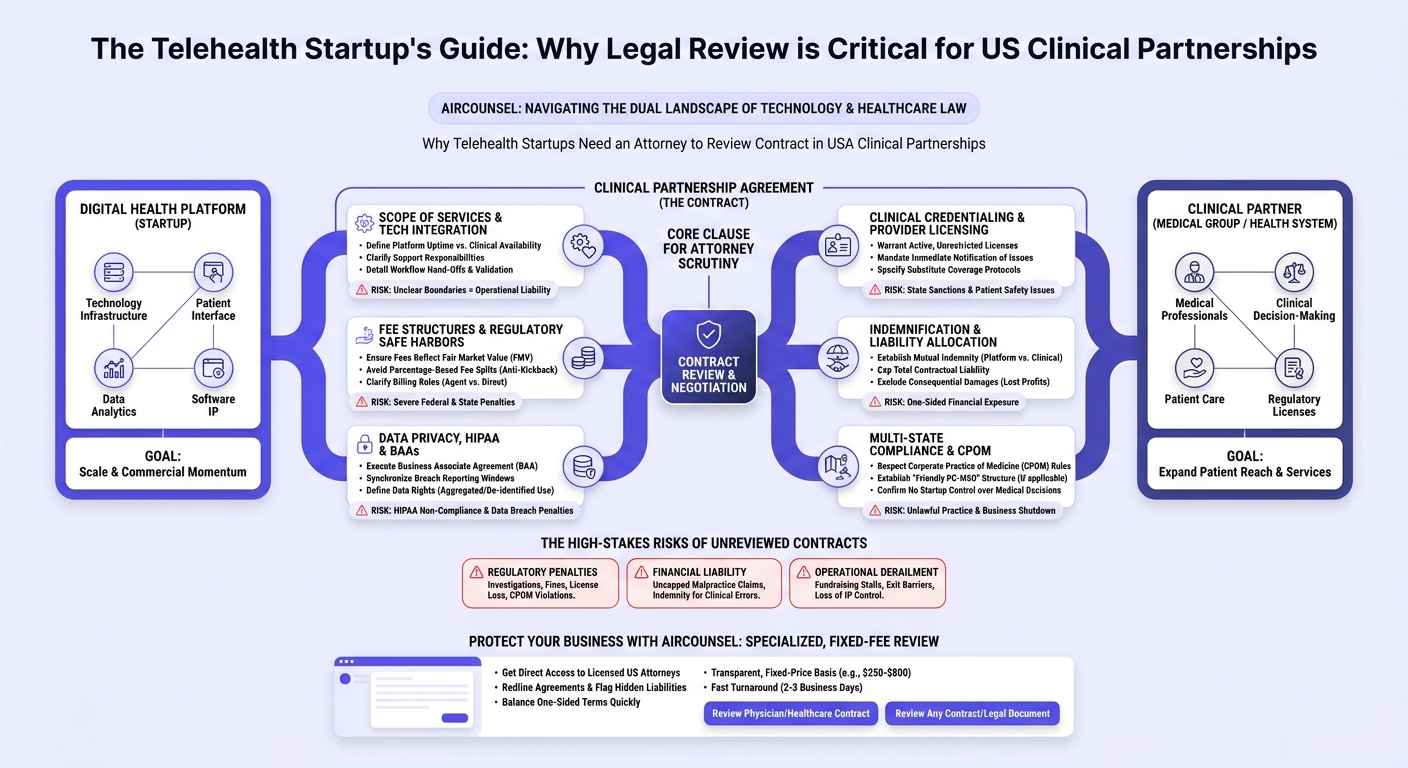
High-Stakes Risks in Telehealth Clinical Agreements
Telehealth contracts differ significantly from standard software-as-a-service (SaaS) or commercial vendor agreements. When your software facilitates patient diagnosis, electronic prescriptions, or virtual triage, your contract terms straddle both technology law and regulated medical practice.
If a contract fails to clearly separate medical decision-making from platform operations, your business could face investigations under state Corporate Practice of Medicine (CPOM) doctrines. Furthermore, poorly drafted service level agreements can inadvertently make your startup financially liable for missed clinical consultations or provider downtime.
Working with an experienced contract attorney helps early-stage operators navigate these dual technology and regulatory risks without slowing down commercial momentum.
Core Clauses Your Attorney Must Scrutinize
A thorough legal review must examine how operational workflows translate into binding legal commitments.

1. Scope of Services and Technology Integration
The agreement must state precisely where your technology obligations end and where the clinical partner's medical responsibilities begin.
- Platform Uptime: Define realistic software availability targets and carve out scheduled maintenance windows.
- Support Responsibilities: Clarify whether your team or the clinical partner handles patient-facing technical support.
- Workflow Hand-Offs: Detail how patient intake data is validated before routing to an on-call physician.
2. Clinical Credentialing and Provider Licensing
Your clinical partner must warrant that all participating healthcare providers maintain active, unrestricted licenses and malpractice insurance in every state where your end users reside.
- License Verification: Require the partner to verify provider credentials regularly and provide proof of coverage upon request.
- Immediate Notification: Mandate written notice within 24 hours if a provider faces disciplinary action, license suspension, or loss of DEA registration.
- Substitute Coverage: Specify replacement provider protocols if a scheduled clinician becomes unavailable.
3. Fee Structures and Healthcare Regulatory Safe Harbors
How money flows between your startup, clinical partners, and patients determines whether your model complies with federal and state healthcare regulations. For broader startup protection when structuring initial deal terms, you can also read our guide on protecting startup IP and NDAs.
- Fair Market Value: Ensure administrative and software fees reflect fair market value for technology services rather than patient referral volume.
- Anti-Kickback Alignment: Avoid percentage-based fee splits that could trigger scrutiny under the federal Anti-Kickback Statute (AKS) or state fee-splitting laws.
- Billing Transparency: Clarify whether your startup acts as a billing agent or if the medical group bills payers directly.
4. Indemnification and Liability Allocation
Standard partner agreements often ask startups to indemnify the clinical partner for all platform-related losses. An attorney balances these clauses to protect your balance sheet.
- Mutual Indemnity: Limit your indemnification to direct platform defects and IP infringement, while requiring the partner to indemnify you against medical malpractice and provider negligence.
- Liability Caps: Cap total contractual liability at fees collected over the prior 12-month period.
- Consequential Damages: Exclude lost profits, indirect damages, and loss of business opportunities from standard indemnity remedies.
Data Privacy, HIPAA, and Business Associate Agreements
Whenever a digital health startup creates, receives, maintains, or transmits electronic protected health information (ePHI), federal law requires a written Business Associate Agreement (BAA). The U.S. Department of Health & Human Services guidance on Business Associates establishes strict liability frameworks for both covered entities and downstream technology vendors.
Your contract review attorney will confirm that:
- BAA Alignment: The underlying clinical agreement and the BAA contain synchronized breach reporting windows (typically 24 to 72 hours).
- Data Rights: Your platform retains the right to use aggregated, de-identified healthcare data for machine learning and product optimization in compliance with HIPAA de-identification standards.
- Audit Rights: Partner security audit requests are bounded by reasonable notice, confidentiality terms, and mutual cost agreements.
Multi-State Compliance and Corporate Practice of Medicine
In the US, telehealth practice regulations vary across state borders. Over 30 states enforce CPOM restrictions that prohibit non-physician-owned business entities from employing doctors or exerting control over clinical decision-making.
If your startup provides software to a nationwide clinical group, your contract must respect the "Friendly PC-MSO" structure (Professional Corporation - Management Services Organization) if applicable. The contract should expressly state that your startup exerts no control over diagnosis, treatment plans, triage guidelines, or prescription authorizations.
Clinical Partnership Contract Red Flags
Before signing any clinical partnership agreement, review this checklist of terms that require negotiation:
| Contract Clause | Risky Partner Term | Recommended Protective Term |
|---|---|---|
| Malpractice Defense | Startup agrees to defend partner against patient malpractice claims. | Partner carries $1M/$3M malpractice coverage and indemnifies startup for clinical acts. |
| Termination for Cause | 60-day cure period for partner loss of medical licensing. | Immediate termination rights if partner loses state medical licenses or DEA registration. |
| Data Ownership | Clinical partner owns all proprietary platform data and user telemetry. | Startup owns all software IP, product analytics, and de-identified platform metrics. |
| Regulatory Fines | Startup absorbs all regulatory penalties arising from shared operations. | Each party bears sole responsibility for its own regulatory and licensing compliance. |
| Exclusivity | Startup cannot partner with other healthcare providers in the state. | Non-exclusive terms allow the startup to expand across competing health systems. |
Contract Review Costs and Timelines for Startups
Traditional corporate law firms frequently bill between $450 and $900 per hour for commercial healthcare contract reviews, leading to open-ended legal invoices. Modern legal platforms provide flat-fee structures that give early-stage founders cost certainty.
A comprehensive review of a 10-to-25 page clinical partnership agreement typically costs between $250 and $800 on a fixed-price basis, with turnaround times averaging 2 to 3 business days. Investing in an upfront review prevents contractual renegotiations that can stall Series A financing or customer expansion.
Protect Your Telehealth Business with Fast Legal Review
Signing clinical agreements without experienced legal scrutiny puts your intellectual property, cash flow, and regulatory standing at risk. AirCounsel gives digital health founders and operators direct access to licensed US attorneys who redline agreements, flag hidden liabilities, and balance one-sided terms quickly.
Whether you are formalizing a nationwide clinical coverage deal or negotiating with an independent physician network, our attorneys provide clear, fixed-fee contract feedback so you can launch your partnership with total confidence. Get started by selecting our Physician and Healthcare Contract Review or comprehensive Review of your Contract or Legal Document to safeguard your venture today.
Frequently Asked Questions
Why should a telehealth startup have an attorney review a clinical partnership contract before signing?
An attorney ensures that your contract accurately reflects your technology model while protecting you from clinical malpractice claims, regulatory fee-splitting violations, and CPOM non-compliance. Legal review also ensures that liability caps and indemnities are balanced rather than one-sided.
What contract terms matter most in telehealth clinical partnerships?
The most critical clauses include clear division between software support and clinical care, active provider credentialing obligations, balanced indemnification, HIPAA data rights, fee structures aligned with healthcare safe harbors, and immediate termination rights for regulatory breaches.
Do HIPAA business associate agreements always need to be part of telehealth vendor and partner contracts?
Yes. If your software or team handles, stores, or transmits ePHI on behalf of a covered healthcare provider, federal law mandates an executed Business Associate Agreement defining data safeguards, permitted uses, and breach reporting duties.
What risks can come from using a telehealth partnership template without legal review?
Generic or partner-provided templates often include hidden exclusivity clauses, one-sided indemnity burdens, unachievable uptime warranties, and ambiguous IP provisions that can compromise your core technology ownership.
Recommended
Need Legal Assistance?
Our expert legal team is ready to help you navigate complex legal matters with confidence.