Business Contract Review in the USA: Structuring Independent Contractor Agreements in 2026

Engaging independent contractors, freelancers, and specialized consultants allows small businesses and startups to scale flexibly without taking on immediate payroll liabilities. However, simply downloading a generic online template and signing it does not shield your business from costly misclassification claims under federal and state employment laws.
According to the U.S. Department of Labor, worker misclassification under the Fair Labor Standards Act denies workers legal wage protections and exposes businesses to substantial retroactive liabilities for back pay, overtime, and civil monetary penalties. Regulators and courts look past formal titles to evaluate the economic reality of the relationship.
Securing a professional business contract review in USA commercial agreements ensures your legal paperwork protects your intellectual property, establishes enforceable terms, and aligns with current federal labor standards.
Table of Contents
- The Reality of Independent Contractor Classification
- Key Factors in the Federal Economic Reality Test
- Essential Contract Clauses to Protect Your Business
- Operational Alignment: Why Paper Contracts Fail Without Execution
- Federal Tax and 1099-NEC Reporting Touchpoints
- Common Misclassification Mistakes Small Businesses Make
- Protect Your Business with Fixed-Fee Legal Review
- Frequently Asked Questions
- Recommended
Quick Summary
| Takeaway | Explanation |
|---|---|
| Contract vs. Reality | A signed agreement does not guarantee contractor status if day-to-day operations mirror employment. |
| Economic Reality Test | Federal DOL standards examine 6 core factors including control, profit opportunity, and integration. |
| Essential Provisions | Agreements must clearly define deliverables, intellectual property ownership, tax responsibilities, and termination rights. |
| Tax Compliance | Businesses must collect Form W-9 upfront and report payments of $600 or more annually on Form 1099-NEC. |
| Legal Review | Attorney review prevents unenforceable provisions, clarifies IP assignments, and minimizes classification risks. |
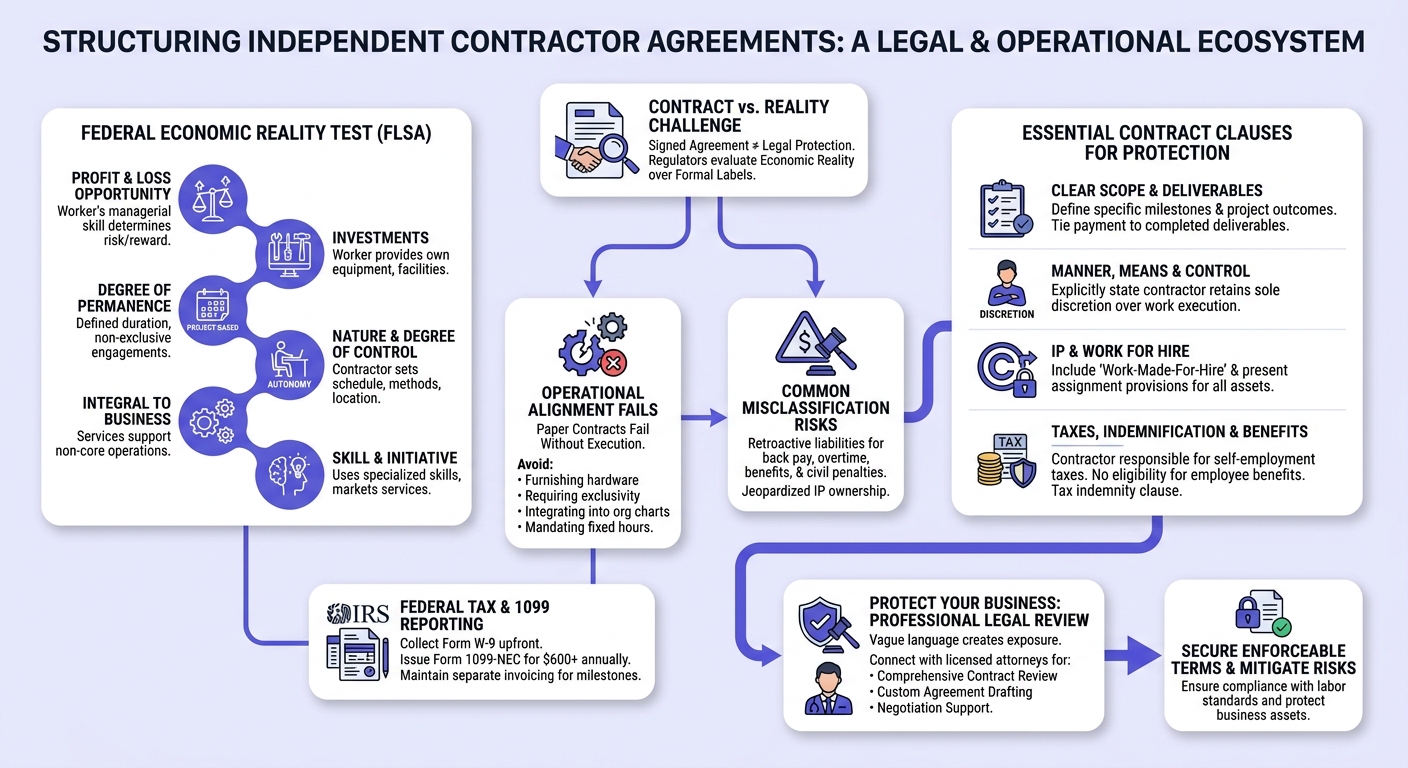
The Reality of Independent Contractor Classification
A common misconception among founders is that a signed contract titled "Independent Contractor Agreement" provides absolute legal protection. In practice, federal regulatory bodies—such as the Department of Labor and the Internal Revenue Service—along with state labor boards apply substantive legal tests rather than relying on labels.
When undergoing a business contract review in USA operations, an attorney checks whether the contractual terms match federal classification standards and reflect practical day-to-day management. If a contract claims an individual is an independent contractor but dictates strict daily schedules, provides company equipment, and restricts outside client work, authorities will classify that worker as an employee.
Key Factors in the Federal Economic Reality Test
Federal classification under the Fair Labor Standards Act (FLSA) relies on an "economic reality" framework. This analysis determines whether a worker is economically dependent on the employer or operating an independent business for themselves.
| Economic Reality Factor | Contractor Indicator | Employee Indicator |
|---|---|---|
| Opportunity for Profit or Loss | Worker exercises managerial skill to determine profitability and loss risks. | Worker receives a fixed hourly or piece rate with no business investment exposure. |
| Investments by Worker and Employer | Worker invests in their own tools, equipment, facilities, and operational overhead. | Business supplies all essential equipment, software licenses, and tools. |
| Degree of Permanence | Project-based, defined duration, or non-exclusive ongoing engagements. | Continuous, indefinite, and exclusive working relationship. |
| Nature and Degree of Control | Contractor sets their own schedule, work location, and execution methods. | Business directs specific work hours, methods, and day-to-day oversight. |
| Work Integral to the Business | Services support specialized, non-core operations (e.g., outside marketing agency). | Work directly produces the primary product or service the business sells. |
| Skill and Initiative | Worker uses specialized technical skills and markets services independently. | Work relies on employer training and routine tasks without independent initiative. |
Essential Contract Clauses to Protect Your Business

To build a legally enforceable contractor agreement that withstands regulatory scrutiny, you must structure specific operational safeguards directly into the contract text.
Clear Scope of Work and Deliverables
Rather than defining a general job description, contractor contracts should outline specific milestones, deliverables, and project outcomes.
- Milestone Pricing: Tie payment disbursements to completed deliverables rather than open-ended weekly hours.
- Statement of Work (SOW): Use detailed project exhibits that define acceptance criteria, deadlines, and project completion parameters.
Manner, Means, and Control
The agreement should explicitly state that the contractor retains sole discretion over the manner, means, and timing of completing the deliverables. Language requiring contractors to attend routine internal company meetings or adhere to company employee handbooks should be avoided.
Intellectual Property and Work for Hire
Under US copyright law, independent contractors own the intellectual property they create unless the contract contains express assignment provisions.
- Work-Made-For-Hire Clauses: Clearly state that deliverables constitute "work made for hire" under US copyright statutes.
- Present Assignment Provisions: Include language explicitly stating that the contractor "hereby assigns all right, title, and interest" in all project assets, code, designs, and materials to your company upon creation.
Taxes, Indemnification, and No-Benefits Acknowledgments
The contract must clearly establish financial boundaries:
- Self-Employment Taxes: The contractor expressly acknowledges responsibility for all federal, state, and local income taxes, self-employment taxes, and statutory filings.
- No Employee Benefits: Explicit disclaimers stating the contractor is not eligible for company benefits, including health insurance, 401(k) contributions, paid leave, or unemployment compensation.
- Tax Indemnity: A provision requiring the contractor to indemnify your business for tax assessments or penalties arising from improper tax reporting.
Operational Alignment: Why Paper Contracts Fail Without Execution
Legal documentation is only effective when supported by actual business behavior. Common ways businesses unintentionally undermine their contractor agreements include:
- Furnishing Primary Hardware: Providing dedicated laptops or company-owned devices when the contractor should use their own equipment.
- Requiring Exclusivity: Preventing a contractor from taking on other clients or marketing their services publicly.
- Integrating into Internal Org Charts: Listing independent contractors alongside regular staff on company directories with corporate job titles.
- Mandating Fixed Office Hours: Forcing contractors to log into communication platforms during set operational hours rather than focusing on milestone delivery.
Federal Tax and 1099-NEC Reporting Touchpoints
Hiring independent contractors introduces distinct tax and reporting obligations managed by the Internal Revenue Service. Businesses should maintain a structured compliance process:
- Collect Form W-9: Always obtain a signed Form W-9 (Request for Taxpayer Identification Number and Certification) before issuing any payments.
- Issue Form 1099-NEC: File Form 1099-NEC for each non-corporate contractor paid $600 or more during the calendar year, submitting copies to both the contractor and the IRS by January 31.
- Maintain Separate Invoicing: Ensure the contractor submits formal commercial invoices for all completed milestones prior to disbursing funds.
Common Misclassification Mistakes Small Businesses Make
- Using Outdated Templates: Copying boilerplate agreements from non-US jurisdictions or outdated sources that do not reflect recent DOL rules.
- Misusing Non-Compete Clauses: Inserting overly broad restrictive covenants that effectively prevent the contractor from operating an independent enterprise.
- Treating Former Employees as Contractors: Shifting an employee to 1099 contractor status while keeping their duties, hours, and supervision unchanged.
- Failing to Secure Written IP Assignments: Assuming payment automatically transfers copyright ownership without explicit assignment terms.
Protect Your Business with Fixed-Fee Legal Review
Structuring contractor engagements properly requires balancing business speed with robust legal protection. Vague language or contradictory operational terms can turn an agile hiring strategy into expensive legal exposure.
AirCounsel connects entrepreneurs and growing companies with licensed US attorneys for rapid, transparent legal guidance. Whether you need an experienced lawyer to analyze an incoming agreement or draft a custom framework tailored to your operations, you get actionable results with clear, fixed pricing and fast turnaround times.
Ensure your agreements protect your business assets and comply with current labor standards:
- Get a comprehensive Review of your Contract or Legal Document to identify hidden risks and non-compliant clauses.
- Order a tailored Custom Independent Contractor / Consulting Agreement drafted specifically for your business model.
- Secure direct attorney support for contract adjustments and deal terms through Negotiation Support.
This article provides general information and is not legal advice.
Frequently Asked Questions
What clauses should an independent contractor agreement include in the US?
An independent contractor agreement should include a clear statement of work, milestone-based compensation terms, an explicit manner-and-means clause granting operational autonomy, robust intellectual property assignment language, tax responsibility acknowledgments, confidentiality protections, and defined termination rights.
How do federal labor standards affect contractor classification in 2026?
Federal labor standards evaluate whether a worker is in business for themselves using an economic reality test. Regulators examine factors such as degree of control, opportunity for profit or loss, capital investments, permanence of the relationship, skill level, and how central the service is to the company's core business operations.
Does signing an independent contractor agreement make someone a contractor?
No. While a written contract is essential evidence of the parties' commercial intent, government agencies and courts prioritize the actual day-to-day working relationship over written labels. If your business controls how, when, and where the work is performed, the worker may still be classified as an employee.
What is the biggest misclassification risk for small businesses using contractors?
The biggest risk is financial liability for retroactive payroll taxes, unpaid minimum wage and overtime, backdated workers' compensation insurance premiums, employee benefits, and government fines. Misclassification can also jeopardize intellectual property ownership if agreements lack proper assignment wording.
Recommended
- Employment Contract Review — Get expert legal review of your employment contracts to verify state and federal compliance.
- Custom Services Agreement — Obtain a customized B2B services agreement drafted by licensed US attorneys.
- Custom IP Assignment Agreement — Protect your core business assets by securing complete ownership of software, designs, and content.
Need Legal Assistance?
Our expert legal team is ready to help you navigate complex legal matters with confidence.