How to Use a Contract Review Attorney to Mitigate B2B Indemnity Risks

Closing enterprise B2B sales agreements is a major milestone for growing businesses, but hidden legal traps in standard commercial paperwork can jeopardize your balance sheet. When enterprise clients present lengthy Master Services Agreements (MSAs), their vendor contracts routinely include sweeping indemnity clauses, broad duty-to-defend obligations, and uncapped liability carve-outs designed to shift counterparty risks onto your company.
According to commercial contract research, 69% of SMB owners admit to signing legally binding contracts without fully understanding the risks embedded within the text. Assuming boilerplate terms are harmless or standard across the industry often results in unexpected exposure to costly litigation, regulatory fines, and third-party disputes.
Engaging a licensed contract review attorney before signing ensures that your risk exposure remains proportional to the deal value. Professional contract analysis isolates predatory language, ensures compliance with US state laws, and equips you with pragmatic redlines that protect your business assets without stalling the sales cycle.
Table of Contents
- Why Enterprise Indemnity Language Puts Small Businesses at Risk
- Quick Summary
- Understanding the Core Triad: Indemnify, Defend, and Hold Harmless
- Top Indemnity Red Flags Found in B2B Contracts
- How State Law Influences Indemnity Enforceability
- Essential Edits a Contract Review Attorney Implements
- When to Immediately Escalate a Contract to Legal Counsel
- Protect Your Deals With Fixed-Fee Contract Review
- Frequently Asked Questions
- Recommended
Why Enterprise Indemnity Language Puts Small Businesses at Risk
Large corporate buyers use enterprise sales agreements to shift operational, technical, and regulatory risks downward to their vendors. While enterprise procurement teams view these provisions as standard governance, an unrevised indemnity clause can obligate a small vendor to cover millions of dollars in third-party lawsuits originating from a modest $15,000 service contract.
Federal resources like the U.S. Small Business Administration emphasize that sound commercial risk management starts with understanding contract liability terms before executing deals. When entering negotiations, businesses must ensure that contractual exposure does not exceed the protection provided by their commercial general liability or errors and omissions insurance policies. To navigate complex multi-year customer agreements, you can also read our guide on hiring an attorney for enterprise MSAs.
Quick Summary
| Takeaway | Explanation |
|---|---|
| Indemnity Imbalance | Enterprise customer paper routinely shifts massive third-party legal risks entirely onto vendors and suppliers. |
| Defense Costs Trap | A "duty to defend" requires paying ongoing litigation legal fees immediately, even before any liability or fault is proven. |
| State Law Nuances | US states treat indemnification clauses differently, especially regarding comparative fault and public policy limits. |
| Proportional Risk Caps | A contract review attorney ties indemnity obligations to overall contract liability caps and existing insurance coverage. |
| Turnaround Speed | Targeted legal contract review flags critical liabilities within 2 business days without derailing sales closing timelines. |
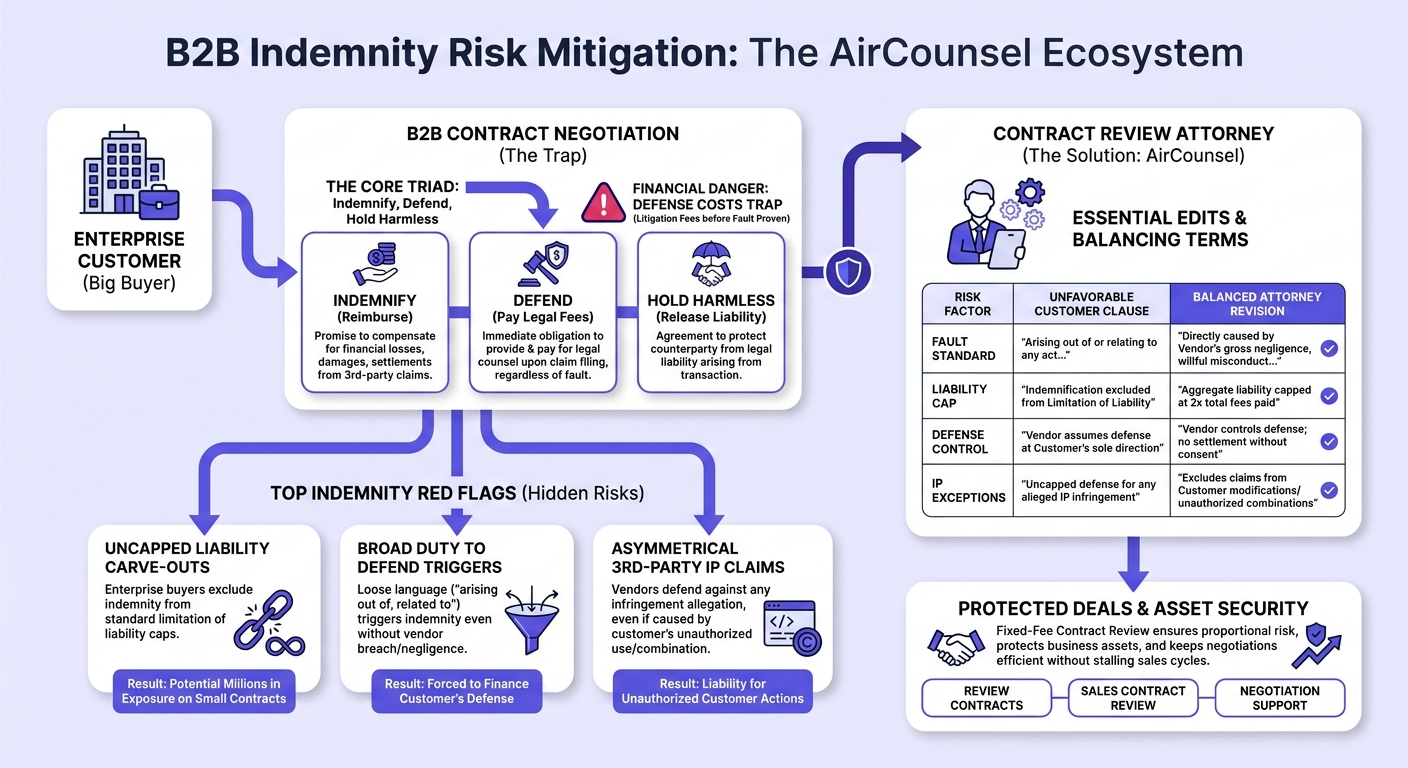
Understanding the Core Triad: Indemnify, Defend, and Hold Harmless
Commercial agreements frequently combine three distinct legal terms into a single clause: "Vendor shall indemnify, defend, and hold harmless Customer." Although these words are often grouped together as boilerplate phrasing, each imposes a separate, enforceable financial obligation under US contract law.
- Indemnify: A direct promise to reimburse or compensate the other party for financial losses, judgments, damages, and settlements resulting from specified third-party claims, as defined under standard legal doctrine by the Cornell Law School Legal Information Institute.
- Defend: The distinct obligation to provide, manage, and pay for legal defense counsel immediately upon a claim being filed against the counterparty, regardless of whether your business is ultimately found at fault.
- Hold Harmless: An agreement to release and protect the counterparty from legal liability arising out of the transaction, ensuring they are shielded from bearing the loss themselves.
The financial danger for small businesses lies in the "duty to defend." Litigating commercial disputes in federal or state courts frequently costs hundreds of thousands of dollars in attorney fees before a case ever reaches trial. If your contract includes an unrestricted defense obligation, you may be forced to finance your customer's defense team even if the underlying claim turns out to be meritless.
Top Indemnity Red Flags Found in B2B Contracts
Commercial contracts provided by customer legal departments are written to favor the buyer. A thorough review flags several common indemnity traps before execution.

Uncapped Liability Carve-Outs
Most standard B2B contracts contain a Limitation of Liability (LoL) clause that caps total aggregate damages at the total fees paid under the contract over the preceding 12 months. However, enterprise buyers routinely insert express carve-outs stating that indemnity obligations are excluded from the liability cap. For an in-depth breakdown of these provisions, read our guide on uncapped indemnity risks in sales agreements.
Broad Duty to Defend Triggers
Predatory contracts use loose nexus language, such as requiring indemnity for claims "arising out of, in connection with, or in any way related to" your services. This language triggers indemnity even if your company committed no breach, negligence, or wrongdoing. A seasoned contract attorney narrows this phrasing to require that indemnification applies solely to claims "directly resulting from the vendor's gross negligence, willful misconduct, or material breach."
Asymmetrical Third-Party Intellectual Property Claims
Customers frequently demand comprehensive IP indemnity, requiring vendors to defend them against any allegation of patent, copyright, or trade secret infringement. Without strict contractual boundaries, you could be held financially liable if a client combines your software or service with unauthorized third-party tools, altering the workflow and triggering an external patent troll lawsuit.
How State Law Influences Indemnity Enforceability
In the US, contract enforceability is governed primarily by state statutory and common law rather than a uniform federal standard. The governing law clause in your agreement significantly impacts how indemnity provisions operate in practice:
- Anti-Indemnity Statutes: Several states (including Texas, California, and Louisiana) enforce statutory limits on indemnity clauses in specific sectors such as construction and oilfield services, rendering provisions that indemnify a party for its own sole negligence void against public policy.
- Express Negligence Doctrine: In jurisdictions like Texas, an agreement requiring one party to indemnify another for the indemnitee's own negligence must satisfy the "express negligence rule," meaning the intent must be explicitly stated in conspicuous text within the contract body.
- Duty to Defend Severability: In states like California and New York, courts interpret the duty to defend as broader than and independent from the duty to indemnify, meaning defense obligations activate instantly when a complaint is filed unless the contract explicitly conditions defense on a final judicial determination of fault.
Essential Edits a Contract Review Attorney Implements
When an attorney reviews your commercial agreements, they replace one-sided obligations with balanced commercial terms that align with standard market expectations.
| Risk Factor | Unfavorable Customer Clause | Balanced Attorney Revision |
|---|---|---|
| Fault Standard | "Arising out of or relating to any act or omission of Vendor..." | "To the extent directly caused by Vendor's gross negligence, willful misconduct, or material breach..." |
| Liability Cap | "Indemnification claims are expressly excluded from Section X (Limitation of Liability)." | "Vendor's aggregate indemnification liability shall not exceed 2x the total fees paid under the agreement." |
| Defense Control | "Vendor agrees to assume defense at Customer's sole direction and expense." | "Vendor shall control the defense using counsel reasonably acceptable to Customer; no settlement without Vendor consent." |
| IP Exceptions | "Uncapped defense for any alleged infringement of third-party IP." | "Excludes claims arising from Customer modifications, unauthorized combinations, or compliance with Customer specifications." |
| Notice Requirements | "Customer shall notify Vendor of claims when practical." | "Customer must provide prompt written notice within 10 business days; failure to notify relieves Vendor of liability." |
When to Immediately Escalate a Contract to Legal Counsel
While simple operational agreements can sometimes be managed with standard internal templates, certain high-risk provisions require immediate review by a qualified attorney:
- Broad Affiliate Coverage: Clauses requiring you to indemnify not just the contracting corporate entity, but all of its parents, subsidiaries, affiliates, directors, officers, agents, and subcontractors.
- Data Privacy and Cybersecurity Breaches: Language demanding open-ended reimbursement for consumer notification costs, credit monitoring, forensic investigations, and regulatory fines following a data event.
- Unilateral Indemnity Provisions: Contracts where you provide comprehensive indemnity to the customer, but the customer provides zero reciprocal protection for their own content, instructions, or payment defaults.
- Liquidated Damages Multipliers: Provisions that combine indemnity clauses with predetermined liquidated damages penalties for project delays or service level agreement (SLA) misses.
Protect Your Deals With Fixed-Fee Contract Review
Reviewing complex commercial contracts should not introduce friction or unpredictable hourly legal bills into your sales pipeline. Experienced counsel identifies hidden exposures, protects your assets, and provides actionable redlines that keep negotiations collaborative and efficient.
Protect your business against open-ended indemnity exposure before signing. Submit your documents for comprehensive feedback through our Review of your Contract or Legal Document or access rapid commercial turnarounds with our dedicated Sales Contract Review. For active enterprise deals requiring strategic counterparty redlines and direct legal support, explore our on-demand Negotiation Support services.
Frequently Asked Questions
What is the difference between indemnify, defend, and hold harmless?
Indemnification requires compensating another party for financial losses and judgments after a claim occurs. The duty to defend requires paying for and providing legal defense counsel as soon as a lawsuit is filed. Holding harmless means releasing the counterparty from legal liability so they do not bear financial responsibility for specified actions.
Can an indemnity clause make my business pay the other party's legal fees?
Yes. If a contract contains a duty-to-defend obligation or specifically includes "reasonable attorney fees and court costs" within the definition of indemnifiable losses, you are contractually liable for those legal fees even if your company did not commit intentional wrongdoing.
Are indemnity clauses enforceable in every US state?
Indemnity clauses are generally enforceable across the US, but individual states enforce public policy restrictions. Many states restrict or void provisions that attempt to indemnify a party for its own intentional misconduct, gross negligence, or sole negligence, particularly in construction, real estate, and consumer contracts.
What should I ask a contract review attorney to check first in a B2B agreement?
Ask your attorney to evaluate the nexus between the indemnity triggers and your actual fault, verify whether indemnity is subject to the contract's limitation of liability cap, ensure mutual indemnity protections exist, and align indemnity commitments with your commercial liability insurance coverage limits.
How fast can an attorney review and redline a B2B sales contract?
Standard professional contract reviews are typically completed within 2 business days. Express turnaround options can deliver attorney-annotated redlines within 4 to 24 hours to ensure time-sensitive enterprise sales agreements close on schedule.
Recommended
Need Legal Assistance?
Our expert legal team is ready to help you navigate complex legal matters with confidence.