Hiring an Attorney to Review Contracts in the USA: Master Services Agreements for Enterprise Deals

According to the U.S. Small Business Administration, small businesses represent 99.9% of all private enterprises in the United States, driving massive economic momentum across every industry. Yet as growing companies scale to close lucrative enterprise deals, contracting procedures often present unexpected operational friction and substantial legal liabilities.
Signing a complex enterprise contract without independent legal guidance exposes founders to dangerous legal loopholes, uncapped liability, and aggressive IP-transfer terms. Securing a qualified attorney to review contract in usa transactions ensures that your hard-won deal accelerates company growth rather than burdening your bottom line with unseen disputes.
Whether you are negotiating a vendor contract with a Fortune 500 buyer or formalizing multi-phase engagements, structured legal review clarifies risk, safeguards your intellectual property, and equips you with practical redlines to close faster.
Table of Contents
- What Is a Master Services Agreement and Why Does It Matter?
- When to Involve a Legal Specialist Before Signing
- High-Risk MSA Clauses Founders Must Scrutinize
- Resolving Conflicts Between MSAs, SOWs, and Security Addenda
- The Contract Review Process: What to Expect and Prepare
- Cost-versus-Risk Analysis for Small Businesses
- Navigating State-Specific Law and Enforceability in the USA
- Streamline Your Contract Reviews with AirCounsel
- Frequently Asked Questions
- Recommended
Quick Summary
| Takeaway | Explanation |
|---|---|
| Strategic Purpose | A Master Services Agreement (MSA) sets baseline commercial terms for all future project statements of work (SOWs). |
| Core Risk Points | Uncapped indemnification, broad warranties, unilateral IP assignments, and vague termination clauses create outsized liabilities. |
| Review Turnaround | Professional legal reviews typically take 2 to 3 business days, delivering redlines and actionable negotiation points. |
| Cost Efficiency | Fixed-fee contract reviews allow startups and SMBs to manage risk without unpredictable hourly legal fees. |
| Document Alignment | An attorney ensures that standard MSAs, detailed SOWs, and vendor security addenda do not contain conflicting language. |
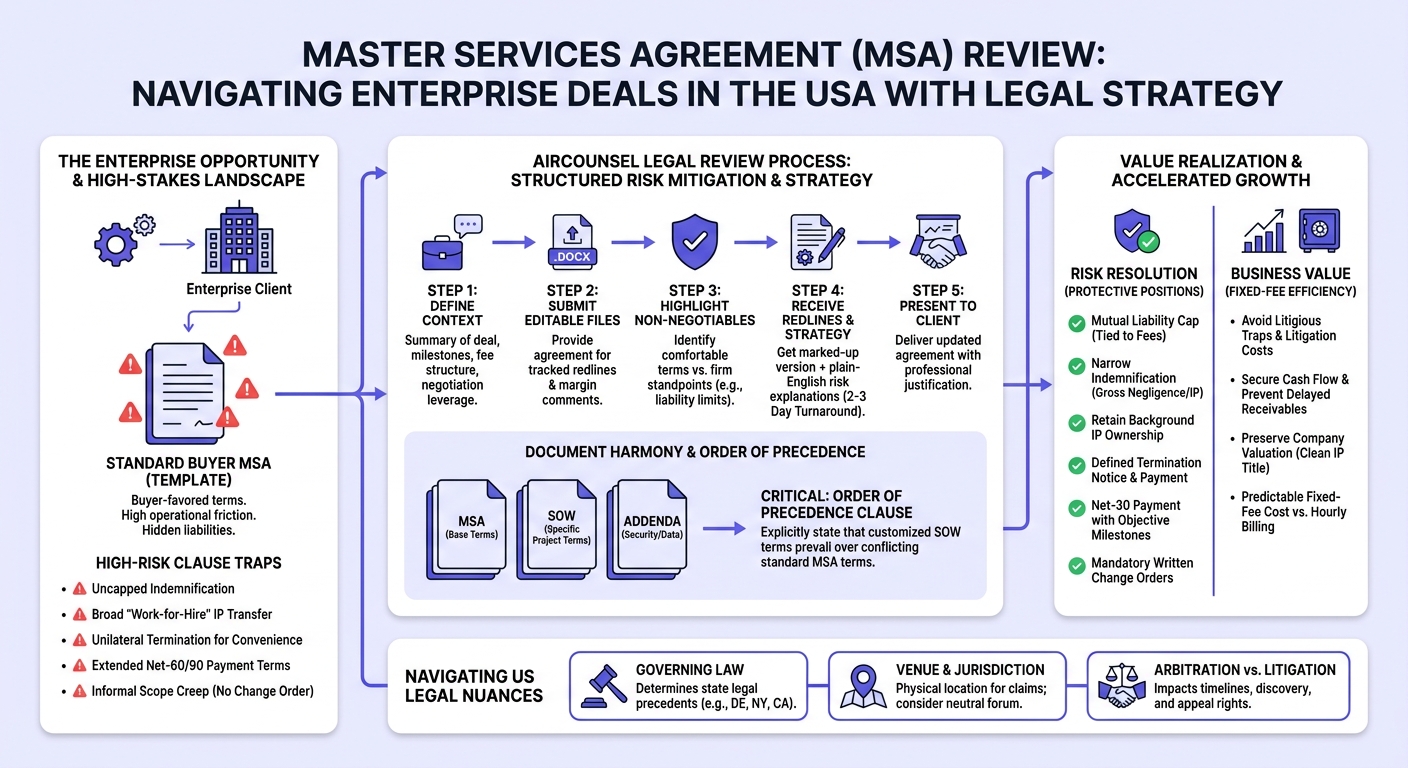
What Is a Master Services Agreement and Why Does It Matter?
A Master Services Agreement (MSA) serves as the legal foundation for commercial relationships where multiple projects or recurring deliverables are anticipated. Rather than renegotiating foundational terms like liability caps, confidentiality, and payment mechanisms for each new assignment, the MSA governs the ongoing partnership. Individual tasks, timelines, and milestones are then detailed in subordinate Statements of Work (SOWs).
For startups and small businesses, signing an enterprise customer's standard MSA often feels like an administrative formality to get paid. However, enterprise agreements are drafted by the buyer's counsel to favor the buyer exclusively. When things go wrong—such as delayed deliverables, scope creep, or customer data incidents—the MSA dictates financial and legal responsibility.
Establishing a solid baseline with a custom Custom Services Agreement or having counsel thoroughly inspect your client's template prevents one lopsided contract from jeopardizing your entire company.
When to Involve a Legal Specialist Before Signing
Founders and operators often wonder if every single document requires outside legal scrutiny. While standardized non-disclosure agreements with mutual terms may carry lower risk, high-value commercial agreements demand specialized review.

You should engage an attorney before executing an agreement under any of the following circumstances:
- Enterprise Client Paper: The client demands you use their multi-page vendor template instead of your standard terms.
- High Contract Value: The total contract value represents more than 10% of your annual recurring revenue.
- Uncapped Financial Liability: The agreement contains unilateral indemnification or lacks an explicit limitation-of-liability ceiling.
- Intellectual Property Transfers: Deliverables involve core software, proprietary methodology, or preexisting trade secrets.
- Stringent Regulatory or Data Obligations: The client requires strict data privacy, HIPAA, SOC 2, or cybersecurity representations.
If you are entering negotiations where commercial stakes are high, pairing legal review with dedicated Negotiation Support helps preserve client goodwill while protecting your operational boundaries.
High-Risk MSA Clauses Founders Must Scrutinize
Enterprise agreements contain recurring operational traps. Knowing how these provisions function allows you to identify deal-breaking terms before signing.
| Clause Category | Standard Enterprise Risk | Recommended Protective Position |
|---|---|---|
| Limitation of Liability | Unlimited liability or exclusions for IP, confidentiality, and breach claims. | Mutual liability cap tied to fees paid under the contract (e.g., 12 months' fees). |
| Indemnification | Broad vendor obligations to defend and pay for third-party claims without fault. | Narrow scope strictly limited to gross negligence, willful misconduct, or actual IP infringement. |
| Intellectual Property | Broad "work-for-hire" language claiming ownership over vendor background IP and tools. | Retain full ownership of preexisting IP and tools; assign only client-specific unique deliverables. |
| Termination for Convenience | Buyer can cancel immediately without penalty or reimbursement for incurred costs. | Require 30 to 60 days written notice, payment for work completed, and non-refundable deposit retention. |
| Payment & Acceptance | Extended net-60/90 terms tied to subjective client approval criteria. | Net-30 payment terms, objective milestone criteria, and deemed acceptance after 10 business days. |
| Change Control | Scope changes demanded informally via email without price adjustments. | Mandatory formal written change orders signed by both parties before new work begins. |
Resolving Conflicts Between MSAs, SOWs, and Security Addenda
In enterprise transactions, a contract rarely consists of a single document. Instead, the agreement is frequently split between an MSA, one or more SOWs, order forms, and enterprise security or data processing addenda.
A common oversight is failing to include a clear Order of Precedence clause. If an SOW contains specialized payment schedules or unique IP licensing terms that contradict boilerplate restrictions in the MSA, the contract must explicitly state which document controls.
Without this clause, courts interpret conflicting terms using general contract construction rules, which can lead to unpredictable outcomes. A proper legal review harmonizes these documents so that customized project terms in the SOW prevail over standard terms in the overarching MSA.
The Contract Review Process: What to Expect and Prepare
Working with an attorney should be a quick, collaborative process rather than a multi-week bottleneck. Modern legal reviews focus on identifying real commercial risks and offering practical redline alternatives.
To maximize value and speed up the review turnaround, prepare the following items before submitting your document:
- Step 1: Define Commercial Context: Provide a brief summary of the deal, key milestones, fee structure, and your negotiation leverage.
- Step 2: Submit Editable Files: Provide the agreement in an editable format (such as DOCX) so the attorney can insert tracked redlines and margin comments.
- Step 3: Highlight Non-Negotiables: Identify terms you are comfortable accepting versus issues where you must stand firm (such as delivery dates or liability limits).
- Step 4: Receive Redlines and Strategy: Your attorney will return a marked-up version alongside plain-English explanations of key risks and negotiation points.
- Step 5: Present Redlines to Client: Deliver the updated agreement to your client with clear, professional justification for each requested modification.
For targeted assessments of specific provisions or clauses, obtaining a quick turnaround via Ask a U.S Attorney a Question can provide fast answers on urgent deal points.
Cost-versus-Risk Analysis for Small Businesses
Historically, small business owners avoided legal reviews due to open-ended hourly billing models, where a simple 15-page review could result in thousands of dollars in unexpected fees.
Modern fixed-fee legal services eliminate this unpredictability. Investing in upfront review provides immediate risk protection:
- Avoiding Litigious Traps: Resolving a single contract breach dispute in U.S. commercial courts typically costs tens of thousands of dollars in litigation expenses.
- Securing Cash Flow: Tightening acceptance criteria and payment milestones prevents delayed receivables and unpaid vendor invoices.
- Preserving Company Valuation: Maintaining clean IP ownership rights ensures investors and acquirers face no title clouds during due diligence.
A structured legal review provides high-leverage risk insurance for enterprise transactions.
Navigating State-Specific Law and Enforceability in the USA
Commercial contract law in the United States is governed primarily by state statutes and state-level common law rather than a single uniform federal code. The choice of governing law and dispute venue in your MSA can materially alter how terms are enforced:
- Governing Law: Determines which state's legal precedents interpret the agreement (e.g., Delaware, New York, or California).
- Venue and Jurisdiction: Dictates the physical location where legal claims must be filed, which can create significant travel and local counsel costs if set in the client's home state.
- Arbitration vs. Court Litigation: Many enterprise agreements mandate binding private arbitration to resolve disputes, which alters procedural timelines, discovery rules, and appeal rights.
An experienced transactional lawyer will evaluate whether these procedural terms create an unfair home-court advantage for your enterprise client, recommending neutral forums or mutual governing law standards when appropriate.
Streamline Your Contract Reviews with AirCounsel
Closing high-value enterprise contracts should accelerate your business growth—not introduce hidden operational liabilities. By working with seasoned corporate attorneys who understand startup dynamics and commercial negotiations, you can protect your assets, enforce clear payment terms, and negotiate with enterprise buyers from a position of strength.
AirCounsel provides fast, transparent, fixed-fee contract solutions tailored to modern businesses. Submit your document today for a comprehensive Review of your Contract or Legal Document with clear redlines delivered in as little as 2 business days.
Frequently Asked Questions
What does an attorney look for when reviewing a master services agreement?
An attorney examines the balance of risk across critical clauses, including limitations of liability, indemnification scope, intellectual property ownership, termination rights, payment and acceptance terms, warranties, and dispute resolution mechanisms. They ensure the contract aligns with your actual delivery model and does not expose your business to uncapped financial damages.
How long does it usually take to have an MSA reviewed before signing?
A comprehensive fixed-fee contract review typically takes 2 to 3 business days. Express review options are often available for time-sensitive deals that require same-day or 24-hour turnaround times.
What clauses in an MSA are most important for a small business or startup?
The two most critical clauses are the limitation of liability and intellectual property ownership provisions. Startups must ensure their financial exposure is capped (typically at the amount of fees paid under the contract) and that they do not inadvertently assign background tools, source code, or proprietary methodologies to the client.
Is it worth paying a lawyer to review a contract for a major enterprise deal?
Yes. Enterprise client contracts are written by corporate counsel to shift commercial and legal liabilities onto vendors. A fixed-fee legal review costs a fraction of the contract value and protects your company from costly litigation, uncompensated scope expansion, and lost IP rights.
Can I negotiate the terms of an enterprise customer's standard contract?
Yes. Enterprise buyers expect redlines and negotiations from established vendors. Presenting clear, reasonable, and professional contract revisions demonstrates commercial maturity and protects your long-term business interests.
Recommended
Need Legal Assistance?
Our expert legal team is ready to help you navigate complex legal matters with confidence.