7 Costly Liability Gaps a US Contract Review Lawyer Identifies in Standard Master Services Agreements

When enterprise clients or vendors hand you a standard Master Services Agreement (MSA), it rarely protects your interests. Standard contracts are designed to shift legal and financial risk onto the counterparty. Engaging a qualified contract review lawyer ensures that you do not sign away critical rights, absorb uncapped financial liabilities, or agree to operational terms your business cannot fulfill.
Commercial disputes can devastate growing enterprises. According to procurement and commercial litigation data, nearly 60% of business contract disputes stem from poorly defined liability allocations, ambiguous scopes of work, and unbalanced indemnification clauses. While boilerplate contracts may appear routine, the hidden terms within them dictate your financial exposure if a project derails.
Before signing an agreement prepared by another party, you must understand where standard contracts fail small businesses and how legal counsel balances the playing field.
Table of Contents
- What Is a Master Services Agreement?
- 7 Critical Liability Gaps in Standard MSAs
- How a Lawyer Evaluates Risk Against Your Business Model
- Practical Negotiation Strategies for Small Businesses
- Protect Your Business with Professional Contract Review
- Frequently Asked Questions
- Recommended
Quick Summary
| Takeaway | Explanation |
|---|---|
| Form Bias | Off-the-shelf MSAs heavily favor the party that drafted them by transferring enterprise risks to vendors. |
| Indemnity Exposure | Uncapped indemnity clauses expose your company to limitless third-party legal costs and settlements. |
| Liability Limits | Caps on liability must directly reflect deal size and prevent disproportionate exposure. |
| Order of Precedence | SOWs often conflict with master terms unless a clear hierarchy clause governs. |
| Proactive Review | Reviewing contracts prior to signing prevents litigation expenses and strengthens negotiating leverage. |
What Is a Master Services Agreement?
A Master Services Agreement (MSA) is a foundational contract that establishes the general terms, payment conditions, intellectual property rights, and liability parameters governing current and future projects between two parties. Instead of renegotiating basic commercial terms for every new engagement, the parties issue separate Statements of Work (SOWs) that inherit the master terms.
Because MSAs govern long-term relationships, standard drafting templates often tilt aggressively toward the drafter. According to the Federal Trade Commission Business Guidance, clear commercial terms and transparent risk allocation are essential for fair business operations. An unreviewed MSA can quietly bind your company to obligations that far exceed the profit margin of any single work order.

7 Critical Liability Gaps in Standard MSAs
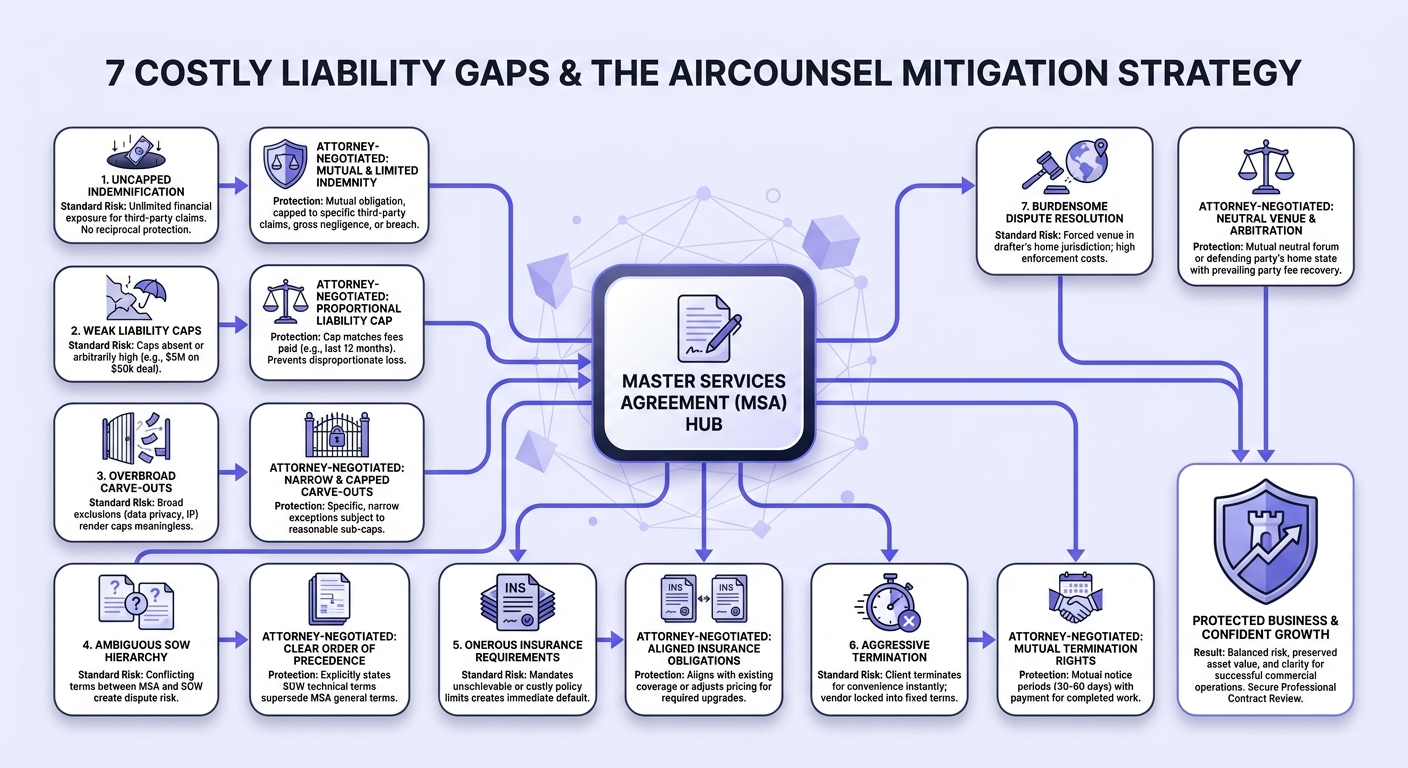
1. Uncapped or One-Sided Indemnification
Indemnification is a contractual promise where one party agrees to pay for the legal costs, damages, and judgments incurred by the other party due to specific triggers. Standard enterprise MSAs frequently require service providers to indemnify the client for virtually any claim, while offering zero reciprocal protection.
A contract review attorney ensures that indemnity is mutual, strictly limited to third-party claims, and tied to direct breach of contract, gross negligence, or willful misconduct rather than simple commercial errors.
2. Weak Limitation of Liability Caps
A limitation of liability (LoL) clause puts a ceiling on total damages recoverable under the contract. In standard buyer-drafted agreements, liability caps are either absent for the buyer or set at an unrealistically high level for the vendor (such as $5,000,000 on a $50,000 contract).
Attorneys typically negotiate the aggregate liability cap to match fees paid under the applicable SOW over a 12-month period. This prevents a single minor delivery error from threatening your company's solvency.
3. Overbroad Carve-Outs and Exclusions
Even if an MSA includes a standard liability cap, broad carve-outs can render the cap meaningless. Drafters often exclude confidentiality breaches, data privacy violations, indemnification, and intellectual property claims from the liability cap.
When these carve-outs are unlimited, a single alleged breach of an ambiguous data protection clause can bypass the agreed-upon cap entirely. Experienced lawyers ensure that carve-outs are narrow and subject to reasonable sub-caps.
4. Ambiguous Scope of Work Hierarchy
When an MSA and an SOW contain conflicting language regarding deliverables, deadlines, or warranties, dispute risk multiplies. Without a clear "Order of Precedence" clause, courts must interpret which document controls.
Your contract must explicitly state that specific technical and commercial terms in an SOW supersede the general terms of the MSA only when specifically cited.
5. Onerous Insurance Requirements
Standard vendor contracts often mandate extensive commercial insurance policies, such as $5,000,000 in cyber liability or commercial general liability, along with requirements to name the client as an additional insured with waivers of subrogation.
If your business does not carry these specific policy limits, signing the contract creates an immediate default. Legal review helps align insurance obligations with your existing coverage or adjust pricing to offset policy upgrade costs.
6. Aggressive Termination Clauses and Auto-Renewals
Master agreements often grant clients the right to terminate for convenience on 10 days' notice, while locking the provider into fixed-term commitments. Combined with restrictive evergreen auto-renewal clauses, your team may find itself trapped in unprofitable scopes or suddenly terminated without recovering committed resource costs.
7. Burdensome Dispute Resolution and Venue Rules
If a dispute arises, the forum and governing law provisions dictate where litigation occurs. Standard forms usually require dispute resolution in the drafter’s home jurisdiction, forcing you to hire out-of-state legal counsel and travel for hearings. Negotiating neutral arbitration or local venue provisions prevents excessive enforcement costs.
| Clause | Standard Draft Risk | Attorney-Negotiated Position |
|---|---|---|
| Indemnification | One-sided; covers direct and indirect claims without financial limit. | Mutual; limited strictly to third-party claims resulting from gross negligence or material breach. |
| Liability Cap | Unlimited or set to arbitrary multi-million dollar amounts. | Capped at total fees paid under the contract in the preceding 12 months. |
| Indirect Damages | Permitted against the vendor for lost profits or punitive damages. | Mutual waiver of consequential, indirect, special, and punitive damages. |
| Termination | Unilateral termination for convenience by the client with zero wind-down fees. | Mutual termination rights with 30–60 days' notice and payment for all work completed. |
| Governing Law | Drafter's local state courts with one-sided legal fee recovery. | Mutual neutral venue or home state of the defending party, with prevailing party fee recovery. |
How a Lawyer Evaluates Risk Against Your Business Model
Legal review is not a generic redlining exercise; it requires balancing legal liabilities against business economics. When assessing risk allocation, an attorney examines three main factors:
- Deal Value vs. Exposure: A $20,000 service contract should never carry a $2,000,000 uncapped liability profile.
- Nature of Services: High-risk services involving sensitive customer data or mission-critical software require precise data warranty limits, whereas standard creative consulting requires distinct intellectual property protections.
- Operational Feasibility: Reviewers evaluate whether your team can realistically meet acceptance criteria, cure periods, and service level agreements (SLAs) without incurring financial penalties.
If you are drafting your own customer-facing agreements from scratch, utilizing a Custom Services Agreement establishes these protections from the outset.
Practical Negotiation Strategies for Small Businesses
Negotiating an MSA does not mean rewriting the entire document or alienating the other party. Enterprise buyers expect pushback on standard terms.
- Focus on Top-Tier Risks First: Concentrate negotiations on indemnification, liability caps, and payment terms before debating minor stylistic wording.
- Offer Reasonable Compromises: Instead of deleting a data liability clause entirely, propose a "super-cap" equal to 2x or 3x the contract value for data incidents.
- Use Neutral Legal Explanations: Frame changes around insurability and standard commercial practice rather than distrust.
- Clarify Deliverable Acceptance: Insert objective acceptance testing periods (e.g., 10 business days) so invoices cannot be withheld indefinitely.
For complex enterprise negotiations, obtaining targeted Negotiation Support allows you to secure favorable redlines while keeping business discussions collaborative.
Protect Your Business with Professional Contract Review
Signing an unreviewed Master Services Agreement can expose your business to catastrophic liabilities that far outweigh the value of the deal. Securing a timely, plain-English legal review gives you the clarity to negotiate from a position of strength, protect your balance sheet, and close commercial deals with confidence.
AirCounsel provides fast, transparent legal solutions tailored for growing companies. Whether you need an experienced attorney to spot hidden risks in an enterprise agreement or require custom drafting for your service contracts, our licensed US lawyers deliver actionable redlines at predictable, fixed prices.
Submit your agreement for an expert Review of your Contract or Legal Document to protect your assets before you sign.
Frequently Asked Questions
What liability clauses in an MSA matter most for a small business?
The three most critical provisions are the limitation of liability cap, the indemnification clause, and the waiver of consequential damages. These clauses define your maximum financial exposure if something goes wrong during performance.
Why do limitation-of-liability caps and carve-outs create hidden risk?
A limitation of liability clause sets a maximum dollar ceiling on potential damages. However, if the contract contains broad carve-outs for data security, IP infringement, or indemnification, those claims bypass the cap entirely, exposing your company to unlimited damages.
Should an MSA indemnity clause be mutual or one-sided?
Indemnity clauses should almost always be mutual. Both parties should only be responsible for third-party claims arising from their own material breach, gross negligence, willful misconduct, or intellectual property infringement.
When is it worth having a lawyer review a standard services agreement before signing?
You should retain a contract review attorney whenever an agreement carries significant revenue, involves sensitive intellectual property, includes one-sided indemnity, or contains obligations that could jeopardize your business assets if disputed.
Recommended
- Review of your Contract or Legal Document – Fast, fixed-fee legal review to spot red flags and negotiate protective terms.
- Custom Services Agreement – Professional, attorney-drafted contracts tailored to your business model.
- Ask a U.S Attorney a Question – Quick, reliable legal answers for pressing commercial and contract questions.
Need Legal Assistance?
Our expert legal team is ready to help you navigate complex legal matters with confidence.